Video Games as Anti-Depressants

I’m feeling nostalgic. And also kind of depressed. Mostly about video games. For some reason, I can’t seem to bring myself to actually turn any of my systems on right now. I don’t want to play any of my currently in progress games, I want to play something old and comforting. However, I also cannot bring myself to go to the bother of scrounging up any of my old favorites. Usually the Wii’s virtual console is the perfect solution to this problem, bringing many of my favorite classic games to my fingertips, but even it is currently unavailable to me.

I am not unfamiliar with this kind of funk; it have spells like this several times a year. And I know just the games I need to snap me out of it. Some are old, some are fairly recent, but all of them turn the controller into a livewire that zaps my brain and jolts me out of my fugue.

Foremost on this fairly exclusive list is the Mega Man series, mostly the NES games, but some others also do the trick. Mega Man 2 and 3 are the absolute pinnacle of NES action games, and all the games in the series are designed to provide the maximum amount of fun as soon as the game is turned on. One of the best ways they achieve this is the level options. There are sure to be parts of even great games that the player doesn’t like and Mega Man at least allows the player put those off as long as possible. Another is the music, which alone is enough to perk me up significantly.

River City Ransom is a game so full of charm that is goes without saying that it is on this list. But I’ve made my case for it already.

Also on my list of picker-uppers is a select number of JRPGs. For anyone who grew up on a steady diet of SNES, the trio of Final Fantasy 3(6), Chrono Trigger and Earthbound should be familiar. Anyone of those is sure to plant a smile on my face that sticks for at least a week. FF3 is the one side of the tipping point of that series, foreshadowing the changes that were coming while still fitting seamlessly with what came before. Chrono Trigger is the genre’s purest expression and has the perfect snappy pacing to cheer one up. Earthbound is a slower burn, but it’s unequalled charm is immediately apparent. The only non-SNES RPG that works for me is Suikoden 2, another case of a game with fast pacing and one of the best looking 2D games around.

There are some newer games that also fit the bill. While not especially new, the Metal Slug series, played on the flawed but sufficient Wii collection, is the perfect game for a quick jolt. With infinite continues there is no stress, but it still provides a player with gumption a chance to challenge themselves. Every time I try to cut down on the number of continues I use, though I am not always successful.

And lastly there is the Phoenix Wright series for the DS. Playing that series again is like watching re-runs of your favorite TV show. There is absolutely nothing new or different, but the characters you love are always there.

The most important thing about these pick-me-up games is that they provide me with a quick, if not necessarily easy, sense of accomplishment. I can beat Mega Man 2 or a Phoenix Wright case in a short amount of time, giving me the sense that I’ve accomplished something. Which the lack of is usually what has me down to begin with. The RPGs are slightly different. Playing them is like listening to my Grandfather talk about fighting in World War II. The accomplishment was a long time ago, but by going over the tale again the sense of worth his brought again to the forefront.

The games listed aren’t the only ones that fit in this category. But they are my most used ones. Do you readers sometimes need to use a video game as a pick-me-up? What games are your feeling down cures?
The Brave and the Bold

So DC Comics has been making some pretty big news last week, huh?

Personally, I really like the idea. While it may turn out to be just a bigger version of the usual post-event shake up, I think this is a genuine attempt by DC to sell comics to more people than the usual comic book readers. There is overwhelming evidence that the general public not only likes superheroes; they love them. From blockbuster movies to video games to toys to clothes, comic book properties sell just about everything but comic books. DC, a perpetual number 2 in market, appears to have finally decided to bite the bullet and change the way they do things. So whether fans like it or not, DC is re-launching their comic line and pushing hard into the digital sales market. DC might save the dying comic industry with this endeavor, it is just as likely they flame out spectacularly. It is a brave and bold risk.

Fan reaction has been hilarious. It is the sort of petulant, entitled complaints one would expect from “comic book geeks.” (Which are not any worse than other sorts of geeks. For instance, check all the LeBron talk during the recent NBA finals. We are all geeks, the only difference is the subjects of our geekdom.) Not that there haven’t been thoughtful, insightful responses, but many fans are just angry about what DC is doing to their characters. Reading lots of reactions this week tells me that the fan base is septic, reacting to every proposed change with pessimism and bile. Kudos to DC for trying to break free from the anchor currently sinking comics.

Not that I’m convinced it will necessarily be successful. Is the audience actually there of for digital comics? Will DC ruin any chances of success by trying to have their cake and eat it too? This things make this a big risk.

DC’s pricing strategy is the only one that makes sense. People say they will only buy digital if it‘s $.99 , but most of those would probably not buy any no matter the price. But keeping them the same as print to start, 2.99, and dropping to 1.99 after a month is a good compromise. 1.99 is not too much, that is about the same as a bottle of soda.

DC has also claimed that they are actually going to try to market Comics to a wider audience. The Green Lantern App is a good start, but if they are really serious they should put an add in the trailers for the coming Green Lantern movie. With comics being available in more bookstores, like Barnes and Nobel and Hastings, it should be easier than it has in a long time to get comics. I have nothing against comic shops, but if they are the only way to get comics then the comics market will continue to shrink.

When every thing is said and done, though, what really matters is how good the books DC puts out. Below are my thoughts on each and every one of the 52 number ones as well as a quick rating of my interest in each title (Excited, Intrigued, Dubious, or Pass): Continue reading

The Best to Never

Anyone remember when I wrote last year that the Heat would not win the championship this year. I’m breathing a sigh of relief that my taking the field turned out to be right. While I started the playoffs rooting for the Celtics, and I would still like to see them get another ring, I am glad the Mavericks won it. Not just because it wasn’t the Heat, whom I don’t actually hate, or the Lakers, who I absolutely hate, but also because it is great to see outstanding players like Dirk Nowitzki and Jason Kidd get a ring. Now they won’t end up on the list of greats without rings.

That is a terrible list to be on, no matter the sport. John Stockton and Karl Malone got close several times in Utah but they never won it, neither did Charles Barkley. Dan Marino probably leads the list in the NFL, along with the Jazz-like Bills greats of the early nineties. Or the greatest running back of all time Barry Sanders (yeah, I take Barry over Brown. And I’m right). In MLB, there’s Ken Griffey Jr., Ty Cobb and Ted Williams. It is sad that some of the best players of all time never got to win it all. Being on the greatest to never list is often a reason for commentators to claim that they weren’t actually that good to begin with. And that is pure bullshit.

Basketball, Football, Baseball. These are all team sports. Measuring individual accomplishments primarily by team success is asinine. A great player is a great player even if he never wins a championship. Dan Marino may be the best quarterback of all time, and the fact that he never won it all shouldn’t make a difference. Same for Ted Williams and Ty Cobb. John Stockton is the best point guard of all-time, he doesn’t lose that because the number 2 (Jason Kidd) won a ring.

That is not to say that team success has no bearing at all. If a player spends his whole career playing for bad teams then it should affect his legacy. If Archie Manning had played for the Steelers, maybe his name would come up more. But he didn’t. He played for the cellar dwelling Saints. He was still a very good player, but he is only remembered today because his sons are successful.

Anyway, congrats Dirk and Jason and Jason and the rest of the Mavs. They deserve it. Dirk was absolutely unstoppable in crunch time. And the naysaying about LeBron will reach a ridiculous crescendo, but I have no doubt he will win a championship sooner rather than later.

A Brief Interruption

I am in the midst of a thoroughly enjoyable (haha, no) family vacation, so I expected to have less time to post than usual this week. But The free WiFi at the hotel only fulfills half of its promise. It is free, but there does actually not seem to be WiFi. So this will be my only post this week.

Next week I’ll have some thoughts on DC’s big re-launch, a review of the last episode of Futurama Season 1, a movie review and a two months worth Last Month in Readings. And maybe more! (but probably not)

Till then, see ya later space cowboy.

Musings on Death (in video games)

It is the 25th Anniversary of Dragon Quest—in Japan, the first game took three more years to get to America—and since I’m currently playing Dragon Quest VI, I thought it might be a good ides to celebrate one of the series best features. Dragon Quest is the bread and butter of the JRPG genre, with nearly every other game using it at as a starting point or inspiration. For as much as the series is copied, too few other games use Dragon Quest’s no game over strategy.

In most RPGs, as well as most other types of games, if you die you get a blood red “Game Over” screen and it kicks you back out to the title. However, Dragon Quest, even as far back as the first game in the series, just tosses the player back to the last—or only in the case of DQ1—church. All experience and items gained stay with the player, though the gold the player was carrying is cut in half. It doesn’t quite take all the penalty out of dying, but it does severely lessen the blow. Most importantly, it assures the player that they are never wasting their time. In the normal death model, being wiped by a boss means that all the progress through the dungeon has been lost, where in Dragon Quest all is means is you have to fight the boss again. It allows the game to up the difficulty of fights without frustrating the player since progress is never lost.

How do games like Final Fantasy get around to loss of progress problem? By adding more save points, an imperfect resolution at best. With more save points, frequently one just before boss rooms, there is less loss of progress, but it still wastes time. It takes the player out of the game. Sure, you’ll just reload your save and try again; nothing has changed from the last time other than any knowledge of the boss gleaned from the failed attempt. Instead of distressingly punitive consequences, there are none. Why games refuse to adopt Dragon Quest’s elegant death mechanic is puzzling.

Many ill-informed critics don’t seem to grasp the Dragon Quest system and instead deride the series for its draconian saving policy (i.e. at churches, only at churches). That is a feature, not a bug. Though a quick save feature like the DS games have is a welcome feature. By restricting permanent saves to town, it encourages players to reevaluate their approach after a death.

Playing Dragon Quest just really makes me wish more RPGs considered what they are penalizing on death. I love Persona 3, but its death mechanics are unfriendly for the sake of being unfriendly. In the game, there are two separate battle situations. There are the full moon story segments, usually a boss and maybe a small dungeon with a few random battles, where a game over makes sense. There is little progress lost and the fate of the world rests specifically on that time. However, Tartarus, the randomly generated grinding pit, is the opposite. A game over loses all progress on the long trek to the next safe floor. Everything is stacked against the player. If the main character dies game over, many enemies like to spam instant death magic. The battles are not really random, but the enemies in each are.

Very little challenge would be lost if instead of losing everything upon death the player was instead forced out of the dungeon for that day. The floors a randomly generated, so there is no memorizing the layout. The player would still have to start from the last safe/boss floor and make it to the next safe/boss floor in one go. All the player would keep are the levels from the battle that they already won. There is no loss of challenge, just a loss of time wasting bullshit.

I’m not sure the same could be said of the Etrian Odyssey series, where the challenge is to survive in the maze-like dungeon. If dying merely sent the player back to town, with say the loss of all items being carried, most of the challenge would be lost, turning the game into one long tedious, toothless grind. Of course, Etrian Odyssey is much less dependant on gotcha deaths than Persona, at least after the first couple of floors. Instead of no penalty, it could use a rescue system, where the player uses other characters from the guild to go get the ones who fell, but as it is I think it works. While Etrian Odyssey could undoubtedly be friendlier, it at least seems well considered in its hostility.

Thoughts on Green Lantern: Rebirth

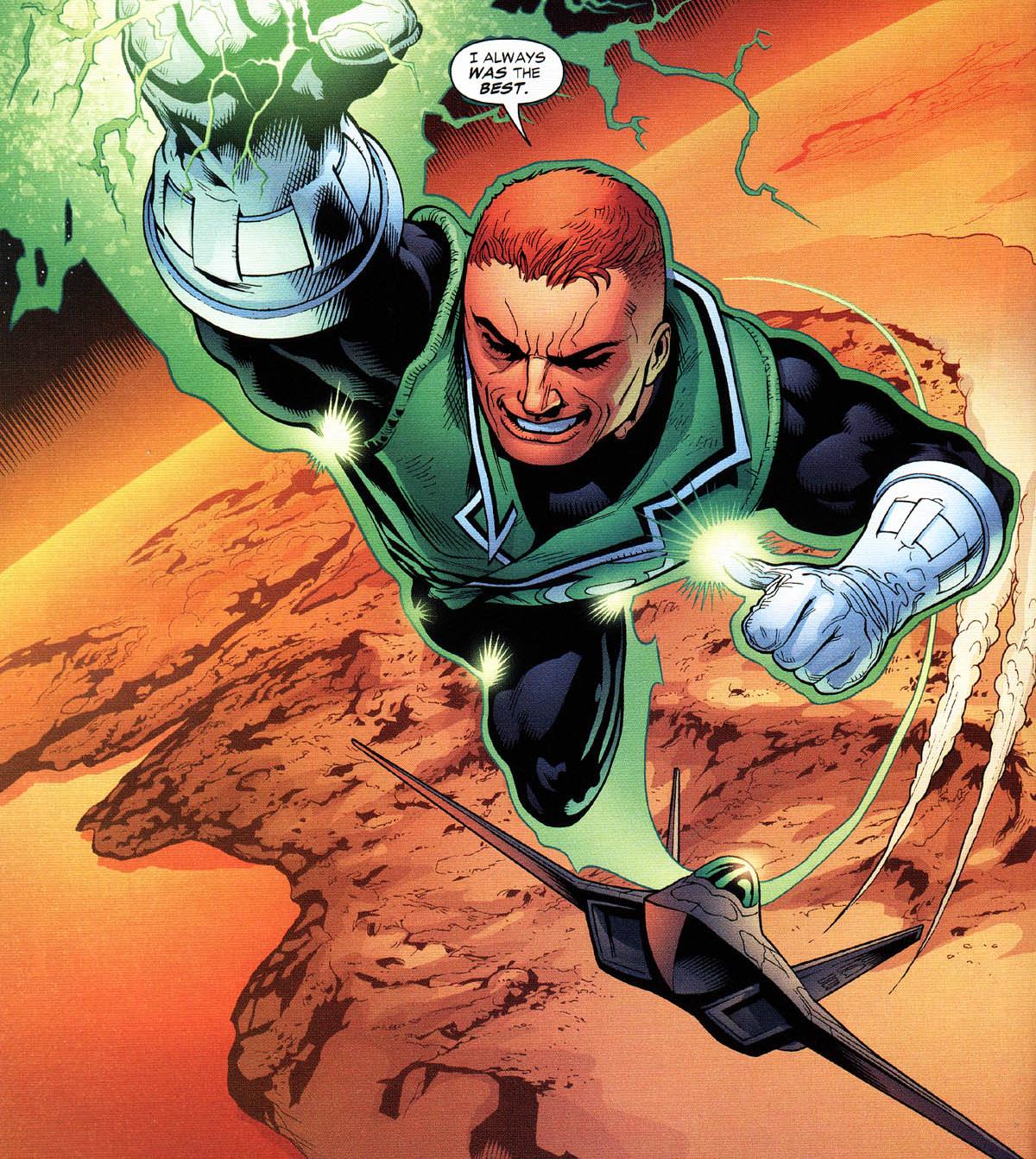
A week or three ago I posted this picture as a part of my lazy Month of Gardner. It is from a pair of pages in Green Lantern Rebirth #6, written by Geoff Johns and drawn by Ethan Van Sciver, which shows the differences in how each of these Green Lanterns use their rings. Although I think these distinctions largely started there and have been used at best sporadically since then, I do really like the idea of each Lantern having a different style.

The rest of Rebirth can be problematic. For the record, I am pro-Rebirth. I like what it did and I mostly like how it did it, but there is no getting around the fact that it is a six issue long retcon or that Johns writes Hal Jordan as though he were Batman. I understand how that could grate on those who did not want to see Hal redeemed. However, I thought Emerald Twilight, the story where Hal goes bad, was somewhat terrible and I would rather have a functioning Green Lantern Corps than Kyle Raynor as Luke Skywalker. Geoff Johns also did a good job of not diminishing Kyle in bringing back Hal. Yes, Hal, not Kyle is the Green Lantern, but even in Rebirth Kyle, John, Kilowog, and Guy get their chances to shine.

However, the reader feels about the “fix” that is Green Lantern: Rebirth, these two pages are really good.

Johns is the master at shaping years of often contradictory or confusing stories, revitalizing tired characters and giving them relatable hooks for future stories. In just a few pages, he manages to get to the heart of all five of the main Green Lanterns.

First John Stewart. His constructs are actually constructed. He builds them, uses his knowledge as an architect to use his green powers more effectively. He is thoughtful and careful in how he uses his ring. Next is Guy Gardner. Rather than John’s careful approach, Guy is reckless. He is all heart and no control. Then there is Kilowog. The only non-human in this group, his ring sends out constructs that are bigger than the others are. That his ring booms shows its raw power. Kyle Raynor is an artist, and he uses flourishes and constant refinement. He is never satisfied and he never gives up. Last is Hal Jordan, who uses precision and focused power.

It really shows what every one of them is about. John and Kyle are thoughtful and somewhat introspective. Their actions are carefully considered and they are rarely rash. Guy is the opposite. He is just held back from action at all time, with almost no thought past his initial instincts. Hal is somewhere in between. He tends toward reckless and instinctive, but is more careful than Guy and choosing his targets. Kilowog’s explanation is probably the least illuminating. His booming ring shows that he cannot be ignored, but it really tells the reader little about who Kilowog is. Still, Johns goes at least 4/5 on explaining who these Green Lanterns are.

I just really like how someone who has little knowledge of these characters before reading this, like me not that long ago, would have a decent grasp of all of them from just these few pages.