Aided by my new fangled smart-phone I did a whole lot of reading last month. Up significantly from my average of 4 books a month, I read 7 in August. While that is not a particularly large number, when you factor in the quality of some of those books, I believe it is safe to say I kicked reading’s ass in August. Continue reading
Books
What I Read in July 2011
Another month, another comfortable four books read. This month there is an unintentional theme, though. Superheroes. I like superheroes, but I had no intention of reading three, four if you squint, prose books about them in one month. But it worked out that way, giving my thoughts a convenient thread to tie them together.
Gods of Mars, Edgar Rice Burroughs.
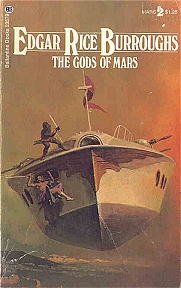 This is the 2nd of the John Carter books and it manages to top the first one. Gods of Mars is pure pulp action. Each chapter has John Carter and friends facing a new threat and greater odds than the one before it, with no time for reflection or thought or meaningful character development. John Carter is the manliest of men, his prowess being almost ridiculous. Not one but three beautiful women are in love with him; not just 3 women but the three most beautiful women on Mars. He can outfight any 10 men, 20 if he is angry. He is as much of a superhero as any in the books I read this month. In fact, with his otherworldly origin and leaping prowess he bears no little resemblance to certain alien rocketed from a dying planet to Earth, where the yellow sun gave him extraordinary powers.
The expanded societies of Mars are nuts. The white Martians exploit the red Martians, but are in turn exploited by the black Martians. And everybody is exploited by the mad false Goddess Issus. It is a terrible, labyrinthine system that only a man as great as John Carter could free them from.
Gods of Mars is a blistering, exciting read, but the prose and plot can be quite simple. It does offer a somewhat pointed critique of blind faith, but there is little her to stimulate intellectually. Still, it is loads of fun.
Masked, ed. Lou Anders.
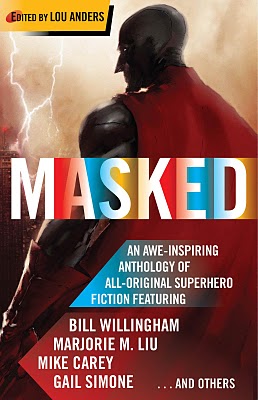
Masked is an anthology of short stories about superheroes, written mostly by comic book writers. Like any anthology, the stories vary in quality. I picked this up because I like many of the contributors, such as Gail Simone, Bill Willingham and Matt Sturges. On the whole the collection is satisfying, even if there are some stinkers.
Among the stories I liked were Matt Sturges’ somewhat gruesome “Cleansed and Set in Gold” about a hero who gets his powers through terrible means and Paul Cornell’s campy “Secret Identity.” The capper is Willingham’s A to Z in the Ultimate Big Company Superhero Universe (Villains Too)” the last and longest of the stories that compress an event comic into 40 or so pages. There were also many other really good stories.
But there were definitely some disappointing ones. Simone’s “Thug” has her trademark deranged yet heartfelt tone, but the stylistic choice of having it seem to be written by the mentally challenged protagonist made it painful to read. Also, too many of the stories focus too much on the gruesome side of superheroics, reveling in the blood and destruction and death. It is tiring and occasionally disgusting.
Still this is a really nice collection. I recommend a checking it out from a library. It is a decent enough way to pass a weekend.
Supergods, Grant Morrison

Supergods is acclaimed comic book scribe Grant Morrison’s part biography, part history of superheroes jumble. Both parts are worthwhile, but not necessarily aimed at the same audience. I am not sure who exactly this book was intended for, other than Grant Morrison fans (of which I am one). Supergods is quite properly aimless.
The first half, though both parts blend together, is a brief, idiosyncratic history of superheroes. Morrison shows just how well he gets the characters, but most of the information is rather basic. The second half is mostly biographical, with some in-depth dissection of the important superhero works of the last quarter century, both Morrison’s own and others. The problem is that anyone who has read enough to understand Morrison’s critiques probably already knows the information in the first half. Meaning the either one half of the book is needless or one half is incomprehensible. Still, taken individually both are good. It is worth to me to hear Morrison go on at length about this topic. He is the undisputed master of superhero storytelling.
There are, however, some downright bad chapters. Such as any time he writes about movies. Morrison wants to note who thoroughly superheroes have taken over summer movies, but he doesn’t seem to have much to say about any of the films.
I still recommend people read this book. People I know can borrow my copy if they wish. Morrison gets superheroes like no one else, and writes with a manic joy that is hard to match. Though this is non-fiction, it is never even close to dry. This is a unmissable opportunity to learn at the feet of a master.
The Amazing Adventures of Kavalier and Clay, Michael Chabon.
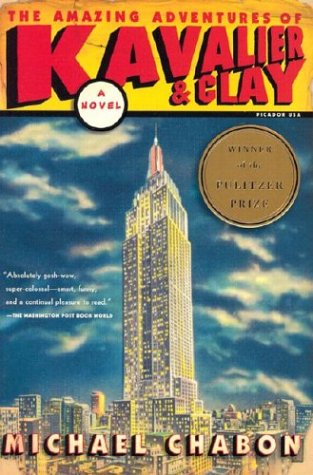
The Amazing Adventures of Kavalier and Clay is an astounding, wonderful, unforgettable novel. It did not quite know me off my feet like Yiddish Policeman’s Union did, but that is solely because I had already experienced Chabon. I was ready this time. Amazingly, Kavalier and Clay was even better than Yiddish Policeman’s Union.
The novel follows the exploits of Sammy Clay and Joe Kavalier, two cartoonist cousins in the early days of comic book superheroes. The two create their own popular superheroes, Sammy providing the stories and Joe the art. Their story closely parallels the experiences of some real comic book creators, but is definitely their own. Their experiences in life grow to mirror their comics, with Joe and Sammy becoming something like comic book characters themselves. Their friends and enemies are like the supporting characters of a superhero. There is the beautiful love interest, the dastardly villain, the nutty side characters. Life reflects art reflects life.
The novel is an effective history of the Golden Age of comics that never gets in the way of the characters personal stories. Chabon’s prose is lush and extravagant, displaying a love of words and of the subject matter. Though the tome is nearly 700 pages long, it moves with astounding celerity. It is never slow, never plodding, but it is a detailed account of the lives of a group of people over more than a decade. There are many events to cover and while Chabon rarely lingers too long, he also doesn’t rush. The novel breathes, it lives. And it is terrific.
I can’t heap enough praise on what I’ve read from Chabon. Though somewhat longer, Kavalier and Clay is slightly more engaging than Yiddish Policeman’s Union. Both novels are wonderful works of fiction. If you read at all, read Chabon. I am definitely going to track down the rest of his books. Do yourself a favor and do the same.
What I Read in June
I read four books in June and that is starting to look like my average for this year. But there were some gems in the four books I read this month. Especially A Princess of Mars and Yiddish Policeman’s Union
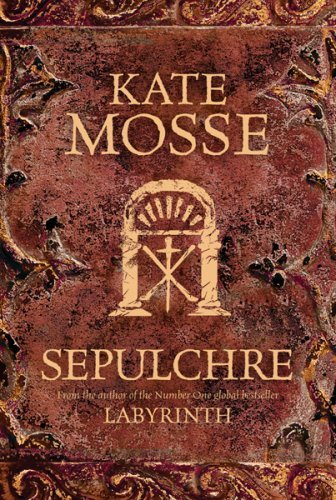
Sepulchre, Kate Mosse
Sepulchre follows two stories set about 200 years apart. In the present day, (2007) American Meredith Martin is in France doing research for a biography she is writing, as well as looking for information about her birth parents. That information is tied to the adventures of Leonie Vernier in the late 19th century. Meredith searches for her family and has a romance with a young British hotel owner. While not uninteresting, it is easily the weaker half of the story. Leonie and her brother Anatole visit their recently deceased uncle’s young wife while trying to avoid a murderous rival of Anatole’s. Leonie spends most of her time exploring the wild grounds of the family estate, the Domaine de la Cade and painting. Of course, the two threads weave together by the end.
The character Leonie is fun. Her adventures drive the novel. I was much more interested in the historical setting than the present day one, and Leonie’s is the point of view that really explores it. She develops and interest in the occult, or at least tarot, and bonds closely with her aunt, who is not much older than she is. She is a woman of the times, leaving most of the decision making to her brother, but she shows more initiative and independence than the most of the other women in her story, such as her aunt. She is just an interesting, complex character.
The problem is that Mosse uses a many many words to tell a rather small amount of story. It is not a bad story, or even badly told, but it is often plodding. It makes for a slow read, but still a mostly satisfying one.

A Princess of Mars, Edgar R. Burroughs.
The first book of Edgar Rice Burroughs Barsoom series is simply perfect pulp adventure. Civil War veteran John Carter is transported to Mars. In its wrecked, dying remains he fights with giant green aliens and falls in love with a red Martian princess.
The plot, a planetary romance, has more in common with fantasy novels than science fiction ones. The prose is simple, as are the characters. There is a refreshing lack of depth and nuance to John Carter. He does what is right because it is right, or at least his definition thereof. The people, yeah lets call them people, he meets are either unrepentantly evil or we are told they are good. It is simple, but the focus is on the adventure of the plot and not on the characters.
John Carter, whose Earthly biology helps him even against the massive green Martians, finds himself on a world in decay. The bestial Green Martians make their in the ruins of ancient cities and even the more human Red Martians do not fully grasp the technology of their past. Through his heroic actions, he shows the Green Martians about human emotions and help Dejah Thoris, the princess, unite her people with the Green Martians and defeat their mutual enemy. Mostly through exciting, straightforward action.
This book is still remembered and popular for a reason. It is just a thrill ride in 200 or so pages. It is also clearly not a great work. The setting and the action are great enough to mostly overcome the simplicity.
What Jane Austen Ate and Charles Dickens Knew, Daniel Pool
This is brief but entertaining overview of life in Victorian times. It is definitely aimed more at readers of the literature at the time than a wholly historical perspective, which is not a bad thing. Unfortunately, it relies heavily on examples from the text of various novels. So most of the information from this book can be gleaned from context in the novels it is seeking to explain. Still, it is an entertaining enough read and does clarify some aspects of life in those times that a person today would not know. Worth it for a big fan of novels of the time who has not quite exhausted the fiction of the time. So it may deepen your understanding of the ones you’ve read and prepare you to dig deeper. Unnecessary, though.

Yiddish Policeman’s Union, Michael Chabon
Reading Chabon is a revelation. Yiddish Policeman’s Union is by far the best novel I’ve read this year and the best in some years previous. Before I even get to any sort of review, I implore you to go and read this. It combines an alternate history set up with a noir plotline. It is wonderful.
Yiddish Policeman’s Union follows Meyer Landsman, a police detective in Sitka, Alaska. In the world of the novel there was essentially a Jewish reserve made in Alaska during World War II after the quick collapse of Israel, so most of the population is Jewish. The world diverges more from the real one, but it is tangential to the plot, merely part of the wonderful exploration that is the novel. Meyer investigates the death of a junkie in his apartment building who turns out to be much more than a simple junkie. As these things often do, the mystery goes farther than anyone can imagine.
Chabon writes with an absolute love of words, piling them on the page in joyful, absurd, inventive sequences. In a story that, while winding, is little more than a simple detective thriller he manages to craft a thoughtful, imaginative but not totally imagined new world. The world of Yiddish Policeman’s Union is often bleak, but the story never is. Terrible things may happen, but the characters always keep a sense of humor that buoys the novel. The cast is real; they are human, with failures and faults but also honor and convictions. Chabon has not only created a believable alternate world, not a task many speculative fiction writers seem to be up to, but he has also populated it with characters that ring true. Yiddish Policeman’s Union is absolutely terrific. I can recommend no book more.
What I Read: May
Dark Angels, Karleen Koen

Dark Angels is a historical romance novel set in the court of Charles II of England, who ruled during the late 17th Century. It stars a young woman, Alice Verney, who must navigate the treacherous, lecherous court in her attempts to foil a possible assassination plot and secure a marriage with a high-ranking nobleman.
The historical setting is what drew me to the book and I was not disappointed. I have a great weakness for the combination of romances and true-ish historical settings. The court of Charles II is a fertile place for intrigues and plots, and this book doesn’t disappoint. It does feel less dangerous than it could; I never had much fear for the survival of the protagonist (and as this is a prequel to a novel where she was old this is probably intentional) but neither did I doubt the survival of a historical figure who did not die by murder. I can’t say with certainty that Dark Angels is an accurate portrayal of life during these times, but it was an entertaining one.
Unfortunately, Alice is not a likeable protagonist. She is a selfish bully, full of herself and often thoughtless when dealing with her friends. She is smart and beautiful and knows it, lording it over her friends who are somewhat lacking in one or both of those traits. Alice’s annoying arrogance surely intentional, but it does grate some. She is a young person, who thinks she knows much more than she does, but the world, and the novel, still has surprises for her. This is about her growing out of her childish selfishness. But that does not make her any more likeable for the first two thirds or so. Also, several threads are left unresolved at the end of the novel. Maybe these are references to the first volume in this tale, but for just this book, they leave some unsatisfying conclusions.
Dark Angels is a decent read. Come for the history, tolerate the tepid romance. I can’t say I didn’t enjoy it, but neither am I rushing out to pick up the author’s other work
Robert E. Lee on Leadership, H. W. Crocker III
I was gifted this brief biography a few years ago but did not get around reading it until now. While not objectionable bad, it does have some problems. The biggest of which is that it is framed as business leadership advice, giving it a very narrow audience. Lee’s leadership techniques are worth remembering, but it is all put as a way to get ahead at work.
Robert E. Lee is a figure worth remembering. He did lead an outnumbered, outgunned force to numerous victories over their larger, better-equipped foes. However, he did fight for the wrong side and there is no escaping that. The argument that the Civil War wasn’t just about slavery has merit, but the Civil War was absolutely about slavery. There were other factors of some importance, but the one thing that changed the struggle from Congressional arguing to all out war was slavery. Lee, though, was not necessarily for slavery. He was for Virginia. The Stated rights argument is one that rose to prominence after the war was won, but for Lee his decision not to lead the Union armies, a position he was offered, but to join the Confederacy was based on the position of Virginia and the fact that he thought of himself as a Virginian and not an American. He is a complex figure worthy of study and without out doubt a great man.
I guess my biggest problem with this book is that it is not the biography of Lee I want to read. Fortunately, it is short enough that I did not waste much time on it.
An Autumn War, Daniel Abraham

The third volume in the Long Price Quartet really ramps up the scope. The first two books were very small for fantasy. This was a strength of theirs. A Shadow in Summer and A Betrayal in Winter were about specific people, specific places at a specific time. Most fantasy involves events of world changing importance, of grand scope and unparalleled consequences. It is both satisfying and somewhat sad to see this series transition to something more like that.
Through the first half of An Autumn War there is the there is feeling of certain calamity. The word war is right there in the title, the reader knows that the potential war will happen. So the protagonists‘, Otah and Maati, struggles to both prevent the war for occurring and prepare for it if it comes are heartbreakingly futile. And while what he is doing is horrible, one can’t help but sympathize with Balasar Gice’s desire to see the andat, the harnessed magical spirits controlled by the poets of the Khaiem that give them the power to prevent wars, destroyed. The first two books have made it very clear that the society of the Khaiem is corrupt, possibly past the point of saving. It requires brother to kill brother to succeed their fathers; it molds it poets through cruelty. The Khaiem is clearly not a nice place and the world might be better off if it fell. However, it is hard to approve of Gice’s ruthless tactics. Maati, who is content to live in the system in place, is trying to find a way to use that to save them, while Otah is relying on more practical, if not more effective, means.
As it did in the first book, it all comes down to Maati, and he is unable to rise to meet the challenge. Maati is a good man; a decent, faithful and kind man. The times require a great man, but all the world has is Maati. There is a certain inevitability to his failure; he has failed at everything else in his life. Despite his failures, Maati is still the most relatable character in the series. He does not want to be a great man. He does not want importance. But he always seems to find himself in places that need a great man, situations that require a hero. And like always, he tries and fails to meet the needs of his world.
An Autumn War is a great piece of fantasy. Even with it’s more epic scope it is still more personal than most of the genre. This is definitely a series to check out.
What I Read in April
This is not what I read last month but the month before because I kind of got distracted and didn’t finish in time. Then I went on vacation and still didn’t get it posted. Books for May will come later in the week. I read five books in April, 3 of them were really good. I’m mostly satisfies with my reading pace this year; I should manage to read more than fifty books this year, which was my goal. Getting on with it:
Emma, Jane Austen
Jane Austen was the master of the novel of manners, and Emma may be her masterpiece. Personally, I’m slightly more fond of Pride and Prejudice, but it is a near thing.
Unlike Pride and Prejudice or Sense and Sensibility, the protagonist of Emma, Emma Woodhouse, is often the target of the comedy. We are not reading just her reactions to the hypocritical, pompous or foolish actions of those around her but also seeing her act the same as those around her. She constantly makes mistakes or misreads situations, but still the reader sympathizes with her. None of her mistakes are out of any sort of malice; she merely overestimates her social abilities. Elizabeth Bennet mostly stands apart from the stupidities of those around her, like her mother or Mr. Collins. They may affect her, but she does not partake in their foolishness. Emma, though, is just as capable of foolishness as anyone in her story is. She is a highly entertaining character.
What puts Pride and Prejudice over Emma, for me, is the near complete lack of plot in Emma. Things happen, to be sure, but there isn’t much of a central plot to tie everything together. Also, Emma is half again as long. I have no complaint with long books, but combined with Emma’s lack of plot it is a slight problem. Emma is a classic for a reason and a classic that is still worth a read today simply for the enjoyment of it.
Water for Elephants, Sara Gruen
In not exactly anticipation, more like serendipitous recognition, I read Water for Elephants just before the movie came out. I did not see the movie, and have no plans to, though I wouldn’t avoid the opportunity if is arose, but the book was all right.
The parts that are about the circus are genuinely enjoyable. Gruen does a great job of making the setting real. While circuses are no something I’ve ever really cared for, I can see why running away to join the circus was a thought of young boys for a long time in this book. And I can see even more clearly how dangerous and treacherous circuses were. The setting in this book is an astounding combination of wonder and ruthlessness. The setting alone is a good enough reason to read this book.
That is a good thing, because the love story that makes up the central plot is mostly lifeless and dull. Once the players are on stage anyone who had ever read a love story can tell how it will play out. There are no surprises or twists, just a tale of falling in love centered on the two least interesting characters in the novel. Still, I would give Water for Elephants a tenuous recommendation.
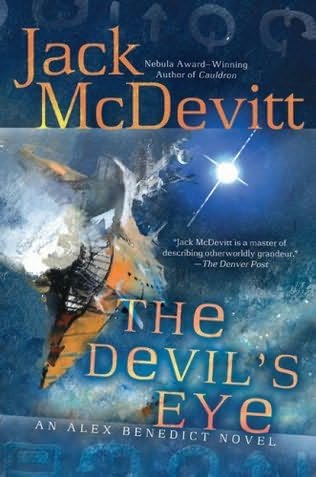
The Devil’s Eye, Jack McDevitt
I am not familiar with the writer of this book at all; I found it on the clearance rack at Books-a-Million and thought it looked interesting. The Devil’s Eye was a surprisingly good read.
The book starts as a Sci-Fi Detective novel, which is great. Chase Colpath and Alex Benedict try to solve a mystery involving the disappearance of a horror writer by following her trail at the last place she was seen. It has a great mix of Sci-Fi action, with alien monsters and space travel, and regular mystery solving. It is obviously not the first story starring the intrepid investigators, but The Devil’s Eye doesn’t skimp on letting the reader get to know these characters. For as long as the mystery was being solved I thought this was going to become a new favorite of mine.
The problem arises when, about two-thirds the way through, they solve the mystery and then must deal with the aftermath. It could be an interesting way to go about ending this book. The protagonists never really consider the implications of rooting out the mystery and whether or not it was right to (it absolutely was) until after it is too late. However, the aftermath part ends up lending an importance to the main characters that rings false. When they are investigating a disappearance and discrepancies about it, they role makes sense. Later they seem to have world changing power. It is as though a police detective started hanging out with the President. It just makes no sense.
All that said The Devil’s Eye is still a fine read. I’ll be looking into McDevitt’s other works, but my enjoyment of this one did take a big it as it floundered to it end.

Pemberley Shades, DA Bonavia-Hunt
A couple of months ago I had the bright idea to read what was basically published Jane Austen fan fiction. I purchased three books (I have to note that I got them for pennies) and the two I read went over about as well as one should expect. I had that third one just sitting there, so I decided to go ahead and read it so I could get rid of it and be done with this disaster of an idea
I wish I had read this one first, because it is actually not bad. For three quarters, it is almost good. Pemberley Shades is another sequel to Pride and Prejudice, though fortunately it reads more like the continuing life of the characters from the book and not new people who happen to share their names. The new characters fit right in to Austen’s milieu as well.
Unfortunately, as the book concludes you begin to realize that while the characters are mostly right, the author did not actually have a story to tell. Things that felt like they were building fizzle unsatisfactorily, motivations change for no reason and then it just sort of ends. I would not recommend this. I am not sure why I read it.

The Bellmaker, Brian Jacques.
This is where my re-read of the Redwall series ends for now. Not because I’m not liking the books, far from it, but because they are all so similar to each other that reading them in rapid succession makes them all run together in my mind.
The Bellmaker is, as far as I can tell, one of the few Redwall books to be a sequel that features the same cast as an earlier book. This one is again about Mariel and her cohorts. Though it is titled The Bellmaker, Joseph the Bellmaker has little to do with it. It has all the hallmarks of the other Redwall book; swashbuckling action, dangerous but cowardly villains and larger than life heroes. It also focused more on seafaring than most of the previous books. It is present in most of them to one degree or another, but it is more prevalent here than in any others. The Bellmaker is not the best book in the series, but neither is it out of line with the general quality.
Related articles
- What’s On My Bookshelf? (swampofboredom.com)
- A Few Words on Darcy and Fitzwilliam by Karen V. Wasylowski (dragonflyy419.wordpress.com)
- Pride and Prejudice and Zombies Goes Interactive Digital on Your iPad (dreadcentral.com)
- #936: Emma – Jane Austen (bridgetsbooks.wordpress.com)
- Where next for the Jane Austen (guardian.co.uk)
- (BOOK GIVEAWAY) Tell Us What Jane Austen Means to You (blogher.com)
- Jane Austen Rankings, Part 2 (bridgetsbooks.wordpress.com)
- 30 Days of Reading: Play by Play (moveshakerepeat.wordpress.com)
- Books I want to read (smalltownrevelations.wordpress.com)
- Lessons From Jane Austen (3quarksdaily.com)
I can’t finish this book
For the better part of the last 2 years, I have been reading The Once and Future King. I blew through the first “book” The Sword in the Stone. As all good people are, I was very familiar with Disney’s animated version and it is mostly the same in the book. Only there is more of it. And Robin Hood. It is exactly what I thought I was getting into. The second part, The Queen of Air and Darkness, sets up Arthur’s goals as king and is largely terrific. But I have not been able to make much progress since I finished the second part, and I have only recently realized why.
I know how King Arthur’s story ends. I’m fairly sure everybody does. Everybody knows about Lancelot, Guinevere, and Mordred. If I read the rest of the book, that stuff happens. As long as the book remains unread, Arthur is still a young, idealistic king. I can still look back fondly on his adventures with Merlin. Once I read it, I’ve condemned him to the failure of his dream. It is like the reverse of “The Monster at the End of this Book,” in which Grover is deathly afraid of the promised monster and appears afraid of letting the reader turn the page.
This sort of thing does not normally bother me; I’m sure I’ll get over before long. I want to read the rest of the book. I feel compelled to see it to the end. However, knowing what is coming has made me put it off as long a possible. I can count the number of books I’ve started but never finished on one hand; aside from The Once and Future King and what I’m currently reading (The Devil’s Eye by Jack McDevitt) the only thing that comes to mind is that monstrous turd Battlefield Earth. There is little fear I will not finish.
Honestly, I wanted to see if I could relate serious literature to The Monster at the End of the Book, and I feel I succeeded. Really, I love that book for introducing young me to the concept of meta-fiction.
Last Month in Reading: March
This was not a good month for me, reading wise. Mostly because all the new handheld games I intend to buy this year came out this month and I used time that would normally be reading time as Tactics Ogre and OkamiDen time. But I still got four books read, so it wasn’t a complete waste.
Fer-de-Lance Rex Stout
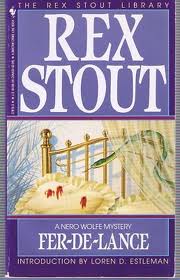
This is the first of Rex Stout’s Nero Wolfe mysteries. I can see why he is considered one of the greats of the genre. This is a terrific mystery. Nero Wolfe seems to be a progenitor of the irascible, eccentric detectives popular today, like TV’s Monk or House (Doctor, yeah, but House is totally a detective). Wolfe’s eccentricities, for those unfamiliar, has him refusing to leave his house to investigate, leaving it all to his assistant Archie Goodwin, who is the narrator. Archie Goodwin does all the legwork, but Wolfe uses his findings to solve the case. It is an interesting, workable good set-up. The actual case they solve is not exactly complex, but it is not too simple. The brother of an acquaintance of Wolfe turns up missing, then a respected man turns up dead with little explanation. Wolfe puts the two together and realizes that they are connected. So he sends Archie to look around. It follows in the standard manner of mysteries, with Archie and Wolfe getting closer and closer to the truth. Though it ends with Wolfe crossing the line from eccentricity to sociopathy. I’d recommend it, and I’ll be reading more of Stout’s mysteries.
Napoleon’s Wars An International History 1803-1815 Charles Esdaile
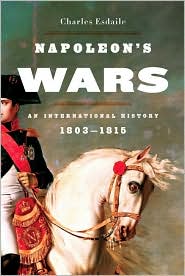
Charles Esdaile’s Napoleon’s Wars is a thorough account of the Napoleonic Wars. I should have known how annoyed I get with this book when I purchased it. Esdaile is British, I am a Napoleon apologist; should have known his take on Napoleon would be one I did not like. Don’t get me wrong, the book is well written and accurate, but he seems to be trying to equate Napoleon with Hitler and cajole readers into thanking Britain for saving the world from him. Every good thing Napoleon did is set as merely a ploy to get to more war and killing. While no one can argue that Napoleon was not inclined to battle, I do not think the rest of what he did is easily swept aside. The wars of the time were almost as much the fault of the leaders of other nations as Napoleon. Still this is definitely a worthwhile read, though possibly more dense that a casual reader would appreciate.
Mariel of Redwall Brian Jacques

Mariel escapes from the pirate Gabool the wild, journeys to Redwall and then goes back to rescue her father, Joseph the Bellmaker. (Remember the Joseph Bell from Redwall?) Joined by new friends from the Abbey she treks back to the fortress of the increasingly insane Gabool. I actually like the cast of this book more than the ones from Redwall or Mossflower. Martin is kind of boring in life, but as a ghostly protector, he is great. But here we get Mariel and the first more nautically themed Redwall book. Also, the first female main character. It is kind of hard to separate these books after a while, because they all are very similar.
Martin the Warrior Brian Jacques
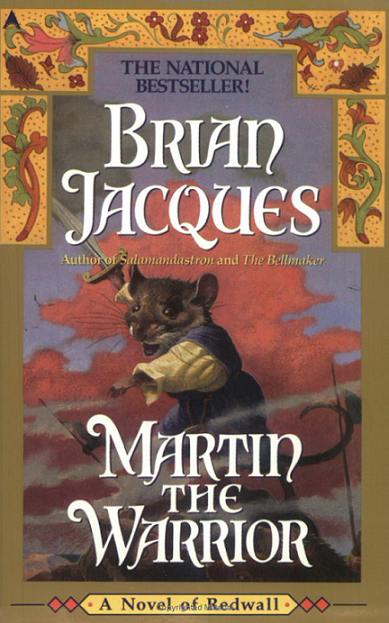
This is my least favorite of the Redwall series so far. The bad guys are ridiculously incompetent, and the knowing what happens next makes the book is predictable. It seems like Jacques realized that Martin did little in his previous book (Mossflower) and needed another book to make him seem as important as he does the books where only his spirit appears. This book details an adventure of Martin’s before he comes to Mossflower. As usual, there is a horde of vermin and imperiled good animals. The most interesting thing in this one it the troupe of traveling performers, who sadly get to do little performing. Martin and his newly met friends escape from , then bring an army back to take him down. You know, the usual Redwall stuff. The fun of these books is not in their plots, which are standard adventure fare, but in the execution. And Martin only slightly under delivers on that.
Last Month in Reading
It’s time for the monthly review of the books I read last month. Quite the variety in terms of subjects and quality. Still a good month for in terms of number of books read.
Opening Atlantis, Harry Turtledove

The first of Turtledove’s trilogy of Atlantis alternate history novels, Opening Atlantis is an adequate read. It is not mind blowing or anything, but it is sufficiently competent and entertaining to be worth reading. The novel tells the story of an alternate history where a large island, or small continent, (I’ve since realized that it is the East Cost pulled off of America) sits between Europe and America. Dubbed Atlantis by its discoverers, the novel follows it is colonization up through its equivalent of the French-Indian War through the eyes of the original English settler and his descendants.
One problem with it is that it covers too much time and is too much of a history to really develop the characters. This is very much a novel of plot and not character, but the viewpoint is too close to the characters to give a wide, history like view. Another problem is that Atlantis’ history too closely mirrors America’s. What is the point of an alternate history when it sticks so close to actual history? This is more of a mild disappointment than a big problem, though. With all of history to use as a canvas, Turtledove transplants what we already know with some cosmetic changes. I hope the latter books deliver on the promise that Opening Atlantis nearly squanders.
Last Month in Reading
I guess I better get this posted before it more than a month old. This should be a monthly review of or jumbled thoughts on the books I read in the previous month.
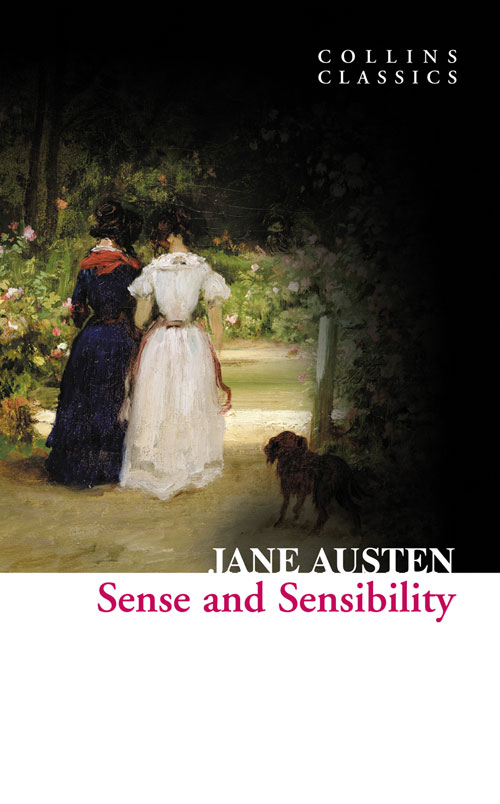
Sense and Sensibility Jane Austen
Quibbling about Austen
I purchased a Collins Classics edition, a bargain line of classic novels from HarperCollins, of Sense and Sensibility expecting something as enjoyable as Pride and Prejudice or Northanger Abbey, my two favorite Austen novels. Though I am currently only about halfway through, so far I have found it to be a mild disappointment.
 Skociomatic