What I Read in April 2015

I read a lot this month, but it was all candy, with little substance. I want to try to read something more substantial next month, though I know I am going to start with another handful of Star Wars books and the last of the Parasol Protectorate. Maybe after that I can get to some non-fiction or something with some heft. Still, getting eight books read in a month, regardless of those books substance, is no mean feat.

blameless

Blameless

Gail Carriger

This book seems to actually agree with my complaints about the end of the last book. An impetuous was needed for Alexia to take off for Italy and this plot to happen, but the split between her and her husband is kind of nonsensical. Still, Alexia and Madame Lefoux going through France and to Italy is a fun road trip. For some reason, vampires are trying to kill Alexia. Without the protection of her werewolf husband, she is in real danger. Her best course of action is to take a vacation to the continent, which would get her out of the vampire’s reach and take her to Italy, where they have knowledge of preternaturals like her and could maybe tell her why the vampires want her dead.

This book really allows Carriger to fill in the world of this series, letting readers see how different countries deal with the existence of vampires and werewolves. Britain may have integrated them into to society, but they are merely tolerated in France and outright outlawed in Italy. Alexia’s unique powers make he sought after by everybody. The vampires want to kill her, the mad scientist of the Order of the Brass Octopus want to study her and the Templars want to turn her into a weapon. Without the protection of her position in the Queens Shadow Council (due to the black mark on her character) and her husband’s werewolf back she has to rely on her wits and Madame Lefoux’s inventions to save her. In the end she only really manages to solve the problems she created for herself during this book, though she does learn more about the nature of her abilities. This series continues to be delightful fun.

heartless

Heartless

Gail Carriger

With Alexia returned to her status quo at the end of the last book, this book again has it male and female leads together. It starts with a ghost showing up to warn her about a coming attack on the Queen. Alexia and her allies immediately jump into action to try to protect the monarch, though they have no real suspects as to who is behind this supposed attempt. The biggest problem Alexis faces in her investigation is that she is now 8 months pregnant. In order to get the vampires off her back, she agrees to let her vampire friend Lord Akeldama adopt her daughter, so the baby will grow up with a friendly disposition towards vampires.

Alexia spends her time looking into the assassination attempt done by her husband’s former pack, without his knowledge, though that proves to be a disturbing dead end. Meanwhile, her friend Madame Lefoux is acting odd, seeming very stressed. Eventually it all builds to the most explosive conclusion of the series yet, an ending that changes just about everything and not necessarily to the good of the characters. These are wonderful little bon bon books, and while I only have one more I do have more from Carriger to look forward to.
newspring

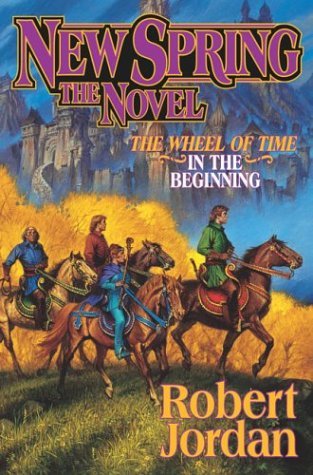
New Spring

Robert Jordan

See Here

third girl

Third Girl

Agatha Christie

Another Poirot mystery. This time, an aging Poirot meets with a seemingly drugged young woman who thinks she may have killed someone. Since she doesn’t leave her name and he doesn’t know who she supposedly killed, he has little to go on. That dearth of information, and her assertion that he is too old to help, spur him on in the investigation. He, along with his mystery writer friend Ariadne Oliver, begins to unravel a despicable web of lies. The girl is the daughter of a businessman who left her and her mother to run away to South Africa when she was young. After her mother died, he returned with a new wife to take over the family business. She is also involved with a rather awful man who appears to be the on supplying the drugs. I believe this is one of the last Poirot stories and it feels like it. Not only is he frequently referred to as old, it also deals with problems that are much more modern than I usually associate with these books. This takes place in the sixties, and Poirot comes up against many problems usually associated with that decade, most notably drug use. It builds up to an ending that is both ingenious and ridiculous. This is a lot of fun.
DLoK

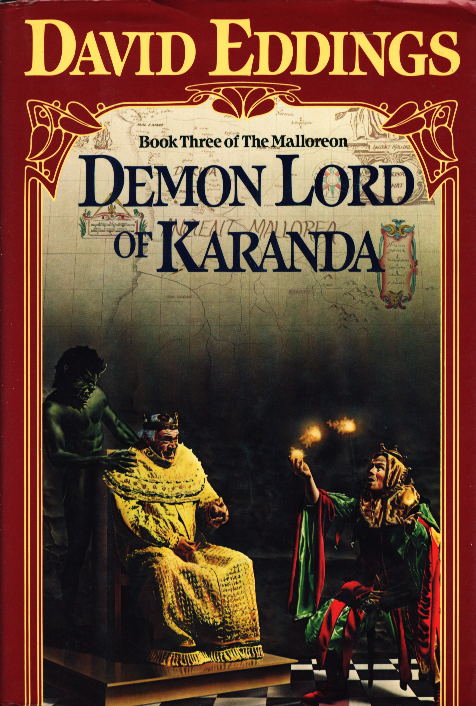
The Demon Lord of Karanda

David Eddings

This series just feels so empty. The cast is the outline of possibly interesting characters, but there is no humanity to them; they are merely collections of quirks and skills. There is also a complete lack of tension. Things happen, but the heroes are rarely active players in the goings on. Any danger they might be in is blunted by the sheer power of magic most of the cast is capable of, though they generally choose not to employ it. They only occasionally seem to remember that they are trying to save a kidnapped child. Any time the group is stuck they call up a God and are simply told what to do.

Here they are captured by yet another theoretically evil king, and he and Garion forge a sort of friendship. He wants to keep them captured, but they must escape. They again follow the trail of Zadramas, which takes them to the north, where they find an evil priest who has summoned a Demon Lord and is starting a war. Right up until near the end, the heroes do little but talk. For once, Garion actually does something, though it is something blatantly and obviously foolish. The good guys move closer to their goal, but do so without seeming to make any real progress or learning anything.

SoK

The Sorceress of Darshiva

David Eddings

At this point I am really running out of things to say about this series. I don’t like; I’ve made it perfectly clear I don’t like. Any sensible person would just stop reading. I am apparently not very sensible. Maybe it is because I received the books as a gift and feel some sort of obligation to the giver to read them. Maybe it is just my refusal to leave a book or series unfinished. (I have only ever not finished one book, the stupendously dreadful Battlefield Earth, and only one series I read more than one book in and gave up, A Song of Ice and Fire) Whatever the reason, I keep reading these. The Mallorean is not for me and nothing I have to say can really inform how people feel four books into this thing.

The Sorceress of Darshiva finally has our heroes learn their destination. So far it had been a series of short stops and begging Gods to tell them the next step. Now, the end is in sight. Still, the problems of the first few books continue. The same character beats are hit over and over. The characters don’t grow or change; they just keep repeating the same bits of tired shtick at each other. Things happen, but the protagonists for the most part are observers; the plot would largely play out the same without their involvement. That changes at the very end, when Durnik does the first memorably thing in the series. This is just not good.
RogueSquadron

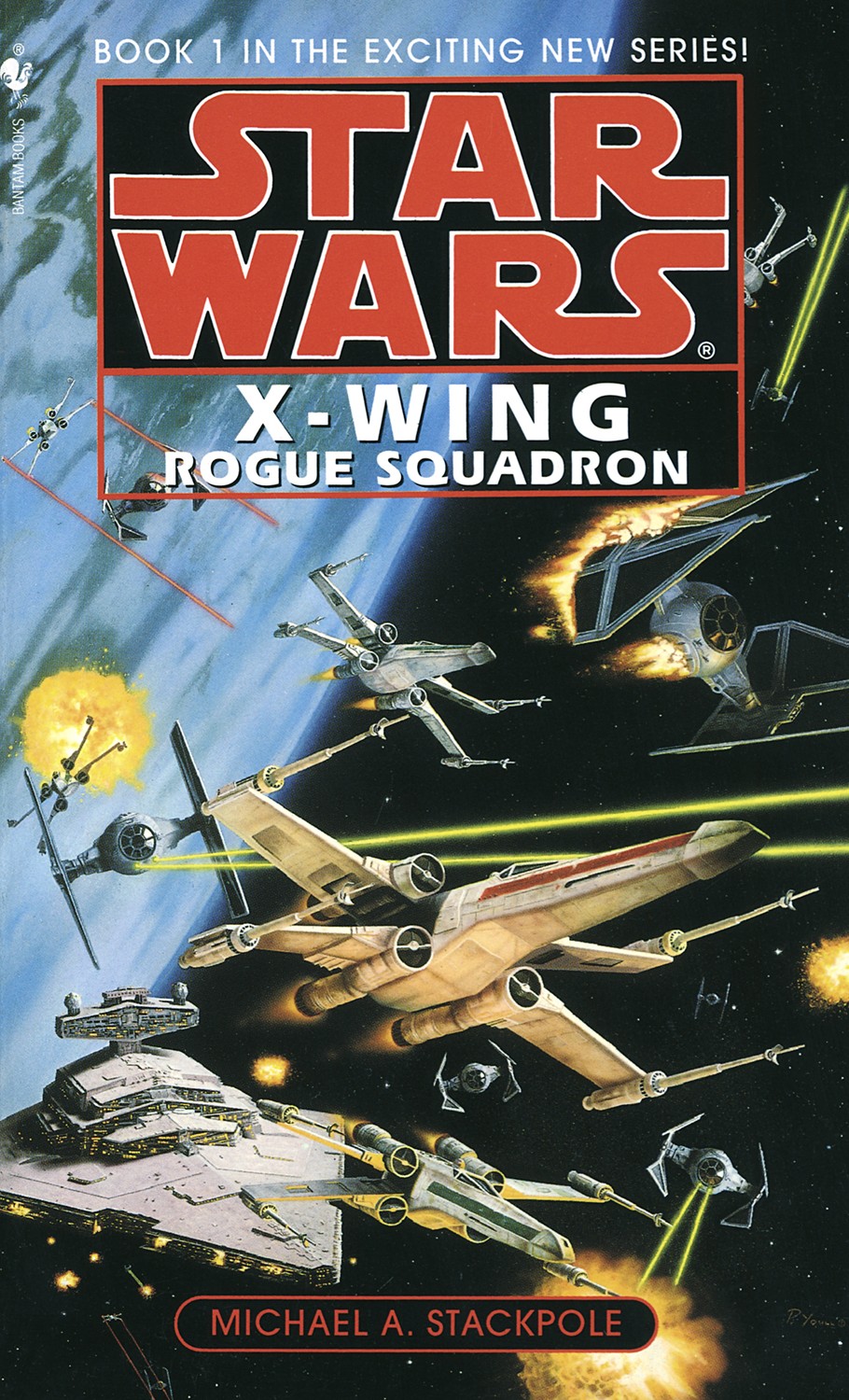
Rogue Squadron

Michael Stackpole

Seeing that excellent Star Wars trailer kind of reminded me that at one time I was a huge Star Wars fan. My first inclination was to watch the movies again, but they weren’t to hand. So instead I pulled out the handful of EU novels I still own. When Disney bought Star Wars and jettisoned the Expanded Universe, fans were upset. Disney was right to do it, though. The majority of the EU is crap. Among few bright spots is the X-Wing series.

This first one is fairly small and self-contained. It has Wedge, a minor character from the movies, putting together a new version of Rogue Squadron. It is filled with a bunch of new characters, led by Corran Horn and Tycho Celchu. It does a good job of building up the team, though only Wedge, Corran and Tycho get any real development. The rest just get sort of sketched out.

The team is essential to an operation to help the Rebellion take the first steps in liberating the Imperial Capitol. It does a great job of setting up storylines that run through the series. While the prose can be terribly grey at times, but it has some great dogfighting scenes. It also actually makes the missions Rogue Squadron goes on seem dangerous. They actually lose pilots. It isn’t great literature, but for Star Wars fans that want something that isn’t Jedi fanwank, this is about as good as it gets. By divorcing itself from the major characters of the movies, it manages to tell a fun story just set in that Universe.

WG

Wedge’s Gamble

Michael Stackpole

This is the one Rogue Squadron book I hadn’t read before this; I actually had to go track down a copy at a used books store. I did know the story, not from the book but from an abridged audio book with authentic Star Wars sound effects. Usually I find abridged works almost offensive, but I got to know this story through it without knowing it was abridged. (I was 12, what do you want?) That abridged version only barely gets the story across.

This time, Rogue Squadron is taken out of their X-Wings and sent on a spy mission. It works really well. They are split up and sent in on an Imperial world to scout out their defenses. This is why some members were chosen for the team, so they could do more than just fly. It lets Stackpole spread the characters around a little more. Corran is still the protagonist and still seems a bit of an author insert. Wedge has a big role, as does Gavin Darklighter, the cousin of Luke’s friend Biggs who died in A New Hope. There is also a Dirty Dozen-ish wrinkle, as Rogue Squadron frees some criminals and sends them to the planet to cause some trouble to cover their activities. They are all sent to different parts of the planet, but are soon brought together for a mission that will give the planet to the Rebellion. Playing against them is Kirtan Loor, an old nemesis of Corran Horn’s. Through him, readers know that there is a traitor in Rogue Squadron, because of course there is.

It moves a little too fast at times, but again it is mostly really fun.
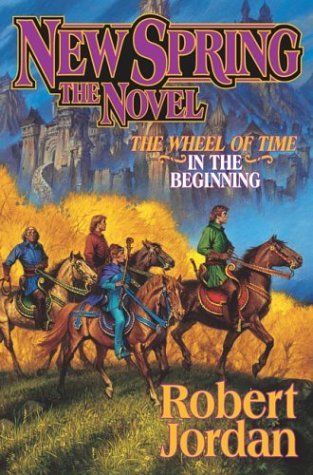
A New Spring

nspring

New Spring, the only Wheel of Time prequel of a planned three, deals chiefly with three (really two, but I’m including a third) of Jordan’s most well realized characters, but characters that do not drive the events of the main series, merely facilitate it. Moiraine and Lan are important characters, but not character that the main series really examines in depth. They are held away from the reader, sources of mystery and awe. Siuan starts that way, though she becomes much more prominent as the series goes along. New Spring gives the reader a completely different look at those characters, seeing them before they were the people they became by the time the series started.

Reading Siuan’s portions of New Spring are a different experience after reading A Memory of Light. (Spoilers for that book) Before knowing her final fate, Siuan’s naïve desire to have adventures and see the world was sadly ironic. Readers knew that she ended up stuck in the White Tower for most of the next two decades, her rise to power as the Amyrlin Seat directly preventing her from living out her youthful dreams. It highlighted how young she and Moiraine were when they fell into the hunt for the Dragon Reborn and their youthful naivety. Knowing that she dies at the end the quest makes it downright tragic. She wasn’t just stuck in the tower for a small portion of an Aes Sedai’s extended life; she was stuck there for the majority of hers. Just as the quest that had marked her entire adult life, to some extent, was coming to a close she was killed. Those adventures she dreamed of as a young woman were not simply put off, they were never to be. It hurts all the more because Siuan was a favorite of mine. In a world of stubborn, wrongheaded people, she was one of the smartest and most rational. To have it end the way it did, so close the finish line, is one of the most painful elements of the series. New Spring is not her first adventure, it was her only one and in it she only got to play sidekick to Moiraine. It’s not fair, but life is not fair.

Lan is the most like his latter incarnation. He is already a grown man. I’m not going to look it is to be sure, but I would guess he is somewhere around 30 years old in this book. He is already regarded as one of the most dangerous men in the world, but his personal war with the Shadow is less focused and more destructive. He still has the last vestige of his disturbed childhood around in Bukama, one of the men who were tasked with saving him in the fall of Malkier and who raised him. Of course, he was raised with the destructive idea that he will spend his life fighting and eventually dying in the Blight for a cause that is already lost. It is a great tragic hook for a character, but a horrible thing for him to have to live with his whole life. This book has him face his greatest hope and greatest fear: that someone would try to bring back Malkier. Lan wants nothing more than to have his home back. That desire is blunted by his knowledge that any attempt to reclaim it is doomed to failure and would cause the death of thousands. He is constantly faced with seeing the last remaining expatriates giving up on Malkieri customs to take on those of their adopted lands. It hurts him, but he realizes it is necessary. Malkier is dead. Meeting Moiraine, and seeing that last desperate hope for his homeland snuffed out, leads him to refocusing his war in the shadow in something less futile. There is little change for Lan here, just as chance to see him as one of the primary movers of the story for once.

Moiraine was always one of Jordan’s most intriguing characters. She is an example of how he didn’t really upset the tropes that many fantasy stories are built on, but he did like to give them a push and see them teeter. Moiraine plays the same role as characters like Obi Wan Kenobi in Star Wars or Gandalf in Lord of the Rings; she is the mentor, the “Wise Old Man.” Except, she is does not appear old, she is not a man and book questions exactly how wise she is. For the first book, and even up to the third, there are questions about just what her motives are. Following her is clearly a better choice for Rand and company than facing the Trollocs, but does she have their best interests at heart? The Eye of the World plays with this, never quite letting the reader trust her. Of course, in the end the true order is upheld, Moiraine is not just trustworthy, she is one of the few trustworthy Aes Sedai in the world. Coming long after her mysterious introduction, New Spring gives readers a new look at Moiraine. She is not the cool and collected mentor of the main series, but a young woman in over her head. She is not too different from the Wheel of Time’s protagonists, though with some training but lacking a mentor. While knowing that she survives to be in the rest of the series robs New Spring of some tension, it is still fun to see a young, less assured Moiraine in action. It is easy to see how she became the character she was by the start of the series.

That is what New Spring delivers to readers. Not an essential addition to the series, but an entertaining look at some characters whose roles in the main series means that they are somewhat remote. It is rarely clear exactly what Moiraine or Lan are thinking in the main series, but New Spring lest readers see inside. And while it is nothing revelatory, it is still fun to see. Of course, calling New Spring “fun” side steps just how dark a tale it is. There is plenty of levity, but the whole book is stained with blood and tragedy. Heading into the climax it is in many ways a romp, allowing for a handful of assassinations, but the end is bleak. Good times must end and adventures tend to be bloodier than Moiraine or Siuan suspect.

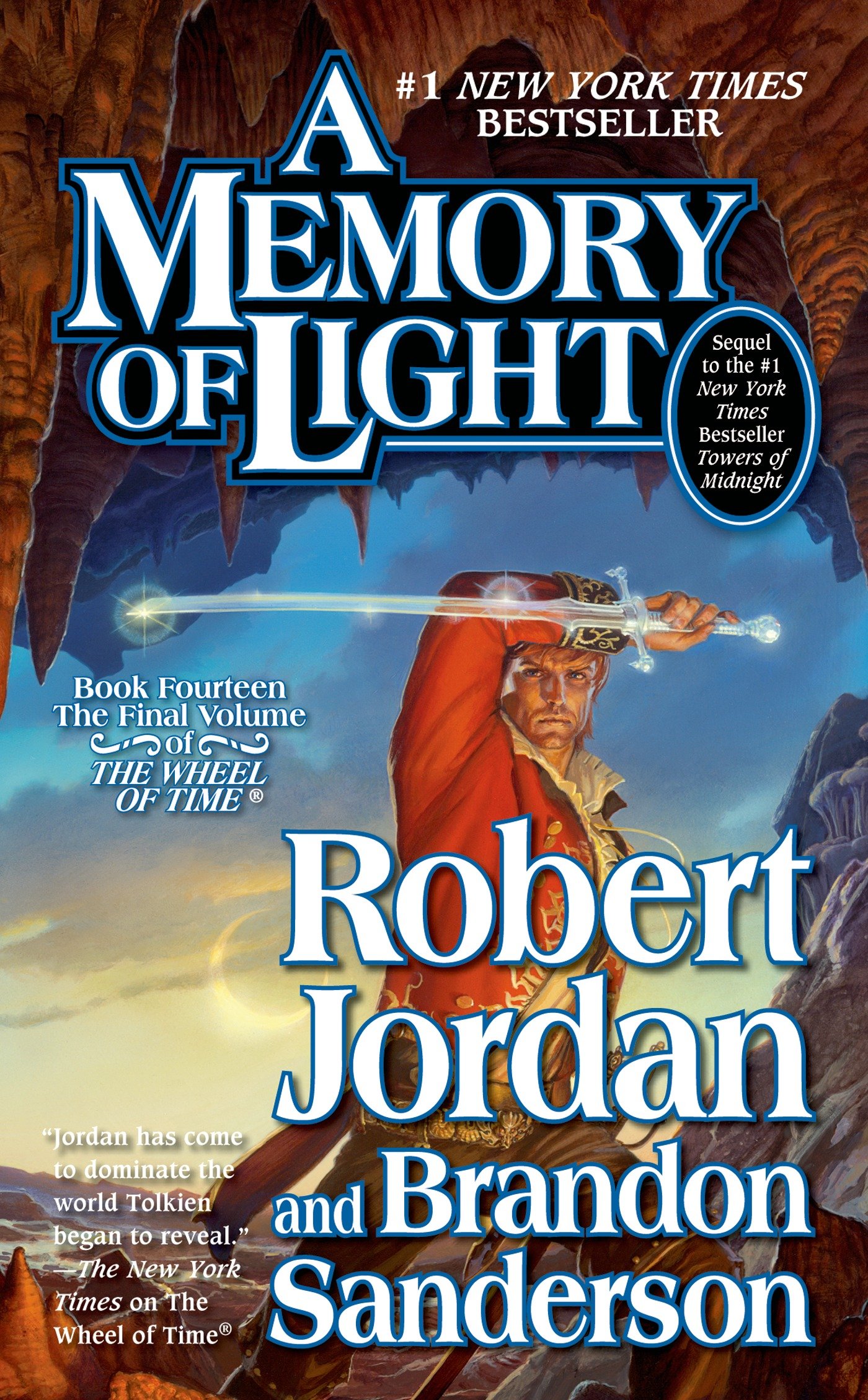
A Memory of Light

amolcover

The years and years that people were waiting for the end of the Wheel of Time made it almost impossible that A Memory of Light could live up to expectations. Somehow, though, this book turned out to be almost everything readers could hope for. It is sometimes triumphant, sometimes tragic, but always riveting. Both times I’ve read it has grabbed me and forced me through it as fast as possible. A Memory of Light will never be counted among my favorite books in this series; in fact, I would put it somewhere near the bottom, but it is a great ending to this towering series.

This last volume highlights the differences in how Robert Jordan and Brandon Sanderson deal with magic. Jordan’s writing is very detailed on how magic is performed and what it takes from the user. Channeling in Wheel of Time is some combination of weaving and chemistry. Mix the right balance of elements and it makes something else. But what is done with magical power is usually pretty prosaic. People make fireballs and use wind like telekinesis. Sanderson’s style goes much more in depth with what people do with that power. For example, Androl Genhold, a character that had been around since Winter’s Heart but really seems to be a pet of Sanderson’s, is not especially strong in the power, but in A Memory of Light he finds a lot of was to use the power he does have. Androl has a special Talent with making gateways and he puts that to some rather creative use throughout the book. Like when he makes a gateway to let lava out of a volcano to flow into an army of Trollocs. The myriad of was he finds to use that power, while a perfectly logical extension of his skills, is completely unlike anything else in the series. It would feel right at home, however, in Sanderson’s Mistborn books. It isn’t really that I find either method here superior, though I do slightly prefer the way Jordan does things, but it is undeniably different. It really contributes to how much this book, with a couple of notable exceptions, feels more like Sanderson’s work than Jordan’s. Again, it is in a different way than the previous two books. The Gathering Storm was Sanderson struggling to get a feel for the characters and Towers of Midnight felt like a perfect synthesis of the two. A Memory of Light has Sanderson triumphant. These may be Robert Jordan’s characters and his world, but this is Sanderson’s book.

The points of view in this book are kind of oddly parceled out. After a brief opening where everyone gathers, the first big meeting of all the forces of the Light, they split up to fight the massive armies of Trollocs that are now swarming down from the Blight. That opening moves pretty quickly through the viewpoints of all the major characters in attendance, which is nearly everybody but Mat. Early on, Rand is the driving force, forging the good guys into something resembling a cohesive force. Once the fighting starts, Rand kind of disappears. And Mat has been largely a non-presence to that point. A lot of the book at that point rest on the shoulders of characters like Elayne and Androl. The main players, Rand, Mat and Perrin, are present but not central. Perrin is the first to have his chance to shine, again setting off into the Wolf Dream and clashing with Slayer. He has to be there, because the dream world is the best avenue to attack Rand that exists. While everyone else directly fights the Trollocs in the real world, he enters the dream and protects Rand from there. Soon, he disappears and Mat steps in, leading the forces of light in the actual last battle. Eventually, Rand comes back to have his prophesied fight with the Dark One. Really, though, those three get surprisingly few pages in this last volume.

Outside of the central characters, A Memory of Light also gives some very important characters very little to do. Characters like Siuan, Thom, and Faile, or most disappointing Moiraine and Nynaeve, end up with almost nothing to do. Moiraine’s return is one of the most disappointing parts of the whole series. It had been teased since before she even “died” and she comes back to have a bit role in the last book. Her actual role, being one of the two women to go with Rand to Shayol Ghul, is quite important, but it doesn’t really give her much to do. Rand is the big player there. That vital but passive role also catches Nynaeve, but it is a little more acceptable for her. She’s been around the whole series as one of the two most prominent women in the series. I knew I wasn’t going to get all that I wanted out of her return, to see her meet up with all the characters who thought her dead, like Siuan. Those five characters I mentioned were big parts of the series, most of them characters who had been around since the first or second book. To see them set aside at the end and newer characters take more prominent roles just didn’t feel right.

The thing is it still works, though it feels very different from what came before. This is a book the majority of which is spent in a handful of battles. Before this, fighting in the Wheel of Time has been messy and short. Battles didn’t tend to last for more than a chapter and the individual scenes tended to be quite short. They also tended to be caught up in the nitty gritty of the fighting, not tending to give a clear picture of the overall battle until the dust has settled. This worked great at Dumai’s Wells and in Crown of Swords. The nature and scope of the Last Battle almost assured that it would be handled differently. All of the politicking and maneuvering is over as well. This is just the good guys versus the bad guys. That is what the entire series had been building to, of course, but it is by necessity different that the previous dozen books. Still, it does manage to pay off nearly every characters own arc. Perrin finally, totally learns how to let go, to be himself and a leader, a man and a wolf. Mat’s luck and stolen battle skills save the day. Egwene leads the Aes Sedai, finally managing to effectively herd cats. Elayne gets to put her skills as a leader to use on a large scale. It is great to see these characters all grown up one last time, but it is bittersweet to know that this is the last time. That is what makes it really hard to call this book a favorite. Before this, every character had potential for future action. This is the culmination of that, but it also means that all of the potential is not spent. Everything is past now.

Rand’s fight with the Dark One manages to be exactly what I expected and completely surprising at the same time. Careful readers were able to guess exactly what was going on during part of it, but it was fitting that the showdown would be a philosophical one, not a physical one. How can anyone fight the personification of evil? What Rand had to do was gain understanding, which let him finally learn that it couldn’t be destroyed; only removed.

The ending [Spoilers, of course] was simultaneously perfect and completely disappointing. What is there is absolutely perfect. I would bet that the very last chapter is all Jordon. (or maybe I know that but forgot where I got that information) It does a pretty great job of closing out the stories for most of the main characters, especially Rand and his trio of women. Maybe Nynaeve’s is enough as well, and Perrin too. But anyone outside of the main characters is all but forgotten. I wanted some sort of final tally, or at least confirmation on the life or death of a great number of characters that, while minor in the grand scheme of this series, had been a peripheral part of the series for as many as a dozen books. For example, Mat’s scout/horse thief Chel Vanin. He had ridden with Mat’s Band since at least Lord of Chaos and while his role was never more than minor, he was a constant piece of window dressing. This book leaves him being chased by Trollocs in an attempt to save the Horn of Valere from falling into the hands of the Shadow. Whether he lives or dies is never made clear. One last point of contention, the last bit is also from the wrong POV. It should be Moiraine seeing Rand ride off into the sunset, not Cadsuane. Moiraine is the one with the connection to Rand; Cadsuane was never more than an obstacle.

While the finality of A Memory of Light will always make it a hard book to reread, at least for me, it is certainly a better ending than I ever expected after Jordan was unable to complete it. There are questions left unanswered, there were always going to be. It manages to wrap up all the important things in satisfying and frequently surprising ways. I did cry a little when reading this book, at the death of a certain character. Not the one people would likely expect, though. At the end, I am not eager to read this book again, but I am to get to about half of the dozen that came before it. As far as I’m concerned, the Wheel of Time is still the king of the fantasy genre.

What I Read in March 15

It was another big reading month for me. That doesn’t seem likely to change as long as I am working nights with little to do. In that case I will keep reading. This month’s books mostly come from the same author. I was talked into getting Gail Carriger’s young adult finishing school series during a Kindle sale and ended up getting the entirety of her previous series after I finished them. I complemented reading four of her books with a handful of fantasy books and another thing I picked up from amazon.

thesil

The Silmarillion

JRR Tolkien

The Silmarillion is many things. It is beautiful, majestic, dry, aloof and unfinished. It is not an easy book to read, especially if someone is expecting a novel of some kind. That is not what The Silmarillion is. It is a history, a detailed outline of the myths and history of the early days of Middle Earth. There are some great stories in there, but they are told in a very remote way. It doesn’t deal with characters, but with figures. The wondrous and tragic events that take place over the course of this book can make for great reading, but the reader is kept so far removed from the action that it is hard to form any sort of attachment to these characters. It is just a series of small episodes that kind of form a history. I think a lot of the chappy nature that that creates has to do with The Silmarillion not being finished when JRR Tolkien died. His son and Guy Gavriel Kay did an admirable job of pulling the various versions of these stories he left into a coherent whole, but it still feels incomplete. It is unlike any other fantasy book I’ve read, and it works really well at times. How much the reader is invested in the setting of Middle Earth probably has a lot to do with how much they will enjoy this book. I can’t say that I actually enjoyed it all that much, but I am certainly glad to have read it.

cac

Curtsies and Conspiracies

Gail Garriger

I wasn’t overly impressed with the first book in this series. It wasn’t bad, but instead of making me want more it felt more like I didn’t get enough. That would have been a problem if I didn’t have another book to start on right after I finished the first one. Curtsies and Conspiracies isn’t really any better than Etiquette and Espionage, it is just more of it, which solves that books biggest problem.

It really builds off of the world that the first book only really began to set up. I know that these books are connected to Carriger’s Parasol Protectorate series, but the first book didn’t really help acclimate the reader to the world of this series. The second book only does about as much as the first on that front, but together it is enough to finally ground the reader. Sophriona remains an engaging protagonist. She is still exceptional, even among the students of this spy and assassin finishing school, but that strength is actually turned into a flaw for her. Her constantly putting her skills to use makes it harder for the others to trust her. She also has to learn to deal with the opposite sex and deal with the practical application of her skills. The supporting characters never really break out, but they are more fully fleshed this time.

For the most part the book does a great job of deftly mixing different genres, mixing adventure and comedy of manners-type stuff, but occasionally the humor is a little too cute for its own good. Giving character ridiculous names is only funny to a point, there has to be something else there. Mostly, though, it hits. Maybe it is just that I am not especially familiar with YA books, other than reading Harry Potter, but this book too feels like it is missing something. It just feels like something is missing.

waw

Waistcoats and Weaponry

Gail Garriger

I continued this one straight from the next, and its quality is largely the same as the previous two books. It has the same strengths and the same flaws. This time Sophriona and friends end up on a stolen train that is somehow causing all the mechanicals, somewhat robotic helpers that exists in this steampunk world, to malfunction. It really focuses in on the handful of characters that matter, Sophriona, Dimity, Sidheag, Mersey and Soap. Sophriona’s love triangle between her, Lord Mersey and Soap comes to a head and the three “intelligencer” students put their skills to good use in a mission of their own. It still feels like something is missing, with storylines being played up before disappearing completely, but those are mostly easy to ignore. I don’t know when the fourth (and final?) book of this series is coming, but I am now really looking forward to it. The more I read of Carriger, the more I wanted to read from her. These three books may not be perfect, but they are incredibly charming.

Print

Soulless

Gail Carriger

I picked up the fairly cheap collected edition of this whole series as soon as I finished Waistcoats and Weaponry. This is a more fleshed out take on the same thing as the finishing school series.

This is a fun combination of a steampunk adventure and romance. Though it deals with vampires, werewolves and mad scientists, a significant portion of the books is about the romance between the protagonist, Alexia Tarabotti, and the werewolf Duke Maccon. Alexia is a “preternatural,” a person whose apparent lack of a soul causes nearby supernaturals to lose their powers. That power lets her fight off the advances of a starving vampire at a ball and gets her involved in a mystery involving suddenly appearing vampires and a mysterious group of mad scientists. She also has to deal with her flighty mother and sisters half-sisters as well as dealing with some unexpected romantic interest.

Other than just being a more complex work than her Finishing School series, Soulless really shines on its supporting cast. The leads, Alexia and Conall, are both well drawn and interesting, but the other characters elevate this. Professor Lyall, the second in command of the werewolf pack, is an intriguing mix of contradictions, an educated monster and a small but powerful fighter. He interesting enough to lead a book himself. The same goes for the flamboyant vampire Lord Akeldama, who is independent from the vampires trying to kill Alexia. Her family might be a little too flighty, but her friend Ivy is just about right. The eclectic cast of characters really helps the humor, which can still be too precious for its own good at times, actually be funny. Writing humor is a hard thing to do and Carriger does it better than most that I’ve encountered.

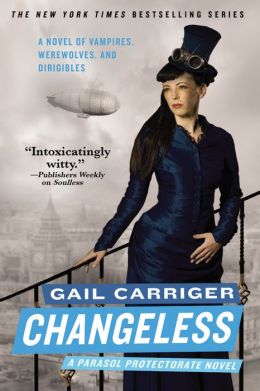
changeless

Changeless

Gail Carriger

With this book, the pieces all fell into place as to why I felt like I was missing something at time with the Finishing School books. Most of those dropped plots and subplots are actually call backs to this series. Which makes reading the two of them together more fulfilling, but it makes that sequel series feel like it is missing something. But that was only a small problem with those books and have nothing really to do with this one.

This time Alexia is investigating what is causing supernaturals, like werewolves and vampires, to suddenly lose their powers and become completely human. Since she can do the same thing with just a touch, it is first assumed that she is somehow behind it. Soon, it appears it has something to do with a returning regiment of Scottish werewolves, who had recently been overseas and lost their pack alpha. Since that is the pack that Alexia’s husband left twenty years ago under mysterious circumstances, he heads to Scotland to help them find a new leader. Alexia’s investigation sends her the same direction. With new friends and continual attempts on her life, Alexia has a lot of problems to deal with in her first official assignment as part of Queen Victoria’s Shadow Council.

My only real problem with this book has to do with the ending. While I am sure it will be resolved going forward in the series, the events at the end of Changeless feel kind of manufactured to me. They just don’t feel true to the characters as they have been presented for these first two books. It is not an unreasonable complication, just one that doesn’t feel all that earned. It kind of soured my feelings on the whole book.

aregmur

A Regimental Murder

Ashley Gardner

I picked this up in a bundle with a couple of other books from this series about murder mysteries set in Victorian England. I really don’t have a lot to say about it. It isn’t a bad book, just one that didn’t really invite further thought. Captain Lacey, the former soldier turned investigator, sets out to help a woman whose husband apparently committed suicide but she believes was murdered after being forced to take the rap for some bad behavior during the war. So Lacey looks into the men who were truly responsible for that, while also forming a relationship with the widow. His investigation takes him to the hedonistic parties that those men throw, as well as forcing him to ally with his former mentor turned nemesis when more bodies start showing up. It is a reasonably entertaining mystery, but it didn’t do much to really excite me.

kotm

The King of the Murgos

David Eddings

I’m not sure why I am reading these. I didn’t like the first book, Guardians of the West, and this one did nothing to improve my opinion of Eddings as a writer. There are two problems that derail The King of the Murgos and the series so far. The first is that, while this book does say Book 2 on the cover, it is actually something like book 7. The Mallorean, the series, is a sequel to the Belgariad, it is building off the foundations that first series built. That is all well and good, but Eddings does nothing to endear new readers to these returning characters. More than half the book is just characters reminiscing about the last time they did this exact same thing. It is a part of the series, that the two sides of this prophesy will keep fighting until someone finishes things right. However, that doesn’t change the fact that large portions of the book mean nothing to people who haven’t read the previous books. Did this book not purport itself to be the second book of a series that wouldn’t be a problem. I wouldn’t pick up book six of a series and expect to follow everything perfectly, but if I read books one and two I should be able to figure things out.

The other is that it is just the most bog standard, dullest of quest fantasies. Without giving the reader reason to care about the characters, which King of the Murgos does not, it is just a group of characters doing things that are themselves not that interesting. They travel a not too exciting fantasy world and make broad judgements about the people they meet. Like the first book, I think it is trying to be funny with the byplay between characters, especially along gender lines, and with the supposedly racial traits of the countries they visit but it mostly ends up feeling like a bad sitcom. Polgara is bossy, Belgarath is messy, Durnik wants to sneak away from his wife and go fishing. It all comes together to form an unappealing fantasy mush.

tomcover

Towers of Midnight

Robert Jordan and Brandon Sanderson

See Here

amolcover

A Memory of Light

Robert Jordan and Brandon Sanderson

Coming Soon

The End of A Legend

Wheel of Time Book 13: Towers of Midnight.

tomcover

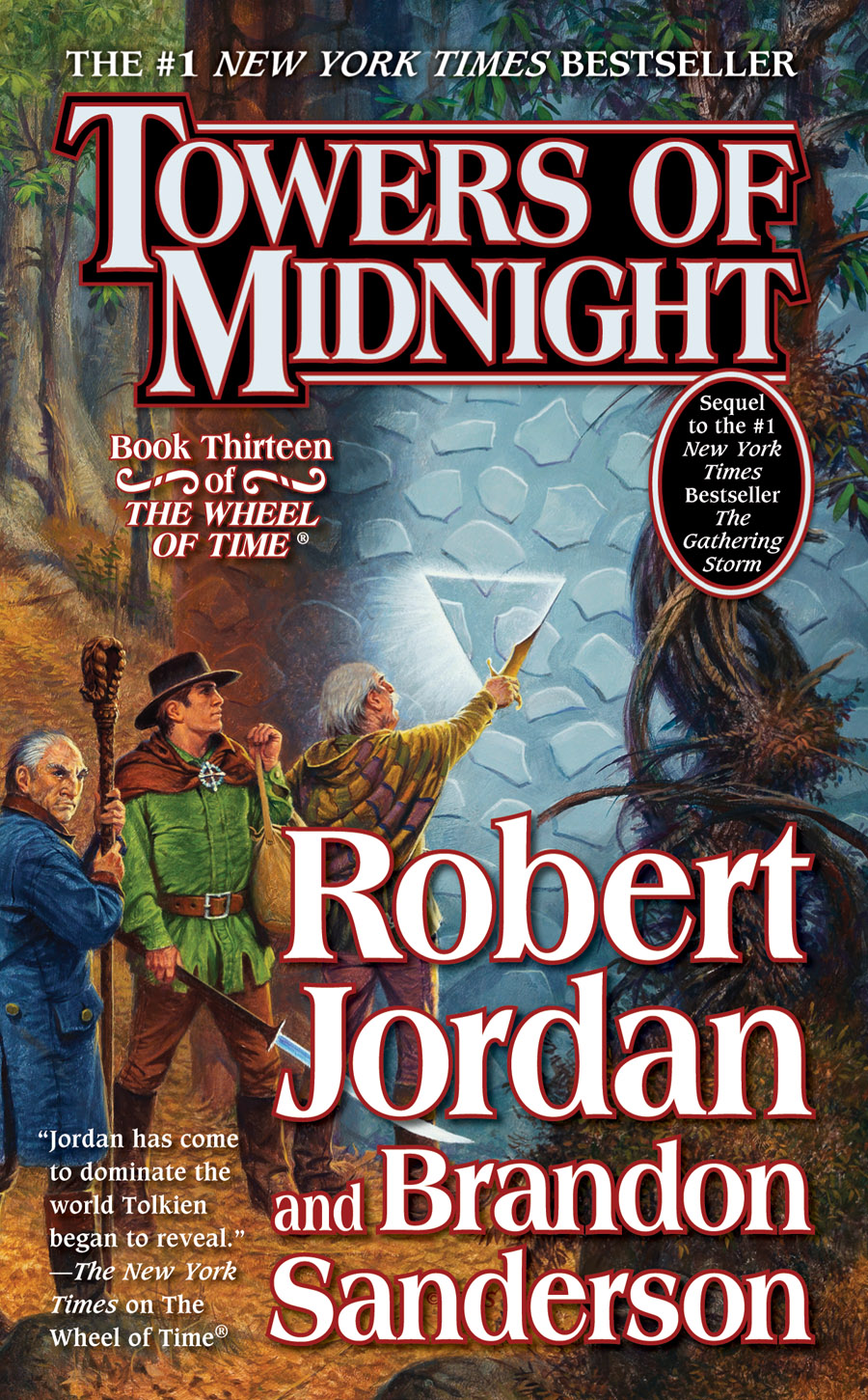
Brandon Sanderson’s second WoT book with his name on it is much better than the first. Everything just feels much more natural this time out. While The Gathering Storm set Rand for the last battle, Towers of Midnight does the same for Perrin, Mat and Egwene. Towers of Midnight also continues to ramp up the feelings of dread of Tarmon Gai’den’s eminent arrival. In all honestly, that last battle starts in this book. Right from the beginning it has Kandor falling under a never ending stream of Trollocs and other darkspawn. It has begun and the good guys are still scattered and fractured. Rand is rallying them, but his enlightenment on the mountain has taken away his rage and struggle in his role. Towers of Midnight show the world finally coming together to face the threat that is already starting to overwhelm them.

Rand doesn’t make many appearances in this book, but the ones he does make are memorable. The book proper starts with Rand walking down from Dragonmount, having found peace. His very presence is enough counter the Dark One’s touch on the world. It actually works to pull the reader away from him at this point. Rand’s storyline accelerated way past everyone else’s in the last book; you can see the wrinkly in the chronology with Tam’s continued presence with Perrin’s group despite ending that last book in Rand’s company. He has a few chapter’s scattered through, as he divests himself of direct power and prepares everyone to meet with him at Merrilor, where he will unveil his plan to break the seal and fight the Dark One. The biggest thing he accomplishes is finally sorting out the Borderlanders. While their absence from the Blight might have led to their fall, it might have actually been to the good that they weren’t there to face it and fall as the Trollocs hordes came.

The two characters that dominate this book are Perrin and Mat. The two of them really could not be more different. Perrin’s stories tend to feature a lot of what poor readers call whining but is really just constant introspection. Perrin wants to think things through before he acts; this has been his defining trait since the series began. Now that he has had the mantle of leadership thrust upon him, he spends a lot of time trying to think of exactly what that means. Perrin, the most direct and straightforward character is probably the one that Sanderson, who tends to be blunter in his writing, writes best. Perrin’s story over the last half of the series tend to repeat, but that is because he is determined to accept change in half measures. Every time it seems like he’s solved his problems, he achieves the goal in front of him and starts everything over again. He doesn’t want things to change; so he makes bargains with himself. He will lead the Two Rivers until they clear out the Trollocs, he will lead his amalgamated army until he has rescued Faile. He will use his wolfbrother skills only as much as he must. It isn’t until this book that Perrin finally admits that he has to take full responsibility. Only after having thoroughly considered what that means, of course. That is why his wolf connection terrifies him. Giving in to the wolf means living by instinct, to act with the careful consideration that makes Perrin Perrin. His concerns are dealt with by dealing with the act that has haunted Perrin since The Eye of the World. He killed two Whitecloaks, which set them against him and caused him to fear giving in to his wolf abilities. Here, is finally forced to confront the Whitecloaks and he does so in his own way, by allowing them to put him on trial. He is willing to accept judgment for his actions because even as he accepts his role as leader he knows that if the laws don’t apply to him then they mean nothing.

His story in Towers of Midnight plays into his role as the builder. Other than Rand himself, Perrin is the one who binds the greatest number of people to Rand’s cause. By the time he has returned from his endless sojourn, he has brought with him Ghealdon and the remnants of Amadicia and The Whitecloaks, forged some ties with the even the Seanchan. While Perrin wasn’t able to bring back the Prophet, he did bring back a force much greater than the one he left with. He also gets one of the coolest scenes as he brings back power wrought weapons to world by forging his hammer, as well as making his mythological connection to Thor as overt as possible. It is also great to see Perrin work once he accepts leadership. He manages to match wits with Elayne over what to do about the technically rebelling Two Rivers, coming to a useful solution.

Unlike Perrin, Mat is not one for reflection. He seems almost pathologically incapable of introspection. Only Nynaeve rivals his lack of self-awareness. He is capable of forethought, but he does not consider his role. Mat doesn’t have the trouble taking the leadership of an army because it would never occur to him that it could change him. Fittingly, Mat’s final plotlines are mostly action based. He hunts the Gholam and rescues Moiraine from the Snakes and Foxes. Most of the rest of the main cast has undergone significant change since the start of the series, but not Mat. At least not in his heart. He may dress nicer now, may actually be a Prince, and has had ages of military knowledge jammed into his head but he is still the same. He still spends his time in taverns and let’s his mouth run more than is likely healthy. It is somehow reassuring. It is also hard to write about without simply spoiling it all. The trip to the Tower of Ghenjei is pretty much exactly what readers had been expecting for more than a decade. How little in is actually surprising should be disappointing, but it is not; it remains wholly satisfying, even if Moiraine’s return seems like a bit of a wasted opportunity.

Aviendha had been largely sidelined for the better part of three books at this point. But here she gets one of the most momentous scenes in the whole series. Back in The Shadow Rising, Rand going through the arches and seeing visions of the Aiel’s past was an amazing piece of writing. Here Aviendha goes through them and sees their future. Starting far in the future and coming back to just past the present, Aviendha’s vision of the fate of the Aiel is heartbreaking. She sees them first as barely more than animals before slowly going back and showing their fall. To see this come at the hands of the Seanchan is all the more devastating. It is becoming obvious at this point that the Seanchan problem is not going to be dealt with in the course of this series, which is fine. But to show a future where they are not only an ongoing problem, but that they manage to conquer all of the world that readers have spent more than a dozen books getting to know is perfectly horrifying. That is not even getting into the complete loss of culture the Aiel go through, the loss of everything that makes them what they are. It is one of the most devastatingly effecting scenes in the whole series.

Even though she also had a large role in the last book, Egwene doesn’t fade into the background like Rand kind of did in this book. While she has rooted out the bulk of the Black Ajah from the White Tower, she know that a member of the Forsaken is still hiding. What she doesn’t know is that a handful Seanchan assassins are also running around. It is a perfectly fine storyline that is hard to read thanks to Gawyn continuing to be a complete blockhead, albeit a very deadly blockhead. He forces Egwene in to the position she finds herself in more and more often in the latter half of the series, the killjoy bitch. While I never really found her likeable, her abrasiveness is generally justified. She needs to force the other Aes Sedai to recognize her power or they will try to walk all over her. She also must do the same with her friends so they will recognize her a Amyrlin Seat, not just their friend Egwene. It is uncomfortable to read, but it is necessary for her character. Especially with Gawyn, who has a habit going off half-cocked on poor information. Egwene really takes her place as one of the most badass characters in the series here, joining Rand and Nynaeve (and maybe Moiraine depending on how you look at it) as characters to take on a Forsaken and win.

Towers of Midnight is a more enjoyable book than its predecessor for many reasons. The first of which being that Brandon Sanderson just seems more comfortable with the characters this time out. Mat is still a little off, but he is much better in this one. While The Gathering Storm had Rand reaching his nadir then apex, Towers of Midnight has the rest of the cast reaching the conclusions, or nearly so, of their character arcs. That means that readers get to see a lot of their favorite characters triumphant one last time. However, the book never lets readers forget that the end is coming. That is never more apparent than with Lan’s hopeless march across the Borderlands, heading for the former Malkier and what he assumes is certain death. Even that is positively slathered with heroism, as many displaced Malkieri and their decendants come to join him, eventually forcing him to do the thing he had always refused to do: raise the Golden Crane, the flag of Malkier, formally accepting his place as King and leading men into the Blight, all of them knowing that the most likely outcome is death.

What I Read Feb 15

I don’t think I’ve actually spent that much more time reading this month, I just really got in a groove and read things quickly. I don’t see how I can keep up this pace, but I’d have to fall off terribly now to not hit my goals. Eight books in a month, even if two of them were rereads, is hard to beat. I am very happy with my reading pace so far this year.

RAc

Royal Assassin

Robin Hobb

A couple of years ago, I read the first book in the Farseer trilogy, Assassin’s Apprentice. I liked but didn’t love it. I had always intended to get to the other two, but I didn’t actually pick them up until just after Christmas. I am glad I did. Royal Assassin is still a frustrating read at times, but it grows stronger the further it goes until it absolutely has the reader by the end.

It picks up a few months after the last book left off, with Fitzchivalry Farseer, the apprentice assassin, struggling to overcome his poisoning at the hands of is uncle Regal after he had prevented an assassination attempt on his other uncle, Verity, and arranged a marriage between him and the princess of a neighboring kingdom. After lying in bed sick for some time, he finally decides to head back to the castle and help out his family again. The book is told from Fitz’s point of view, so the reader largely only knows what he does. Now being an adult, he has a lot more difficulties to manage. He has more responsibilities as assassin, riding through the countryside and poisoning the Forged, who have been made basically zombies by villainous Raiders. He also is often the sole source or comfort for the new Princess and he has to deal with two princes: one distracted one vengeful and a King whose health is failing. Eventually things build to the tragic, yet inevitable conclusion where Fitz pretty much makes things worse while trying to set things right and pays a very dear price for it.

While for the most part characters motivations and actions are clear and coherent, at least eventually, there are some odd parts. Fitz realizes early on that the King’s health is not being cared for properly, but no one makes any move to help remedy this. It plays a big part of the ongoing story and only Fitz and one other character seem to care. Also, while the Kingdom of Six Duchies is supposedly fighting a war against Raiders, but at no point are the Raiders actions or motivations explained. While the desire to fight the Raiders is the foremost problem for most of the book, they are a complete nonentity. And while it makes sense that Prince Regal would escape without repercussion from the events of the last book, but why does the unfaithful coterie (essentially wizards) continue to operate unheeded? None of these are huge problems, but they all add to each other to make the book are frustrating as it enjoyable at times.

AQc

Assassin’s Quest

Robin Hobb

In the last book, Prince Verity left to seek the Elderlings to help combat the Raiders, only to lose contact with everyone but Fitz. (Spoilers for the end of the previous book) Fitz is believed dead by nearly everybody. Now that Regal has had the King killed and named himself King, he has moved himself to his mother’s home. Once he recovers, Fitz takes it on himself to live up to his title as the royal assassin and kill the treasonous Regal. He treks across an increasingly dangerous countryside and after a failure that nearly cost him his life; he is again contacted by Verity and goes to help him, taking with him a handful of others.

I don’t want to spoil too much, but this book changes things completely from the first two. Those two took place primarily in the Castle at Buckkeep, in this one Fitz ranges all across the kingdom. No longer is he beholden to the king; now he is the one in charge. He might not necessarily choose his path, but he does choose how to walk it. It also deals more directly with the magic and myths of this world. It also leaved behind many of the characters from the first two books and fills out the cast with newcomers. I think it is the best book in the trilogy, but it is not without its flaws. One is similar to the previous books, that being told from only Fitz’s perspective is needlessly constraining for what in many ways is a sprawling tale. There are interesting and exciting things happening to characters readers grew to know in the first books that are glossed over here. And again the nature of the war that they are supposedly fighting is left vague and unsatisfying.

Luckily, the sheer magic of the last third or so of the book is hard to ignore. Once Fitz truly sets out for the realm of the Elderlings, aided by the Fool and Queen Kettricken, among others, Assassin’s Quest is impossible to put down. And the nature of the Elderlings and how they are summoned is spectacular. Like everything in this series, even the brightest of victories are laced with tragedy. It seems odd, but somehow fitting, that the usurping Prince is pretty much ignored in the final conflict. For much of the book he was focus, but again at the end it goes back to the vague evils of the Raiders, who in the absence of a useful King have conquered much of the coastal territory of the Six Duchies. Really, the book lives and dies by how much the reader likes Fitzchivalry. He is a great character; flawed but earnest. He can be frustrating to read about, but more often he is all too real.

thd

The Hangman’s Daughter

Oliver Potzch,
translated by Lee Chadelayne

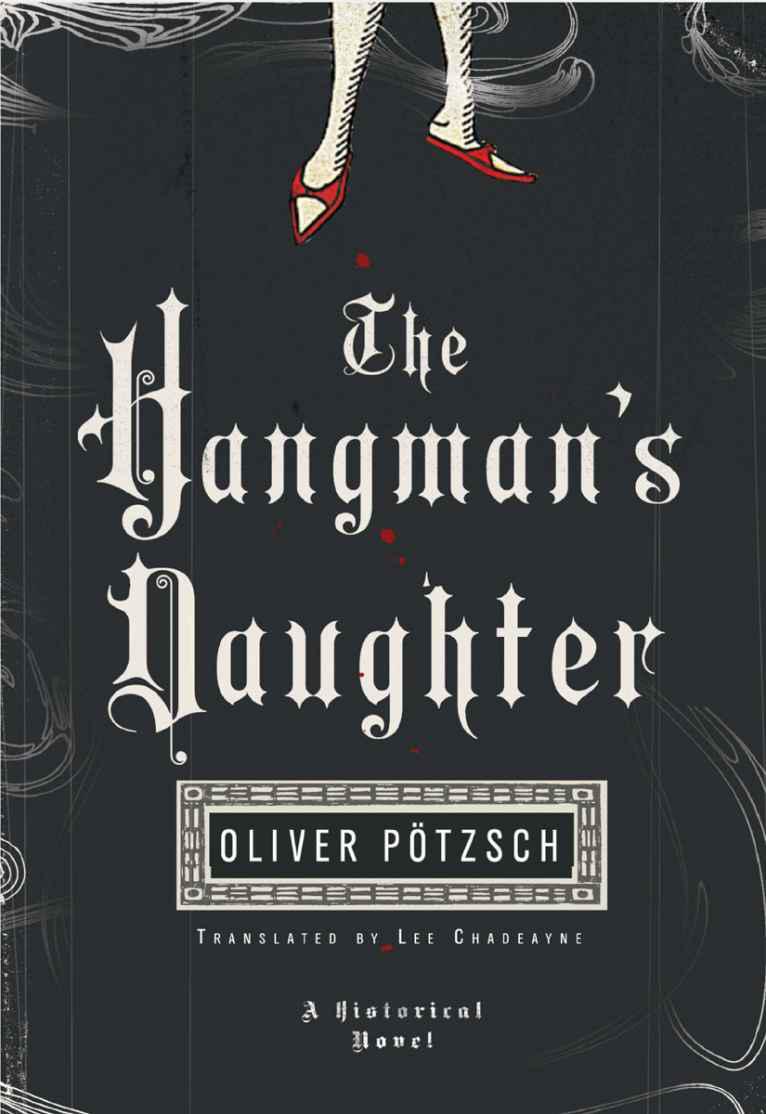
Another Kindle book I picked up on a whim. The Hangman’s Daughter is a mystery set in 17th century Germany. A local orphan boy is found dead with an apparent witch mark on him. The villagers attack the local midwife, who was known to spend time with the orphans and midwifery is basically witchcraft anyway, right? While the authorities lock her up, only the Hangman and young doctor trying to find the truth of the matter.

The biggest selling point of The Hangman’s Daughter is the setting. The stigma of being the hangman, witch hunts, and the supposed medical care of the time are all big parts of the book. The mystery itself isn’t bad, though it is a little frustrating how obvious suspects are ignored by everybody. Oddly enough, the titular daughter isn’t really the focus of the book. She is a prominent character, but she is more of a subplot than a central one, at least until the very end. There is a pretty chilling section in the middle when the hangman must do his job in torturing the suspected witch, which is hard stomach and historically interesting. In all, it is a highly entertaining read, but far more good that great.

tmotbtc

The Mystery of the Blue Train

Agatha Christie

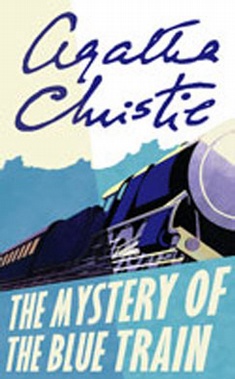
This is supposedly one of Christie’s least liked books that she wrote. I don’t know why, it seemed perfectly fine to me. Not the best of hers that I’ve read, but also not the worst. The ending doesn’t feel so strained as some others. There is a lot of build up to start with book, with a cheating husband, a stifled but selfish wife and her controlling dad as well as a slew of other characters. When Hercule Poirot rides the same train as most of those characters, along with newly rich Katharine Grey who inherited a ton of money and is going to visit relatives, the wife gets killed and it is up to Poirot to solve the case.

One interesting note about the Blue Train is that it features the village of St. Mary Mead, which would soon be home to Christie’s other prominent sleuth Miss Marple. That is where the heiress hails from. The mystery gets untangled fairly quickly, with a lot of time spent with Miss Grey, who assists Poirot on the case, meeting with her quite unique family. Most of the time the investigation focuses on the husband, who is too obvious a culprit to even be considered a possibility my most readers. What is uncovered is never preposterous but never obvious either. It is a slight book, with subplots and set up overwhelming the mystery, but it all comes together quite well at the end.

ditc

Death in the Clouds

Agatha Christie

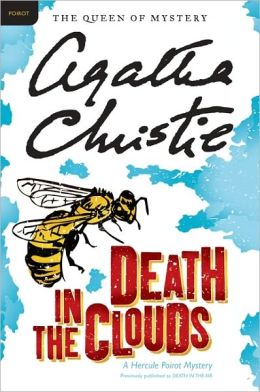
Another Poirot mystery. This time a murder occurs on an airplane with Poirot onboard. It becomes a not quite locked room mystery, with only the passengers as possible suspects. The group of suspects here is a good one, with a very obvious and easily discounted pair of archaeologists, a few rich ladies, a doctor and a dentist. On the flight, a blackmailing money lender is killed, maybe by a rogue wasp or maybe by a poisoned blow dart. Poirot is the initial suspect of everyone but the police. He goes about ferreting out the various motives of the different passengers, with the help of a few other suspects. The eventual solution is fairly ingenious and surprising, without breaking the fairness of making believe that a reader could solve it before the ending. Though I doubt any would with this one.

knifedreams

Knife of Dreams

Robert Jordan

See here

tgscover

The Gathering Storm

Robert Jordan, Brandon Sanderson

See here

ee

Etiquette and Espionage

Gail Carriger

This series of young adult steampunk books came highly recommended and very cheap from an Amazon sale. This first book is fairly entertaining. Still, I found it to be slight even for a young adult book. Everything is just as presented, with no real twist outside the premise and a finishing school for spies and assassins. I know this is set in the same world as another set of novels that Carriger has written, but here the world building is slight. It gets by with a fast pace and something new to be found all the time, but it still feels really barebones. Every character except Sophriona, the protagonist, is summed up upon their first appearance and never deviates. What there is of a plot is dealt with rather perfunctorily. My biggest problem with it that I am never quite sure of the rules the world of this book operates on. It comes across as overly precious at times, making jokes about people proudly being evil geniuses but not really backing that up with a world where that fully fits. I hope the next two books do a better job of giving the reader a solid footing of how this world works.

The Last that Could be Done

Wheel of Time Reread Part 12: The Gathering Storm

tgscover

It is impossible to discuss The Gathering Storm without noting that it is the first book that Robert Jordan was not able to finish. While he intended to finish the series in just one book after Knife of Dreams, Jordan tragically did not live long enough to do so. His passing was tragic from any point of view; the fate of the series was insignificant in the face of his loss. Still, as a reader I wanted to see the series come to its conclusion. Luckily for readers, Brandon Sanderson was tapped to finish the series in Jordan’s stead. Sanderson is one of the best writers of the fantasy genre working today. I have read and enjoyed nearly every book he’s had published. That being said, he is not Robert Jordan. Whether one finds his writing better or worse than Jordan’s, there is no getting around that it is different.

One of the changes when Sanderson took over was that the last book became the last three books. With all that happens in these last three books, doing it in one looks like it was always a pipe dream. It would, however, fit better structurally. The first six books of the series fit nicely into a pair of trilogies; if the series had been finished in one book after Knife of Dreams, the last six would as well. Books seven through nine do not follow as thematically coherent a trajectory as Rand’s rise and fall from books four through six. Rand is faltering, after his troubles at the end of Lord of Chaos, but he has created a new weapon: the Asha’man. They appear at the end of that book, start out appearing trustworthy and useful before betraying him and showing the effects of the taint. So Rand cleanses the taint. That covers Rand’s journey through those books, seeing first-hand the effects of the taint and dealing with it once and for all. Rand’s journey though the last trilogy, albeit a trilogy that ends up consisting of five books, is his nadir before truly understanding and accepting what it will take from him to be The Dragon. Fixing what made the last part five books instead of three would be difficult. Counting all of Sanderson’s books as one it works, at least for Rand’s story. It is everyone else whose stories don’t quite fit. More than half of Crossroads of Twilight takes place before Winter’s Heart ends. Moving that stuff back, folding the rest of Crossroads back into Knife of Dreams and condensing the last three books into just two would largely fix things.

The change from Jordan to Sanderson was hard to swallow. Especially in light of how many people I heard gushing about how much improved Sanderson’s take was to Jordan’s. I can’t fault someone for liking Sanderson; I like his books an awful lot. His work is creative and inventive and the man is crazy prolific. The Mistborn books are excellent, the Stormlight Archive is a worthy successor to the sort of absurdly large scale fantasy of which The Wheel of Time is the most exceptional example and even his one off and young adult books are good reads. But he is not the same writer as Robert Jordan and I would say for this series a lesser one. At least, coming from the perspective of a Wheel of Time fan he is. Sanderson tends to be more direct and blunt than Jordan; characters were suddenly more open with each other instead of speaking in half-truths and assumptions. Character also go through a slight metamorphoses, some worse than others. Elaida, for instance, goes from being wrongheaded and stubborn to being a complete clown. It is the end of her arc as a character, but in this book she is reduced to just arrogance and megalomania. She is not the worst, though.

It is never clearer that Sanderson is not Jordan than in the few chapters in this book from Mat’s point of view. Jordan’s Mat is funny, but not from any conscience effort on his part. Jordan’s Mat doesn’t see himself as a funny guy, what makes him so fun is his complete lack of self-awareness. Mat has no clue that other people find him hilarious. Under Sanderson’s pen, Mat is doing some kind of tired shtick with Talmanes. You can almost feel all of his companions rolling their eyes at every word he says. It is painful. It isn’t just Mat trying to be funny, but Mat failing to be funny. The biggest flaw is that Mat’s stuff just isn’t amusing. It falls completely flat.

Luckily, one adjustment Sanderson made when splitting this last book was to sideline most of Mat’s and Perrin’s stuff to Towers of Midnight and have The Gathering Storm focus on Rand. Rand had been essentially sidelined for the two books previous to this. He had a few impactful chapters in KoD and a few forgettable ones in CoT; in The Gathering Storm he is again the protagonist. He had been teetering since Lord of Chaos, after the kidnapping. The madness that is the inevitable end for male channelers is starting to affect him. No longer feeling safe even in his palaces, he jumps from front to front in his attempts to combat the Forsaken and the Seanchan. And he continually build up this idea that he can’t harm women or allow them to be harmed, even trained fighters like the Aiel Maidens; turning it into a kind of especially destructive chivalry. It becomes less of a principle and more of complex. The Gathering Storm has Rand finally reaching the nadir of his fall in what is easily one of the darkest moments in the entire series. The male a’dam, the collar that lets one channeler control another, is placed on his neck by no one less than the most sadistic of the Forsaken. It was not strictly a surprise when it happened; all the pieces for this tragedy were in place. Things like secreting away the a’dam instead of getting rid of it or keeping Semirhage captive instead of just doing away with her. That is stuff that the characters should have known, there is more that the readers knew, like the fact that Elza was Black Ajah. Everything just goes wrong in the worst way possible.

Knowing that the end is coming soon makes the outcome all the more uncertain. Yes, it was easy to guess that Rand would get out of his predicament, there are two more books to go, but how much damage would done before then? The complete hopelessness when Rand is forced to strangle Min is crushing, because there could be nothing more tragic than the very real possibility at that time that he would kill her. Fortunately, thanks to some divine, or infernal, intervention Rand manages to free himself from his bonds and do away with Semirhage. Even more than the supposed victory at Dumai’s Wells, this battle left its mark on Rand. After this, all the light has gone out of Rand. It is laid on rather heavily, but Rand is now completely broken. It is disturbing seeing just how wrong things go. Everything is visibly coming unraveled and Rand is now fully a source of the problems instead of a solution. Rand gets darker and darker, even his closest allies Min and Nynaeve must turn to outside help to try to save him. But Rand’s salvation does not come from anyone’s help, but from within. He sits on Dragonmount, toying with the idea of finally giving in to Ishamael/Moridin and destroying all of creation. What calls him back is part of the very thing that nearly drove him to do it, the voice of Lew Therin he hears thanks to the Dark Ones taint. Together they find what they need to see the value in creation.

While Rand hits his lowest ebb in this book, the other major storyline is Egwene at her most triumphant. Captured in the White Tower, her rebel Aes Sedai still besieging the city from the outside, she starts her own siege from the inside. By simple strength of character she shows the completely divided sisters inside what they need to be. It helps that Elaida has been reduced to a complete fool, worried only about her increasingly tenuous grip on power and reality. For a character that had become almost as unenjoyable as Rand over the back half of the series and for much less reason, Egwene really shines here. It helps to see others react to her strength, showing why she deserves the power she now wields. And for a character who is in captivity, she manages to accomplish an awful lot. The crowning moment might be in the Seanchan raid, when she almost single handedly saves the White Tower from complete disaster.

Her second accomplishment, nearly ridding the Aes Sedai of the Black Ajah, came to her with the great help from one of the best minor characters in the series. Since The Great Hunt, when Verin stepped in for Moiraine for most of the book, she has been an intriguing figure. She was up to things that usually seem to be for the good of the Light, but using tactics that were decidedly underhanded. Here we get an explanation that was surprisingly simple but also somewhat unexpected. Verin joined the Black Ajah by mistake, wanting to study them but not herself being a darkfriend. So she played her role, all while keeping tabs on the others in the sect. Egwene is able to use her information, after one of the bravest and most touching moments in the series, to clean out a large portion of the Black Sisters. Including Sheriam, who had been given a fake-out Min viewing to fool people off of her trail, one of the only times that Jordan seems to have inserted information with the deliberate goal of misleading readers.

The Gathering Storm is easily one of the weaker books in the series; Sanderson doesn’t quite have a feel for many of the characters, though he does get better in the subsequent books. It is also one of the most focused books in the series. There are a few chapters of Mat and Perrin, but the book hinges almost entirely on Egwene and Rand, as well as the supporting characters in their orbits. The whole book feels like a weird shadow of the rest of the series, the darkest book thematically and also one where everything else seems not quite right.

Embers Falling on Dry Grass

Wheel of Time Reread Book 11 Knife of Dreams

knifedreams

I haven’t touched a Wheel of Time book since about five days after A Memory of Light was released. After I finished reading that, I put the series down and have barely looked at it since. Honestly, I haven’t read much fantasy since then, or at least not from that branch of the genre. Sure, I’ve read Curse of Chalion and Words of Radiance, among scant others, since then but it wasn’t until very recently that I have truly gotten back into things. Coming back to the series, a series I doubt I’d went a year without reading a least a couple of the books in more than a decade, is a little strange, especially one that is now finished after years spent speculating about what was to come next. It is comfortable, familiar, but also melancholy. Before, all of these characters were full of potential. Anything could happen in the next book. Now, that potential is gone, there is the reality of what happened at the end of the series. It doesn’t really make the books any less enjoyable; it merely makes reading them a somewhat different experience.

Knife of Dreams was the last book that Jordan completed and is a return to form after a trio or so of books that seem to have, in some ways, gotten away from him. Each of Books 7-10 are important chapters in the series, but none of them were as complete of works as the preceding six books were. After splitting the Gordian knot that was Crossroads of Twilight, Knife of Dreams hits the ground running. Characters that were mired in interminable storylines start to finally move forward. Path of Daggers, Winter’s Heart and Crossroads of Twilight were largely middles, with few resolutions. Knife of Dreams contains those endings. I’ve titled this post after the title of the prologue, “Embers Falling on Dry Grass”, one of Jordan’s great turns in the chapter titles. It is clearly evocative of what is going on, not just in the title but in this whole volume. The little sparks are finding the fuel to turn into great fires. The idea of Tarmon Gaidon, the last battle, has been paramount to the series all the way through. It has always been coming. But until Knife of Dreams it never felt truly close. In this book there is the constant feeling that events are spiraling increasingly out of control. The anarchy has spread beyond just Rand’s doing. The endgame is upon the world.

What is most exciting is that from the first scene things are happening. Only a fool would argue that nothing happens in the previous books, but little of what does is definitive. Outside of some really big things, like cleansing the taint, it all feels like maneuvering and small potatoes. Here, the book opens with Galad, a longtime character that was all potential and no action, finally getting involved. He challenges and beats the Whitecloak leader Valda to a duel for the rape and murder of his mother, not knowing that he is only half right. Then it jumps to Ituralde, a name that has been around forever but wasn’t seen until book 10 (I think) who springs his trap on the Seanchan, setting up raids in numerous places across hundreds of miles, living up to his reputation as a great general. The prologue also refreshes the situations with the Seanchan leaders, the Aes Sedai Black Ajah hunters and Egwene after being captured by the Tower Aes Sedai. It immediately tosses a lot of balls in the air which are followed up in the first few chapters by adding more. Perrin is moving in on the Shaido as Faile attempts to escape, Mat continues his journey northward, away from the Seanchan. And Rand is trying to make a deal with the Seanchan.

While it doesn’t exclude others entirely, Knife of Dreams in many ways pulls things back to its trio of male heroes, Rand, Mat and Perrin. Rand’s part in this book is smaller than the others, but no less momentous. He is further breaking down from the strain, the effects of the taint and his own hang ups. More and more, the Lews Therin voice in his mind is gaining power. Set in motion in his few appearances in Crossroads of Twilight, Rand meets with the Daughter of the Nine Moons, who readers know is currently with Mat. It turns out this Daughter of the Nine Moons is the Forsaken Semirhage. In the ensuing conflict Rand loses a hand. That loss furthers some of Rand’s mythological allusions, specifically his connection to the Norse God of War Tyr, who sacrificed his own hand to subdue the wolf Fenrir. It is not really a turning point for Rand, just another step in the gradual wearing down he faces in the back half of the series. Since Lord of Chaos, in each battle Rand seems to lose another piece of himself, though usually not quite as literally as here.

Mat, meanwhile, is still in his escape from the Seanchan, as well as in the middle of his courtship of Tuon. Tuon is a fun character, coming from a completely foreign culture that the completely unself-conscious Mat cannot understand. The Seanchan are one of Jordan’s greatest creations in this series, a wrench in the works and a completely vile foreign power coming in to mess things up. Their whole empire is built on almost fetishized slavery and rituals of order. Slavery for the Seanchan can be a hereditary condition or a punishment for failure or the natural state for anyone capable of channeling. The channelers are brainwashed and convinced that they are no better than animals, that they are dangerous if not leashed. It is disgusting. Then there are several other types of slavery, from hereditary servant to the Imperial family’s personal guard. Seanchan society is a nightmare. Yet Tuon, the person responsible for leading these people, comes off as entertaining.  Likeable, even.  A lot of that, though, falls to Mat, who makes any other character entertaining. Exploring the differences of high and low society with Mat and Elayne was a lot of fun a few books ago, but it is taken to an even greater extreme here. Tuon is interested in Mat thanks to prophesies, the same reason he believes he must wed her, but Mat doesn’t know that. He has accepted that they will be married and is just trying to get to know her. She is doing the same thing with him. This is one of the most fun storylines in the whole series, with Mat getting to play many roles. He is, as always, the fool. Here he is trying to herd cats with his uneasy alliance of soldiers, willing captives and Aes Sedai. Once they leave the traveling show and meet with The Band, Mat must plays the general, leading a short brilliant campaign against the Seanchan to clear the way out of Altara to Andor. Having Tuon realize that she has only seen one small side of him once they meet back up with The Band is another great moment. It is always fun to see the protagonist though other’s eyes and Tuon’s growing realizations about Mat are incredibly well done. The whole arc here is entertaining, ending with Mat and Tuon finally married, but separated.

Then there is Perrin, who as of the last book has finally cast off the axe and chosen the Hammer, forges together an alliance with the Seanchan and the Prophet’s forces to save Faile. Perrin realize how gross the Seanchan are, but he is single minded enough to not care if it helps him get his wife back. For all of Perrin’s lack of faith in himself as a leader, he has a way of binding people to him and building something. That is what Perrin is; he is the builder to Rand’s destroyer. His interactions with General Tylee of the Seanchan is the first large scale piece or cooperation between the Seanchan and the rest of the world. Egeanin working with Elayne and Nynaeve was a blip and Mat and Tuon barely count. It also shows the decadence of the Shaido. Always considered a little lesser than the other Aiel, here they have completely failed. They are shown to be largely drunk and indolent. Even those who seem to keep the Aiel ways, like Therava, are just as interested as the rest in indulging their baser desires, it just that Therava’s appetites are less immediately apparent. This storyline for Perrin, essential to his and Faile’s growth as it is, is never truly a good one. It takes way too long and is too disconnected to everything else.

Lastly, Knife of Dreams also finally finishes the interminable Andor civil war. In her own courageous yet thoughtless way, Elayne bumbles into decisive victory. I know she is a character that many do not enjoy, but I am not among them. Elayne is what she is and, unlike many others, never really learns her lessons. From the start of the series to the end, she does grow. She changes from a spoiled princess to a competent, yet still spoiled, Queen. She does become a better leader and a better politician, but she never loses the recklessness that makes her infuriating and enjoyable. Really, even her growth as a leader is mostly just her putting the lesson’s she’s learned to good use. This volume has Elayne simultaneously at her best and her worst. While she skillfully conducts the war, she also completely bungles searching out the Back Ajah Aes Sedai, getting several of her allies killed. It is the third long running plotline, along with Perrin’s and Mat’s, that Jordan finally brings to close in this book.

The relatively focused nature of Knife of Dreams makes it probably the best book in the second half of this series. The somewhat muddled nature of the previous four volumes has been wiped away. The Wheel of Time, from this book, is a boulder rolling downhill. With the end more clearly in sight, things begin to accelerate. Like the title of the prologue suggests, small sparks have started a fire that will not be put out.

What I Read in January 2015

This is a heck of a start to the year. After coming up short most of last year, I hit the ground in 2015 running. I read 7 books in January and left another couple half finished, so I should be up around five again for February.  I am getting back into fantasy in a big way, at least during the early part of this year.  I never really stopped reading fantasy, but I got a double handful of new books in the genre for Christmas so they’re there.  And I’ve noticed that I’ve only read a narrow sliver of the genre, maybe a wider study would be helpful.

gotw

Guardians of the West

David Eddings

This is boilerplate fantasy.  Other than some sub-sitcom level Battle of the Sexes “comedy” there is nothing to separate it from the hordes of other Tolkien imitators.  The occasional spark of a fresh idea or interesting development is quickly wiped away to go back to the same thing everyone has read a hundred times.

Maybe my opinion would be different if I had read the previous books in this series. However, this book bills itself as a part one, so it should be readable on its own.  There is just not enough here to be recommendable. The occasionally interesting characters are hamstrung by the books rather rigid view of gender roles and the plot meanders around in neutral for more than half of the page count before finally finding some forward momentum just as the book ends.

tss

The Soprano Sorceress

LE Modesitt Jr.

With this Modesitt Jr is writing feminist fantasy.   It is a great antidote to how male dominated the genre usually is.  The protagonist, Anna Marshall, is transported from modern day Iowa to the magical land of Erde.  Once there she finds that her singing ability translates into magical power.  The place she arrives in is threatened by the evil dark monks and she is recruited to help fight them.  While she does do that, she spends most of her time fighting the backwards and sexist attitudes of her allies.

For the most part the book works, but it doesn’t quite gel into something better than good.  Seeing a woman with power destroying stupid conventions is entertaining, but her obstacles don’t stay in her way for that long.  Anna encounters a problem and then simply solves it.  While she is constantly fighting, she gets rid of her problems a bit too easily; most of them seem no more difficult than swatting a mosquito.  The straw chauvinist stuff works really well, many of the attitudes come from conventions of the fantasy genre, but the central conflict doesn’t make the reader feel its weight.  Bad things are happening, but the bad guys are never anything but stock evil figures.  It is disappointing.  Still, it is a largely enjoyable book all the same.

attwn

And Then There Were None

Agatha Christie

This book certainly lives up to its reputation.  It is riveting.  As well-known as it is, I had not been spoiled, so I got to read the whole mystery fresh.  It does a marvelous job of keeping readers on their toes.

And Then There Were None starts with ten people arriving at an island house expecting to be at a dinner party thrown by an old friend, only to find out that it was all a set up to get them there.  Then they are accused of murder by a record and people start dying.  There is no detective, just ten strangers trying to guess which of them the murderer is.  It is tense and thrilling as one by one they are knocked off.  I haven’t read a ton of Agatha Christie (though I did get a couple of collections for Christmas so that should change) but this is the best so far.

tdp

The Domino Pattern

Timothy Zahn

I bought this thanks to an interesting blurb and my memories of reading Zahn’s Star Wars books.  While this isn’t the first book in this series, it is easy enough for a new reader to pick it up and not miss much.  Frank Compton works security for the Quadrail, an interstellar train system, along with his assistant Bayta.  Following up on whatever happened in the previous book, they take an express train that won’t stop for six weeks.  Once their trip gets going, passengers start dying.  Frank suspects poison, which should be impossible because passengers are screened for that before they get on the train.  He has to get to the bottom of things before everyone panics or they reach their destination and the culprit escapes.

The Domino Pattern is not great, but it is a fun mix of science fiction and mystery.  Zahn keeps things moving, with entertaining if not especially vivid characters and an exciting non-stop plot.  It is a fine example of genre fiction.

tnt

The Nine Tailors

Dorothy Sayers

While I’ve read most of Sayers’ Wimsey books by now, this is the only one I knew anything about before I started reading them, thanks to Edmund Wilson‘s fatuous essay “Who Cares Who Killed Roger Akroyd” which savaged it.  The reality, though, is that The Nine Tailors is a really good mystery.  There are a lot of strange things going on and none of them are truly red herrings, everything is connected, it is just hard to see how it all connects until the end.

The Nine Tailors starts with Lord Wimsey’s care breaking down in a small town and while it gets fixed he helps out ringing the church bells, known as the nine tailors.  While there he hears about a case of stolen jewels from 20 years previous.  The culprits were caught, but the jewels were never recovered.  A few months later he is called back when an extra body is found in a grave during a burial.  As usual, everything unwinds through Lord Peter’s investigation.  I don’t want to spoil it, but it does feature a rather novel manner of death.

taaote

The Amazing Adventures of the Escapist Volume 1

Michael Chabon and others

This more interesting in theory than in practice and it is pretty interesting on its own merits.  The Escapist is the hero the main characters of Chabon’s excellent novel, The Amazing Adventures of Kavalier and Clay, created, their rival to Superman in the early days of comic book heroes.  This collection of comics, with some written parts, creates a fake history of that character. He is mentioned in the book, but the book is about cousins Kavalier and Clay.  Here Chabon and an all-star collection of comic book talent create those fictional adventures, sampling from many different eras of comic book history. It does a great job weaving these characters into a plausible history.

It helps that the stories themselves are largely really good.  Generally they involve The Escapist using his escape artist powers to foil bad guys.  It goes from the bare bones early days, moves on to goofy a goofy Silver Age version.  Then there is a manga version.  All of them are recognizably the same character, but all from different of comic books and they accurately reflect those eras. It helps that creators from those eras are here to add the lie.  Gene Colan, Howard Chaykin and Jim Starlin all contribute pages.  It looks good and tells some very good stories. This is worth it just based on the merits of the creative teams alone, the added meta-fictional element just make it all the more interesting.  I hope to be able to track down the other two volumes soon. This is really good.

sed

Swords And Deviltry

Fritz Leiber

I had heard a lot about Leiber’s Fafhrd and the Grey Mouser stories, but to start this volume did not live up to the hype.  The first two stories, The Snow Women and The Unholy Grail, are origins for those two characters and are simply not that interesting.  In the first, young northern barbarian Fafhrd stains against his domineering mother and wishfully controlling young lover, while falling in with a cunning dancer.  The other has a young wizard’s apprentice Mouse trying to get revenge for the murder of his master.  I am going to assume that though these are the first stories in the chronology of the series, they were not the first stories that these characters appeared in.  While they do a good job of illustrating each character, otherwise there is little about either story than generic swords and sorcery adventures.

However, the third story in the collection, Ill Met in Lankhmar, is excellent.  The two characters meet up while shaking down some member of the thieves’ guild.  After a night of drinking in celebration, Fafhrd and the Grey Mouser are goaded into taking on the whole guild.  So they sneak in and things go badly.  For everybody.  The third story is also where the quality of the writing really picks up.  The first is filled to the brim with reminders the ice and snow, mostly using variations on those two words over and over.  The third story, though, is when the darkly humorous tone really shines through.  At least it does right up until the story shifts from comedy to tragedy right around the middle. Leiber really lets the reader feel the rage and despair of his characters.  This series reputation for somewhat more human pulp adventures is well founded.  If the rest of the series is closer to the Ill Met in Lankhmar than the first two stories, then I can’t wait to get to the rest of them.

What I Read in December ‘14

I only managed three in December, another month in a near yearlong slog. I could have pushed it and finished up on more, but I just kept to my usual pace, which meant I finished it up a couple of days into the New Year. Still, I got a few read. I am quickly running out of Wimsey mysteries from Sayers; I’ve greatly enjoyed the series and hope to find another set of similar books to dig into. Also, my physical book supply, which recently ran dry, was completely restocked on Christmas, when I got a stack of books as tall as I am. Here’s to actually hitting my reading goals in 2015.

mma

Murder Must Advertise

Dorothy Sayers

In this mystery, Peter Wimsey guest stars in Mad Men. Not quite, but it does feature the detective getting embroiled in a murder in an advertising agency. This story lets Lord Peter play to a lot of his strengths in fun ways. Sure, he gets to show off at an inter-company cricket match, but he also gets to throw around words for a reason for once. Peter is hired to investigate a murder at an advertising agency, but in order to keep things quiet, he assumes the role of Death Bredon, a supposed Wimsey cousin. He also gets involved with a fashionable crowd that is big into cocaine.

Some of the parts don’t really work, like the poorly explained cocaine ring, but large parts of Murder Must Advertise are just a lot of fun. It separates Wimsey from most of his usual allies. He spends a little time with most of his friends and family, but other than a small role for Parker, they don’t have much to do in this one. It is all on Lord Peter and the people introduced in the ad agency to carry things. It kind of becomes a little workplace comedy for the middle part of this, as Lord Peter comes to like working at the agency, though he really has no stake in the goings on. Despite the murders and the cocaine, it feels a little lighter than others in the series. It just gives Lord Peter more leeway to enjoy himself.

nyt

The New York Trilogy

Paul Auster

I didn’t know what I was getting into with this. While these are detective stories of a sort, they aren’t really genre stories. These are stories that feature detectives, but they are more surreal explorations of identity and authorship. They are about people getting hired to investigate and losing track of who they are. Interesting and dense, this really wasn’t what I was expecting when I started reading this. Really, I don’t know what to make of these; I feel this trilogy needs to be studied and I really didn’t spend enough time with this to dig into them. I also don’t think I like it enough to put in that time.

trm

The Rithmatist

Brandon Sanderson

In incredibly reductive terms, this is Sanderson’s take on Harry Potter. There is some truth in that; this is about a kids a magical school of sorts. But it is different enough and more than interesting on its own merits. It is set in an alternate reality where America is half submerged and the American Isles are fighting against monsters from the island of Nebrask. They do so by infusing chalk drawings with magic to create chalklings, which they call Rithmatics. It follows Joel, a student at Armedius Academy, though not a Rithmatic student. Though unable to perform magic, he does love to study it. A new teacher arrives at the school, and students start to disappear. Joel, along with a remedial Rithmatic student and a disgraced professor start to investigate. Along the way, Joel proves himself adept with drawing, though still not able to perform magic.

While the world and setting are completely different, it does hit a lot of Harry Potter-esque beats. It is more than just the school setting, it is the combination of the overlooked students and possibly evil teachers and equal importance put on school goings on as the more serious and deadly plots. While that part isn’t exactly original, the originality of the setting more than makes up for any echoes of other works. The Chalklings and Rithmatics are unlike anything else I’ve read. I’m not sure this is Sanderson’s best work, but it is a brisk, fun read. I can’t recommend it highly enough.