I would have words with thee!

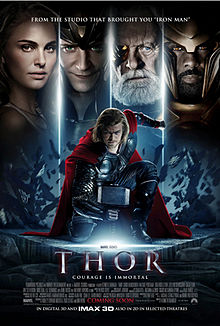
I loved Thor. This should be no surprise; I have been a fan of Marvel’s God of Thunder for years. I love the old Stan and Jack stories, I love Walt Simonson’s near perfect run, I just love Thor. More than any movie save Scott Pilgrim, Thor feels like it was made just for me. My already positive inclination to Thor aside, Thor is the right up there with Iron Man as one of the best movies based on Marvel’s superheroes in recent years.

Marvel’s Thor, based somewhat loosely on the Norse myths, is the arrogant son of Odin, the king of a race of what are basically space-Gods. Cast down to Earth for his arrogance and disobedience, Thor must prove his worth to return to Asgard while dealing with the scheming of his cunning and jealous bother Loki. He is aided on Asgard by his friends the Warriors 3 and the Lady Sif and on Earth by Physicists Jane Foster and Eric Selvig as well as their taser-happy assistant Darcy.

The movie hinges on the trio of Thor, Loki and Odin. Luckily, all three actors, Anthony Hopkins, Chris Hemsworth and Tom Hiddleston, give fine performances. Hopkins fills Odin with the requisite grandeur and Hemsworth has an impressive physical presence and perfect comic timing as Thor, but Hiddleston’s Loki really nails the character. All smiles and false innocence, he is perfectly sneaky, pulling the wool over everyone’s eyes. His plots weave around themselves like Gordian knots. The Earth side of the cast is only slightly less good.

The biggest hurdle Thor clears is its balancing the appeal of the two worlds. While the film tips slightly in favor of the otherworldly Asgard neither drags. Asgard is nearly perfect. It looks like a Renaissance Fair in space, with glittering towers as a rainbow bridge made of glass. It truly looks like the realm of Gods.

The Earth based portions nicely balance the occasionally grandiose cheesiness of Asgard with a scoop of humor and a dash of romance. Even the SHEILD portions, which were intrusive in Iron Man 2, fit mostly seamlessly here.
There are some flaws. Thor’s period of punishment and growth on Earth are quite short. His romance of Jane Foster is similarly rushed. Both are somewhat underdeveloped. In addition, the final showdown, while anything but anticlimactic, is a bit brief. Those flaws are small, niggling things, and while easily ignored do keep the movie from being as good as it could have been. Especially since Thor is not particularly long. An extra scene or two would have made the difference.

Thor does so many things right, though. It never winks about the ridiculousness of its premise, but injects enough humor that it doesn’t become pompous. The sound effects are particularly great as well. Thor’s hammer makes a delicious metallic “thuwummn” when it makes contact. His punches are accompanied by the crack of a gunshot. It is great.

Thor is largely a success. It perfectly captures what makes Thor so great while sanding off the incongruous parts. (Like the Donald Blake identity.) If one can accept the premise of a Space-God come to Earth to learn humility and smash things with his hammer, then Thor is as entertaining a popcorn movie as one is likely to encounter.
Sucker Punch Review

If you have read the reviews of Zack Snyder’s Sucker Punch you have no doubt heard that it is insultingly bad, a complete failure of filmmaking.  While the glee some reviewers seem to be taking in eviscerating the movie is disgusting, there is some truth to them.  Sucker Punch is largely a failure.  But many of the reviews seem to miss the point entirely.  Roger Moore‘s, of the Orlando Sentinel, review called it “an unerotic unthrilling erotic thriller.” While I am sure he pleased with his wittiness, the quote exposes just how much he missed the point.  Sucker Punch is something of a thriller, it sits in between that and about five other genres, one thing it is definitely not, nor is it intended to be, is erotic.  Though someone judging the movie based on its trailers could be forgiven for thinking so.  Sucker Punch appears to be cotton candy; light and sweet and wholly insubstantial, but it is not.  It is cotton candy wrapped around a corn dog; there is substance there even if you maybe wish there were not.

Sucker Punch tells the story of “Babydoll”, a young girl whose evil stepfather has her committed to an insane asylum and scheduled for a lobotomy in order to get his hands on her inheritance.  With the help of some fellow inmates, Babydoll masterminds an escape attempt.  Instead of this simply occurring in the asylum, the movie takes place in two levels of imagination.  The first, which is seen through the bulk of the movie, is the asylum as a bordello.  The corrupt orderly becomes a ruthless pimp and the doctor trying to help the girls becomes the Madame.  When the women attempt to retrieve one of the items needed for their escape the world becomes a fantastic battlefield, where the characters become soldiers.

Problems arise with the exact relationship among the three levels of reality.  Sometimes it works great, like the lighter (with a dragon on it) needed becoming a fire-breathing dragon.  Sometimes the parallel is not clear.  In the bordello, Babydoll entrances everybody with an implied striptease, but what is she doing to draw attention in the asylum?  The concept is interesting, but the execution is less confusing than confused itself.

The missions, each set to a different song that it just too meaningful, are the films highlights.  Whatever problems Snyder may have with storytelling, he knows how to film an action scene, slow motion notwithstanding.  The mission’s settings are not believable because the settings are intentionally and inherently unbelievable.  They take place in fantastic, but coherent worlds.  These are the cotton candy.  The young stars, Emily Browning, Abby Cornish and Jena Malone, do a great job in the action scenes.  The enemies they face are delightfully unbelievable.  20 foot-tall samurais and clockwork zombie German soldiers.  They are beaten by barely more than teen girls, but these scenes are expressly fantasies, they are deliberately unreal.  Though the movie may falter in other places, the actions scenes are great.

The bordello/asylum parts are less good.  It seems like parts of it were not completely thought out.  Dr. Gorski’s position is particularly problematic.  If she is a doctor, shouldn’t she have a better idea of what is happening with her patients, especially is she is supposed to care.  It does play with the viewers expectations.  Positioned as a “geeky” movie, shown at comic conventions and whatnot, Sucker Punch is not what they expected.  While the characters are dressed in somewhat skimpy outfits, and I’m being generous to call them somewhat so (I mean really look at how much skin is showing), Snyder makes sure never to titillate.  While the setting and outfits may suggest sexiness, the movie is deliberately unsexy.  It is the same with Babydoll’s dances.  We know they are sexy due to everyone else’s reactions, but we never see her dance.  Babydoll and friends are put into the most powerless position possible, then take control of it.  We are supposed to know they are exploited, but not given a chance to revel in the exploitation.

The problem is not with these scenes empowering intentions, but with the clumsiness of their execution.  Snyder knows neither subtly nor irony, (I once heard that somebody tried to explain subtly to Snyder, but Snyder punched him the face until he exploded.  I assume that is why no one has had the courage to try with irony.) which is often a strength (the action scenes) but here it is a weakness.   The setting of the asylum and the bordello is poorly explained and poorly resolved.  Sucker Punch wants to be deep and meaningful, but its message is not particularly deep and its meaning is not clear.

Sucker Punch is admirable in its failure.  It could have just been the action scenes, and possibly been a better movie for it, but Snyder tried to do more.  It does spectacle, and does it well, but the depth it strives for just is not there.  It is that corn dog in the middle of your cotton candy; it may be more filling, but it clashes with the sugary sweetness of outside and is not particularly good on its own.  Still, you have to admire the audacity of trying to put a corn dog in the middle of some cotton candy.

**

Adjustment Bureau Review

The Adjustment Bureau is not quite a great movie.  It poses some interesting questions, but spends more time ignoring them than exploring them.  It takes an intriguing sci-fi concept, much like those found in The Matrix and Inception, but does not make that the true focus of the film.  Inception is an unfortunately apt comparison, because it also uses a science fiction concept to tell another type of story.  In Inception it was a heist movie, in The Adjustment Bureau it is a romance.  The comparison to Inception is unfortunate because it ties the two genres together better than the Adjustment Bureau does.

Matt Damon plays David Norris, a congressman and prospective Senator whose recent flub, mooning people at his college reunion, has seemingly cost him the election.  While preparing a concession speech, he meets Elise (Emily Blunt) whose more relaxed attitude rubs off on David and his speech.  The relaxed speech makes him the front-runner for the next election.  At the same time, mysterious chapeau’d men cryptically talk about all their hard work.  A mistake made by one of the men soon after allows Damon’s character to discover about the Adjustors, a Guardian Angel  like group who influence people into doing what their plans deem best.

These Adjustors show both the films strengths and it flaws.  While there may be sinister undertones, the Adjustors are simply unassuming bureaucrats.  The movie poses a question about free will, but it keeps everything so low key that it never really capitalizes on the issue.  The philosophical issues are largely ignored.  It leaves the film entertaining but ultimately forgettable.  Whether or not people have free will is not really questioned, merely how free it is.  The Adjustors claim to have no sinister motive and this is accepted.  David does not seem to be troubled by their control, except in one regard.  David loves Elise, but the plan says they are not to be together.  His struggle to have a relationship with her is the conflict of the movie.  Fortunately, the romance is entirely believable.  It seems right to the viewer that they be together.  Everything David does, as this is much more his story than hers, makes sense.   Other than believe what he is told by shadowy controllers.

The different elements of the movie, the sci-fi and the romance, each work well, but they do not tie together very effectively.  It is frustrating that the grander implications are ignored, but the movie is still entertaining.  The Adjustment Bureau is a small movie.  Well-made and thoughtful, but almost too restrained.  There is, though, a certain amount of charm in The Adjustment Bureau’s restraint.

3 1/2 Stars

Paul Review

As big a fan as I am of Shaun of the Dead and Hot Fuzz, it should come as no surprise that I was eagerly looking forward to Paul.  Simon Pegg and Nick Frost together again was all I needed to hear.  I was aware director Edgar Wright was not a part of the movie, but that was only a slight deterrent.  After watching Paul I think I have a better idea of how important he is to this team’s success.  With Edgar Wright, they made two outstanding movies, without him, they made a fairly good movie.  Paul is not bad, but it does not come anywhere near the quality of Shaun of the Dead or Hot Fuzz.

Comparing Paul to Pegg and Frost’s previous movies is both easy and apt.  As with those, Paul is a parody that also works as a fine example of the movie type being parodied.  Shaun of the Dead works as both a comedy and a zombie movie; the same is true for Hot Fuzz, albeit with buddy cop action movies.  Paul is both a humorous send up of Sci-Fi movies, especially the works of Spielberg, as well as a good Sci-Fi movie in its own right.  Somehow, the movie does not come together as well as the other two.

The biggest failing is on the comedy side.  For a comedy, Paul is surprisingly short on laughs.   The alien story works well.  Paul, voiced by Seth Rogan, is a foul-mouthed E.T.  Graeme and Clive (Pegg and Frost), two British science fiction nerds, are just the sort who would help him try to escape from his captors.  Their attempts to evade capture work.  But the jokes often fall flat.  They try to do pot jokes, but they do not work.  They try gratuitous cursing and I expected better.  The only jokes that really work are the references to other sci-fi movies.  They are incredibly frequent, but still weaved into the movie mostly seamlessly.  Paul requests Reece’s Pieces during a gas stop and it took me a few moments to realize it was an E.T. reference.  If you have never seen E.T., it won’t seem out of place, just the alien asking for candy.  (Though if you haven’t seen E.T I suggest you remedy that.)  These references are more likely to get a small chuckle than a big laugh, but they go a long way in keeping this movie amusing.  While it never rises to any real hilarity, Paul is genially humorous throughout.

One thing the movie does well is its treatment of the nerds and of the old sci-fi movies.  While the main characters are frequently referred to as nerds and do exhibit some the standard nerd behavior, they are much more likeable characters than the usual movie nerds are.  They treat the characters’ nerdiness not as something to be embarrassed by but as a simple description.  The sci-fi references, as mentioned earlier, are also respectful.  Often parodies treat the works they are mocking with sheer contempt.  Paul’s treatment of old sci-fi movies, though, borders on reverent.  The jokes are never at their expense.  Paul is not about mocking old sci-fi, it is about celebrating it.  That is where the movie really shines.

Paul is not a masterpiece.  It is not a classic.  It is simply a mostly enjoyable comedy.  Coming from whom it does, this is something of a let down.  It is a comedy that is not particularly funny, but it is intelligent and well made enough that it remains generally enjoyable throughout.  Your enjoyment may be dependant on how well you know 1970’s and 80’s science fiction movies, but those who have fond memories of Star Wars, E.T. and Close Encounters of the Third Kind, among others, will be amused throughout.  Paul is a worthy addition to the Pegg and Frost oeuvre, if a lesser one.

Scott tells you what to watch: Summer Movie Preview

Even though it is only just now spring, the big summer blockbusters are starting to came back to theaters.  In order to help stop disasters like last years Scott Pilgrim fiasco, I am going to tell you what to watch this summer.  Seriously, to everyone who did not go see Scott Pilgrim last year:  shame on you.  This is why we can’t have nice things.  By going through the coming soon section on IMDB I have pulled out about 20 movies coming this summer, some to recommend, some to ridicule and some to merely comment on.

  • Sucker Punch:  Zack Snyder has proven that he knows how to make entertaining and visually stunning movies.  His films might not hold up to close scrutiny, but as summer popcorn flicks go they are very good.  Sucker Punch looks to be in line with his other movies.  Most notably, it is an original movie (or at least an original combination of tired ideas)  I am very excited about this one.
  • Super:  I had not heard of this until I saw on IMDB, but a dark superhero comedy starring The Office’s Rain Wilson, Ellen Page and Kevin Bacon?  Sign me up.  It sounds like what if Kick-Ass wasn’t terrible.  Not that I’m sure this won’t be terrible, but at least it seems worth watching.
  • Your Highness: This can’t be as bad as it sounds, can it?  James Franco has me interested, and I like Danny McBride, but this sounds like Year One all over again.
  • Fast Five:  The trailer for this in The Adjustment Bureau nearly broke my brain.  Luckily, this is the kind of movie intended to be watched with the brain off.  If past Fast and Furious movies are anything to go by, this will be stupid and stupidly awesome.  Plus, it adds the Rock.  There is nothing the Rock can’t improve.
  • Thor: I won’t lie, I love Thor.  Thor is the best.  As long as he wrecks things with his hammer in sufficient quantities I will be satisfied.  The fact that Kenneth Branagh, known for Shakespeare films, is directing is a good sign for the right tone.  I will see this, possibly multiple times.  The trailers look good.  They do not appear to be shying away from the crazy Kirbyan Space-Asgard.  Highly Recommended.
  • Pirates of the Caribbean:  On Stranger Tides:  While the last Pirates movie was really tired, they seem to have jettisoned most of the baggage the original trilogy built up.  I hope this is a return to entertaining antics from Depp’s Capt. Sparrow.  I’m not too optimistic though.
  • The Hangover 2:  While I seem to be the only person who did not see the original, the universal praise it has gotten makes me interested in both remedying that oversight and seeing the sequel.  Even with a returning cast, comedy sequels are no sure thing, but this my be the best comedy of the summer.
  • Kung Fu Panda 2:  The first Kung Fu Panda was a pleasant surprise:  a really good non-Pixar animated film.  I see no reason why the sequel can’t be just as good.  Dreamworks is pretty hit or miss, but they have been on a roll lately with How to Train Your Dragon and Megamind. I can’t whole heartedly recommend this, but I really want a Jack Black movie I can like.  (Goddamn you, Year One)
  • X-Men First Class:  While I am a defender of X-Men 3, that movie seemed to have left the X-Men movie franchise scorched earth.  This prequel is reportedly set in the 60’s and looks to get he X-Men very right.  There is even a commendable lack of Wolverine.  Don’t get me wrong, I like Wolverine, but the original 3 movies might as well have been titled Wolverine and the X-Men.  This could easily be a train wreck or the best superhero movie of the summer.  Go see it.
  • Green Lantern:  This will likely be the best superhero movie of the summer.  It seems to be doing just about everything right.  Except the costume looks a little weird.  Ryan Reynolds is a good fit for Hal Jordan, and the Green Lantern is a different kind of Superhero, one with a distinctively sci-fi premise.  Maybe if it is really successful and I’m very lucky the next film will have Guy Gardner.
  • Cars 2:  Cars was not the worst Pixar movie–not that that is a very damning mark–but it was pretty far down the studios list.  But I expect the sequel to be nothing less than great simply because it is a Pixar movie.  I still wish this was Incredibles 2, but Pixar has earned my trust.  Recommended.
  • Transformers Dark of the Moon:  Michael Bay continues to rape your childhood and you continue to thank him for it.  Though I know my pleas will fall on deaf ears, but please don’t go see this movie. (A note to friends of mine:  by all means invite me to see this movie with you, but know that I will mock it constantly throughout, probably ruining your day.)
  • Horrible Bosses:  Jason Bateman and Charlie Day were all I needed to hear to be interested in this.  Put upon employees try to murder their bosses.  If the Hangover sequel does not meet expectations, this looks to be the next best comedy bet.
  • Harry Potter and The Deathly Hallows 2:  The first part of this movie was pretty good, and I hope this series goes out with a bang.  The movies have always been a pale imitation of the books, but they have largely been entertaining pale imitations.
  • Winnie the Pooh:  Do you have a soul?  If so, then you already want to go see this movie.  I wouldn’t say I was excited for Winnie the Pooh, but I foresee nonoccurrence that keeps me from seeing this.  I am so glad Disney has returned to traditionally animated theatrical releases, even if I did not love the Princess and the Frog.
  • Captain America:  The fact that it is last to the party could be a problem for its box office take, but Captain America looks to continue Marvels solid job of putting it’s biggest characters on the big screen.  Chris Evans was great last year in The Losers and Scott Pilgrim, I have no doubt he will do great as Cap.  I am less excited about Captain America than by this summer’s other Superhero movies, but I have liked a lot more of the last decades superhero movies than I’ve hated.  Better enjoy it before the Avengers ruins things for everyone.
  • Cowboys and Aliens:  While the title is banal, Harrison Ford is action movie gold and Daniel Craig is no slouch.  Favreau did a great job with the Iron Man movies, I am eager to see is he can work outside that.  A sci-fi western mash-up could be great, or it could be a generic mess like the title.
  • Conan the Barbarian:  This claims to be less a revival of the Schwarzenegger Conan movies and more of a adaptation of Robert E. Howards original Conan stories.  Either way, it could be a very good swords and sorcery flick.  There have been too few of those of late, especially like those prevalent in the 80’s, like the old Conan movies, Red Sonja, Ladyhawke, Willow and Legend.
  • The Smurfs:  I’m seeing Garfield and Scooby-Doo here.  Looks like one to avoid, despite the presence of Neil Patrick Harris.  How many beloved cartoons from my childhood have to turn into horrible CGI travesties.

Yeah, my interests this summer lie mostly in the blockbuster and children’s fields, but there are an abnormally large amount of movies I’m looking forward to this year.  If there is anything coming I’ve missed, please point it out to me.  I don’t see myself having a free trip to the theater to see something picked at random this year, though that is how I saw RED and The Losers last year and they were some of my favorites.  It should be a great summer for movies.


To the Cinema: Harry Potter 7, Part 1

With the release of Harry Potter and the Deathly Hallows, Part 1, the dominant pop culture franchise of the last decade begins its end.  Sure, the last book has been out for more than 3 years, which has lessened the excitement around the series, but the two-part last movie is Harry’s final send-off.  Fortunately, the first part of it is the best movie in the series to date.

For the record, I mostly did not like the last book.  I had been a fan of the series since the first book came out, and I was on line at midnight to buy The Deathly Hallows.  I had the book read by 9:30 that morning and I have not touched the book since.  Partially this is because I’ve had the book loaned to friends and relatives for much of the intervening three years, but mostly because I just did not care to read it again.  The book does away with Hogwarts and its various intrigues to focus on the much less interesting battle between good and evil.  That was to be expected and is understandable, but the school stuff was replaced with interminable camping scenes.  While I did not hate the book, I did enjoy it much less than the other books in the series.

The movie, however, is better than the others are for some of the same reasons the book was worse.  The lack of Hogwarts is to the movies advantage.  Those parts never really worked in the movies and Deathly Hallows benefits from their absence.  The camping scenes, which drag in the book, actually help the movie maintain its tension.  Combined with the captivating landscapes in some of those shots help make Harry and his companions feel isolated and lost.

Another thing that helps the film is the decision to split the book into two movies.  While this seems like, and probably is, a blatant cash grab, cutting the book in half allows the movie to slow the pace down.  Most of the previous movies tried to be so faithful to the source material that they felt more like filmed summaries moving at a breakneck pace in an attempt to include every possible scene from the book.  To be fair, I am not sure there was a better way to handle the adaptations, but it did occasionally kill the movies’ pacing.  Covering only half of a book in this movie, though, allows the director to construct scenes that are not always rushing to their end.  This pace that occasionally stops to take a breath is the biggest improvement over the previous movies.

It is also apparent how much better the principle actors are than they were in the first couple of movies.  This movie relies on the trio of Harry, Ron, and Hermione, and the three performers do a good job.  The movie feels more like a thriller or horror movie rather than the straight magical adventure of the previous ones.  This is something from the books that had been lost in the previous films.  However, Deathly Hallows sticks more successfully to the book’s tone.

Even though I liked Deathly Hallows, all is not peaches and gravy.  It ends on a cliffhanger and really feels like very little was accomplished.  It is hard to shake the feeling that you just watched a two and a half hour prelude to Part 2.  Moreover, for what is ostensibly a children’s movie there is quite a bit of gore and sexual content.  Even with my praise of the slower pacing, outside of the escape scene at the beginning and the infiltration of the magical Nazi headquarters, there is not a ton of action.

Harry Potter and the Deathly Hallows, Part 1 is a flawed but entertaining movie.  Even with those flaws, it is the best Harry Potter film.  It is sad to see Harry go, but I’m glad he gets to leave in such a satisfactory manner.

***1/2

What Is Keeping Him Up

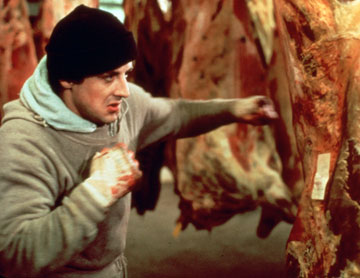
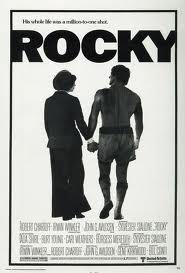
My favorite romance movie is undoubtedly Rocky.  People who have not watched it recently, who have memories of the later Rocky films cluttering their memories of the first, do not tend to think of it as such, but Rocky is a love story.  Rocky’s burgeoning relationship with Adrian is at least as vital to the films plot as boxing is.  But the image of Rocky in pop culture is more about the vibrant, outrageous sequels than the somber and contemplative first movie.  All that anyone usually remembers is that Rocky loses at the end and even that I would say is wrong.  At the end of Rocky, the eponymous lead has won all he ever wanted.
The best and most enduring element of this movie is the title character.  I defy anyone to watch Rocky and not empathize with the beleaguered boxer.  Though I call the movie a romance, as the title would suggest this is very much Rocky’s story.  His romance of Adrian may be the central plot, but the story is told from Rocky’s point of view.  The movie quickly establishes Rocky as a down and nearly out man.  His boxing career is going nowhere and the proprietor of his gym wants him out.  To make ends meet he works as leg breaker for a two-bit loan shark.  Rocky is also show to be honest and an all around good guy.  He clearly works for the loan shark only reluctantly.  Rocky tries to help a young girl who is hanging out with a bad crowd, only to have her throw his advice back in his face.  What Rocky seems most interested in doing is chatting up the shy pet store clerk Adrian.
One of Rocky’s several opposites is his friend Pauley, Adrian’s brother.  He is cruel and dismissive of his sister, though he does care about her.  Where Rocky hates having to work for Gazzo, Pauley wants to do it.  Pauley is sad, pathetic, and mean, but he is one of Rocky’s few friends at the start.  Another is Apollo Creed.  Creed is one of the things that make this first movie so interesting.  There is no villain in this movie, like Clubber Lang or Ivan Drago from later movies.  Apollo is whom Rocky fights at the end, but his portrayal very sympathetically.  He may be cynical, but his cynicism is what lands Rocky his big chance.  Apollo is what Rocky wants to be.  He has a successful boxing career; he is intelligent and eloquent.  He has all the qualities that Rocky wants.  Then there is Mickey.  Mickey is Rocky’s future.  He is what could happen to Rocky forty years down the road, after life gives Rocky it is last few knocks.
The big fight with Apollo comes into the movie late, for most of the film Rocky is trying to woo Adrian.  He spends time coming with bad jokes to tell her.  He stops by her pet store twice everyday.  Adrian is reluctant at first, but after a push from Pauley, she starts seeing Rocky.  Adrian is who Rocky loves, but Rocky mostly wants someone to care about him.  She is incredibly shy and repressed at the beginning, but Rocky is eventually able to draw her out of her shell.  Their deepening relationship takes up most of the first half of the movie.
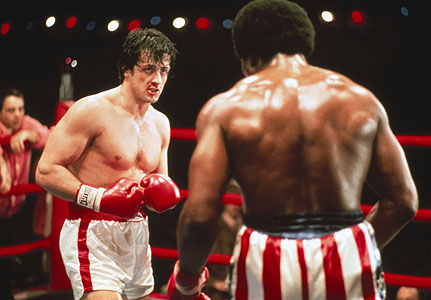
After Rocky agrees to fight Apollo, all the people who wanted nothing to do with him before come to him for help.  Instead of dismissing them outright, Rocky lets those who can help him help him.  Mickey originally was trying to run Rocky out of his gym, but afterwards he sees Rocky as his last chance to matter, Rocky proves his caliber by agreeing to let Mickey train him.  Once the unforgettable training montage starts, Rocky becomes the greatest sports movie ever.  Despite knowing that he is completely outclassed Rocky knows that this is his last and only chance at mattering and he has to give it his all.  The fight highlights the differences between Rocky and Apollo.  Apollo is a showman; he is putting on a performance for the crowd. Rocky is workmanlike, he simply puts his head down and goes to work.  No one takes Rocky seriously until his is able to down the champion.  After that, Apollo shows his other side, the ruthless fighter.  Rocky just continues as he started.
Possibly my favorite sequence in any film is round fourteen.  Both fighters are exhausted, especially Rocky, but they continue to go at it and one of the announcers, who really help make the fight scene, exclaims, “What is keeping him up?”  That question is the essence of Rocky’s, both the film and the characters, appeal.  He may go down, but he will never stay down.  When Apollo does knock him down everyone expects him to stay down.  Apollo dances victoriously, Mickey tells Rocky to stay down, Adrian finally finds the courage to watch the fight, and music the crescendos as Rocky shows his unbreakable spirit as he climbs to his feet.  Apollo, who despite his early lackadaisical approach is show to be a supreme competitor, stares in disbelief.  After that moment, the outcome of the fight is all but irrelevant.
When the fight does end, it is interesting to note that the judge’s decision is drowned out by Rocky’s cries for Adrian.  The only way the outcome is known is by Apollo’s reaction.  The movie does not hinge on the outcome of the fight, but on Adrian’s joining Rocky in the ring.  Like when he is interviewed after accepting the fight he has no answer about how he intends to fight Apollo, but he does remember to say hi to Adrian on TV.  Adrian proves to always be more important to Rocky than fighting.  And the romance is more important than the boxing.

I Must Break You

Rocky 4

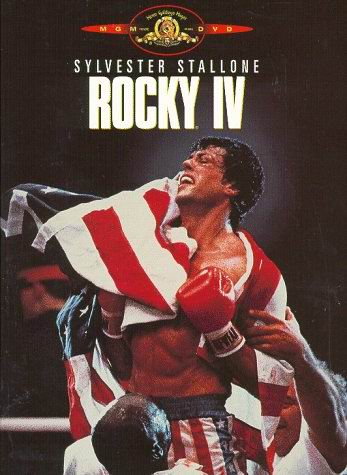
This weekend I started what I hope will become a 4th of July tradition.  I watched Rocky 4, which is of course the one where Rocky wins the Cold War by beating a giant Russian.  It is one of the most American movies of all time and the last true Rocky movie.  Not that Rocky Balboa was bad, but it came out so far after that it feels more like strange coda than part of the series.  Rocky 5 never happened.  Nevertheless, Rocky 4 should have probably been the last movie in the series.  There was nowhere to go but down.  Even Rocky cannot top winning the Cold War.

Rocky 4 is smarter than most people give it credit.  Not that it that smart, or subtle at all, but there is more there than blind patriotism and propaganda.  It is about growing old and how to face that.  There is no one who grows old faster or more publicly than professional athletes do.  All sports fans have seen a favorite player hang on past their prime, winced at the struggles of those who used to be great.  For some, like Bret Favre, while their skills have obviously diminished there are still enough flashes and moments of the player, we used to know and love to make us believe that he still has something left.  Too often, it is just gone and is painful for both players and spectators.  Rocky and now friend Apollo Creed are both dealing with this.  Apollo cannot let go, despite the advice of all those close to him.  Rocky, not quite as old as Apollo, still has something left, but he can see the writing on the wall.  Due to his inability to accept the changes that time has, wrought Apollo pays the ultimate price.  There is also Rocky’s guilt because he did not throw in the towel.  Like Rocky told Mickey in the first movie, Apollo told him not to throw the towel and Rocky let it go.  He did what he would have wanted Creed to do foe him in the same situation, but he say why people do throw in the towel.

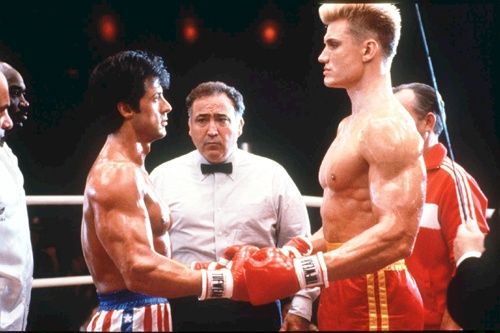
On top of the aging issue is the comparison of the USA and USSR.  Apollo is part of America.  He is loud, boisterous and arrogant.  He is also capable and honest, but even the honesty hurts the loud and arrogant part.  Drago is stoic and cold.  He is also just as selfish as Creed.  In their fight, he doesn’t care that it is an exhibition or that he is clearly the better fighter he still is relentless.  Because a resounding victory is helps him and his groups agenda, sportsmanship be damned.  The biggest contrast is in Rocky and Drago’s pre-fight training methods.  Drago has a committee that cares nothing for him and with the most advanced technology available.  Rocky has a few close friends and uses simple training methods.  While Rocky 4 is about as fair as a mid-80ies movie can be, they show the American methods to be better than the Russian ones. Like what actually happened, America wins in the end.

However, while there is this veneer of real issues, Rocky 4 is still a 90-minute movie with about 35 minutes of music montages.  It is still a movie that has Rocky win the Cold War by punching out a giant Russian.  It is not as good as the first two Rockys, but it is possibly the most entertaining movie in the series for repeated viewings.  In the end, Drago turns on his uncaring trainers and the crowd turns on him.  Rocky draws strength from his friends and from the crowd.  Because everybody loves Rocky.

***

Prince of Persia Movie Review

Prince of Persia is not a very good movie.  It could and should have been better than it was, but due to some truly baffling plot points what could have been an entertaining summer epic is just a mess.  Many viewers will write this off as the inevitable consequence of basing a movie on a video game, but contrary to that this movie is better when is stays close to its video game roots and falls flat when it deviates.  The deviations from the game include obvious twists and drawing heavily on tired influences.  The result is that what could have been the first truly good video game based movie is instead an uninspired and uninteresting amalgam of better movies.

The parts of Prince of Persia that could have made it good are there if the plot had let them.  First, for a summer action movie the acting is actually very good.  The casting was dead on as well.  There were no outstanding performances but neither were there any noticeably poor ones.  The acting was better than expected for a blockbuster.  Also the action scenes were good.  They were clear and well choreographed.  The movie shines when the focus leaves the asinine plot and shows Prince Dastan (Jake Gyllenhal) performing acrobatic parkour feats.  This is something that hews closely to the video game, which was primarily about using the Prince’s acrobatics to traverse the trap filled wreckage of a ruined palace.  In the movie this translates into entertaining and unique action sequences.  Prince of Persia is a joy to look at as well.  The plot of the movie goes to some breathtaking and awe-inspiring places that really make the movie feel epic.  It’s bad that the adventure itself is so dull.

Prince of Persia starts by showing how the titular Prince became such.  Unlike the game, Dastan was not born a Prince.  For some reason the script writers or somebody felt that what PoP really needed was a big dose of Disney’s Aladdin.  In fact he is introduced in a near exact copy of the scene that introduces Aladdin in his movie.  It then moves to the Prince, his two brothers and their uncle debating whether or not to attack a castle that they have been told not to but appears to be conspiring with their enemies.  As soon as the uncle appears on screen he might as well have “villain” tattooed to his forehead.  He looks very much like “Aladdin’s” Jafar.  The uncle, who wants to fight, wins the argument and the battle begins.  During the well done battle scene Dastan acquires a dagger that can control the sand of Time.  He is quickly framed for the death of his father and escapes with the princess of the attacked castle.  This leads to about an hour of the Prince trying to get in touch with his uncle to tell him he was framed, even though it is obvious to everyone in the audience that the uncle is the one who framed him.  The movie plays it as though it is some big twist, but it is really just a waste of time.  How could anyone doubt that Jafar is the bad guy?

The Princess is a troubled character.  At the start she is capable of defending herself and even of killing the Prince when she catches him by surprise.  But as the movie goes along she becomes more and more helpless and useless.  Also introduced are Han Solo and Chewbacca.  Actually it is the leader of a band of gambling thieves and his faithful bodyguard.  Despite being somewhat pointless additions they are entertaining.  Though why it was thought adding Star Wars to an already confused plot was a good idea baffles.

The plot eventually takes the Prince and friends to a place where the dagger can be kept safe, though hit is not clear how considering it has already been found and destroyed.  It is revealed that Jafar wants to use the sands to go back and stop himself from saving his brothers life when they were kids.  The Prince is able to stop him, but only after he has rewound time to before all the bad things in the movie happened.  And he still gets the girl.  In the game it starts with the Sands being unleashed and it follows the Prince’s attempts to fix things.  Rewinding to before it happened is the goal and it costs the Prince his relationship with the Princess.  Instead of the goal, the rewind is a happy accident that was said to cause the destruction of the world in the movie.  It takes something that is convenient in the game and makes it stupidly more so.

Prince of Persia ends up as a messy combination of several better works; Aladdin, Star Wars and the game.  It feels longer than its already bloated runtime, with its stellar action scenes too few and far between when compared to the lame plot.  It is sad that the most glaring flaws of Prince of Persia will be written off as the remains of its video game heritage when in actuality those are the parts that stray furthest from the video game.

**

Just short: Robin Hood

Robin Hood, directed by Ridley Scott and starring Russell Crowe and Cate Blanchett, is nearly a great movie.  Scott and Crowe came close to recapturing the magic that made Gladiator so great.  Unfortunately some tonal inconsistencies mar this epic just enough to make it slightly disappointing.  Most of the Robin Hood is similar in tone to Gladiator, somber and serious with majesty and grandeur, but it also has some moments that come off as goofy.  The movie is humorous in between the serious parts, which is not a problem on its own, but it does not in smoothly with the rest of the film.

One thing I liked about the film is the portrayal of Robin and his merry men.  In the few scenes in which they act as a team are truly delightful.  Robin, Little John, Will Scarlett and Allan A’Dayle go about their wayfaring exuberantly and it makes for some enjoyable scenes.  Too bad such scenes were few and far between.  Blanchett as Maid Marian was also very good, as was Friar Tuck.  Easily the best parts of the film were the parts that focused on the traditional Robin Hood myths.

Then there were the historical parts, which were not quite as good.  Kings Richard and John were great.  Richard the Lionheart was well loved, but he did not actually care too much about governing his kingdom.  And John was all hubris and arrogance he meant well, but he was not actually that good at being king.  He was the King who ended up signing the Magna Carta, so having that be Robin’s focus rather than having him playing a waiting game while they hoped for Richard’s return from the Crusades was an  interesting change.  But there were also some quite strange things.  Like Robin being a commoner who assumed the name of a dead noble.  That itself is an interesting twist, but the fact that the father of the noble he impersonates just happened to know his real father strain credulity.  That his real father just happened to be an integral part of the group that wrote the first attempt at a Magna Carta is unbelievable.  The whole real father reveals were just confounding and disappointing.  As was how people suddenly knew was an imposter at the end.  The were also other strange bits, most notably Marian leading an army of orphans into the battle at the end.

Robin Hood is and enjoyable movie, but the little things that do not quite match the tone of the rest keep it from being great.  A possible sequel, as the ending suggests and practically begs for would probably improve upon this one, with Robin and his merry men hopefully acting as outlaws more than in this film.  But Robin Hood, in the end, is an almost great movie.