The Wrong Game at the Wrong Time

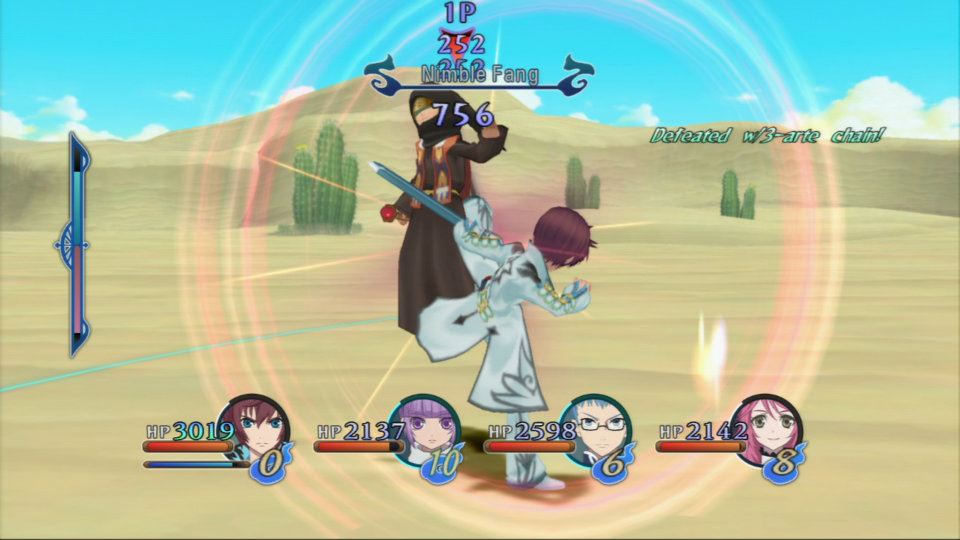
I am currently somewhere between a third and halfway through Tales of Graces f and I am getting pretty frustrated with it. It really isn’t due to any fault in the game, it is just not the game I wanted it to be when I started playing. My growing dislike of Tales of Graces f is really not fair to the game, which isn’t really that bad.

togf1

JRPGs are kind of my thing. That is my go to genre; JRPGs are my comfort food. Especially games on the SNES and PS1. That is not to say that I like all of them or that I don’t like any from earlier or later console generations. There is just something soothing about the often cliché stories and exploring the worlds of those games. For the last few months, I really haven’t played any of those kinds of games. The closest I’ve dug into is Persona Q which, while enjoyable, is really not the same thing. The thing is, as much as I wanted it to be, Tales of Graces f really isn’t either. What I really wanted was a game with a big world map to explore, something to give a real sense of another world. I want to explore, or at least to appear to explore, some fantasy world. Tales of Graces f doesn’t provide that in any meaningful way.

Wanting that from the game is not outrageous; it is something that all the other Tales of games that I have played have provided. The first I played was Tales of Symphonia, which is exactly the sort of game I was looking for. It has a massive over world to mess around in and one of the most pleasant, dopiest stories I can recall seeing in a game. The next two games in the series I played, Tales of the Abyss and Tales of Legendia, flubbed at least one of those things, but how much I enjoyed Symphonia made me eager to give the series yet another shot.

togf

At first, Tales of Graces f seemed to be all that I wanted. The party the game shoves at the player are a largely enjoyable arrangement of anime tropes and the first glimpses of the world have the comfortable familiarity of well-worn fantasy tropes. It soon became apparent that the game wasn’t really what I wanted. Tales of Graces follows the Final Fantasy X school of game design. There is no big world to explore; it is all corridor-like paths leading from town to town. You follow those paths and go through the game’s story. While eventually you can go pretty much wherever you want, the game never really stops funneling the player down those paths. It is a style of game that can work. I really like FFX. But it isn’t really what I wanted. In older games the ability to explore is mostly an illusion. While the player can theoretically go anywhere, the world map tends to restrain the player into the places it wants them to be. However, that illusion is important. The second layer of abstraction, the different scale used for the world map than the towns, can make the world feel less real, but making it all one scale but hemming in the player everywhere makes it feel small. (Some games, like Dragon Quest 8 and Final Fantasy XII manage to have both) Without that exploring, the game becomes just story and battles. Tales of Graces’ story is not strong enough to hold my interest on its own and the battle system, at least so far, has not really required any mastery.

The battle system is the game’s strongest feature. They are fast and action while still allowing the player to do a lot of strategizing. The problem with it, so far at least, is that it tends to be really easy. Most battles are over in a matter of seconds and the biggest worry is using specific skills to unlock new titles, which is how this game manages customization. The game hasn’t really required me to really care how it works. It isn’t helped by the story bogging the game down early. The player spends most of their time running back and forth through the same paths, fighting the same enemies. While the player gets stronger, the enemies don’t, meaning that the already brainless battles become even easier.

Honestly, though, the game’s biggest problem is that I am not 14 anymore. When I was a youngster, playing through games like FFVI, Chrono Trigger and Skies of Arcadia, among many others, were brand new experiences. Each game brought something new to the table. The clichés didn’t seem as clichéd to me, having not experienced them as often. What was once enjoyable goofy to me now just seems dumb. I think even then I might have rolled my eyes at basing a large part of the plot on a “friendship pact” or taking 5 minutes to painstakingly explain the concept of amnesia, but I find that barely tolerable these days. Of course, it is incredibly unfair of me to hold that against the game. Recognizing that doesn’t make me like the game any more than I do, unfortunately.

The End of A Legend

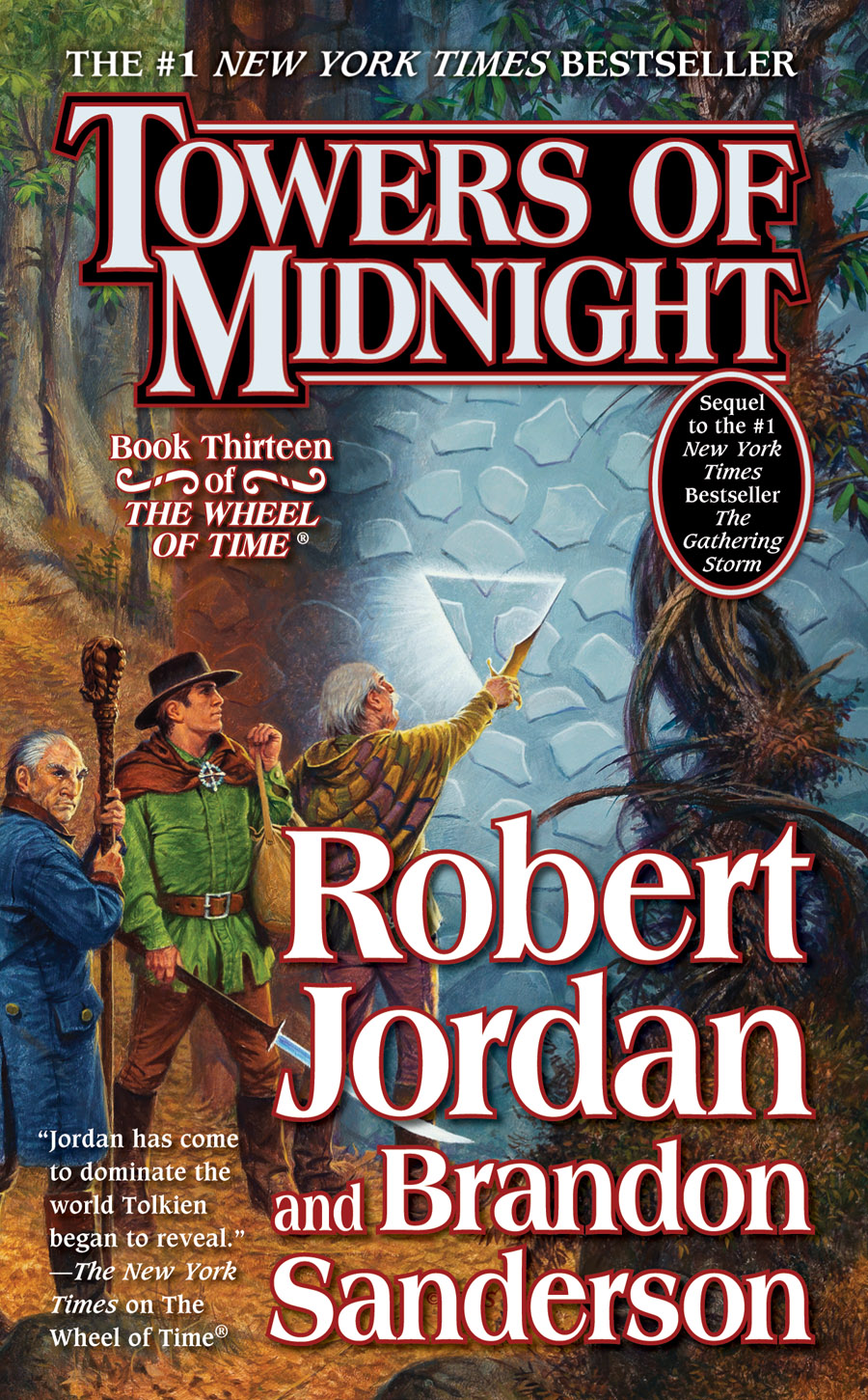
Wheel of Time Book 13: Towers of Midnight.

tomcover

Brandon Sanderson’s second WoT book with his name on it is much better than the first. Everything just feels much more natural this time out. While The Gathering Storm set Rand for the last battle, Towers of Midnight does the same for Perrin, Mat and Egwene. Towers of Midnight also continues to ramp up the feelings of dread of Tarmon Gai’den’s eminent arrival. In all honestly, that last battle starts in this book. Right from the beginning it has Kandor falling under a never ending stream of Trollocs and other darkspawn. It has begun and the good guys are still scattered and fractured. Rand is rallying them, but his enlightenment on the mountain has taken away his rage and struggle in his role. Towers of Midnight show the world finally coming together to face the threat that is already starting to overwhelm them.

Rand doesn’t make many appearances in this book, but the ones he does make are memorable. The book proper starts with Rand walking down from Dragonmount, having found peace. His very presence is enough counter the Dark One’s touch on the world. It actually works to pull the reader away from him at this point. Rand’s storyline accelerated way past everyone else’s in the last book; you can see the wrinkly in the chronology with Tam’s continued presence with Perrin’s group despite ending that last book in Rand’s company. He has a few chapter’s scattered through, as he divests himself of direct power and prepares everyone to meet with him at Merrilor, where he will unveil his plan to break the seal and fight the Dark One. The biggest thing he accomplishes is finally sorting out the Borderlanders. While their absence from the Blight might have led to their fall, it might have actually been to the good that they weren’t there to face it and fall as the Trollocs hordes came.

The two characters that dominate this book are Perrin and Mat. The two of them really could not be more different. Perrin’s stories tend to feature a lot of what poor readers call whining but is really just constant introspection. Perrin wants to think things through before he acts; this has been his defining trait since the series began. Now that he has had the mantle of leadership thrust upon him, he spends a lot of time trying to think of exactly what that means. Perrin, the most direct and straightforward character is probably the one that Sanderson, who tends to be blunter in his writing, writes best. Perrin’s story over the last half of the series tend to repeat, but that is because he is determined to accept change in half measures. Every time it seems like he’s solved his problems, he achieves the goal in front of him and starts everything over again. He doesn’t want things to change; so he makes bargains with himself. He will lead the Two Rivers until they clear out the Trollocs, he will lead his amalgamated army until he has rescued Faile. He will use his wolfbrother skills only as much as he must. It isn’t until this book that Perrin finally admits that he has to take full responsibility. Only after having thoroughly considered what that means, of course. That is why his wolf connection terrifies him. Giving in to the wolf means living by instinct, to act with the careful consideration that makes Perrin Perrin. His concerns are dealt with by dealing with the act that has haunted Perrin since The Eye of the World. He killed two Whitecloaks, which set them against him and caused him to fear giving in to his wolf abilities. Here, is finally forced to confront the Whitecloaks and he does so in his own way, by allowing them to put him on trial. He is willing to accept judgment for his actions because even as he accepts his role as leader he knows that if the laws don’t apply to him then they mean nothing.

His story in Towers of Midnight plays into his role as the builder. Other than Rand himself, Perrin is the one who binds the greatest number of people to Rand’s cause. By the time he has returned from his endless sojourn, he has brought with him Ghealdon and the remnants of Amadicia and The Whitecloaks, forged some ties with the even the Seanchan. While Perrin wasn’t able to bring back the Prophet, he did bring back a force much greater than the one he left with. He also gets one of the coolest scenes as he brings back power wrought weapons to world by forging his hammer, as well as making his mythological connection to Thor as overt as possible. It is also great to see Perrin work once he accepts leadership. He manages to match wits with Elayne over what to do about the technically rebelling Two Rivers, coming to a useful solution.

Unlike Perrin, Mat is not one for reflection. He seems almost pathologically incapable of introspection. Only Nynaeve rivals his lack of self-awareness. He is capable of forethought, but he does not consider his role. Mat doesn’t have the trouble taking the leadership of an army because it would never occur to him that it could change him. Fittingly, Mat’s final plotlines are mostly action based. He hunts the Gholam and rescues Moiraine from the Snakes and Foxes. Most of the rest of the main cast has undergone significant change since the start of the series, but not Mat. At least not in his heart. He may dress nicer now, may actually be a Prince, and has had ages of military knowledge jammed into his head but he is still the same. He still spends his time in taverns and let’s his mouth run more than is likely healthy. It is somehow reassuring. It is also hard to write about without simply spoiling it all. The trip to the Tower of Ghenjei is pretty much exactly what readers had been expecting for more than a decade. How little in is actually surprising should be disappointing, but it is not; it remains wholly satisfying, even if Moiraine’s return seems like a bit of a wasted opportunity.

Aviendha had been largely sidelined for the better part of three books at this point. But here she gets one of the most momentous scenes in the whole series. Back in The Shadow Rising, Rand going through the arches and seeing visions of the Aiel’s past was an amazing piece of writing. Here Aviendha goes through them and sees their future. Starting far in the future and coming back to just past the present, Aviendha’s vision of the fate of the Aiel is heartbreaking. She sees them first as barely more than animals before slowly going back and showing their fall. To see this come at the hands of the Seanchan is all the more devastating. It is becoming obvious at this point that the Seanchan problem is not going to be dealt with in the course of this series, which is fine. But to show a future where they are not only an ongoing problem, but that they manage to conquer all of the world that readers have spent more than a dozen books getting to know is perfectly horrifying. That is not even getting into the complete loss of culture the Aiel go through, the loss of everything that makes them what they are. It is one of the most devastatingly effecting scenes in the whole series.

Even though she also had a large role in the last book, Egwene doesn’t fade into the background like Rand kind of did in this book. While she has rooted out the bulk of the Black Ajah from the White Tower, she know that a member of the Forsaken is still hiding. What she doesn’t know is that a handful Seanchan assassins are also running around. It is a perfectly fine storyline that is hard to read thanks to Gawyn continuing to be a complete blockhead, albeit a very deadly blockhead. He forces Egwene in to the position she finds herself in more and more often in the latter half of the series, the killjoy bitch. While I never really found her likeable, her abrasiveness is generally justified. She needs to force the other Aes Sedai to recognize her power or they will try to walk all over her. She also must do the same with her friends so they will recognize her a Amyrlin Seat, not just their friend Egwene. It is uncomfortable to read, but it is necessary for her character. Especially with Gawyn, who has a habit going off half-cocked on poor information. Egwene really takes her place as one of the most badass characters in the series here, joining Rand and Nynaeve (and maybe Moiraine depending on how you look at it) as characters to take on a Forsaken and win.

Towers of Midnight is a more enjoyable book than its predecessor for many reasons. The first of which being that Brandon Sanderson just seems more comfortable with the characters this time out. Mat is still a little off, but he is much better in this one. While The Gathering Storm had Rand reaching his nadir then apex, Towers of Midnight has the rest of the cast reaching the conclusions, or nearly so, of their character arcs. That means that readers get to see a lot of their favorite characters triumphant one last time. However, the book never lets readers forget that the end is coming. That is never more apparent than with Lan’s hopeless march across the Borderlands, heading for the former Malkier and what he assumes is certain death. Even that is positively slathered with heroism, as many displaced Malkieri and their decendants come to join him, eventually forcing him to do the thing he had always refused to do: raise the Golden Crane, the flag of Malkier, formally accepting his place as King and leading men into the Blight, all of them knowing that the most likely outcome is death.

Unbreakable

Netflix isn’t exactly new to the television game anymore. They’ve been pumping out original series for the better part of three years now and have a handful of quality titles. Orange is the New Black is a certified hit and House of Cards is entertaining. I’ve also heard good things about Peaky Blinders, but I haven’t made the time to check it out. As far as comedies, they’ve had success with castoffs. The new Trailer Park Boys was solid and Arrested Development Season 4, while not up to the ludicrously high standards that show set in its original run was still hilarious. Most of those are coming back for more, and the new additions of some Marvel shows to fill it out should be great additions. Just the other day, though, they released the best original show to grace their service to date. I am referring, of course, to The Unbreakable Kimmy Schmidt.

The Unbreakable Kimmy Schmidt comes from the creators of the instant classic 30 Rock. For most of its seven year run 30 Rock was the best comedy on TV. Tina Fey and Robert Carlock were able to bring that same energy and wit straight over to Kimmy Schmidt without making the new show seem like just a rehash of their previous work. It does share some DNA with the previous show, Jane Krakowski’s Jaqueline Voorhees is not too far removed from Jenna Maroni and Tituss Burgess Titus Andromedon is quite similar to his guest appearances as D’Fwan, Kimmy Schmidt soon finds its own places to work, being something much closer to the average sitcom. The show is about a girl who was kidnapped into a cult and held underground in a bunker for 15 years. After her and her fellow “Mole Women” are released, she flees to New York City to start her life over, not wanting to be thought of as just a victim by the residents of her hometown. There she meets her new roommate Tituss, an aspiring performer, and their eccentric landlady. She gets a job babysitting for Jaqueline and tries to build a new life.

Everything starts up front with Ellie Kemper playing Kimmy. She does a great job of making her sunny, optimistic and occasionally ignorant but never stupid. Kimmy might not know some things after being held out of society for a decade and a half, but she isn’t an idiot. She is just unbreakable, not matter what she faces she is able to look on the bright side. Not only does that help her get by, but it also helps those around here. Flashbacks to the bunker make it clear that Kimmy played a big role in keeping the others sane and her influence on the show gets both Titus and Jacqueline moving forward with their lives. The show’s premise may be the darkest of comedy, but the sunniness of Kimmy tends to overwhelm any possible bleakness.

What sets The Unbreakable Kimmy Schmidt apart is how it refuses to settle down. It appears to be, and is in many ways, just a sitcom, but unlike most sitcoms, the cast never really sticks in any place. Maybe that will change when there are more than 13 episodes, but for this first season, things are continually in flux. Jacqueline’s marriage falls apart as the season goes on, Titus finds a job that he keeps, though he doesn’t stop his acting pursuits. Outside of Kimmy and Titus, the rest of the cast slides in and out. Sometimes their landlady Lilian plays a big role, sometimes she is absent. Jacqueline’s kids come and go, as do Kimmy’s love interests and fellow mole women. While there are patterns, the show is far from static.

The highlight of the season, which is largely a 10 episode highlight, is the trial of Reverend Richard Wayne Gary Wayne, first prophet and CFO of Savior Rick’s Spooky Church of the Scare-pocalypse. Jon Hamm, as good in comedies as he is in Mad Men, plays the kidnapping Preacher and wedding DJ with just the right amount of charisma and ego, especially put against the gullible jury, incompetent prosecutors and disinterested judge. While Kimmy initially refuses to go, wanting to put the whole thing behind her, her fellow mole women aren’t able to overcome him. It takes Kimmy’s indomitable spirit to help bring the Reverend down. It really helps highlight how the 4 mole women each deal with their ordeal. Kimmy puts it behind her and tries to forget all about it. Cyndee, always looking to Kimmy for help in the bunker, revels in the pity the townsfolk feel, feeling after what she’s been through she deserves to be happy. Maybe she does, though it doesn’t seem healthy. Donna uses her notoriety to sell mole sauce, turning a tragedy into an opportunity. And Gretchen never really escaped, being the only one of them who went into the bunker by choice.

How Kimmy Schmidt ended up on Netflix is kind of baffling. NBC ordered the series, but for some reason kicked it over to Netflix rather than air it on their network. I guess they had to make room for The Mysteries of Laura and The Slap. Whatever confused reasoning made NBC take its best new show and dump it on Netflix, I am kind of glad they did. This show might not has caught me so thoroughly if I had watched it one episode at a time. It has already been guaranteed another season and hopefully that is not the end of it. With the end of Parks and Rec, there aren’t a lot of good comedies left on TV. At least I know where to go to get quality TV.

Monster Hunter 4 Ultimate

I found Monster Hunter 3 Ultimate to be something of a revelation. The series had intrigued me, but I had never encountered it on the right system so I had never played it. I let myself be talked, thanks to word of mouth and a nice deal Capcom set up, into buying both the 3DS and WiiU versions of the game. (Actually, I did pick it up for Wii as Monster Hunter Tri just a few weeks before the 3DS and WiiU versions were announced, so I’ve never actually played that version) As much as I ended up enjoying MH3U, my save file has somewhere in the neighborhood of 300 hours on it, I wasn’t too happy with that choice. Almost all of my time with the game was spent with the WiiU version, the one with online multiplayer and able to be played on the big screen so as to enjoy the spectacle of the monsters. The 3DS version simply felt cramped in all respects.

mh4u4

Thanks to my experiences with that game I was a little hesitant about jumping on Monster Hunter 4 Ultimate. It looked good, but I really didn’t enjoy my previous 3DS monster hunting. Now I’ve had MH4U for the better part of a month and I am very happy with my purchase. MH3U is the rough draft of a great game; MH4U is the final draft of that great game. It is a masterpiece. There are tons of ways it is a better game. Part of it is because I am now playing this on a 3DS XL. It is likely even better on the NEW 3DS XL, but I am not in a position to drop the money on that. Another reason is that this game is designed from the ground up for the 3DS. MH3U was a Wii game crammed onto inferior hardware. The 3DS is capable of ports from that system, but not without compromises. The upcoming Xenoblade port requires the extra processing power of the NEW 3DS. While the game played alright, it wasn’t quite right. While MH4U isn’t a big leap in graphical quality, being designed for the system it does more with the power that the 3DS has to offer. It is not a great a change, but a noticeable one. Also, this game adds online on the 3DS.

The one biggest way that the game improves on all versions of its predecessor is that it gets rid of swimming. Swimming was a decent idea and does have some fun battles that make use of it. I do find that I miss the Lagiacrus. However, the controls in the water, especially on the 3DS without a second stick, are frustrating. It made an already cumbersome game downright unwieldy. Honestly, even on the WiiU I found myself putting off missions with swimming as long as possible. Without the swimming, MH4U becomes all the more playable. It’s disappearance from this game is no loss.

mh4u2

Despite losing those aquatic monsters, MH4U has a much better and more varied stable of monsters to hunt. It is not just dragons and dinosaurs; MH4U also has giant bugs, massive apes and even a monstrous hermit crab. On top of the variety being better, there are also simply more monsters, jumping from somewhere around 75 to closer to 90. Not all of them are great, but there are tons of fun fights to be had. Since 3 was the only game in the series I’ve played to this point, I don’t know which monsters a new and which ones just missed the last game.

The quest structure is also improved, with fewer required trivial missions, like tracking down mushrooms or gathering honey. They are still there, but they are mostly optional. It also does a better job of doling out new monsters to fight. More beasts are available in Low Rank, though plenty are still held out until the player reaches High. Rare is the time that the game doesn’t have a new monster available to fight. It also adds some mission to help people trying to grind drops from specific monsters with Hunt-a-thon quest, where the player hunts one monster over and over until time runs out. It is also quicker to give mix and match quests to hunt two different monsters. In all, the quests are just much better balanced.

mh4u3

Monster Hunter is an odd duck of a series. It has an odd mix of realism and video game logic. The quests and areas are all very video game like, but it also makes the player hunt down ingredients and cook their own food. The way it makes players track how they are wearing down the monsters during a fight, watching for signs of tiredness or rage, seems kind of realistic, but the carving and building armor is very video game. It is an action RPG that is simultaneously all about getting better stats and being very skilled at playing the game. It has a little bit of everything.

mh4u1

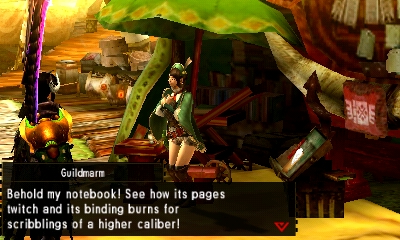
The cherry on top of the delicious sundae that is Monster Hunter 4 Ultimate is how charming the localization is. This game puts the player with a caravan traveling across the world, in each stop the monsters the player hunts helps improve the caravan’s services and mode of transportation. Sometimes new characters join up until you finally reach your destination. The player’s fellow caravaneers are a lively bunch. Watch any of the games enjoyable but highly unnecessary CGI movies will help set the tone. The Guildmarm, the woman who tracks the player’s quests, is delightfully daffy. The blacksmith, named simply The Man, is great in his quiet competence, as is the cook with his incompetence. It is just a fun crew that makes great use of the little dialogue there is to be enjoyable.

Monster Hunter 4 Ultimate is just an excellent game. The joys of fighting and crafting just never end. This game keeps trickling out the rewards and new experiences over what will surely be hundreds of hours.

What I Read Feb 15

I don’t think I’ve actually spent that much more time reading this month, I just really got in a groove and read things quickly. I don’t see how I can keep up this pace, but I’d have to fall off terribly now to not hit my goals. Eight books in a month, even if two of them were rereads, is hard to beat. I am very happy with my reading pace so far this year.

RAc

Royal Assassin

Robin Hobb

A couple of years ago, I read the first book in the Farseer trilogy, Assassin’s Apprentice. I liked but didn’t love it. I had always intended to get to the other two, but I didn’t actually pick them up until just after Christmas. I am glad I did. Royal Assassin is still a frustrating read at times, but it grows stronger the further it goes until it absolutely has the reader by the end.

It picks up a few months after the last book left off, with Fitzchivalry Farseer, the apprentice assassin, struggling to overcome his poisoning at the hands of is uncle Regal after he had prevented an assassination attempt on his other uncle, Verity, and arranged a marriage between him and the princess of a neighboring kingdom. After lying in bed sick for some time, he finally decides to head back to the castle and help out his family again. The book is told from Fitz’s point of view, so the reader largely only knows what he does. Now being an adult, he has a lot more difficulties to manage. He has more responsibilities as assassin, riding through the countryside and poisoning the Forged, who have been made basically zombies by villainous Raiders. He also is often the sole source or comfort for the new Princess and he has to deal with two princes: one distracted one vengeful and a King whose health is failing. Eventually things build to the tragic, yet inevitable conclusion where Fitz pretty much makes things worse while trying to set things right and pays a very dear price for it.

While for the most part characters motivations and actions are clear and coherent, at least eventually, there are some odd parts. Fitz realizes early on that the King’s health is not being cared for properly, but no one makes any move to help remedy this. It plays a big part of the ongoing story and only Fitz and one other character seem to care. Also, while the Kingdom of Six Duchies is supposedly fighting a war against Raiders, but at no point are the Raiders actions or motivations explained. While the desire to fight the Raiders is the foremost problem for most of the book, they are a complete nonentity. And while it makes sense that Prince Regal would escape without repercussion from the events of the last book, but why does the unfaithful coterie (essentially wizards) continue to operate unheeded? None of these are huge problems, but they all add to each other to make the book are frustrating as it enjoyable at times.

AQc

Assassin’s Quest

Robin Hobb

In the last book, Prince Verity left to seek the Elderlings to help combat the Raiders, only to lose contact with everyone but Fitz. (Spoilers for the end of the previous book) Fitz is believed dead by nearly everybody. Now that Regal has had the King killed and named himself King, he has moved himself to his mother’s home. Once he recovers, Fitz takes it on himself to live up to his title as the royal assassin and kill the treasonous Regal. He treks across an increasingly dangerous countryside and after a failure that nearly cost him his life; he is again contacted by Verity and goes to help him, taking with him a handful of others.

I don’t want to spoil too much, but this book changes things completely from the first two. Those two took place primarily in the Castle at Buckkeep, in this one Fitz ranges all across the kingdom. No longer is he beholden to the king; now he is the one in charge. He might not necessarily choose his path, but he does choose how to walk it. It also deals more directly with the magic and myths of this world. It also leaved behind many of the characters from the first two books and fills out the cast with newcomers. I think it is the best book in the trilogy, but it is not without its flaws. One is similar to the previous books, that being told from only Fitz’s perspective is needlessly constraining for what in many ways is a sprawling tale. There are interesting and exciting things happening to characters readers grew to know in the first books that are glossed over here. And again the nature of the war that they are supposedly fighting is left vague and unsatisfying.

Luckily, the sheer magic of the last third or so of the book is hard to ignore. Once Fitz truly sets out for the realm of the Elderlings, aided by the Fool and Queen Kettricken, among others, Assassin’s Quest is impossible to put down. And the nature of the Elderlings and how they are summoned is spectacular. Like everything in this series, even the brightest of victories are laced with tragedy. It seems odd, but somehow fitting, that the usurping Prince is pretty much ignored in the final conflict. For much of the book he was focus, but again at the end it goes back to the vague evils of the Raiders, who in the absence of a useful King have conquered much of the coastal territory of the Six Duchies. Really, the book lives and dies by how much the reader likes Fitzchivalry. He is a great character; flawed but earnest. He can be frustrating to read about, but more often he is all too real.

thd

The Hangman’s Daughter

Oliver Potzch,
translated by Lee Chadelayne

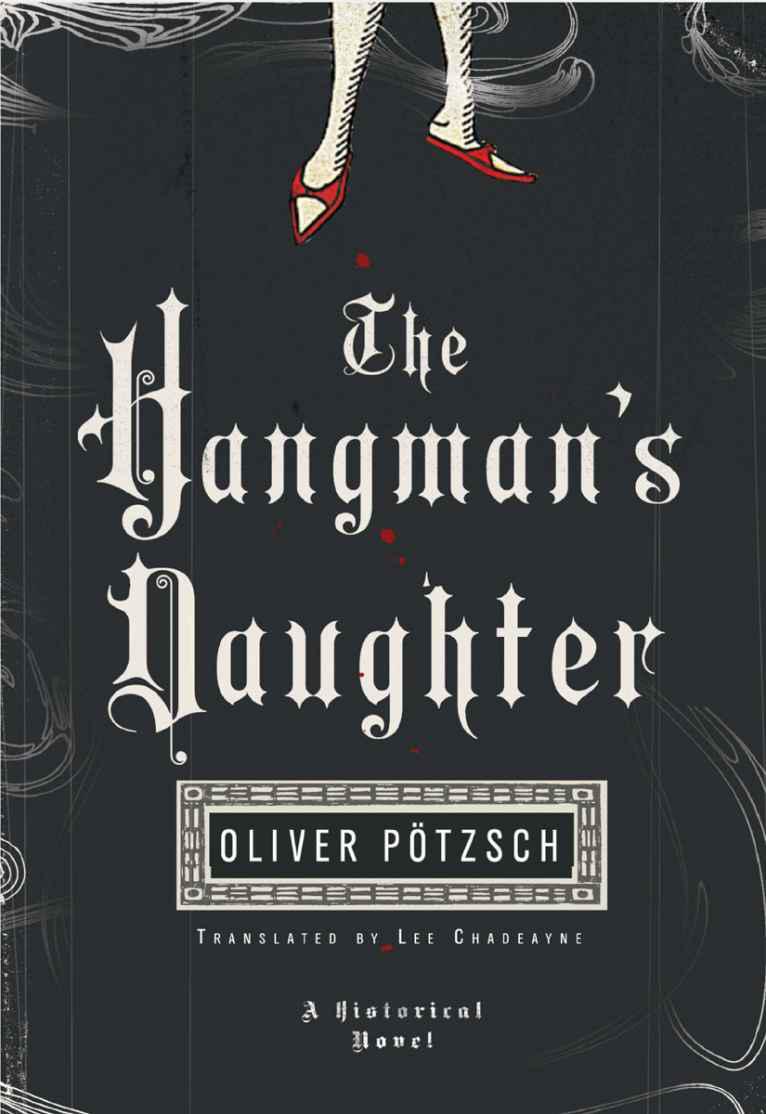
Another Kindle book I picked up on a whim. The Hangman’s Daughter is a mystery set in 17th century Germany. A local orphan boy is found dead with an apparent witch mark on him. The villagers attack the local midwife, who was known to spend time with the orphans and midwifery is basically witchcraft anyway, right? While the authorities lock her up, only the Hangman and young doctor trying to find the truth of the matter.

The biggest selling point of The Hangman’s Daughter is the setting. The stigma of being the hangman, witch hunts, and the supposed medical care of the time are all big parts of the book. The mystery itself isn’t bad, though it is a little frustrating how obvious suspects are ignored by everybody. Oddly enough, the titular daughter isn’t really the focus of the book. She is a prominent character, but she is more of a subplot than a central one, at least until the very end. There is a pretty chilling section in the middle when the hangman must do his job in torturing the suspected witch, which is hard stomach and historically interesting. In all, it is a highly entertaining read, but far more good that great.

tmotbtc

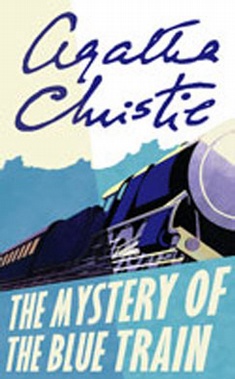
The Mystery of the Blue Train

Agatha Christie

This is supposedly one of Christie’s least liked books that she wrote. I don’t know why, it seemed perfectly fine to me. Not the best of hers that I’ve read, but also not the worst. The ending doesn’t feel so strained as some others. There is a lot of build up to start with book, with a cheating husband, a stifled but selfish wife and her controlling dad as well as a slew of other characters. When Hercule Poirot rides the same train as most of those characters, along with newly rich Katharine Grey who inherited a ton of money and is going to visit relatives, the wife gets killed and it is up to Poirot to solve the case.

One interesting note about the Blue Train is that it features the village of St. Mary Mead, which would soon be home to Christie’s other prominent sleuth Miss Marple. That is where the heiress hails from. The mystery gets untangled fairly quickly, with a lot of time spent with Miss Grey, who assists Poirot on the case, meeting with her quite unique family. Most of the time the investigation focuses on the husband, who is too obvious a culprit to even be considered a possibility my most readers. What is uncovered is never preposterous but never obvious either. It is a slight book, with subplots and set up overwhelming the mystery, but it all comes together quite well at the end.

ditc

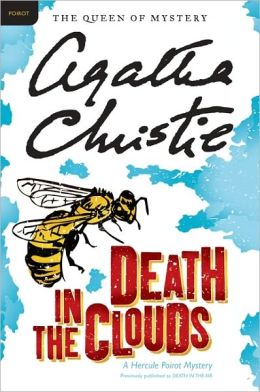
Death in the Clouds

Agatha Christie

Another Poirot mystery. This time a murder occurs on an airplane with Poirot onboard. It becomes a not quite locked room mystery, with only the passengers as possible suspects. The group of suspects here is a good one, with a very obvious and easily discounted pair of archaeologists, a few rich ladies, a doctor and a dentist. On the flight, a blackmailing money lender is killed, maybe by a rogue wasp or maybe by a poisoned blow dart. Poirot is the initial suspect of everyone but the police. He goes about ferreting out the various motives of the different passengers, with the help of a few other suspects. The eventual solution is fairly ingenious and surprising, without breaking the fairness of making believe that a reader could solve it before the ending. Though I doubt any would with this one.

knifedreams

Knife of Dreams

Robert Jordan

See here

tgscover

The Gathering Storm

Robert Jordan, Brandon Sanderson

See here

ee

Etiquette and Espionage

Gail Carriger

This series of young adult steampunk books came highly recommended and very cheap from an Amazon sale. This first book is fairly entertaining. Still, I found it to be slight even for a young adult book. Everything is just as presented, with no real twist outside the premise and a finishing school for spies and assassins. I know this is set in the same world as another set of novels that Carriger has written, but here the world building is slight. It gets by with a fast pace and something new to be found all the time, but it still feels really barebones. Every character except Sophriona, the protagonist, is summed up upon their first appearance and never deviates. What there is of a plot is dealt with rather perfunctorily. My biggest problem with it that I am never quite sure of the rules the world of this book operates on. It comes across as overly precious at times, making jokes about people proudly being evil geniuses but not really backing that up with a world where that fully fits. I hope the next two books do a better job of giving the reader a solid footing of how this world works.

The Last that Could be Done

Wheel of Time Reread Part 12: The Gathering Storm

tgscover

It is impossible to discuss The Gathering Storm without noting that it is the first book that Robert Jordan was not able to finish. While he intended to finish the series in just one book after Knife of Dreams, Jordan tragically did not live long enough to do so. His passing was tragic from any point of view; the fate of the series was insignificant in the face of his loss. Still, as a reader I wanted to see the series come to its conclusion. Luckily for readers, Brandon Sanderson was tapped to finish the series in Jordan’s stead. Sanderson is one of the best writers of the fantasy genre working today. I have read and enjoyed nearly every book he’s had published. That being said, he is not Robert Jordan. Whether one finds his writing better or worse than Jordan’s, there is no getting around that it is different.

One of the changes when Sanderson took over was that the last book became the last three books. With all that happens in these last three books, doing it in one looks like it was always a pipe dream. It would, however, fit better structurally. The first six books of the series fit nicely into a pair of trilogies; if the series had been finished in one book after Knife of Dreams, the last six would as well. Books seven through nine do not follow as thematically coherent a trajectory as Rand’s rise and fall from books four through six. Rand is faltering, after his troubles at the end of Lord of Chaos, but he has created a new weapon: the Asha’man. They appear at the end of that book, start out appearing trustworthy and useful before betraying him and showing the effects of the taint. So Rand cleanses the taint. That covers Rand’s journey through those books, seeing first-hand the effects of the taint and dealing with it once and for all. Rand’s journey though the last trilogy, albeit a trilogy that ends up consisting of five books, is his nadir before truly understanding and accepting what it will take from him to be The Dragon. Fixing what made the last part five books instead of three would be difficult. Counting all of Sanderson’s books as one it works, at least for Rand’s story. It is everyone else whose stories don’t quite fit. More than half of Crossroads of Twilight takes place before Winter’s Heart ends. Moving that stuff back, folding the rest of Crossroads back into Knife of Dreams and condensing the last three books into just two would largely fix things.

The change from Jordan to Sanderson was hard to swallow. Especially in light of how many people I heard gushing about how much improved Sanderson’s take was to Jordan’s. I can’t fault someone for liking Sanderson; I like his books an awful lot. His work is creative and inventive and the man is crazy prolific. The Mistborn books are excellent, the Stormlight Archive is a worthy successor to the sort of absurdly large scale fantasy of which The Wheel of Time is the most exceptional example and even his one off and young adult books are good reads. But he is not the same writer as Robert Jordan and I would say for this series a lesser one. At least, coming from the perspective of a Wheel of Time fan he is. Sanderson tends to be more direct and blunt than Jordan; characters were suddenly more open with each other instead of speaking in half-truths and assumptions. Character also go through a slight metamorphoses, some worse than others. Elaida, for instance, goes from being wrongheaded and stubborn to being a complete clown. It is the end of her arc as a character, but in this book she is reduced to just arrogance and megalomania. She is not the worst, though.

It is never clearer that Sanderson is not Jordan than in the few chapters in this book from Mat’s point of view. Jordan’s Mat is funny, but not from any conscience effort on his part. Jordan’s Mat doesn’t see himself as a funny guy, what makes him so fun is his complete lack of self-awareness. Mat has no clue that other people find him hilarious. Under Sanderson’s pen, Mat is doing some kind of tired shtick with Talmanes. You can almost feel all of his companions rolling their eyes at every word he says. It is painful. It isn’t just Mat trying to be funny, but Mat failing to be funny. The biggest flaw is that Mat’s stuff just isn’t amusing. It falls completely flat.

Luckily, one adjustment Sanderson made when splitting this last book was to sideline most of Mat’s and Perrin’s stuff to Towers of Midnight and have The Gathering Storm focus on Rand. Rand had been essentially sidelined for the two books previous to this. He had a few impactful chapters in KoD and a few forgettable ones in CoT; in The Gathering Storm he is again the protagonist. He had been teetering since Lord of Chaos, after the kidnapping. The madness that is the inevitable end for male channelers is starting to affect him. No longer feeling safe even in his palaces, he jumps from front to front in his attempts to combat the Forsaken and the Seanchan. And he continually build up this idea that he can’t harm women or allow them to be harmed, even trained fighters like the Aiel Maidens; turning it into a kind of especially destructive chivalry. It becomes less of a principle and more of complex. The Gathering Storm has Rand finally reaching the nadir of his fall in what is easily one of the darkest moments in the entire series. The male a’dam, the collar that lets one channeler control another, is placed on his neck by no one less than the most sadistic of the Forsaken. It was not strictly a surprise when it happened; all the pieces for this tragedy were in place. Things like secreting away the a’dam instead of getting rid of it or keeping Semirhage captive instead of just doing away with her. That is stuff that the characters should have known, there is more that the readers knew, like the fact that Elza was Black Ajah. Everything just goes wrong in the worst way possible.

Knowing that the end is coming soon makes the outcome all the more uncertain. Yes, it was easy to guess that Rand would get out of his predicament, there are two more books to go, but how much damage would done before then? The complete hopelessness when Rand is forced to strangle Min is crushing, because there could be nothing more tragic than the very real possibility at that time that he would kill her. Fortunately, thanks to some divine, or infernal, intervention Rand manages to free himself from his bonds and do away with Semirhage. Even more than the supposed victory at Dumai’s Wells, this battle left its mark on Rand. After this, all the light has gone out of Rand. It is laid on rather heavily, but Rand is now completely broken. It is disturbing seeing just how wrong things go. Everything is visibly coming unraveled and Rand is now fully a source of the problems instead of a solution. Rand gets darker and darker, even his closest allies Min and Nynaeve must turn to outside help to try to save him. But Rand’s salvation does not come from anyone’s help, but from within. He sits on Dragonmount, toying with the idea of finally giving in to Ishamael/Moridin and destroying all of creation. What calls him back is part of the very thing that nearly drove him to do it, the voice of Lew Therin he hears thanks to the Dark Ones taint. Together they find what they need to see the value in creation.

While Rand hits his lowest ebb in this book, the other major storyline is Egwene at her most triumphant. Captured in the White Tower, her rebel Aes Sedai still besieging the city from the outside, she starts her own siege from the inside. By simple strength of character she shows the completely divided sisters inside what they need to be. It helps that Elaida has been reduced to a complete fool, worried only about her increasingly tenuous grip on power and reality. For a character that had become almost as unenjoyable as Rand over the back half of the series and for much less reason, Egwene really shines here. It helps to see others react to her strength, showing why she deserves the power she now wields. And for a character who is in captivity, she manages to accomplish an awful lot. The crowning moment might be in the Seanchan raid, when she almost single handedly saves the White Tower from complete disaster.

Her second accomplishment, nearly ridding the Aes Sedai of the Black Ajah, came to her with the great help from one of the best minor characters in the series. Since The Great Hunt, when Verin stepped in for Moiraine for most of the book, she has been an intriguing figure. She was up to things that usually seem to be for the good of the Light, but using tactics that were decidedly underhanded. Here we get an explanation that was surprisingly simple but also somewhat unexpected. Verin joined the Black Ajah by mistake, wanting to study them but not herself being a darkfriend. So she played her role, all while keeping tabs on the others in the sect. Egwene is able to use her information, after one of the bravest and most touching moments in the series, to clean out a large portion of the Black Sisters. Including Sheriam, who had been given a fake-out Min viewing to fool people off of her trail, one of the only times that Jordan seems to have inserted information with the deliberate goal of misleading readers.

The Gathering Storm is easily one of the weaker books in the series; Sanderson doesn’t quite have a feel for many of the characters, though he does get better in the subsequent books. It is also one of the most focused books in the series. There are a few chapters of Mat and Perrin, but the book hinges almost entirely on Egwene and Rand, as well as the supporting characters in their orbits. The whole book feels like a weird shadow of the rest of the series, the darkest book thematically and also one where everything else seems not quite right.

Now Playing in Feb 15

I finished up a few short games in February, and one big one. Most of my gaming time was spent with Mario and Luigi Dream Team right up until I got Monster Hunter 4, then that was all I had time for.

Beaten

Gunman Clive 2 – The first Gunman Clive was an amazing surprise. It had a really low price point, but it played like a love letter to NES action game, like Mega Man with a muted color palate. This game expands everything, especially the colors. There are some rough spots, like the flying and horse riding portions, but for the most part it is just more of the same goodness from the first one. This is just a really great little action game. It doesn’t try to do too much or go on too long, it is just a perfectly sized romp. Buy it if you have a 3DS.

Ratchet and Clank: Quest for Booty – This is a pretty DLC campaign for Ratchet and Clank. It is just a small version of the real games. Everything you want from the series is here, but there is just very little of it. Only a few areas and a small handful of weapons. Still, it is a lot of fun. There really isn’t a lot here, but is perfectly fun. The biggest change with it is that Clank doesn’t appear until the very end to set up R&C A Crack in Time.

Star Fox 64 3D – Thank you Club Nintendo for handing me this remake of a classic. It is slightly improved from the 64 version and now portable. I don’t know that I would pay full price for it, but if you can get it cheap, or free, it is completely worth it. It has gotten me somewhat excited for the upcoming WiiU game. I remember why, at one point, I was really excited for new Star Fox games. Of course, three straight disappointing games kind of killed that. But maybe, if it can be a little more like this I can love the series again.

Chariot – When I first started this game, I was delighted. It is a simple physics based platformer about a princess pulling her father’s coffin through the Royal Sepulcher to find the perfect resting place, being hounded constantly by her father’s ghost. For the most part it is wonderful. You push and pull the coffin through twisting caverns, using a rope to pull it places you couldn’t normally get it. After a few stages the troubles start to show. One big trouble really. Each world gives a new challenge, from icy platforms to pools of lava to ghostly barriers that won’t let the coffin through. Each of these are nice twists on the initial obstacles. The trouble comes from the sheer length of the stages. Each stage takes 25 to 40 minutes to complete. It is simply too long; by the time you reach the end of a stage the game has worn down all the joy anyone might have found in it. I almost had to take a day off or so in between each stage to cool down. Shorten each of those stages by about 25% and the game would be about twice as good. I still really liked it, the game itself is good, but those really long stages are just killers.

Legend of Zelda: Skyward Sword see here.

Dragon Age 2 – see here.

Ongoing

Monster Hunter 4 Ultimate – The changes from Monster Hunter 3 to Monster Hunter 4 aren’t that great, but they make the experience just a little smoother. I’ve already had more fun with the 3DS version of this game than I did with the previous one. The biggest change is getting rid of swimming and there is no downside to that. Swimming sucked and was the worst part of the previous game.

Mario and Luigi: Dream Team – As much as I like this game, it seems like I play it forever and never make any progress. I am almost 30 hours into this game and would guess that I am somewhere between halfway and two thirds the way through. Mario RPGs tend to work best when clocking in somewhere between 20-25 hours. This game is already past that and doesn’t seem like it is coming to an end anytime soon. It feels like too much of a good thing.

Persona 2: Eternal Punishment – This has been some really slow going. I like the game, but Monster Hunter 4 stole most of my portable gaming time and I’ve kind of lost my place here. In a couple of weeks I’ll get frustrated with MH4U and this is what I’ll turn to.

HarmoKnight – I don’t have rhythm, which makes playing rhythm games rather frustrating. This game is super charming, but I am terrible at it.

Indiana Jones and the Fate of Atlantis – I’m still not sure that I’m a fan of adventure games. I never seem to have as much fun playing them as I remember the games being once I’m finished. There always seems to be a disconnect between what I want the game to do and what I am actually telling it to do. For example, there is a point early on when Indy has to melt a wax statue in a furnace. I figured out what I needed to do quickly, but it took me a long time to realize I missed a step. I couldn’t but the statue in the furnace because I hadn’t opened the furnace. Indy was just sitting there jamming the statue into the furnace door.

Upcoming

Ratchet and Clank: Into the Nexus – Quest for Booty was just a tantalizing taste of the full course of a R&C game. Into the Nexus is that last one I have left to play and it feels like time to finally get to it.

Mario vs Donkey Kong – I’ll likely pick this up for the WiiU when it finally releases. The Mario vs Donkey Kong games have the problem of not actually being much like Donkey Kong ’94, despite kind of looking like it. Still, once that disappointment is gotten over, the games are generally pretty fun. I am trying to keep to a fairly restrictive gaming budget this year, so I am having to ration my purchases pretty tightly. So no Majora’s Mask and maybe no Codename STEAM. But this likely budget priced game is right up my alley.

Star Wars: Knight of the Old Republic – I guess I’m playing all of Bioware’s games this year. I’ve played through Baldur’s Gate, then instead of taking a break from them like I intended, I sort of randomly picked up and started playing Dragon Age 2.

What I Watched in February 15

I didn’t waste quite as much time watching TV or movies this month, but I still watched quite a few. The two movies I saw in the theater were disappointing, though. Seventh Son was just dull and Jupiter Ascending was a fun mess. Still, I watched some really good new stuff on Netflix.

Movies

Clear and Present Danger – A perfectly entertaining thriller. Harrison Ford isn’t quite at his Indiana Jones best, but even his second best stuff is better than most starts. This film is good, but not really great. ***

The Triplets of Belleville – This is one weird film. Beautiful, but also strange. It tells its story brilliantly with almost no dialogue and is just thoroughly excellent. ****

Snatch – I love Guy Ritchie’s movies, and Snatch may be his best. Ask me that after I watch Rock’n’Rolla and Lock, Stock and Two Smoking Barrels again. Still, they can’t be much better that this. It is just the perfect whirlwind of bad decisions smashing into each other. *****

Indie Game the Movie – I like documentaries in general, but this one took a subject I am very interested in and made it dull. Perhaps I am being too harsh, but it seemed too long and somber for the subject matter. It did give a good idea of the kind of work that goes into indie game development, though. **1/2

Seventh Sonsee here **

The Ideal Husband – An adaptation of an Oscar Wilde play, which means it is full of witty dialogue and veiled innuendo. It isn’t The Importance of Being Ernest, but it is still very amusing. ***1/2

The Great Muppet Caper – The best Muppet movie? Maybe. It starts with the perfect joke of Fozzy and Kermit being identical twins and is just hilarious and charming throughout. ****1/2

The Pink Panther 2 – Based on its reputation, I expected this to be worse. Based on it cast, it should have been so much better. Pink Panther 2 has a bunch really talented comedic actors going through the motions of some sub-par farcical material. **1/2

Jupiter Ascending see here **1/2

A Knight’s Tale – It is charmingly anachronistic, but ultimately slight. I have fallen asleep trying to watch this movie no less than three times. Yet still, when I think on it I remember enjoying it quite a bit. ***

Austin Powers – It is odd to watch this movie nowadays. The “modern” scenes from the 90’s are almost as dated as the stuff from 60’s. Still, I find it more entertaining than it has any right to be. It is really just a solid comedy. ****

Austin Powers 2: The Spy Who Shagged Me – It isn’t quite as good as the first one, some of the jokes have worn thin, but it is ultimately still enjoyable. It is clear watching it that Mike Myers is having a blast and that is infectious. ***1/2

Austin Powers 3: Goldmember – Overall a touch more statisfying than the previous entry. You could tell they know this was drawing to a close and they just went for it the whole time. ***1/2

30 for 30: Winning Time – This covered the rivalry between the Indiana Pacer and the New York Knicks in the mid 90’s. It focuses mostly on Reggie Miller’s exploits, including a pair of unforgettable performances. Those Pacers were one of my favorite teams growing up, so I really got into this one. ****

30 for 30: No Crossover – This one is more somber than Winning Time, being about Allen Iverson and the legal troubles that nearly derailed his life and whether or not the trouble he got into was deserved. The filmmakers allow each side on this issue to present their case and does a pretty great job of present a complex issue. ***.5

The Adventures of Baron Munchausen – Terry Gilliam is a genius. No one captures the idea of imagination on film better than him. This is thoroughly satisfying all the way through. *****

TV

Malcolm in the Middle S3-6 – This is the meat of the series, as Malcolm grows from a know-it-all kid to a whiny teenager and Lois and Hal take over the show. This is one of the best sitcoms of the last fifteen years. Just a brilliant seven year run, just shy of the sustained greatness of 30 Rock or Parks and Rec, but it is up there. I’ve always seen a lot of my family in the one on this show; I think a lot of the humor is near universal to anyone with siblings.

Poirot Series 1-2 – I’ve started reading some Agatha Christie, having picked up a couple of collections around Christmas, so I thought I would give this show a try and watch the adaptation of one of the Poirot books I’d read. After that, I just started from the beginning and started watching. They can be a little slow at times, but largely very entertaining on the whole. Just some solid mysteries.

Psych S3-7 – This is the show I turn on for white noise as I try to go to sleep. I love this show, but it makes perfect turn on Netflix and fall asleep material. I expect it to be on my watched list most months.

Danger 5 – I am so glad some people introduced me to this show. It is the perfect kind of madness. A team of superspies fight Nazis, trying to foil plots like the Nazis using dinosaurs to fight the war or stealing famous monuments for Hitler’s birthday present, all shown with delightfully cheesiness. It is perfectly low budget and delightfully over the top.

Years Past the Hype

Possibly the third worst problem with video games, besides the vile adherents to a certain hashtag and the constant shuttering of mid-range developers, is the constant cycle to hype, blacklash and disappearance that games go through. Before they are released, most games are hyped to all hell, even those that have no business generating such excitement. It is expertly manufactured, but false anyway. After their release, games tend to be broke down. Maybe they didn’t live up to that prerelease hype; that certainly happens. Just as often, the tearing down is done by the developers themselves once they start the process of hyping their next game. A couple of years after their release most games then lie forgotten, never entering into current discussions. A select few retain some mind share, the rare few the combination of popular, profitable and good enough to leave their mark on the landscape, are constant used as benchmarks to compare everything else to. It is strange. I can’t think if any books being sold by putting down the ones that came before it. Movies sometimes pride themselves on being bigger and better than the previous one, but usually tacitly selling the notion that the previous film was already very good. Only video games try to show their worth by detailing how their predecessors were crap. It boils down to the video game industry’s focus on the now, or maybe on the near future. No one seems interested in what came before, only in what is coming next.

I am increasingly less concerned with what is coming next, because so little of what gets covered interests me at all. What are the big games expected this fall? The only ones I know of are Legend of Zelda for WiiU and I have an outside hope of seeing Persona 5, both of which I wouldn’t be surprised to see slip into next year. There are other games, yes, but I have yet to see a game that makes me want to drop any amount of money on a PS4 or XBone and it seems more likely every day that there won’t be any. (I’ll want to play FFXV eventually) And every day I am more okay with that. Despite lackluster sales, the WiiU is kicking a whole lot of ass in terms of games. Anything else I could theoretically get on my PC. When nothing being hyped is at all interesting to me it becomes all the easier to just check out. Honestly, this isn’t a new thing for me. I was pretty current for a lot of the PS2 generation, but the most recent generation was too expensive for me to hop on right away. I was still at least somewhat checked in at that point; I actually did want the games coming out. I looked with longing with at pictures of The Last Remnant, Valkyria Chronicles or Metal Gear Solid 4, but satisfied myself with Mario Galaxy and Etrian Odyssey.

da2

Now that I am playing a lot of PS3 games, I am finding that my experience with them does not match their reputation. Disconnected from the hype that preceded their release, I’m not comparing the game to what was promised before it came out. There is just the game. Did Final Fantasy XIII have a highly trouble development cycle and come out as something of a mess? Yes, yes it did. But playing it years later I wasn’t judging it against what I expected it to be. I find I have a lot better experience with games without expectations.

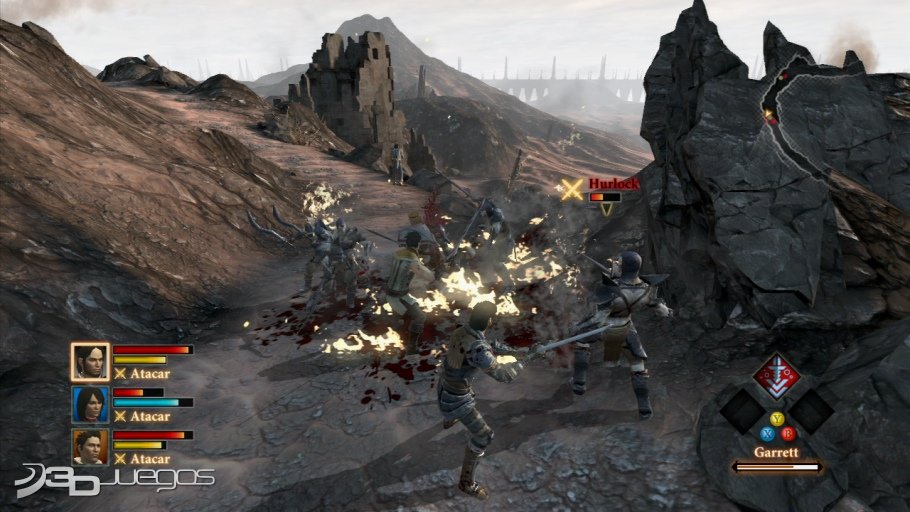
Recently, I’ve been playing Dragon Age 2. I had planned to take a break from Bioware games after finishing Baldur’s Gate, but when I fired up my PS3, for some reason I couldn’t bring myself to start back with Yakuza 4. Instead, I pulled DA2 off the shelf, actually thinking it was the first but not realizing my brother had taken it. It is certainly a Bioware game. My first thoughts were that games have come a long way aurally and visually since Bladur’s Gate, but they haven’t done much on the gameplay side. Look at how far we’ve stayed. The more I played, the more the game’s specific faults and strengths were apparent.

Dragon Age 2 is a small game. There is no getting around that. It isn’t short; I’m nearing the end and likely nearing thirty hours played. It would take at least one more play through to see the bulk of what the game has to offer. But it is small, just one not especially large town and a handful of repeated dungeons to quest in. It is also a good looking game. That likely has to do with how small it is. The game can look good when it only has to render so much.

da2a

The game’s biggest problem is that every quest essentially ends the same way. The player can make decisions, but the end result is the same: a fight. Nine times out of ten, no matter what choices you make during a quest you are still going to have to fight the same battle at the end of it. The big conflict in Kirkwall is the tension between the Templars and the Mages. The game is constantly coming back to that conflict and forcing the player to choose a side, but in the short term the choice don’t matter, because the quests tend to play out the same whether you back the Templars or the Mages. Really, the gameplay is mostly just a simplified version of what was found in Baldur’s Gate. There is a clear line from that first game, to Knights of the Old Republic to this. This plays like Baldur’s Gate designed to be played with a controller instead of a keyboard. In practice, it works out like a slightly inferior version of what was found in Final Fantasy XII.

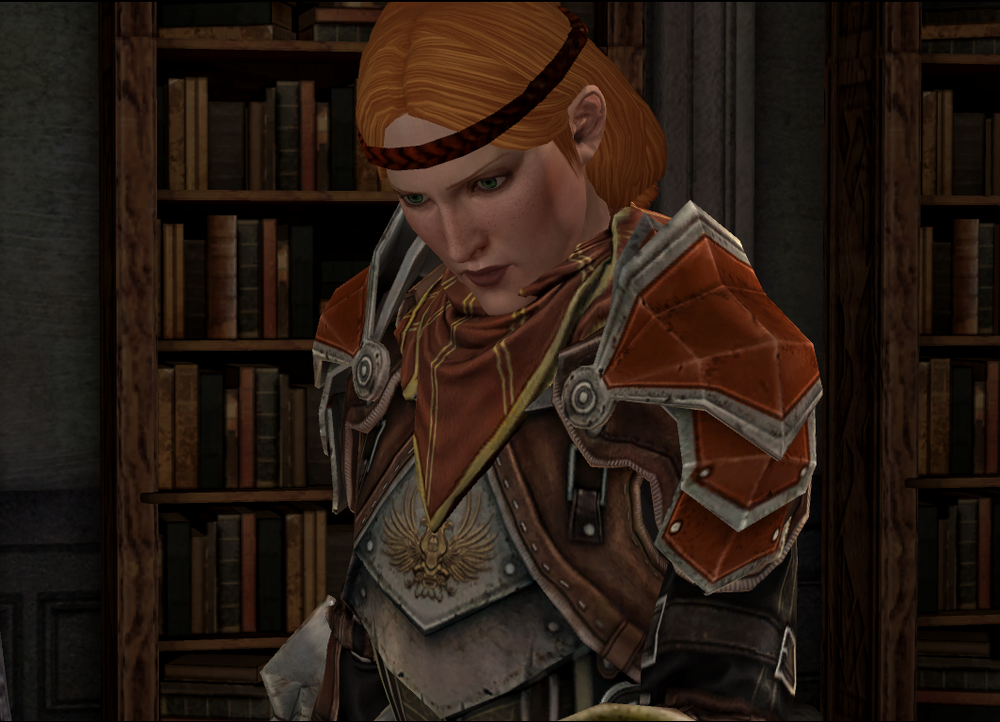
Really, it does a lot of good things on the story telling side, ludonarrative dissonance aside. It sets up a take within a tale, removing the player another step back from the action. You are not necessarily playing the through the events of the game, you are playing though dwarven rascal Varric’s version of what happened. The player makes the choices, but there is another level of separation between the player and the protagonist. It is not the protagonist telling their own story. This is all second hand. Honestly, while there are some foibles, the story is rock solid, one extraordinary individual’s rise from disaster to greatness. Sure, the limpness of The Champion’s family members is a disappointment, but the character the game lets you build and his or her companions are quite good. My character, a female rouge, sided strongly with the Mages, backing her sister at every opportunity. She forged a strong connection with the wayward young elf mage Merrill, especially after her sister was taken to join the circle, fell in love with fellow rogue Isabel and even formed a mutual respect Aveline, the straight-laced guard captain.

da2i

Dragon Age 2 is an interesting game. I was surprised at how much I enjoyed it, because its reputation is that it was something of a mess. It isn’t as epic as other Bioware games, but in place of that epicness the game has an intimacy. This is a small story, and it mostly makes good use of it limited scope.  The only big fly in the ointment there is that movement through the town is not seemless, instead kicking the player back out to a map, making the already small world seem less real. The meta-fictional aspect of it all being Varric’s tale he is telling is really neat in theory, but I don’t think it is used as well as it could be. The game doesn’t make quite enough use of the unreliable narrator. Honestly, I liked the how small the game was, it really kept things focused. It isn’t the bloated mess that many western RPGs turn out to be.  My opinion seems to be opposed to many people who played the game when it was new, when its size was in direct contrast to its more loved predecessor. Removed from prerelease expectation, I have found it to be a fun experience.

JSA Reread Part 8: Our Worlds at War

This is not a huge entry in the series, covering just an inconsequential event tie-in and a fairly slight two part story.  Those two issues, while not particularly important in themselves, do set into motion some much larger events to come.  The standard in comics, really.

JSA: Our Worlds at War 1

JSA Our Worlds at War 01

Johns, Saltares and Kryssing

Our Worlds at War was a crossover primarily centered on Superman and his ancillary characters. Villain Imperiex is trying to destroy the universe and trigger a new big bang to fix imperfections in the universe. He intends for Earth to be the epicenter of his recreation of the universe. President Lex Luthor (strange times) rallies the heroes of Earth to fight him, and Brainiac, off and save Earth and the universe.

JSA Our Worlds at War 02

This issue is far from essential to the run. It does have some interesting things going on, but it is really just fluff. It takes the legacy approach of the title and mixes it with the society. Basically every old or named for an old hero that is not on another team is called into action with the JSA. People like Iron Monroe and the Freedom Fighters. It also has the first JSA appearance of Power Girl. She immediately adds some pep to the team, another character that is just abrasive enough to cause some waves.

JSA Our Worlds at War 03

The JSA and about three or four more teams worth of characters are given the mission of going into space and stopping Imperiex’s Jupiter sized ship. When the get there, they find that the ship is powered by the planet Daxam, whose inhabitants have Superman like powers. So they split into several teams. The most powerful members cause a distraction while the unpowered characters go to shut down the ship and the Freedom Fighters attempt to free Daxam. Lastly, the magical characters try to find a way to send Daxam back where it belongs.

JSA Our Worlds at War 04

There really isn’t much more to say than they succeed. It does play up some ongoing character stuff. Atom Smasher doesn’t like having a former villain in Black Adam on the team. Hawkman is chasing after Hawkgirl like she was in heat. Dr. Mid-Nite and Black Canary are dating. There is another appearance by Nemesis. It is a fine tie in issue, but that is all it really is. The art is no great shakes either, but the sheer number of characters around in most issues makes it hard to judge the artist too harshly for it. This could not have been an easy book to draw. It does reinforce that the JSA are the keepers of superhero legacy. The opening pages are all the heroes introducing themselves and saying who they are carrying on for, or maybe just who they stole their name from.


JSA 26 Who Do You Trust

JSA 26-1

Johns, Morales and Bair

This issue, another sort of breather that is credited to Johns only, starts with Atom Smasher challenging Black Adam to an arm wrestling match. Smasher doesn’t like having Black Adam on the team, despite his approval from the senior members of the team. He doesn’t think villains are capable of reforming. Black Adam doesn’t consider himself a villain and doesn’t think he needs reformation. Atom Smasher is still a little lost from way back in issue #15 when he killed Extant. There to cheer Atom Smasher on is Star Spangled Kid. Those two are in some ways the heart of the book, Star being the good student and Atom the wayward one.
JSA 26-2

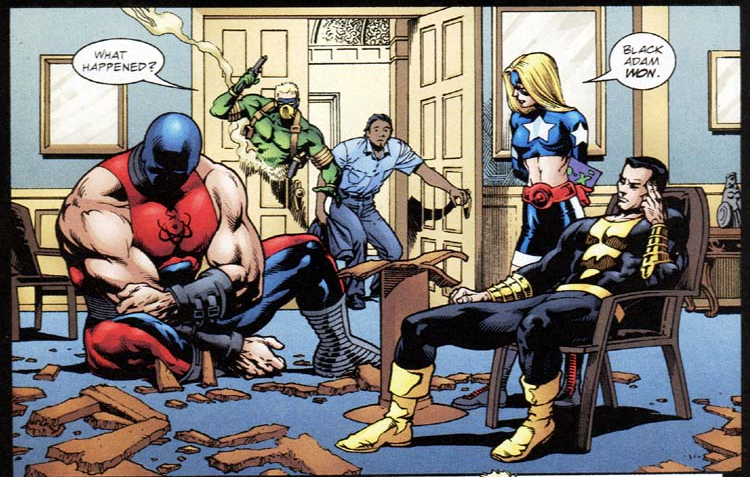
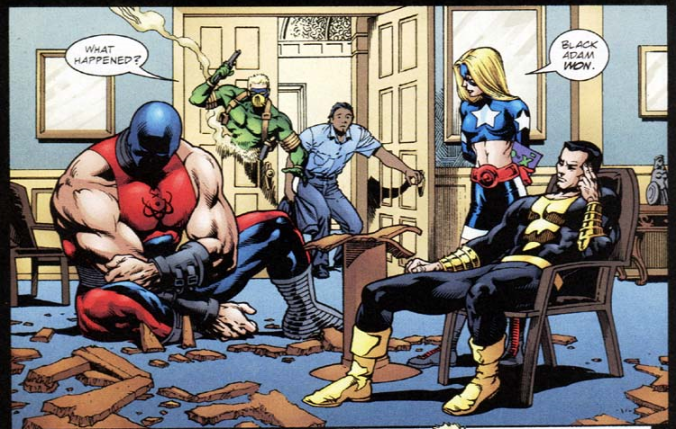
Elsewhere, Sand is showing the new curator, Alex Montez, around the museum area of the Brownstone. He is the brother of Yolanda Montez, who for a time was the second Wildcat, though she was unfortunately killed. Still, there is no piece of history from these characters that Johns won’t incorporate into the title. Alex is something of a legacy to. A crash in the conference room sends them running to find that Atom and Adam have smashed the table. After Sand gives them a dressing down, Star goes to show Hawkgirl the pictures of her new baby sister while Sand and Alex continue with the tour.

They find Wildcat and Hawkman retrieve Hawkman’s mace and chatting about Hawkgirl. Wildcat rushed to catch up with Alex. Sand pulls Hawkman aside and offers him the chairmanship of the JSA. Hawkman declines, telling Sand he’s doing a great job before flying away.

In the infirmary, Dr. Fate is again trying to rouse his comatose wife. When he fails, he retreats to his Tower to research a method of freeing her from Mordu’s curse. After he leaves, Dr. Mid-Nite has a talk with Sentinel about his recent physical. He is in suspiciously perfect health and Terrific and Mid-Nite think that his body is now composed entirely of the Green Flame that gives him his powers.

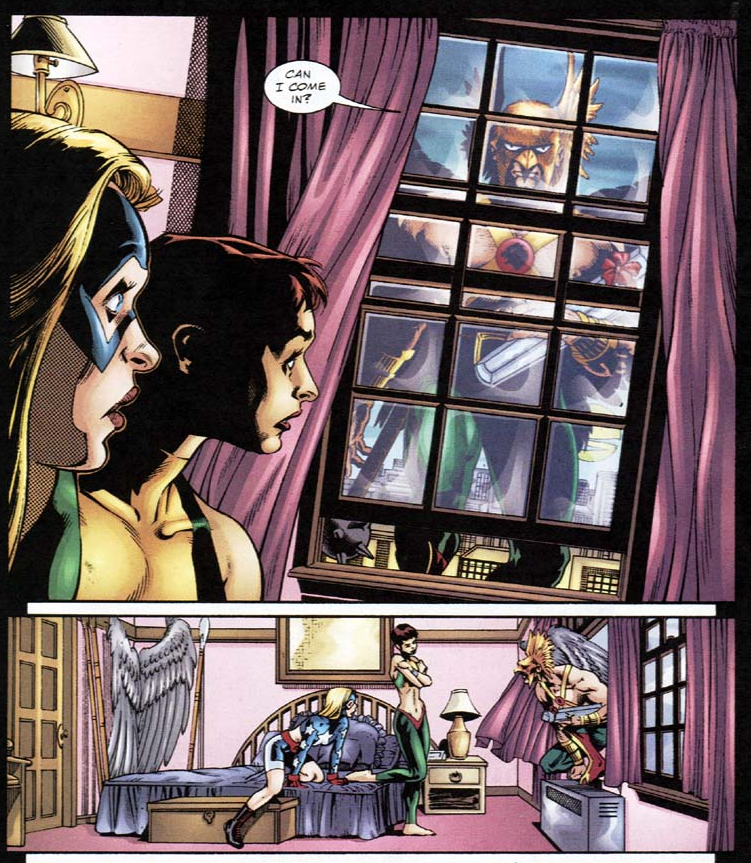
Star is with Hawkgirl, showing her the pictures of her new baby sister, when Hawkman flies up to the window with flowers for Hawkgirl. He won’t stop pushing her about beginning or continuing their relationship. Really, Hawkman comes off as a huge dick. Which makes sense for Hawkman. Meanwhile, Black Adam and Atom Smasher have finished cleaning up the table when Adam makes a comment about it being a poor use of their powers. They start to argue again, only for it to be broken up this time by the big red cheese himself, Captain Marvel.

JSA 26-3

Sand finishes with Alex, only to find Hawkgirl crying in her room. He tries to council her. Hawkgirl is in the strange position of being both the continuation of a legacy and the originator of it. She is both Kendra Saunders, Hawkgirl’s cousin and Hawkgirl reborn. All she really wants is for Hawkman to leave her alone and let her sort out her feelings. Outside, Hawkman is flying around trying to figure out how to make her comfortable when he flies to her window again (flying in her window whenever feels like is probably a bad way to go about that) only to see her kissing Sand.

JSA 26-4

That is where the issue ends, with Hawkman staring in shock at Hawkgirl and Sand kissing. While this story plays out pretty quickly, it never really feels right. Hawkman is consistently a jerk, but here he is just an ass, jumping to conclusions and getting jealous for no damn reason. He is the only one that comes out looking bad in this and the only one that does suffer some adverse consequences from it. The bigger story in this issue is the Atom vs Adam stuff. Johns lays it on thick, but these two have a very good reason to be fighting. Letting Black Adam, who shows no remorse for his misdeeds because he doesn’t consider them his, on to the team does not gel with Atom Smasher increasingly hardline take dealing with villains. He saw first-hand what happens when villains are allowed to go free.


JSA 27 Thunderstruck

JSA 27-1

Johns, Morales, and Bair

This issue starts right off the last one, with Hawkman seeing Sand and Hawkgirl kissing. It then shows the reactions inside, where Sand pushes Hawkgirl away. She was kissing Sand because she was looking to be in a relationship with anybody but Hawkman, who is pressuring her to get together again. Sand comforts her and agrees to tell Hawkman to back off.

After a quick interlude with Captain Marvel and Black Adam, where Atom Smasher punches Black Adam through the roof, Mr. Terrific and Dr. Mid-Nite prove their hypothesis about Sentinel just as the alarm, trigger by Black Adam’s forcible ejection, goes off. They rush to confront the problem. The all get to the Aviary to find Atom Smasher blaming himself, rightly, for causing trouble with Black Adam as the former villain and Captain Marvel, who is trying to calm him down, fight in the sky. Atom Smasher knows he messed up, that is what he does. He is possible the most earnest member of the team, he is a superhero because he wants nothing more than to help people. Not that the others don’t, but he is the one who grew up specifically wanting to be a superhero. After what he did to Extant, he’s forced to actually examine what it means to him to be a hero. He overreacts to Black Adam’s comment about getting glory for doing good mostly because he doesn’t want to think about whether there is any truth to it. He doesn’t want to accept that someone like Black Adam could reform because he didn’t give Extant the chance to do so. Maybe causing his death was not the right move, maybe Atom Smasher messed up and that is the last thing he wants to do as a superhero.

JSA 27-2

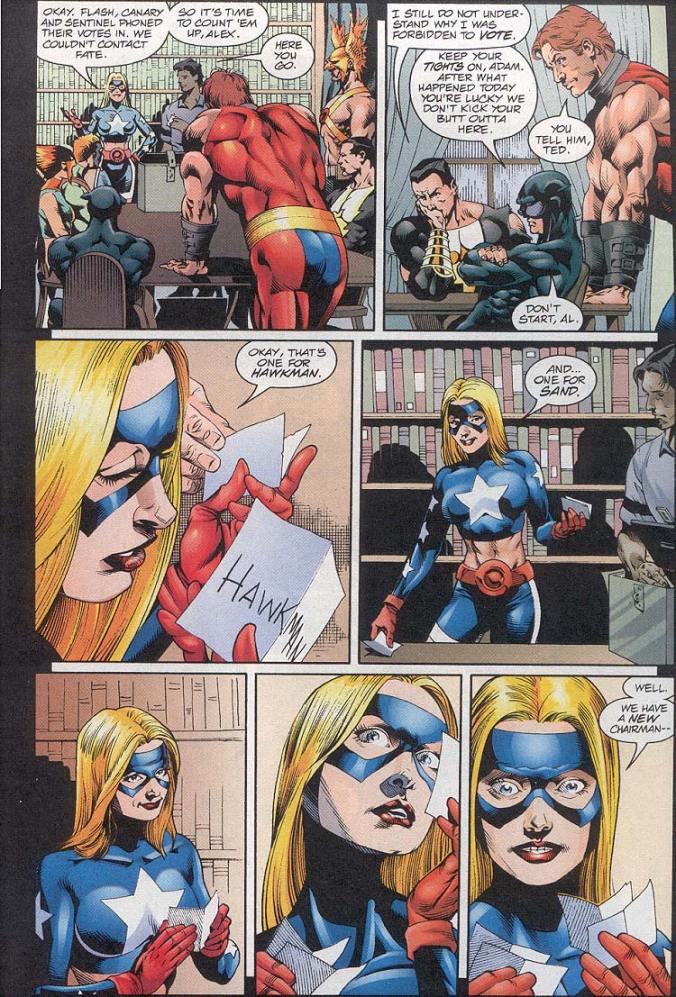
They all fight with Black Adam for a few pages before Hawkman shows back, drops his mace in the middle of the scrum and declares the fight over. Completely ignore Sand, the team leader recall, Hawkman takes control of the situation and takes Captain Marvel and Black Adam into the meeting room. It turns out that Captain Marvel was actually there to vouch for Black Adam and declare him worthy of receiving a second chance. After he leaves, Sand storms into the room. He confronts Hawkman about whether he wants to lead the team or not, but the rest of the team bursts in and demands they take a vote on the matter. After the votes a quickly tallied, the new chairman is neither Sand nor Hawkman, but Mr. Terrific.
JSA 27-3

Really, this is mostly a blow to Sand. Hawkman is not a huge player in this book, he was generally busy in his own Johns written book at the time, but until now Sand had been one of the biggest players in this title. A lot of that was due to him being the leader of the team; he was the team’s center. He fit in between the old hands, like Sentinel and Flash, and with the new guns like Star Spangled Kid and Hawkgirl. Now, he is just another cog in the machine. He is not going to leave the team, at least not for a good long time, but he is no longer as front and center as he has been. Mr. Terrific, though, now gets pushed up to the top rung. He is the team’s center.

So Star and Wildcat run out to get some pizza for the team and the others all congratulate Mr. Terrific, one of his T-Sphere’s flies in erratically. But It is not one of his, and it teleports all the team members present (Terrific, Mid-Nite, Sand, Hawkman, Hawkgirl, Atom Smasher and Black Adam) away. The sphere flies away to a woman, Roulette, in an elegant dress and a massive tattoo up her side, who says it is time to place bets. Her limo is licensed in Nevada and it is clear that they are to be used in some sort of gambling scheme.

JSA 27-4

This issue is rather slight. Much of its real estate is taken up with a pointless fight with Black Adam. Still, some momentous things do happen, from Black Adam’s acceptance on the team to Mr. Terrific becoming team leader. It isn’t bad, but it really feels like more could have been done with the 22 pages of this issue. The fight with Black Adam is neither visually interesting nor is it narratively important. We already know that he is tough and that he has a temper, the big brawl is unnecessary. Still, it works as a slow paced stop after the epic heights of The Return of Hawkman.

Next time: Roulette.