Professor Marston and the Wonder Women

With fortuitous timing, Professor Marston and the Wonder Women arrives perfectly timed to cash in on the current popularity of Wonder Woman. Not that the movie could accurately be described as a cash in, it is a delightful film. In some ways very traditional and in others very unconventional.

Professor Marston and the Wonder Women tells the story of psychology professor William Moulton Marston, who created the superhero Wonder Woman, with some help from his wife and girlfriend. That wife and girlfriend thing is what the movie is really about. It is based on the real life of this triad, Marston, Elizabeth Holloway and Olive Byrne. Holloway and Marston are already married at the start, when Marston becomes infatuated with their new student assistant Byrne. A romance develops between the three of them that leads to a sort of triad.

One of the best things this movie does is to stage the movie as a traditional romance. Formally this is very much a classic romance, with the same sort of obstacles and journey, only that structure is applied to a love story that is anything but traditional. It works, not toning down the content of the story but also not presenting it as lurid or obscene, just a normally somewhat melodramatic romance. At the time, and really would be even now, their story was a sensational one. Their triad relationship is pretty outre, with or without the bondage. From the account in The Secret History of Wonder Woman, Professor Marston actually plays up the luridness of the relationship in content, but because the movie doesn’t present it as such, it plays very differently. Ignoring any sort of moralistic concerns, the relationship at the heart of this movie was apparently a happy and long lasting one. It is presented as a true love story and the facts back that up. By not staging it as something extreme, it downplays the differentness of the relationship, including the absolute ickiness of the fact that it began while Olive was Marston’s student, allowing the other parts to shine through.

It is also just well constructed. Luke Evans is fun as William Marston, being almost childlike in his enthusiasm but also clearly educated. He is an idealist and a fantastic weirdo and Evans brings that across. Bella Heathcote brings vulnerability but not truly naivety to Olive Byrne. She knows what she is getting into and goes into it hopefully but not blindly. Rebecca Hall as Elizabeth gives the best performance as the voice of reason in this triad, the one who recognizes how this will be viewed by others and how hard it will hurt their reputation and their children. She isn’t cold, but she is pragmatic. Hall makes her conflicts clear, she is clearly not unfeeling; she wants this relationship too. But she has the hardest journey to get to the point of believing in it. Mostly because she is more experienced than Olive and more rational than her husband. Again, the movie is kind of old fashioned in its presentation, which works well as a contrast with the content.

The one part of the movie that gets kind of sidelined is the creation of Wonder Woman. As a comic fan, I immediately recognized that it was somewhat fictionalized. But little about the character or the content really come through. That is not what this movie is really about, it is a small part of a larger story, but it supposedly builds up to his hearing with the decency board and that thread is ultimately unfulfilling.

Professor Marston and the Wonder Women is one of the more entertaining biopics I’ve seen in recent years. It tells a story that legitimately hasn’t been seen before, or at least tells this story in a new way. It is highly worth seeing, though fans of this summer’s Wonder Woman might not get the story of that character’s creation that they might expect.

****1/2
Logan Lucky Review

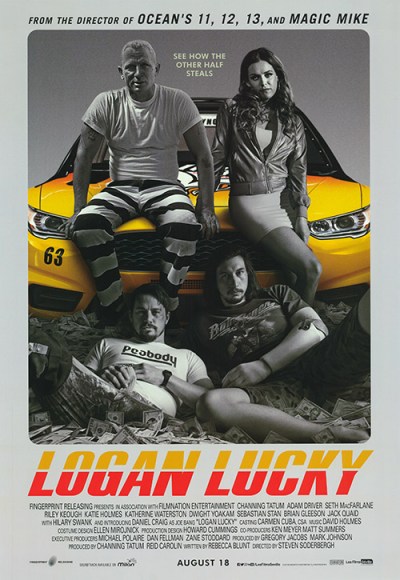
I’m not a big Steven Soderbergh fan. Not that I don’t like his movies, only that I’ve only seen the Ocean’s trilogy and those, while enjoyable and essentially perfectly crafted, didn’t leave that big of an impression on me. Logan Lucky uses a similar formula, but replaces Ocean’s Vegas glitz with West Virginia grit. It works, with strong performances all around and funny moments from start to finish.

Channing Tatum plays Jimmy Logan; a divorced father who loses his job thanks to an old football injury that causes a liability issue at the same time he finds out his ex is taking their daughter and moving.  He needs money.  So he concocts a plan with his siblings, the one armed Clyde (Adam Driver) and hairdresser Mellie (Riley Keough), to rob a race track.  They recruit another group of siblings, the Bang brothers, to help them.  It is a heist movie, with the characters going through the usual hurdles of a heist movie, like needing to appear to be one place when they are actually somewhere else, before it all comes together.

It is a joy to watch even these largely kind of stupid characters be good at their jobs.  The Logan brothers are especially competent, while Joe Bang, played by a Daniel Craig who appears to be having a blast, MacGyver like knowledge of explosives is delightful.  Soderbergh knows the heist game as well as anybody, and he executes it again here.

I don’t want to explain more of the plot, because the joy is seeing it play out for yourself.  Any plot details, other than the base premise seem to spoil something.  This is a tight movie, with everything working just as it should.  Tatum is the perfect rock for the rest of oddball characters to play off of. He and Driver really manage to feel like brothers, with long standing gripes with each other but no doubt that the two of them always have each other’s backs.

This is the perfect movie to close out a somewhat disappointing summer.  It is just so competent and entertaining.  It isn’t a desperate attempt to set up a franchise or the dying gasp of last decade’s franchise.  Its plot is complex without being convoluted and just so goddamned effortlessly entertaining.

****1/2

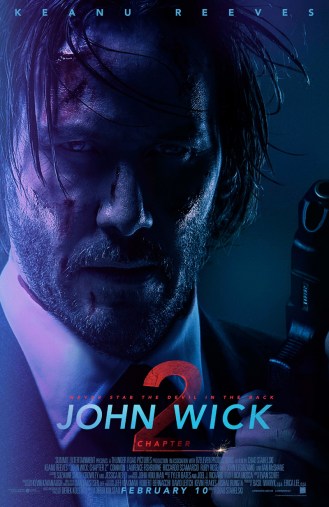
John Wick Chapter 2

jwc2

The first John Wick movie was a very well executed piece of pulp. It was a stripped down, lean revenge movie with excellent action sequences and some nice bits of humor. This follow up loses a lot of the humor, but comes back strong in every other regard, fleshing out the world that first movie only hinted at and doing its best to outdo that movies already terrific action. I don’t know that it quite succeeds in being better than the first movie, but if it’s not it is really close.

John Wick Chapter 2 picks up soon after the last movie left off. Once Wick (Keanu Reeves) has gotten revenge for the murder of his puppy, he sets out to retrieve the car that was stolen from him at the same time. Once that little detail is taken care of, he returns home with his new dog to resettle into retired life, only to find another link to his time as a hitman coming back in the form of Santino D’Antonio. Wick owes him a blood debt and since Santino has heard that Wick is out of retirement, he’s decided to cash in. After some convincing, Wick takes on the mission and the movie is off and going.

The movie does a lot of more to flesh out the intricate underworld that the first movie hinted at with its Continental hotel that caters to assassins and everyone pays in gold. The rules that they all live by, most importantly that no business is to be done on Continental grounds, are fleshed out and made more clear. It does this not through rote or dull dialogue, but by having Wick take advantage of the services provided and oblique conversations that mention new concepts. It gives the viewer just enough to understand the plot and to give the feeling that there is more going on in this world than is immediately apparent. The best little Continental interlude is easily Wick’s visit to the sommelier, who instead of dispensing wines he helps match customers to the proper weapons. It is one of the few scenes that keep the first film’s sense of humor.

Where the film truly shines is its actions scenes. Few movies have actions scenes as well choreographed and realized as the John Wick movies. Much of the thanks goes to Keanu Reeves, who is able to do the extended takes that many of the action scenes here feature. Unlike many choppy action movies, John Wick’s fight scenes are frequently smooth takes that go on much longer than most and zoom out further to give the viewer a better view of scene rather than closer to hide how much of it isn’t really happening. It helps that whoever staged the action did simply an incredible job. The action is as good as it gets and that is why you are coming. It is worth mentioning, though, that the fights have incredibly graphic violence, so those with an aversion to blood or unspeakable things done with a pencil might want to think long and hard before watching this.

The film’s storytelling economy that reveals its world is also put to good use introducing characters, especially since the bulk of the characters from the last movie didn’t make it out alive. John Wick Chapter 2 introduces some rival assassins in Common’s Cassian and Ruby Rose’s Ares, both of which are given fairly full sketches with only small amounts of screen time. It also introduces Laurence Fishbourne as some sort of homeless king in a fun cameo, as well as maximizing the time to the returning Ian McShane and Lance Reddick.

The title character changes the most in this second film, or more accurately our perception of him changes the most. In the first he was a retired assassin out for revenge, now he is an assassin out of retirement. Before it was kind of fun, this time it is more sad. There is no escape for John Wick, and when there is an escape he seems incapable of taking it. It changes him from a driven, talented man out for revenge to a very sad man with a death wish. He could walk away, he should walk away but what does he have to walk away to? This movie systematically strips the few things he had after the last movie away from him, leaving him with nothing.

While it is something of a downer, it is still an excellent film. It is the Empire Strikes Back to the first John Wick’s Star Wars. With a third movie already announced on the way let’s hope there is a satisfying next chapter in this tale.

****1/2

To the Cinema: Harry Potter 7, Part 1

With the release of Harry Potter and the Deathly Hallows, Part 1, the dominant pop culture franchise of the last decade begins its end.  Sure, the last book has been out for more than 3 years, which has lessened the excitement around the series, but the two-part last movie is Harry’s final send-off.  Fortunately, the first part of it is the best movie in the series to date.

For the record, I mostly did not like the last book.  I had been a fan of the series since the first book came out, and I was on line at midnight to buy The Deathly Hallows.  I had the book read by 9:30 that morning and I have not touched the book since.  Partially this is because I’ve had the book loaned to friends and relatives for much of the intervening three years, but mostly because I just did not care to read it again.  The book does away with Hogwarts and its various intrigues to focus on the much less interesting battle between good and evil.  That was to be expected and is understandable, but the school stuff was replaced with interminable camping scenes.  While I did not hate the book, I did enjoy it much less than the other books in the series.

The movie, however, is better than the others are for some of the same reasons the book was worse.  The lack of Hogwarts is to the movies advantage.  Those parts never really worked in the movies and Deathly Hallows benefits from their absence.  The camping scenes, which drag in the book, actually help the movie maintain its tension.  Combined with the captivating landscapes in some of those shots help make Harry and his companions feel isolated and lost.

Another thing that helps the film is the decision to split the book into two movies.  While this seems like, and probably is, a blatant cash grab, cutting the book in half allows the movie to slow the pace down.  Most of the previous movies tried to be so faithful to the source material that they felt more like filmed summaries moving at a breakneck pace in an attempt to include every possible scene from the book.  To be fair, I am not sure there was a better way to handle the adaptations, but it did occasionally kill the movies’ pacing.  Covering only half of a book in this movie, though, allows the director to construct scenes that are not always rushing to their end.  This pace that occasionally stops to take a breath is the biggest improvement over the previous movies.

It is also apparent how much better the principle actors are than they were in the first couple of movies.  This movie relies on the trio of Harry, Ron, and Hermione, and the three performers do a good job.  The movie feels more like a thriller or horror movie rather than the straight magical adventure of the previous ones.  This is something from the books that had been lost in the previous films.  However, Deathly Hallows sticks more successfully to the book’s tone.

Even though I liked Deathly Hallows, all is not peaches and gravy.  It ends on a cliffhanger and really feels like very little was accomplished.  It is hard to shake the feeling that you just watched a two and a half hour prelude to Part 2.  Moreover, for what is ostensibly a children’s movie there is quite a bit of gore and sexual content.  Even with my praise of the slower pacing, outside of the escape scene at the beginning and the infiltration of the magical Nazi headquarters, there is not a ton of action.

Harry Potter and the Deathly Hallows, Part 1 is a flawed but entertaining movie.  Even with those flaws, it is the best Harry Potter film.  It is sad to see Harry go, but I’m glad he gets to leave in such a satisfactory manner.

***1/2