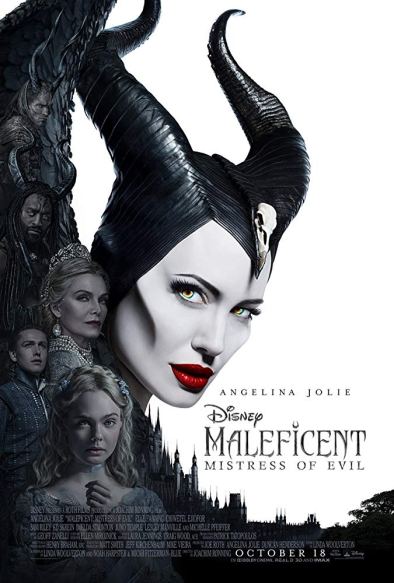
Maleficent: Mistress of Evil

The first Maleficent movie was one of the better Disney live action adaptations because it was one of the few that did more than slavishly recreate the animated movie. I mean, a version of the story where the bad guy is actually the good guy is not the most original thing, but at least it’s something. (I know I didn’t like Dumbo which did the same, but it was bad for other reasons). This sequel had the potential to be something really good and at times its seems poised to realize that potential, only for it to be kind of muddled and distracted. Early on, the movie, when Maleficent is preparing to meet her daughters new in laws, practicing small talk with her raven companion, hints at a much better version of this. A movie that builds to the conflict between Maleficent and fey against the humans. A comedy of manners that spirals out of control. Instead, the movie jumps right to a brewing war.

The problem is the movie has so much to get to that it can’t let any of it land. There is the marriage plot, the people kidnapping fairies, the dark fey, like Maleficent, who are itching for a fight with the humans. Much of it needs to be explained. But in the midst of all the explaining, there is little time for anything else. It also renders the heroes alternately moronic and inert. The connection between Aurora and Maleficent was established in the first movie, it doesn’t make a lot of sense how quickly she believes the worst of her. Maleficent has to get all of the history of the dark fey and their current situation in a quick dump, with no time to process finding a whole world of people just like her. Phillip’s mother Queen Ingrith is plotting a war, and the movie has to walk the viewer through it.

All of these plots could be interesting, if the movie either handled them with a lighter touch or had a little more time to work through them. It almost feels like the last two parts of a trilogy smashed together. Maleficent’s journey doesn’t quite work. She goes from distant, but loving mother, to spurned and hated, to prophesied hero over the course of this movie, but none of it really lands. No one else really has much of an arc. Aurora learns something she already knew. Everyone else learns that racism is bad.

At least the movie looks good. The magical creatures don’t exactly look real, but they look appealing. The fey are really well done, with their wings looking and acting like real appendages most of the time. It also has some awe inspiring castles and vistas. The movie simply looks good.

Angelina Jolie is pretty great as Maleficent. And Michelle Pfeiffer seems to be having fun as the evil Queen Ingrith. Elle Fanning has precious little to do as Aurora, and Prince Phillip spends most of the movie being ineffectual. It is just short of being a waste of a great cast, only saved by how much the actors seem to be enjoying themselves.

As messy as it is, I still largely enjoyed Maleficent Mistress of Evil. I don’t think it’s good, but there are enough interesting things going on that I don’t regret seeing it.

**1/2
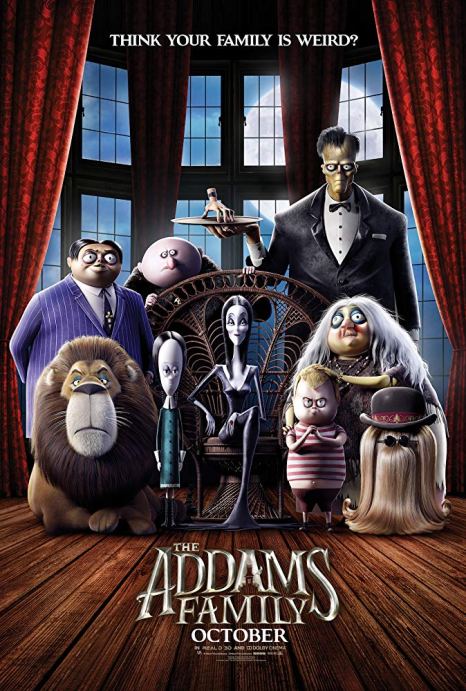
Addams Family

I feel like I shouldn’t like this version of The Addams Family. Sure the character designs for this adhere pretty closely to the look from the original single panel comics, but the movie does all the things that tend to sink bad modern animated movies. Gratuitous pop culture references, obnoxious needle drops, star-studded voice casts that aren’t really voice actors, cardboard stories. Somehow, though, I found myself very entertained by it anyway. That might just be my natural affection for the Addams family. This movie turns their satire of old money weirdness into a tale about immigrants, but it keeps the charm of this group of delightful weirdos. It isn’t the best movie you are likely to see this year, but it is a more than passable way to spend 90 minutes.

The plot is barely worth recounting. The Addamses, the consummate weirdos that they are, are driven out of their home country, due to racism that feels sadly timely. They settle in a New Jersey swamp and begin to raise a family. Some fifteen or so years later, someone builds a housing development in the swamp and suddenly the Addams have neighbors. This is happening when the extended family is coming into town for Pugsley’s Mazurka ceremony, where he becomes an Addams man. Wednesday wants to learn more of the outside world and go to the local middle school. The ‘normal’ people clash with the Addams. Everyone learns some sort of lesson.

There are plenty of good bits with the people reacting to the strangeness of the Addams. Whether it is Wednesday and Pugsley being caged schooled, or the constant murder attempts, or anything with Fester, they are fun. The Addams Family works because they combine the outwardly spooky traits of the Addams with their treating everything like normal. They are a happy family that just so happens to be filled with psychopaths. The movie goes overboard with the ‘normal’ people though. Does the town need to be named Assimilation? DO they need to sing a song about how great it is to be just like everyone else? There is a movie where that stuff would work, but this movie is either pushing it too far or not pushing it far enough. Go full brainwashed weirdness with that stuff, or dump entirely. Doing just a little bit of it muddles exactly whether these are normal people or cult members. Actually, the Addams family would likely love to be living next to a cult. There are good individual sequences and a good message in this movie but it only barely overcomes the junk that would sink a movie with lesser characters at the heart. (See The Angry Birds movie.)

One way this movie was never going to satisfy me is that it wasn’t going to replace the 90’s movies as my favorite versions of these characters. I won’t claim to be overly familiar with the comics, but I did watch quite a bit of the TV show on stuff like Nick at Night (a quick google search suggests that Nick at Night never aired the Addams Family; so while I watched it somewhere in the early 90’s, it wasn’t there). The movies, especially the sequel Addams Family Values, are what I really loved. This movie was never going to be that. But I am judging what it is, not what it is not. This movie stays true to the characters and the family, has some good jokes and is rarely actively obnoxious, but just as rarely actually truly outstanding. It is worth seeing.

***

Gemini Man

Gemini Man is a movie I wish I liked more than I do. It is this weird juxtaposition of a throwback to 90’s sci-fi thrillers and a movie that is pushing technological boundaries as far as possible. Ang Lee is more thoughtful with his approach than I believe most directors would be, but this movie still feels like it did not fully consider the ramifications of the events in the plot. Still, as unsatisfying as the story ends up being, it does feature a collection of largely excellent actions scenes to make it at least worthwhile.

Will Smith plays Henry Brogan, a government assassin who feels the years catching up with him and decides to retire after nearly missing a shot on a job. He meets up with an old marine buddy, who uses his connections to look into the man Brogan just assassinated, and learned that he was not a terrorist like Brogan was told. Before they can go forward, the old friend his killed. Brogan realizes that he is next and teams with an agent sent to watch him, played by Mary Elizabeth Winstead, to escape and figure out what is going on. He is escaping from Clay Verris, who reveals that his top agent is a younger version of Brogan. After a few showdowns where neither agent can get the upper hand, Brogan gets to the bottom of things.

As I noted above, the action scenes are really good. There is an excellent motorcycle chase and a brutal fight in some catacombs. It is not quite John Wick, but they are good. It also is more worried about the inner lives of its characters, or at least with Brogan and Junior, than most action movies are. It is also just filled with terrible, obvious dialogue. Like early on when Brogan laments that he “hates looking in the mirror.” It was bad enough then, but later the movie calls back to that line to tie it directly to his struggle with his younger self. The movie is full of stuff like that. Its bad. The plot is wild, though mostly internally consistent. I’ve heard some people complain about dropped plots, but it holds together well enough if you just pay attention.

I know some people are really into the technical aspects of this movie, but I am at best neutral when it comes to what this movie does. I do not get the appeal of high frame rate. I understand what it is and why it is technically better, but my eyes have been trained to watch movies at the regular rate. The same goes for 3D, which even when done well is not really a positive. The high definition stuff is good, I guess. I have some appreciation for the movie pushing boundaries, but that can’t be the only justification for its existence. There is enough good otherwise here to make the movie worthwhile. I guess the HFR and 3D stuff did not do anything to make the script terrible.

Gemini Man falls just on the side of being worthwhile. Will Smith and Mary Elizabeth Winstead fun to watch and the action scenes are well executed. The movie, however, is dragged down by some terrible dialogue and convenient plotting. It ends up feeling like something of a missed opportunity.

**1/2

Joker Review

I don’t know that I’ve seen a better made bad movie. It is a movie wearing the darkness and grit of late 70s-early 80s Scorsese as cosplay, without attempting to understand what movies like King of Comedy or Taxi Driver were trying to say. Essentially, why is not a question Joker ever considers. It does things because those things seem dark and provoking, but there is nothing behind them. It is vacant posturing, a movie hoping its darkness will mask its emptiness.

Joker tells the story of Arthur Fleck. Fleck works as a clown, scraping out a life in what appears to the early 80s Gotham City for him and his invalid mother. Fleck suffers from mental illness, taking numerous medications and still being prone to bouts of irrational laughter. He dreams of being a stand up comic, like his idol Murray Franklin. In the opening minutes of the movie, Fleck is beaten by a handful of kids who were harassing him as he worked as a clown. From his already abject starting point things get worse for Fleck. The funding for the social services that helped him pay for his medications gets cut, so he goes off his meds. He gets a gun from a coworker after his beating, but having while working gets him fired from his clown job. After another beating on the subway, Fleck fights back, shooting three men who were accosting him. The lone bright spot in his life is his budding relationship with a single mother living a few apartments down from him and his mother.

As shit keeps being piled on Fleck, he begins losing his hold on rationality. Many people treat his subway killings as a call to action, since the three men were well off money men, working for Wayne Enterprises. Thomas Wayne, exploring a potential run for mayor, calls the poor people reacting that way clowns, inspiring clown make-up at the protests arising all over the city. Things finally come to a head when Fleck gets the chance to meet Murray Franklin.

Joker pulls scenes and shots straight out of movies like Taxi Driver, The King of Comedy, and A Clockwork Orange. It seems desperate to appear to have something to say. But as the movie attempts to unravel Arthur Fleck goes on, it becomes more apparent that there is nothing there. That is despite some all caps ACTING from Joaquin Phoenix in the title role. Fleck starts delusion. The movie maybe wants to show why the character finally broke and became the Joker, but it doesn’t come to a better answer than that he was crazy. The movie can’t seem to help but show its contempt for the people protesting in the streets, but they are contrasted with the selfish and corrupt like Wayne or Franklin. Everyone is venal and self-serving.

The movie was numbing. Its desire to shock, to provoke radiates from every scene. But the movie doesn’t actually have anything provoking to say. It is utterly bleak, but that bleakness isn’t expressing anything. It isn’t a black comedy; there is nothing funny here. This is just two hours of ugly posturing that has nothing to say.

**

Ad Astra Review

Ad Astra joins the ranks of a rash of hard-ish science fiction movies. They present plausibly realistic futures and show people dealing with the harsh realities of the unforgiving nature of space. Movies like The Martian, Gravity, and Interstellar. I don’t know if this is the best of those, but does it really matter when the end result is another thoughtful, interesting space movie to enjoy.

Brad Pitt stars as astronaut Major Roy McBride. The movie introduces him as the coolest man in the US Space Command. His heart rate never cracks 80 bpm, not even when he is falling off a space antenna back to earth after a strange energy surge causes disasters all over the world.

The accident that send McBride plummeting back to earth is what sets up the plot of the movie. That energy surge came from the Lima Project, a research mission to the outer edge of the solar system that was captained by Clifford McBride, Roy’s father and one of the most decorated astronauts ever. They were reported lost years ago, but this surge is the first communication with them in 16 years. So mission command wants to send Roy to Mars to get a message to his father to stop whatever is happening, and to get a precise location for the Lima Project.

So Roy goes to space. The movie presents an interesting dichotomy between the physical journey and the emotional one. Roy’s trip is a Heart of Darkness-esque trek into the unknown, getting further and further from anything he recognizes. There is a lot of pulpy action, with a car chase and zero-g fights. This is presented with austerity and solemnity, but it is really stuff that verges on silly. The combination works, the presentation really sells the wilder stuff happening.

It dovetails nicely with the emotional journey that Roy goes on. At the start, he seems to idolize his father, but also resent his absence. As long as he is on, or near, earth he can maintain his balance. As he travels further from his home, and closer to the father he didn’t really know, the more unbalanced he becomes. This is doubly true as he begins to learn more about his father and The Lima Project. He has to deal with finding out that his father may not be the hero he has been portrayed as as he journeys further and further out into space.

What makes the movie work is Pitt. He is at first somewhat inscrutable; his is cool and cut off from his emotions. He keeps his cool by essentially cutting off his emotions, not actually dealing with his emotional problems. Pitt plays the coldness perfectly, as he does the slow unraveling of Roy’s emotional state as he gets closer to a reunion with his father and as that eventual reunion becomes more conflicted. When the big moment finally happens, you’ve been on this emotional journey with Roy and know where he is.

The movie is a bit too somber and spare at times; it feels like it could be a much more fun movie and still accomplish its central journey. But in my experience that looseness and fun is anathema to James Gray’s filmmaking. But that is a criticism of what this movie is not, not what this movie is. I found it to be one of the most moving film watching experiences I’ve had this year. Ad Astra is a must see.

****1/2

Hustlers Review

Another review I read of Hustlers described it as “Goodfellas in a g-string,” and I cannot think of a better description than that. Hustlers is a crime movie that puts the focus on women. A group of dancers pull a scam on their odious clients, at least until a few of them can overcome the shame and tell the police what happened. It is one of the better movies to come out in the last few months and a good kick off for fall movies.

This is a true crime story of a group of strippers who stole tons of money from their clients. They did this by drugging them and stealing their credit cards. Constance Wu stars as Destiny, who comes under the wing of experienced dancer Ramona, played by Jennifer Lopez. Ramona teaches Destiny how to dance. Eventually, they split up, but after Destiny’s relationship fails and she tries to go back to dancing, they meet back up. The early part of the movie takes place before the financial collapse, the latter half after. The money just doesn’t flow like it did before. So Ramona assembles a crew for a new venture. They go to bars and find men and entice them to go to the strip club. But eventually that well runs dry. So then they hatch a new plan; drugging the men, bringing them to the club and robbing them blind.

Hustlers does a great job of playing with the audience’s sympathies. The first hour is all about getting you to sympathize with its main characters. You see the women’s struggles and their dreams. Those dreams might be somewhat ridiculous–I am not sure about Ramona’s clothing line of denim swimwear–but the movie never asks you to laugh at them. It also goes out of its way to portray the men who are coming into the club as absolute creeps. They are mostly wall street traders just before the stock market collapse. The movie gets you on board with them, and when their efforts turn criminal the movie makes it easy to follow their justifications. Then the movie pushes further and further. The marks become less odious, the women less justified. Then the movie pulls it back once it closes in on the ending.

The movie lives by the performances and relationships of its crew. Lopez is the standout as Ramona, a force of nature in the club, whose drive leads to the plan and whose foibles lead to their inevitable capture. Wu doesn’t appear quite as comfortable as Destiny; at first because that is the character, but later because her attitude is inconsistent. Other characters move in and out, with Keke Palmer and Lili Reinhart rounding out the primary crew of scammers. Palmer in particular steals every scene she is in. The chemistry between Wu and Lopez drives the movie. At first it seems almost romantic, but the real nature of the connection becomes clear later. Destiny was abandoned by her mother at a young age and was raised by her grandmother. Ramona becomes like her surrogate mother. That fits with Ramona’s mother hen tendencies. But Destiny is not the only young dancer she has formed such a relationship with. Ramona’s refusal to cut any of them loose, no matter how untrustworthy they prove to be. Even at the end, Destiny still craves that connection with Ramona.

The other thread, that one that doesn’t quite work, is how this story is being told as a story to a reporter played by Julia Stiles. She is fine, but the storyline only seems to deflate the tension of the main story.

Hustlers is a delight. It is a crime story with a fresh perspective. It is a movie that takes characters that are usually treated as disposable and showing that they are people. It doesn’t quite land every note, but the whole package is a lot of fun.

****

The Goldfinch

The best thing I can say about The Goldfinch is that it made me want to read the book. That sounds like, and is intended to be, damning with faint praise, but I think I liked it more than most people. It doesn’t seem to be entirely deserving of the critical drubbing it has taken. It also not completely undeserving of its reception, either. The Goldfinch feels like a well crafted failure; it has all the ingredients and make up of something great, but the end result is significantly less than the sum of its parts.

The Goldfinch takes place in time periods; in the past with 13-year-old Theo and in the present with adult Theo. The parts with young Theo get a lot more time, and therefore work a whole lot better, even if many of its characters get no development. The inciting incident of the movie is the bombing of a museum that kills, among others, Theo’s mother. During the aftermath, Theo makes off with a painting of a Goldfinch. The movie follows his journey as he lives with the Barbour family, headed by the kind yet distant matriarch played by Nicole Kidman. Eventually he ends up with his father out in the Nevada desert. Along the way, he struggles to process his grief. When overcome, he clutches the Goldfinch, a connection to his mother. As an adult, Theo sells antiques and tries to fit in with the social set he left as a child. There are numerous plots and subplots, eventually building to a conflict around the stolen Goldfinch.

The adult stuff feels like a full movie squashed into less than an hour. There is not enough to get a feel for any of the characters or their relationships. Especially with the time jump, it makes it hard to get a read on the world the characters live in. You see young Theo attempt to process his grief, with him finding some solace living with the Barbours, and less living with his father. He makes some friends that help him cope, if not always in healthy ways. Then it jumps to his time as an adult, and the movie never really establishes who he is. Revelations are fast and frequent, but without knowing what the situation was, it is hard to tell how this new information changes anything. Ansel Elgort tries to do what he can, but adult Theo is a cypher. You see him meet a character for the first time in years. The next thing you know, they are engaged. Then the relationship is on the rocks. The movie never really gives a reason to care.

The movie goes through all the motions, but never gets to the emotions. There is a big scene near the end, when Theo comes into conflict with his mentor and business partner. The movie makes it feel like it should be a big moment, but it doesn’t have the impact because the reasons things matter so much to that character aren’t mentioned until that scene. The movie spends so much time with everything else, it could have spent more time on The Goldfinch. You know, the one from the title.

In the end The Goldfinch feels a bit like the early Harry Potter adaptations. There are a lot they do well, but in the end those movies feel a little like they are marking boxes on an adaptation checklist. All of these scenes need to get in, even if that doesn’t leave the time to actually develop any of the characters or the plot. The Goldfinch gives a look into a story that feels like a modern day Dickens (again, I haven’t read the book) but sapped of most of its humanity. It is a movie about grief, but it shows the effects without really letting the viewer into the minds of the characters to see how it affects them.

**1/2

The Boys

I guess superhero TV shows are my niche. There are a lot of them these days; everyone is in on it. You’ve got DC and Marvel shows all over the place, Netflix is staying in the game with Umbrella Academy, and Hulu having Marvel’s Runaways. Like everyone else, Amazon has made its forays into the genre, first with the recently cancelled The Tick, and now with its adaptation of Garth Ennis and Darick Robertson’s The Boys, from Dynamite Comics.

I’ll admit straight up that I am not a fan of The Boys comic. I will also admit I haven’t read a lot of it. I have generally bounced pretty hard off of Garth Ennis’s work and I have never really been interested in forcing myself to acquire a taste for it. He combines some genuinely good observations about human nature with a somewhat cheeky revelry in the most absolute profane imagery or ideas imaginable; I usually end up put off by how gross stuff can get. His approach to superheroes seemed to me to be an extended take on the old “Man of Steel, Woman of Kleenex” concept. I know people really like his work with The Punisher, but I’ve never really cared for The Punisher in general. I’ve also heard good things about Hitman, but DC hasn’t made that easy to get a hold of these days (If I missed a collection or something, let me know!). What I read of The Boys didn’t do anything for me and I never really felt any need to revisit it.

So I was not exactly excited for The Boys at Amazon. Still, I gave it a shot and I am glad I did. The Boys still displays plenty of the meanness and profanity that turned me off on the comic, but enough has been reimagined here to make it a different story and, in my opinion, a much better story. The bones of the plot remains the same; Hughie’s fiancé is killed by a drugged out superhero in a completely avoidable accident. This leads to Hughie being recruited by Billy Butcher into The Boys, a former CIA team that polices superheroes. In the show, the team is officially no more, but it is unofficially recreated to allow Butcher to seek revenge against the Superman analogue Homelander and against all superheroes in general.

One central level of the satire of The Boys is superheroes as corporate celebrities. It is a direct shot at Marvel and Disney with the MCU. A bold shot from a giant corporation like Amazon, but there is still some truth in it. Most of the “superheroes” operate within this; they are some corporatized failure of the idea of being a hero. It is fine, but nothing particularly new or eye-opening. The same goes for most of The Boys’ story. It is not a familiar tale, but it isn’t a surprising one. Butcher is clearly somewhat unhinged, and the other members are in the group for their own reasons. The show does a good enough job showing how amoral the “heroes” are that most of the awful things that the Boys do feel at least somewhat justified.

The part of the show that worked for me was the relationship between Hughie and Starlight. Mostly it was the character arc of Starlight. It starts off so bad, but by the middle portion of the season has easily become the highlight. Starlight is a young superheroine from Iowa. She had been managed by her mother like a stage mom with a pageant girl. Somehow she had caught the eye of the Vought Corporation and the Seven, the Justice League analogue superhero team. She is called up to replace a departed member. The first thing that happens when she arrives at headquarters is that The Deep, an Aquaman analogue, coerces her into a sexual act. It is a gross way to start things out, but of a piece with the rest of the show. Luckily, things look up from there.

Like Hughie with his girlfriend, Starlight has had her innocence violently shattered. She is the only superhero on the show who is shown to be trying to do good, to actually be a superhero. The other heroes, though, treat her like everyone else, like she is below them and not worth their time. Starlight, with some advice from Hughie, refuses to let that break her. She goes back determined to be a hero. I understand if the start of her story is enough to put someone off; large parts of The Boys seems to exist just to dare the viewer to stop watching. Especially because The Deep goes on to be shown as more of a goof than actually awful like some of his contemporaries. I, however, found sticking with Starlight’s story very rewarding. Because she goes from this sheltered, naive and unsure person to a much stronger one. That journey would be possible without the sexual assault, but that is not the story told. She not only reevaluates her career as a hero, but she also reexamines all aspects of her life, like her relationship with her mother and her religion. For me, it all worked. It also works in tandem with Hughie’s story.

Starlight seems much more focused that Hughie; he doesn’t really have anything to hold on to, personally, after the loss of his girlfriend. So he is more easily swayed by Butcher’s excesses and falls more easily into that quest for revenge.

The show truly won me over near the end, when some characters are forced to make a moral choice, and the show, at least for the moment, rejects the nihilism that had always threatened to run away with the show.

So, The Boys is a show for people who want a cynical look at superheroes that eventually reveals itself to have a sincere heart. I was pleasantly surprised by this show and I’ll be back for season 2.

Angel Has Fallen

A person can derive a lot of enjoyment out of the right kind of bad movie. Angel Has Fallen, while plenty bad, is not that kind of bad movie. It is a mostly competent action movie that somehow manages to be really dumb without being fun.

This is the third entry in the, I don’t know, Fallen series, after Olympus Has Fallen and London Has Fallen. None of them are good. Angel Has Fallen is obvious and completely uninteresting. Mike Banning, Gerard Butler with his trademark shockingly appealing gruff anti-charm, is an aging secret service agent. While he still has incredible agent skills, he is feeling the effects of his dangerous life. He is popping pain pills and suffering from insomnia. This never matters in the plot. He meets up with an old war buddy who went private contractor and his training facility and agrees to put in a good word for him with secret service training. Especially because Banning is up to be the new director. While guarding the President while he is fishing, a drone attack kills everyone at the scene, except for the President and Banning.

Evidence shows that Banning is responsible. The president is in a coma, so he can’t tell how Banning saved his life during the attack. Banning ends up on the run, trying to find out who set him up and who tried to kill the president and eventually stop that person from finishing the job.

You can tell almost exactly how this will play out from the opening minutes. There is never any doubt who the bad guys are. (Hint: it is the old army buddy and the VP.) What you are left with are some moderately entertaining action scenes, some stupid mystery unraveling and themes that are muddled or non-existent.

The Banning is getting too old for this is undercut by his being the best at everything all the time. His struggles go away completely when it is time for the plot to shift into high gear. Who has time for migraines and insomnia when you have to go on the run from the US military. You meet Banning’s dad, who I guess is supposed to be the worst case for what Banning might become, but the movie doesn’t do more than suggest that. The villains motives change over the course of the movie. The FBI characters are a complete waste. The movie is just a bunch of things not done particularly well.

Angel Has Fallen is not a movie to hate; it is hard to summon enough feeling to actually hate it. I can’t imagine too many people actually like it, either. The best case scenario for this movie would be so bad it’s good, but it’s just kind of bad. The plot makes some observations about the use of PMCs that Metal Gear Solid made more than a decade ago, with more intelligence and more nuance. And I wouldn’t say much about Metal Gear Solid is nuanced. This movie isn’t worth anyone’s time.

**

Ready or Not

Ready or Not is not a subtle movie. At one point its protagonist flat out states a succinct version of the movie’s theme: “Fucking rich people.” That theme is on display pretty obviously throughout the movie. It is gory and funny and fun.

The movie opens with Grace (Samara Weaving) and Alex (Mark O’Brien) preparing for their wedding. The wedding is taking place on Alex’s family, the Le Domas’s, estate. Grace is an orphan, so while she is nervous, she is eager to be part of a family. The family is a little strange, but happy to have her is she is bringing Alex back, as he had been estranged for some years. After the wedding, Grace learns about a strange family tradition. On the wedding night, the person marrying into the family draws a card and they play a game. It is weird, but since the family made their fortune with board games, it is not that crazy. Unfortunately, Grace draws the hide and seek card. The family believes that they must hunt and kill any person who draws the hide and seek card. The rest of the movie is Grace attempting to evade her new in laws throughout their mansion.

The whole thing becomes a big class conflict. Along with the come from nothing Grace, there are a handful of household servants. The family are all third and fourth generation wealth. They are fortunately not especially talented or parcticed at murder. They are all awful in their own way. Alex’s older brother is a drunk, his wife is a gold digger. Their father is a fail-son patriarch. Their aunt is the bitter widow of the last time this game was played. The daughter is a drugged out wreck and her husband is callous and thoughtless. The hardest one to get a read on is Alex’ mother, Becky, played by Andie MacDowell. She is the only competent member of the family, but she seems somehow both reluctant and resolute.

They come after her with ancient weaponry that they don’t really have an idea how to use. Thanks to Alex’s working on Grace’s behalf, she manages to evade her captors. The movie does a great job of showing Grace’s bravery and determination, which is not undermined by the Le Domas’s incompetence. They have all the power, but no idea how to do anything. Most of Grace’s problems come from her run ins with the butler and the children.

While Grace is the only target of the hunt, there are significantly more casualties. As revealed by the trailers, the maids have a habit of being in the wrong place at the wrong time. It is also gory. Grace gets quite injured; shot and cut and generally abused. A bullet hole through the hand is put to a some gruesome use.

The movie has more than gore and thrills going for it. It is also quite clever. The dialogue is pretty great and almost all of the jokes land. The disinterest or over-eagerness of various family members play off each other perfectly. The cast is excellent. Samara Weaving is a star, and MacDowell and Adam Brody are likewise terrific. It is definitely some B-movie fun, but as a bit of late summer fun it is hard to beat

****