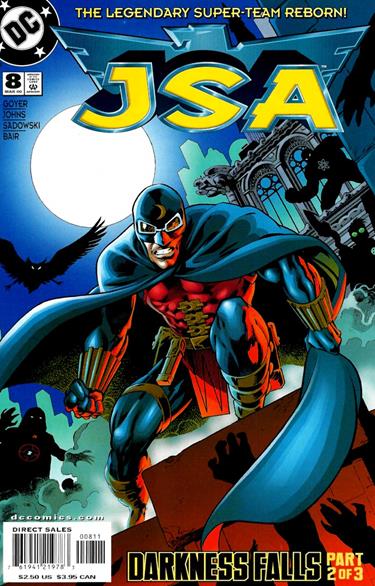
JSA Reread Part 6: Injustice Be Done cont.

Sorry about the delay, the holiday’s got in the way.  I have one ready to go here, and another one by the end of the week. This entry finishes up the Injustice Be Done storyline, including the epilogue issue.

JSA 19: Into the Labyrinth

Johns, Goyer, Sadowski, Bair and Champagne. 

1

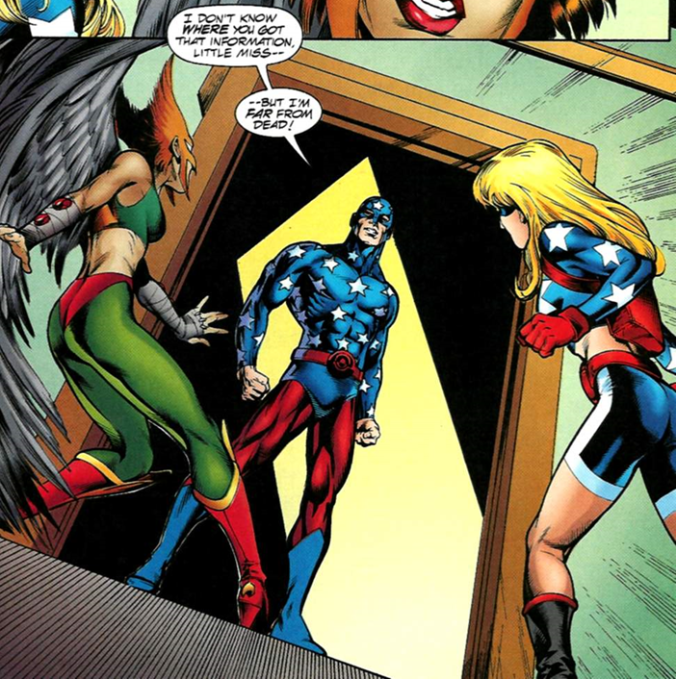
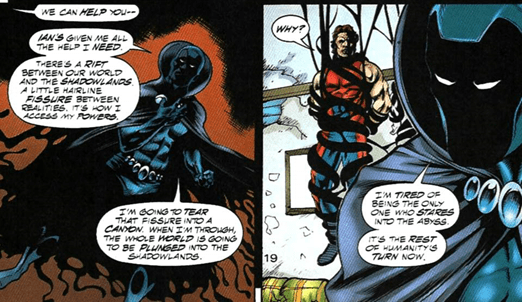
This issue starts with Wildcat and Black Adam at the Rock of Eternity.  Wildcat doesn’t believe that Black Adam has actually reformed, while Black Adam argues the he doesn’t need reformation.  According to him, all the villainous acts he did were under the control of Theo Adam, his descendant who gained his power.  They are at the Rock of Eternity to ask the wizard Shazam to help them find the Spectre.  Instead, they find the Spectre right there waiting for them.  This Spectre is not the same Spectre from last issue’s flashback.  Now the soul controlling the Spectre’s powers is former Green Lantern Hal Jordan, a character that Geoff Johns has quite a history with.  He wrote the series Day of Judgment where he made Hal Jordan the Spectre.  A few years after this story, Johns will finish Jordan’s redemption with Green Lantern Rebirth and make him a Green Lantern again.

2

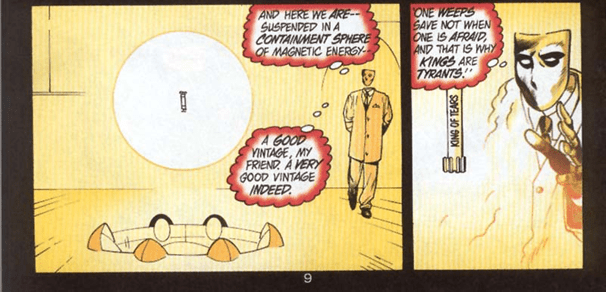
Now it moves to Johnny Sorrow and Sand at the center of the maelstrom.  The King of Tears is coming into the world and as he does so the world is changing to fit him.  Once he is completely manifested in reality, then the barrier between his dimension and ours will disappear and all sorts of unworldly horrors will come through.  Some already are.  According to Sorrow, the JSA has only hours.

3

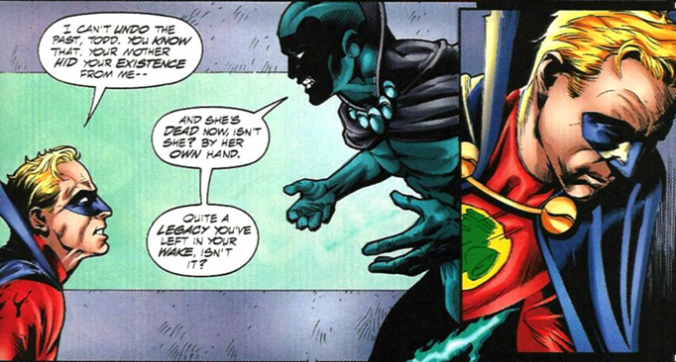
Continuing the check up on each member of the team, Star Spangled Kid, Hawkgirl and Mr. Terrific burst into a hospital with the dying but stable Green Lantern.  Terrific has managed to save his life, but only for the time being.  He needs a real doctor.  Back in the horror dome, Black Canary is giving Dr. Mid-Nite CPR.  She manages to revive him.  It turns out he didn’t die when he looked as Sorrow’s face because he is technically blind.  Also, Canary is in tears.  Their abortive relationship is one of the great disappointments of the series. They had something interesting going, but then somewhere else Green Arrow got resurrected and she ran right back to him.  As they chat, Flash shows up, covered in electricity from absorbing Rival’s speed (and stealing his helmet).  The three of them can’t stop the reality altering themselves, so Flash runs to get help.

4

He comes back with JJ Thunder, a character introduced by Grant Morrison in JLA’s Crisis Times Five, who has Johnny Thunder’s genie.  So he summons the genie and uses it to fight off the bug looking monsters that are appearing. As the four of them fight, Black Canary wonders what happened to the team’s other heavy hitter, Dr. Fate. Segue to him looking for his missing wife.  He is visiting the comatose woman that gave birth the baby version of him in the first issues of this series.  He uses his Dr. Fate magic to reveal that the Jane Doe coma patient is actually his ensorcelled wife.  Which adds another layer of creepiness to his story, since remember she gave birth to him.  And that is the entire interlude with Dr. Fate.

5

Back with the team, the genie is being overwhelmed.  Just as he is about to give up, Mr. Terrific and the others arrive.  Terrific gives him a pep talk while the girls jump right into battle.  Star Spangled Kid goes to Black Canary with the growing problem of Hawkgirl’s weirdness. Finding his confidence thanks to Terrific, JJ uses the genie to take out all of the bug monsters.  However, that doesn’t do anything to stop the growing problem of reality changing. Luckily, just then Wildcat, Black Adam and the Spectre show up. The Spectre goes one on one with the King of Tears, who strips him down to just a skeleton.

JSA 20: Godspeed

Goyer, Johns, Sadowski and Bair.

1

As they team watches in disbelief at the defeated Spectre, the Spectre’s body fixes itself in front of them. Since the Hal Jordan version of the Spectre is about redemption instead of vengeance, he can do nothing against the King of Tears, because it has no soul to be redeemed.  So he apologizes and disappears, freaking everyone out even more.  Hawkgirl calls Black Adam by his ancient name, Teth-Adam.  She is still having memories of her previous lives.

2

Terrific the hatches another plan, to send Flash running at lightspeed and knock the King of Tears back where he came from.  However, the only Flash that can run at lightspeed is Wally West, the main Flash.  However, with the speed he stole from Rival and stealing speed from the superfast Black Adam, Jay might just be able to go fast enough. In order for this to work, someone will have to disorient Johnny Sorrow so he isn’t controlling the King of Tears anymore.  Dr. Mid-Nite thinks he has a plan to deal with that, though.

3

After a brief, possibly last, chat with his wife, Jay and Black Adam take off.  The rest of the team starts fighting the returned monsters.  The Spectre shows back up to take away all the citizens’ fear so they can fight as well.  And just to toss one more thing on, Hawgirl call Mid-Nite McNider, the name of the previous Dr. Mid-NIte. As Flash steals Black Adam’s speed, Mid-Nite fights his way to where Sorrow is.  He then reveals his plan: he used his goggles to record Sorrow’s face.  He plays it back a Sorrow, disabling him, giving Flash the opening he needed to punch the King of Tears back out of reality, which causes the city to revert to its natural state.

4

The team recovers Sorrow’s mask, all that is left of him.  Hawkgirl finally breaks down when Star Spangled Kid somewhat rudely asks her what is going on.  The only problem is that the Flash is still gone.  The last few pages show Jay almost lose himself into the speed force, but he uses Black Adam’s speed to pull him back to reality.  However, instead of coming back to the team, he ends up with Teth-Adam in ancient Egypt.  And it’s not just Teth-Adam, but also Nabu, the wizard that helps Dr. Fate, and Prince Khufu, the ancient precursor to Hawkman.

JSA 21: Guardian Angels

Goyer, Johns and Buzz

1

Here is the cool down issue that got interrupted to start the Injustice Be Done story, with Sand running about the being rebuilt JSA Brownstone headquarters putting out fires, metaphorical ones, of course.  First there is Black Adam, who is petitioning to be allowed onto the team.  He makes a strong case, if you believe that Black Adam and Theo Adam are different people.  The JSA team, currently short Green Lantern Alan Scott, is underpowered and Black Adam needs the credibility of the team name to rehabilitate his image.  Black Adam is not going to make this easy on Sand either, intimating that he knows the fate of Flash without telling.  Black Adam’s arrival, or at least more permanent arrival since he has been showing up since issue 6, is the big game changer for this series.  With many of Geoff John’s runs on superhero books, the most dynamic characters tend to be morally grey villains.  He built up the rogues on the Flash (especially Captain Cold), took Sinestro through a whole rise and fall redemption arc and is currently doing the same thing with Lex Luthor in Justice League.  Johns is great about getting in the heads of the bad guys and showing how they tick, as well as realizing that good villains do not see themselves as such.  His work with Black Adam, mostly on this title, is the ultimate expression of that.  It works best here because Black Adam is largely Johns’ creation, appearing only a handful of times before Johns got ahold of him here.  With this attempt to join the team, Black Adam manages to come off both sincere and menacing.

2

Sand them moves on to Hawkgirl, confronting her about her recent odd behavior and aobut how little the team actually knows about her, plot threads that have been running since the very start of the series.  He points out the scars on her arms, last seen in the all ladies annual, which seem to be from a suicide attempt.  Hawkgirl flies off, upset and unwilling to answer his questions.  As we’ll see later, the Black Adam story and the Hawkgirl story are related.  They really combine quite organically and make for a solid history, especially with what is coming for the Hawk characters.

There are a handful of asides that finish up the Wildcat’s son abortive subplot (Killer Wasp is not his son, but he did know him), Alan Scott recuperating and talking with and about his two kids, and a slight furthering of Atom Smasher’s walk down his dark path.  This is mostly making sure everyone is caught up on where the major players on this team are, with many of these stories stuck in a holding pattern for now.

3

After that it is back to Kendra, who is struggling with the changes she is facing.  She meets up with Zauriel, a fallen angel, hence the title of the issue, and Justice League member.  Actually, he is the character introduced to take the place of the off limits Hawkman in Grant Morrison’s JLA, which was supposed to use all the big heroes.  He tries to offer Kendra help, but she’s not having anything he’s offering, whether it is religion or love, which is what caused him to fall.  That love talk does segue into a two page aside with Black Canary and Dr. Mid-Nite on another date, which both seem to be enjoying.  Then is back to Kendra and Zauriel.  He finally gets her to open up about her attempts at suicide after her parents were murdered.  When she was unconscious after ODing, she sensed someone there with her. Someone named Khufu.

With that name, the scene jumps back to Ancient Egypt, with the Flash.  Khufu was an Egyptian Prince, one who would later be reincarnated as Carter Hall, better known as Hawkman.  Flash is not quite sure if he believes that, though he does believe in the Thanagarian warship Khufu has.  This is a key piece of Geoff John’s revival of Hawkman.  There were several distinctly separate versions of the character that were hard to reconcile.  The first was the reincarnated Egyptian Prince, later was the space cop from the planet Thanagar.  Then there was the avatar of the Hawkgod and the other Thanagarian space cop.  Those, plus a ton of retcons made the characters a giant mess and they were abandoned for half a decade or so.  But Johns and Goyer smartly found a way to work around all this, starting with Flash finding the space ship in ancient Egypt, creating a tie between the two major versions of the characters.

4

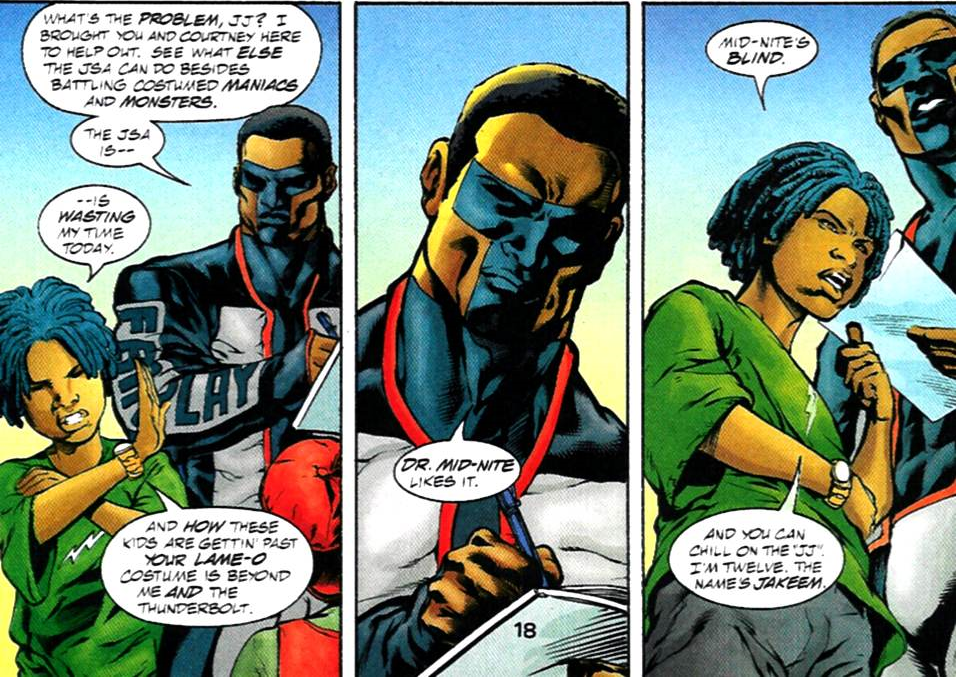
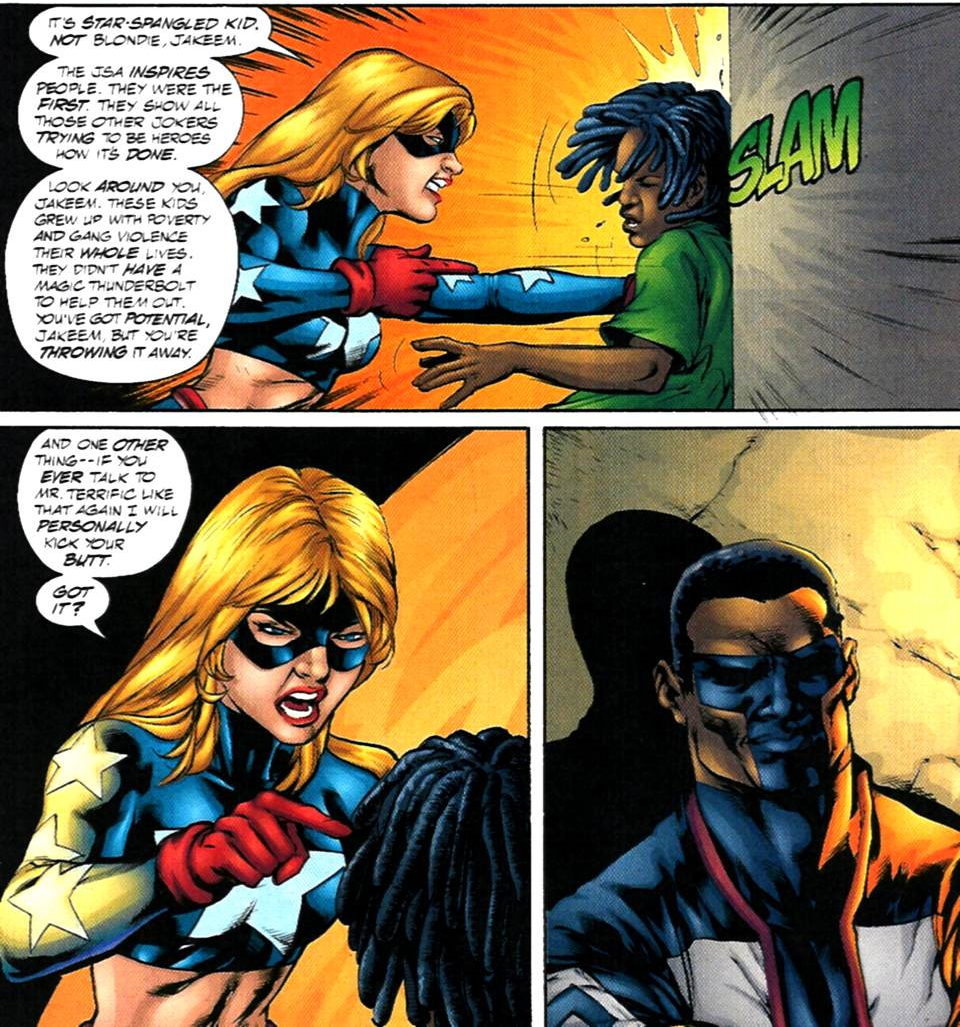
Next is the most heartwarming part of the issue, with Mr. Terrific, Star Spangled Kid and JJ *ahem* Jakeem Thunder signing autographs and playing basketball at a youth center.  This is one of the great things about the JSA; that they are shown to do things besides fight bad guys.  Like the X-Men’s occasional relaxing issue has the team playing baseball or basketball, the JSA members spend their downtime doing charity work.  Jakeem is a little put off by this, and also gets in a pretty sick burn on Mr. Terrific.
5

After a page of Jakeem railing at Mr. Terrific about how being a superhero is a bunch of nonsense (not necessarily untrue, but not on point when they are helping out at a youth center) and generally just being unpleasant, Mr. Terrific walks away, only for Star Spangled Kid to tear into him for being a disrespectful little jerk.  It shows the growth her character has been through, both in this title and her Johns penned own book.  She starting out as nothing more than a disrespectful little kid and has grown into a fine heroine.
6

It then goes back to Kendra and Zauriel for one more little conversation, with Kendra asking him about reincarnation.  After going back and forth for a little bit, Kendra supposes that her memories of past lives are from her near death experience after her suicide attempt.  Zauriel has a different guess, that her suicide attempt was successful and a new soul now inhabits Kendra’s body.

7

Now that there is a solid base to build from, this is when the title really starts to take off.  Most of the seeds for this run have been planted, with Black Adam, Atom Smasher, the Hawks, and Dr. Fate.  All of the characters are firmly established and the JSA really finds another gear.  There is certainly a lot to chew on with this somewhat downbeat issue.  There are no fights, just the characters coming to terms with how things stand now.  Still, it really sets the table for stories to come.

Next Time: The Return of Hawkman.
JSA Reread Part 3

This brings us to the end of the first year of this book, with another one off cool down issue, like issue 6, and the opening act of the title’s biggest story yet. Also thrown in there is a goofy crossover title, that while far from essential in the big scheme does have some worthwhile developments. These are necessary issues to the feel of the title, if not strictly important ones. The fate of the world can’t hang in the balance in every story, there has to be some dramatic highs and lows. This is a bit of a low, though it is only a low by superhero standards.

JSA 10: Wild Hunt

Written by Geoff Johns and David Goyer. Art by Stephen Sadowski and Michael Bair

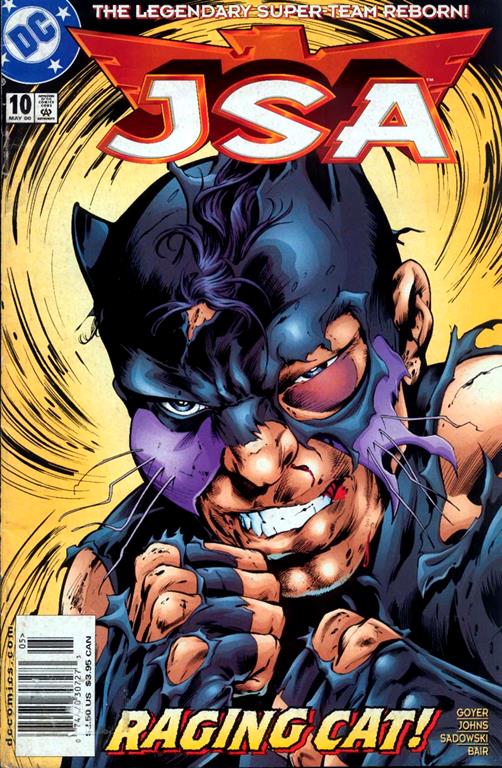
This issue, a bit of a breather between big arcs, is a solo issue for Wildcat, who had to sit out the last arc after Black Adam broke his arm in issue #6. It also introduces the Justice Society’s opposite counterpart, the Injustice Society. The Injustice Society is an evil version of the JSA. Like our heroic team, their focus is legacy. They are a combination of Golden Age villains and replacements for Golden Age villains. It is led by Johnny Sorrow, a Golden Age villain that can kill with a look. It has the 2nd Icicle, who inherited his powers from his father, and 2nd Tigress, who had two supervillain parents, one the first Tigress and the other the Sportsmaster. Count Vertigo and Geomancer are on the team, as is Blackbriar Thorn, an old GL villain. And lastly is Golden Wasp, who is another legacy villain who hides a secret.

The whole team breaks into the JSA Museum with Wildcat the only JSAer on the premises. In fact, he was taking a bath and maybe having phone sex with Catwoman. While Johnny Sorrow goes after a vial labeled The King of Tears in Flash’s lab, the rest try to take out Wildcat. Using his knowledge of the Museum and their overconfidence, Ted manages to separate and take them down. He runs down Geomancer and Count Vertigo with his catcycle, smashes Blackbriar Thorn in the elevator, traps Icicle on an operating table and knocks out Tigress and Killer Wasp. It also very heavily hints that Killer Wasp has some connection to Ted through Ted’s son who was kidnapped years ago. Of course, while Ted does this, Sorrow gets what he’s after and teleports everyone, other than the smashed Thorn, out. And Ted, knowing what’s really important, tries to get back in touch with Catwoman. The references to Catwoman are not just throwaways because they are both feline themed characters, there is a not terrible Wildcat/Catwoman miniseries (written by Chuck Dixon and Beau Smith and likely existing because they are both feline themed characters) where they team-up to stop/pull off a casino heist and flirt. It turns out that Wildcat trained Catwoman in his gym, though they only know each other as civilians.

Other than introducing the Injustice Society, there isn’t a lot to grasp in this issue. It is a relatively low stakes affair that gives Wildcat a chance to shine and to seed a couple of future storylines. It is a fun issue, but not a particularly important one.

Sins of Youth/Sins of Youth: Star-Woman and the JSA Jr.

Written by Geoff Johns, Art by Drew Johnson

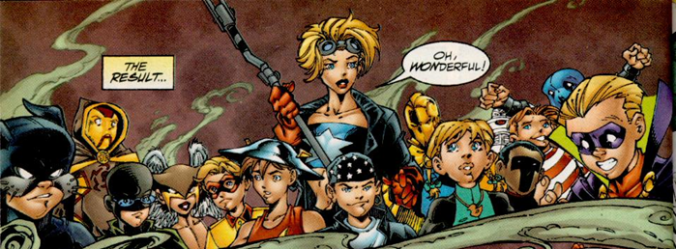
This is a brief detour of a mini-event. Sins of Youth was primarily a Young Justice story, but every DC superhero team gets involved. Through machinations not worth going into, Klarion the Witch Boy manages to turn all of the child heroes into adults and all the adults into children. This affects every superhero and team in the DC Universe. It is gives the heroes and sidekicks a chance to see how things look from the other side of that relationship. The JSA, as the oldest heroes, get turned into the youngest children. Except for Star Spangled Kid, who becomes an adult.

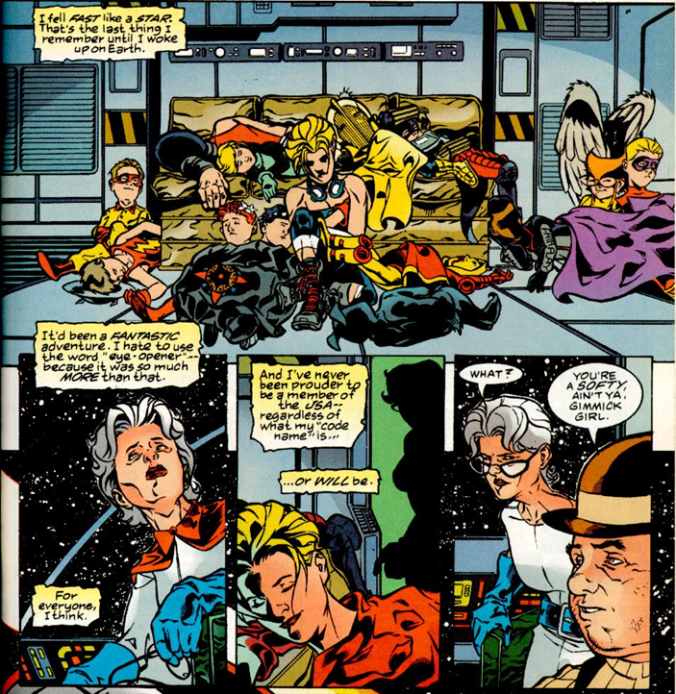
In the JSA’s issue, they go with Doiby Dickles, a Brooklyn cabbie who was Green Lantern’s old sidekick and eventually left Earth to marry an alien princess, to the planet Myrg to get an age changing gun to try to fix everybody. Along for the ride is Merry Pembertonm Gimmick Girl, the sister of Sylvester Pemberton, the original Star Spangled Kid. She hasn’t taken too kindly the current bearer of that title, the JSA’s own Courtney Whitmore. As the lone adult on the team, StarWoman, as the adult Courtney calls herself, has trouble keeping all the toddler JSAers together long enough to help Doiby retrieve another ageing gun.

The only truly important part of this story is that Star Spangled Kid shows that she has the makings of a true hero, holding a team of super-powered children together through space. It is one of her first big steps in going from the bratty kid to a full team member. She also uses Jack Knight’s Star Rod, which he will give to her when he retires from superheroing in a year or two.

JSA 11: Split

Written by Geoff Johns and David Goyer. Art by Bair and Buzz

This issue starts a new two part arc. This is when the title really starts to dig deep into DC universe history. The title has always been about history and legacy, but it now it takes on a wider view than just the team. It brings in ties from Infinty Inc to Zero Hour to Blackhawks.

This one opens on a jet with an elderly woman, who identifies herself as Atom Smasher’s mother. As she chats with the woman seated next to her, the villain Kobra appears on a screen in the plane. He announces that he is taking over control of the plane and blows it up. Kobra is the last of the concepts Jack Kirby created in his time at DC. It was so late in his time there that it didn’t actually come out while he was still there and it was partially redrawn before it was published. Jeffrey Burr is Kobra, the leader of the Terrorist Cult called Kobra. He is a genius and also has a psychic link with his twin brother that makes them share experiences. He’s fought everybody from Wonder Woman to Batman.

Back in the JSA Museum. Mr. Bones, a former villain turned hero turned leader of the Department of Extranormal Operation (DEO) as well as inadvertent killer of the original Star Spangled Kid, is giving the team a rundown of the situation. He explains that Harold Jordan, a cousin of Green Lantern Hal Jordan, who operates as the hero Airwave, has been captured by Kobra. Airwave is just the kind of hero that the JSA, and the old DC Universe in general, overflowed with. In the Golden Age, Larry Jordan was the original Airwave until he got married and retired before training his son to take up his mantle. Kobra is planning on using his powers to take control of all communication and create and Age of Chaos. Kobra has taken over Blackhawk Island, the base of the Golden Age fighter pilot team the Blackhawks, and Mr Bones wants the JSA to take them out. The simple set up for this story takes a turn when Sylvester Pemberton, the original Star Spangled Kid remember, who was killed years ago by Mr. Bones, appears in the building.

Hourman immediately deduces that his appearance is Extant’s doing. Extant is the time traveling villain from the event Zero Hour and formerly the hero Hawk from the pair of Hawk and Dove. In that story he killed a handful of JSAers, the original Atom, Dr. Midnight and Hourman. So they call in all the reserves and split into two teams. Robot Hourman, Sentinel, Hippolyta, Flash, and the Star Spangled Kids board Hourman’s time traveling Viking ship and trek through time to find Extant. They discuss the danger that Extant possess and the SSKs have a little heart to heart. He is glad to see someone carrying on his legacy and offers to help her with the belt. Then they are gone for the rest of the issue and the next one.

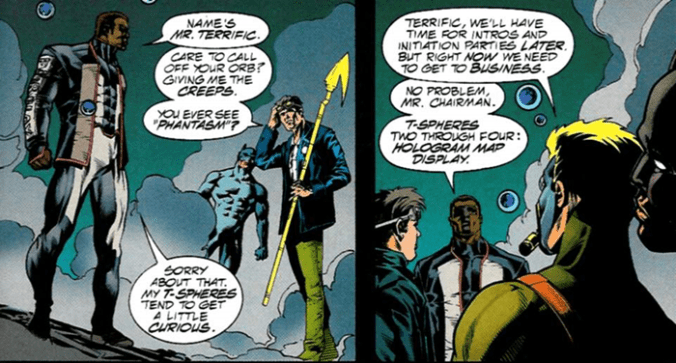
Starman, Dr. Midnight, Sand, Wildcat, Black Canary and an understandably upset Atom Smasher go after Kobra. They infiltrate the island and are soon joined by the new Mr. Terrific. Mr. Terrific immediately shows his worth by using his “T-Spheres” to display a 3D map of the island and outline an attack plan. You’d think an attack plan would be something they had before they showed up on the island.

They split up, with most of the team going to take out the island’s generators. Sand makes his way to where they are holding Airwave, but before he can rescue him he is attacked by Kobra, who uses comic book science to freeze is his sand based body. He then proceeds to use Airwave’s powers to broadcast him executing Sand on Times Square.

JSA 12: The Blood Dimmed Tide

Written by Johns & Goyer, Art by Buzz

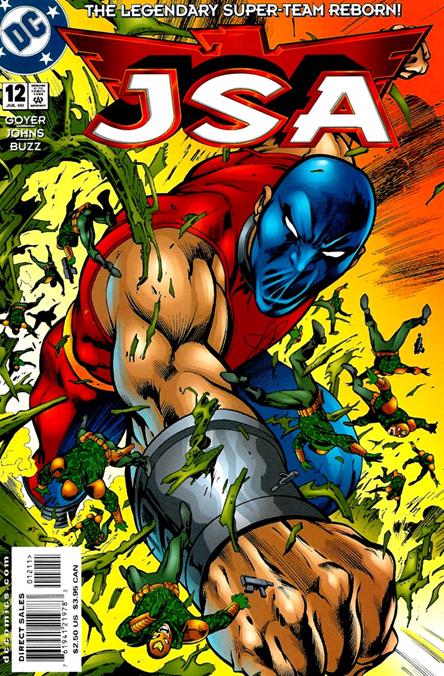
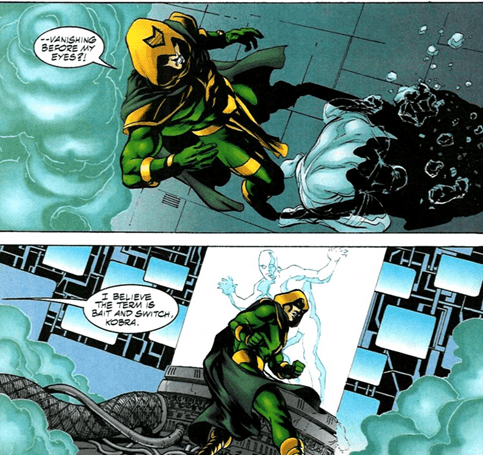
The next issue starts with Kobra gloating over taking out the leader of the JSA, going full villain monologue with how he plans to use killer satellites to destroy every city on Earth. Kobra is not a villain with a strong historical or thematic connection to the JSA. He is just a run of the mill conquer the world supervillain, this time with satellites set up around the world to destroy all major cities with X-Rays. He is quickly disappointed when he finds out that he executed a hologram made by Mr. Terrific and Sand is fine.

While Dr. Midnite helps Sand, Mr. Terrific fights with Kobra. Though he has the upper hand, Kobra manages to slip away. They free Airwave, who takes out the satellites, but Kobra activates the base’s self-destruct and escapes in a plane. Airwave takes off the stop the satellites, leaving the others to make their escape.Except Atom Smasher grows to as big as he can and snatches the plane out of the air. He then debates killing Kobra to get revenge for his mother’s death, but Jack talks him down. This anger is a problem that Atom Smasher tries to deal with as the series goes on, and Kobra is a villain that will be back later.

The team escapes the exploding island on an old Blackhawk plane and discovers that Blackhawk Island is a DEO base, they were dealing with a DEO created problem to begin with.As they have it out with Mr. Bones, something crashes onto the roof. It is Hourman’s Timeship, piloted by Metron, one of the New Gods. He quickly claims that the other team is dead and that they have only seconds to save the universe.

There big occurrence in this issue is Atom Smasher struggling with reigning in his rage. It is all action, not necessarily a bad thing but it doesn’t leave a lot to discuss. It is pure fun. That is where we stop for now. Next time the team will have to deal with this crisis, as well as the crisis of the swollen ranks.


JSA Reread Part 2

I originally expected to cover only issues 6 and 7 for this entry, but I realized that if I only covered 2 issues at a time it would take me more than a year to cover all that I want to cover in this re-read. So now, I am taking on issues 6-9, the first of which is an interlude issue with Black Adam and then the three issue Darkness Falls arc. My plan for the rest of this re-read is to try to cover one arc in each entry, though some of the longer arcs will require more. I have it planned out for 25 Parts total, unless I also decide to cover Johns issues on the re-launched Justice Society of America. So let’s get started on the first four issues of the Johns/Goyer collaboration on the JSA. After the first issue, drawn by Marcos Martin, the rest are drawn by Stephen Sadowski, with inking my Michael Bair and covers by Alan Davis.

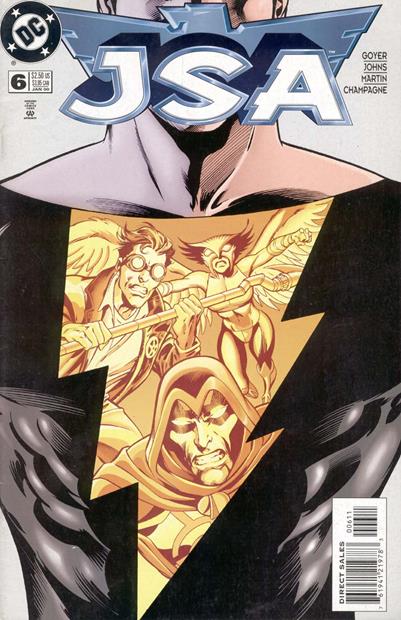
JSA #6: Justice, like Lightning.

This is Geoff Johns’ first issue as co-writer and immediately we are introduced to the character his run centers on: Black Adam. I am assuming most of Black Adam’s arc is Johns’ doing because it is one the few that is not tidied up when Goyer leaves the book around issue 50. Also worth noting is that this issue is penciled by Marcos Martin, who is a tremendous artist. Just look at his work on recent issues of Daredevil or in Batgirl Year One.

The issue starts with the JSA holding a press conference to announce that they have reformed. The superhero press conference is one of the worst ideas in the world of superheroes. Not the idea that a team, like the JSA, would announce to everybody that they are back in business, but that anyone would show up to something like the ribbon cutting in this issue without realizing the obvious would happen. A villain will attack this get together. Every time this scene occurs, a villain will attack. And of course, it happens here.

Johns and Goyer aren’t subtle on this title. Just look at Sand’s speech. The earlier JSA “created a legacy. That legacy isn’t easy to live up to,” he says. That is the major focus on of the book. Sand just comes out and says it. Legacy and the struggle to live up to it or in some cases break free from it. There is another interesting line in that speech, “While others in our line of work are often in the shadows or adventuring beyond time and space, we keep our feet firmly planted on the ground.” While on the surface those are clear references to Batman (shadows) and Superman (time and space), it also foreshadows where the book is going. The next issue starts an arc called Darkness Falls, wherein the entire world is covered in shadow. After that, the team must fight the time traveling villain Extant, a battle the roams over all of time and space. This is a new beginning for this team, and those are the adventures they will have.

Then we get a page of character positioning. Hawkgirl hates the spotlight, Dr. Fate misses his wife, and Star Spangled Kid is a bit self-centered. After Courtney (Star Spangled Kid, soon to be Stargirl) cuts the ribbon, it moves inside the JSA museum. In the middle of the page are three panels highlighting heroes who have passed on. First is Mr. Terrific, the predecessor to the man from issue 5 that Sand offered JSA membership to. Then it’s Dr Midnight, who will join in the next issue and finally Hawkman, whose return is a big arc itself in a few issues.

Then Black Adam attacks. Remember what I said about subtlety or the lack thereof? After the initial wave of JSAers is manhandled by the near Superman powerful Black Adam, Sand opines, “there’s nothing I can do if Black Adam’s feet aren’t on the ground.” An obvious call back to the line in his speech about the JSA being grounded. While most of the team tries to fend off the enraged strongman, Hourman, Dr. Fate and Hawkgirl travel back in time to ancient Egypt to the point when Black Adam received his powers. Using a combination of Hourman’s time powers and Dr Fate’s magic, they channel the magic lightning bolt to the present to drain their foe’s powers. Conveniently, this happens just after everyone on the team had the chance to show off their powers.

Everyone is confused about Black Adam’s attack because they thought he had reformed. For those unaware, Black Adam had been an ancient hero, but now his powers are used by his villainous descendant Theo Adam, though Black Adam had regained control. Sentinel (Green Lantern, really) discovers that he has a brain tumor that may have caused his outburst. Then Agent Chase (of her own short series) from the DEO (Department of Extranormal Operations) shows up and takes custody of Adam, while her boss Mr. Bones thinks some cryptic thoughts about Hawkgirl.

While this issue is primarily a cool down issue between big stories, it does seed a ton of story points for future issues. The most important of which is the introduction of Black Adam, who will play a major role in the series from much of its run. It also marks the first, but far from last, trip the team will make to ancient Egypt.

JSA #7: Darkness Falls

Now we start the second big story of this series. The threat was seeded in a couple of scenes in the first few issues, with Alan “Sentinel” Scott’s son Todd talking with shadows. Now we see what he was going on about.

This issue starts in medias res with Black Canary falling from a window. She is chased by shadows of her teammates, which eventually catch up with her.

Then it jumps back to earlier that morning and the apartment of Jade, Alan Scott’s other child. Johns and Goyer make sure you don’t miss this connection. Jade cuts her hand on a photo of her, her brother and her father and reminisces about the connection her and her brother share and wonders about how odd he’s been lately. So she calls her dad.

On the opposite page, Dr. Fate tries to connect with Hawkgirl, who is both his cousin and possibly his mother reincarnated. Very creepy, and it won’t get better. Echoing Jade cutting her wrist on the previous page, Hawkgirl’s scarred wrists are exposed. Her troubled life before the series is slowly explored during the time she is on the team and this is one of the first hints of her situation.

Fate’s and Hawkgirl’s talk is interrupted by a call to see a news report saying that all the shadows in Milwaukee had disappeared. While the team heads for the city, Sentinel info dumps all the back-story and set up for this arc. He just throws it out there.

Once they arrive at their secret underground bunker, we meet Star Spangled Kid’s step dad, who is the team’s mechanic and appears in only 3 or 4 issues of the series. His inclusion here seems like a bit of cross-pollination with John’s Stars and STRIPE book, where he is the co-star. However, it may have already been cancelled by this point. He takes a little guff from old friends and sets the team up with a plane, the Steel Eagle, which aspires to but never achieves the status of the X-Men’s Blackbird. Off they go to Milwaukee.

Why Milwaukee? Because that is the home of Jim Rice, Todd’s stepfather, a drunk who used to beat him. In his apartment, the team finds a shadow man sitting an armchair. As far as they can tell, it is the only shadow in the city. When Sentinel approaches, the shadow sucks him inside of itself; then it expands to cover the whole the city. The heroes try to protect civilians around the city, but the shadows slowly possess the heroes. Inside the shadow, a realm called the Shadowlands, Sentinel sees Jim Rice and the other part of the villainous duo Ian Karkull. There is the only editor’s note in the issue to explain Karkull’s history, referencing a story from 1941.

Outside the only three JSAers left who aren’t possessed, Atom Smasher, Black Canary and Star Spangled Kid, are captured. Obsidian (Todd) begins a classic villain monologue while Atom Smasher argues with him. Kid manages to free Black Canary, bringing us back to where the story started. Just before Canary is overcome by the shadows, a flash of light disperses them, revealing the new Dr. Midnight.

JSA #8: Shadowland

The first seven pages of this issue are introduction to this new Dr Midnight. Quickly we learn that he is an actual doctor, that he has a few light and shadow based gadgets, he can see in the dark and he has one of the best sidekick/pets ever: and owl. The owl is peeking in on Obsidian with the rest of the JSA, and feeding it back to Dr. Midnight via a tiny camera around its neck. It also features the first pairing of Black Canary and Dr. Midnight, which is the only real, possibly sexual, relationship that suns through the first year or so of the book.

Back with Obsidian, Atom Smasher tries to appeal to his shadow possessed teammates, but Obsidian tells him that they can’t help because they are currently living out their worst nightmares in their minds. Flash sees his dead successors come back to haunt him, Hourman is faced with an existential crisis; Hawkgirl relives an apparent murder she committed, etc. Obsidian proceeds to taunt Atom Smasher until Karkull returns with Obsidian’s fathers.

Obsidian then rails against both of his dads with ideological rantings. Nothing is left as subtext. From the juxtaposition of Nature and Nurture, which this story comes down on the side of nurture, to Obsidian flat asking Sentinel what he thinks about the legacy he’s left, with a wife that has committed suicide and a son who has become a super villain.

As Obsidian moves in for the killing blow, Canary and Midnight arrive. They free their non-possessed teammates and manage to break Hawkgirl free from the shadows. Atom Smasher manages to corner Obsidian, but despite Obsidian’s taunting about him being weak, he is unable to kill him to save his friends. So the team beats a hasty retreat. Karkull then reveals that he has been playing Obsidian from the start and tries to take him down. Obsidian then turns the tables on him and absorbs his powers. He then uses it to cover the whole world in shadow.

This issue is mostly rising action. It is the team beaten, and held at their lowest point. Their enemies appear triumphant. There are some moments of thematic worth here, though. Like Sentinel realizing the failures in his legacy and Atom Smasher thinking he’s found some of his own with inability to kill Obsidian, his best friend. The middle issue is tough, since the first issue generally establishes the conflict and the last one ends it, but in the middle, it is only rising action.

JSA #9: Black Planet.

Now that the entire planet is covered in shadow, everyone on the planet is going crazy. Because not only is the world dark, but also people are forced to face their inner darkness as well. Sentinel tells the rest of the team that by staying together they can pool their willpower and overcome their dark thoughts. So he leaves them to deal with their possessed teammates and the other possessed inhabitants of Milwaukee while he deals with his son.

Star Spangled Kid and Hawkgirl manage to free Hourman, who slows down Flash enough for them to free him as well. Dr. Fate manages to shake free of the possession on his own. Atom Smasher, with Rice hanging around his neck, seals the rest of the shadow people, including Sand, behind a wall of cars. Rice wants to know why Sentinel doesn’t need to be in contact with anyone else to stave off the darkness and Atom Smasher tells him it is because he is already living his greatest nightmare.

The central conflict of this issue is the conflict of this whole arc. It is Sentinel facing his mistakes and the truth of the legacy that he has left behind him, all in the person of his opposite powered son. So they have one of Johns patented shouting philosophical debate/fights. Obsidian feels as though the world has cheated him, with some pieces of a good point. He was the son of the superhero, but he was raised by an abusive drunk. He did not inherit his father’s light-based powers, like his sister, but instead powers of darkness and well as his mother’s mental problems. Not an actual good point, but enough of one to see why he wants what he wants. Sentinel is facing his most immediate legacy, his son, turned from being a hero (just before this he had been a member of a particularly forgettable JLA team) to a villain. And not an ambiguous villain, he has turned evil for evil’s sake. For the reasons mentioned above, as well as for the obvious symbolism (light vs shadow) and because he is actually crazy. It is not the most spectacular fight in this series, but it is a warm up for later, larger stories.

One interesting note is that Alan is only effective against Obsidian after he recalls his time as Green Lantern. Due to supposed reader confusion, he was going by Sentinel at this time, instead of his original name, Green Lantern. In a series about a character’s legacy, being forced to use a different name is problematic.

In the end, Alan is unable to save Obsidian, though he does stop him. Obsidian flees back into the shadow dimension, taking Jim Rice with him while Alan goes off to break the news to his daughter. The team is kind of down here. They saved the world, but they didn’t save Obsidian On the flight home Flash utters a disgusting sentiment about people being born bad, but it does not seem to be one endorsed by the book. Idly some members of the team wonder what Wildcat got up to in their absence.

Which segues to the two-page coda of Wildcat sitting in the bathtub, possibly attempting to engage in phone-sex with Catwoman only to be disturbed by an attack by the all-new Injustice Society.

I don’t feel that this title is completely up to speed yet. Some characters very important to the run have yet to be introduced and Johns has not yet found his footing. However, this is still a solid arc that sets up plenty of future stories. Yes, there will be more intercalations with Obsidian and Atom Smasher’s willingness to do kill to save people will again be tested.

Next time: Wildcat stands alone, JSA v Kobra and Sins of Youth.

JSA Re-read Part 1

This is the first entry in a new weekly — hopefully — series I am writing about the Geoff Johns/David Goyer (later just Johns, who is the writer of focus here) JSA, which is hands down my favorite comic series. This series is the reason I went from someone who liked superhero movies and had read some X-Men comics long, long ago to a someone who actually buys and reads comic books. JSA is not a book that would normally be considered a good series for new readers. It is the reason I am never convinced that that continuity is the reason comic sales are in a prolonged funk. (I’d finger general awareness and physical accessibility.) JSA is not just a book with some reliance on continuity, it is a book steeped in it; it revels in it. JSA is about history, it is a book looking back at and remembering the past. That the JSA was dropped, at least temporarily, in the re-launch makes sense. The series focuses on the legacy of a world with superheroes and DC seems intent on jettisoning that, for better or worse. Without history, there is no Justice Society.

Despite the title’s reliance on history, JSA was still a new reader friendly series. Each arc, if not each issue, is comprehensible to people who have never read the book before. That is impressive especially with the fact that most recognizable character in the series is probably Hawkman. Maybe Captain Marvel or Black Canary, I’m not sure which one is best known. C-list characters at best no matter how you look at it. Much of this is thanks to the writing team. While he is certainly never subtle, Johns (I’ll credit him since he has done this on more books than this. Goyer certainly contributed as well) has a knack for distilling characters down to a core idea that drives all their stories. Not that the characters are one note; it gives them a central, relatable theme. As he does this for each of the numerous characters, he also does it for the team as a whole. And the theme of JSA is legacy. They are a team built on remembering the past, on how that past affects the future. They are about carrying on an ideal and a specific legacy; it is about the importance and dangers of following in the footsteps of parents/mentors/teachers.

Before we got to the run proper, there are the first 5 issues of the series to deal with. Because while Goyer was on to start the book, his co-writer is James Robinson for the first arc rather than Geoff Johns. Robinson was at the time closing in on the end of his wonderful Starman series and was at the time a superstar. Since Goyer was co-writing, I am going to cover it. It is part of the run; it sets up much of what comes later, even though it isn’t Johns work. That being said, I am not going to give it quite the same level of focus that I do the later issues. So let’s begin with JSA issues 1-5
Continue reading

Quick Comic Reviews

Now that I’ve started getting my comic books from an online service and get a shipment every other week, I’ve decided to do biweekly short comic reviews. I’ll be writing some brief thoughts on a handful of comics every other week or so. I won’t be reviewing all that I read, just the ones I feel like I have something to say about.

  • Flashpoint 3, Geoff Johns and Andy Kubert

With this issue, Flashpoint goes from being merely slow to being pointless. Last issues (hilarious) cliffhanger is quickly ignored and the plot moves on, but Flash and friends haven’t really done anything yet. This sort of slow build could be effective, but this is only a 5 issue series and we’ve already burned through three of them. I also take offense to the idea that Superman would be a hero no matter what. I would be fine if he didn’t return after this issues cliffhanger. ** (2 stars)

  • Green Lantern 67, Geoff Johns and Doug Mahnke

The War of the Green Lanterns finally concludes. This crossover has been plagued with shipping problems and I’ll need to go back and reread the whole thing to really rate it. This issue was big on noise but short on sense. As is the way with Johns’ Green Lantern stories, it all comes down to Hal and Sinestro. It is suitably explosive, but the logic behind most of it is either not explained or nonexistent. *** (3 stars)

  • Green Lantern Corps 61, Tony Bedard and Daniel Hor

A fallout issue that follows up on the crossover that just ended. Most of the Lanterns who got their rings from the corrupted Mogo give them up, but one feels that she belongs in the Corps. So she and John Stewart go to her sector and try to stop a war. In general, this is the kind of story I want to see from Green Lantern Corps, highlighting a new/unknown member while still being about the main characters. Unfortunately, this is not a particularly good example of how to do that, unlike last months Emerald Warriors, which was perfect. *** (3 stars)

  • Birds of Prey 14, Marc Andreyko and Billy Tucci and Adriana Melo

Marc Andreyko comes on for two issues between Simone leaving and DC blowing the whole thing up. I like the concept of this story, exploring the WWII origins of some of the Birds characters that is really unexamined. Unfortunately, the art, as it has done for most of this series, hampers the writing. Not the Billy Tucci pages, those are good. But Adriana Melo is not great (weird faces) and her style clashes horribly with Tucci’s. **½ (2 ½ stars)

  • Detective Comics 879, Scott Snyder and Francesco Francavilla

Snyder’s excellent run on this title continues. Francavilla’s art is stupendous. Excellent use of color, with red and green tinting everything. There is a lot of good in this issue, but some stuff is unwanted. Like the opposite surprising appearance of the Joker and James Jr.’s goofy plan. Of course complaining about the Joker being in a Batman story is also really dumb. **** (4 stars)

  • Batgirl 23, Brian Q Miller and Pere Perez

Brian Q Miller’s excellent 2 years of Batgirl comes to end, part 1. As usual, this issue is great. It does feel like this is a larger story crammed into less space than would be desirable, but the snappy dialogue and excellent characterization are still in full effect. I am really going to miss this book. Month in month out this is one of DC’s best. **** (4 stars)

  • Superboy 9, Jeff Lemire and Pier Gallo

Superboy under Jeff Lemire has also been one of DC’s best books. Much like Batgirl, this issue seem to be trying to compress a longer story into the issue left before the relaunch, with longer building subplots abruptly coming to a head. Very good, if rushed. ***½ (3 ½ stars)

  • Frankenstein and the Creatures of the Unknown 2, Jeff Lemire and Ibraim Roberson and Alex Massacci

While most of the Flashpoint tie-ins haven’t been very good, Frankenstein has been a welcome exception. This issue is not quite as good as the last one, but when you open with Frankenstein killing Hitler there is nowhere to go but down. Still, this is good stuff, though the art suffers in spots. **** (4 stars)

  • FF 6, Jonathan Hickman and Greg Tocchini

On the first page of this comic is a cast list. None of those characters appear. This issue exists to explain who Black Bolt is and bring him back to life. Presumably, this is a necessary step for later parts of this story, but it still makes for a disappointing issue. ** (2 stars)

  • American Vampire: Survival of the Fittest 2, Scott Snyder and Sean Murphy

I was going to criticize this issue for being too slow, then I realized that was dumb, just because this issue doesn’t get to any actual vampire fighting. However, the heroes survive a plane crash and infiltrate a castle full of Nazi vampires. And it is drawn by Sean Murphy, who is really good at drawing. Best of all, I don’t see this mini-series getting anything but better. **** (4 stars)

Even Quicker Reviews

  • Secret Seven 2 *1/2  This is not good.
  • Deathstroke and the Curse of the Ravager 2 ***½  This is good.
  • Citizen Cold 2 **  I like Kolins’ art, but his writing is stodgy.
  • Booster Gold 46 **½ Jurgens has left Booster a little fun.
  • Batman: Knight of Vengeance 2 ***½  Crazy, and good.
  • Emperor Aquaman 2 **½  Yawn.
  • World of Flashpoint 2 **½  Guy Gardner is an Australian Buddhist
  • Fear Itself: Youth in Revolt 3 **½ I like the characters because no one else does.

Thoughts on Green Lantern: Rebirth

A week or three ago I posted this picture as a part of my lazy Month of Gardner. It is from a pair of pages in Green Lantern Rebirth #6, written by Geoff Johns and drawn by Ethan Van Sciver, which shows the differences in how each of these Green Lanterns use their rings. Although I think these distinctions largely started there and have been used at best sporadically since then, I do really like the idea of each Lantern having a different style.

The rest of Rebirth can be problematic. For the record, I am pro-Rebirth. I like what it did and I mostly like how it did it, but there is no getting around the fact that it is a six issue long retcon or that Johns writes Hal Jordan as though he were Batman. I understand how that could grate on those who did not want to see Hal redeemed. However, I thought Emerald Twilight, the story where Hal goes bad, was somewhat terrible and I would rather have a functioning Green Lantern Corps than Kyle Raynor as Luke Skywalker. Geoff Johns also did a good job of not diminishing Kyle in bringing back Hal. Yes, Hal, not Kyle is the Green Lantern, but even in Rebirth Kyle, John, Kilowog, and Guy get their chances to shine.

However, the reader feels about the “fix” that is Green Lantern: Rebirth, these two pages are really good.

Johns is the master at shaping years of often contradictory or confusing stories, revitalizing tired characters and giving them relatable hooks for future stories. In just a few pages, he manages to get to the heart of all five of the main Green Lanterns.

First John Stewart. His constructs are actually constructed. He builds them, uses his knowledge as an architect to use his green powers more effectively. He is thoughtful and careful in how he uses his ring. Next is Guy Gardner. Rather than John’s careful approach, Guy is reckless. He is all heart and no control. Then there is Kilowog. The only non-human in this group, his ring sends out constructs that are bigger than the others are. That his ring booms shows its raw power. Kyle Raynor is an artist, and he uses flourishes and constant refinement. He is never satisfied and he never gives up. Last is Hal Jordan, who uses precision and focused power.

It really shows what every one of them is about. John and Kyle are thoughtful and somewhat introspective. Their actions are carefully considered and they are rarely rash. Guy is the opposite. He is just held back from action at all time, with almost no thought past his initial instincts. Hal is somewhere in between. He tends toward reckless and instinctive, but is more careful than Guy and choosing his targets. Kilowog’s explanation is probably the least illuminating. His booming ring shows that he cannot be ignored, but it really tells the reader little about who Kilowog is. Still, Johns goes at least 4/5 on explaining who these Green Lanterns are.

I just really like how someone who has little knowledge of these characters before reading this, like me not that long ago, would have a decent grasp of all of them from just these few pages.