With CW’s Arrowverse adaptation of the seminal DC crossover “Crisis on Infinite Earths,” it felt like a good time to look at my favorite of DC’s Crisis stories. That is not Crisis on Infinite Earths. CoIE is, undeniably, DC’s most important crossover; it shaped the DC Universe for a quarter of a century afterward. However, it is a giant mess of a story. A few really great moments, some nice artwork and a whole lot of nonsense. No, my favorite Crisis story is 2008’s Final Crisis, from Grant Morrison, JG Jones, Jesus Merino, and Doug Mahnke.

Crisis on Infinite Earths was not the first (note the capital) Crisis. Building off the concept of Flash of Two Worlds, where The Flash (Barry Allen) met The Flash (Jay Garrick). From essentially 1963 on, the annual alternate reality crossover between the Justice League, on what was designated Earth-One, and Justice Society, on Earth-Two, met up to have adventures. After 1985’s Crisis on Infinite Earths, Crises became more rare, being reserved for big event crossovers. There was Zero Hour: Crisis in Time, Identity Crisis, Infinite Crisis and finally Final Crisis. CoIE, Infinite Crisis, and Final Crisis operate as something of a trilogy involving the Monitors.
I’ve wanted to write about Final Crisis since I started this blog. Way back then, it was the most recent, big important DC story. Grant Morrison was in the middle of his all-time great Batman run. Comics bloggers were still a thing and I wanted to contribute to discourse around what I thought at the time was an unfairly treated triumph. But I found it hard to write about, and by the time I really focused on it, a few years had passed and DC had reset their comics universe with Flashpoint. It didn’t really seem worth going into when many of the characters in the story didn’t even exist in the comics anymore. Plus, I still couldn’t really find a solid angle to write about. As time went on, though, I liked the story more and more. Part of it was I read more crossovers, and realized just how bad most of them are. Final Crisis is different. There is more going on than just the immediate event storyline.
Final Crisis received a pretty tepid reaction when it first came out, and I think it is worth noting why that is. There was an unprecedented amount of build up to Final Crisis. DC did a weekly book, Countdown, that near the end became Countdown to Final Crisis. There were miniseries that sprung out of and from around that weekly book, like Death of the New Gods. These titles were supposed to set up Final Crisis. There were problems. Without blaming anybody, Countdown and its companions did not, in fact, set up Final Crisis. What they did was muddy the water and make things more confusing to anyone paying close attention. It is pretty well settled that Countdown was something of a disaster. It made it hard to transition into the full event of Final Crisis, with all this ultimately unnecessary build up. Reading it now, completely divorced from that history, Final Crisis is an achievement.
I have a hardcover collected edition of the story; one that contains the main series, Final Crisis 1-7, plus the spin-offs Superman Beyond and Final Crisis: Submit. It is not quite the complete story, but it has all the important bits.

It is still hard to get into what makes Final Crisis so great. What it does better than almost any other similar event is that it feels epic, it feels mythic. From almost the very start of Final Crisis you can feel that the fate of the universe is at stake and the book never really lets that go. There was a war in heaven, and evil won. The book opens with cavemen, specifically Anthro, the First Boy, receiving knowledge from the New God Metron. That knowledge includes fire. From there is moves to the modern day and “Terrible” Dan Turpin.
Dan Turpin is an interesting viewpoint character to start with. Dan Turpin is one of many characters created by Jack Kirby. Many of Kirby’s DC characters form the backbone of Final Crisis. Turpin arguably became most well known on the Superman Animated show from the 90’s, where he was modeled after Jack Kirby. Here he is investigating some missing kids when he finds the New God Orion dying in a dumpster. Red skies, the sign of a Crisis, are already here.
The dying Orion manages to say “. . . heaven cracked and broken … You! They did not die! He is in you all . . . fight.” before falling dead. While it isn’t clear at the time, it soon becomes obvious that the evil Gods of Apokalips, Darkseid and his minions, have possessed people on Earth and are trying to conquer it. The bad guys plans are already in motion, and the heroes don’t even know what is happening. The first issue moves to a meeting of the Secret Society of Supervillains, where the Martian Manhunter is killed so Libra can prove he can help the bad guys win. The Justice League, specifically the Green Lanterns, investigate the dead God. Dan Turpin tracks down the missing kids, and finds out that they have been brainwashed by Darkseid. Then the issue reveals the Monitors; now instead of one character, they are a group that monitors the 52 different universes of the Multiverse. One of them failed, and is cast down to live as a mortal. Finally, the issue ends with Kamandi, the last boy, meeting Anthro, the first boy, to get the weapon that Metron gave him to fight the bad guys.
I am not going to go through the series blow by blow, but this first issue show the breadth of the story. Obviously, it builds from there. Batman is taken off the board by a corrupted Green Lantern. Superman is sidelined when the Daily Planet is attacked. Barry Allen, dead since Crisis on Infinite Earths, appears chasing the bullet that killed Orion backwards through time. He and the other Flashes disappear chasing it. Dan Turpin is taken by the bad guys to be the new vessel for Darkseid. Events continues to outpace the heroes. Wonder Woman becomes the carrier for an evil disease. The Anti-Life Equation, the macguffin that Darkseid has been chasing since Jack Kirby started the Fourth World, is transmitted across the Earth over the internet.

This is when things get weird. Yeah, now. Superman Beyond is something else. Superman is taken on a universe spanning adventure by a Monitor with promise of something to save Lois Lane’s life. He joins a team of Superman analogues, including Captain Marvel–better known now as Shazam–as they try to avert a Multiverse wide catastrophe. They end up in Limbo, where Superman learns the history of the Monitors, as well as the legend of the evil Monitor Mandrakk. It has Superman yelling dialogue like: “There are 52 worlds in the Multiversal Superstructure. Take the Ultima Thule, Marvel! I’ll get the energy you need to return to the Multiverse. Warn everyone, like Paul Revere! Tell them Mandrakk is coming! I’ll do what I can to plug the hole in forever!” It has Superman turn into a giant Superman robot to fight Mandrakk, and cast him out of reality. Also, it shows Superman’s tombstone, which reads “To Be Continued . . .”
When you get into the back half of the series, the narrative starts to break down. Not out of a failure in the writing, but as a part of the story. Time and space are crumbling, and the story starts to break into jagged pieces. It gives you enough to grasp what is going on, but never enough to feel comfortable in the story. I can understand not liking it, but when the goal is to tell a story about all of reality breaking, the brief glimpses it gives the reader work wonderfully.
It basically goes from the heroes figuring out the bad guys are up to something to the bad guys victorious, with the last remaining heroes holed up in a few safe watchtowers, planning a last desperate stand. Wonder Woman has been corrupted, the rest of the big guns, Superman, Batman, Flash, Green Lantern, are all off the board. Instead, it focuses on lesser known heroes. Frankenstein. The Ray. Black Canary. Dan Turpin finally gives in to Darkseid, and it seems like humanity is on its last legs, just as they have mounted some kind of counterattack.
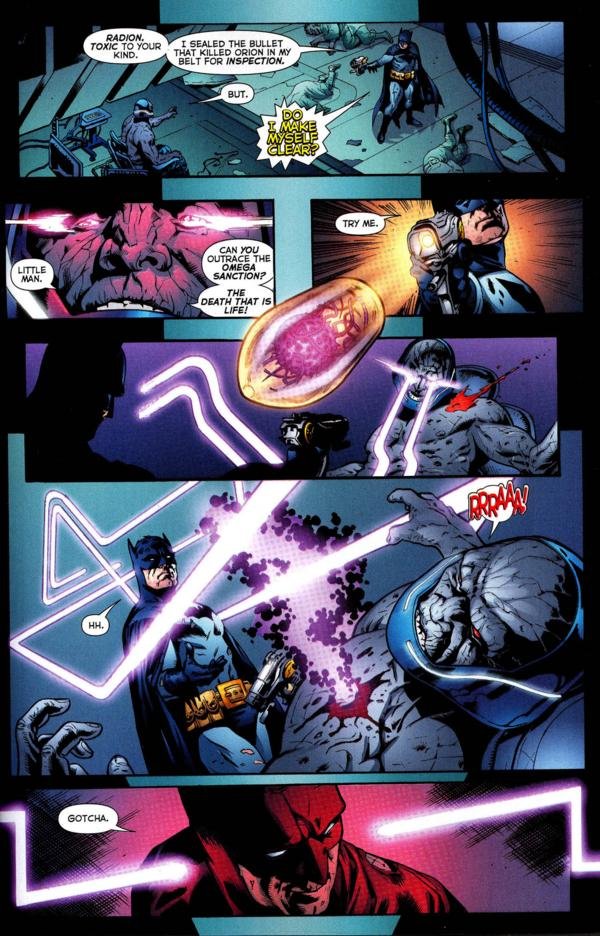
Then the last two issues happen. Issue 6 feels especially desperate. The Battle for Bludhaven, the heroes big plan happens and it is tense. Other than Supergirl, the heroes don’t exactly have their A-team. Batman finally reappears, having escaped. Breaking his rule against guns, he uses the bullet that killed Orion to shoot Darkseid, just as Darkseid blasts him with his Omega Beams. Superman reappears and turns the tide in the battle, setting up the final issue showdown with the wounded and dying Darkseid. All this is happening while reality itself continues to crumble. There is just so much going on. Of course the good guys win.
Final Crisis is the final in that trilogy of Crises. It is also a middle chapter of Grant Morrison’s own explorations of the DC Multiverse. It is in many ways a sequel to Seven Soldiers of Victory, another Morrison experiment I’ve really wanted to write about, and a prequel to Multiversity, which needs to be added to my list of comics to write about. For my money, and with respect to Spider-Verse and DC One Million, Final Crisis is the most enjoyable event crossover either DC or Marvel has ever put out. There are just so many moments and concepts. And considering that DC wiped that version of the world away a bare few years later, it feels kind of like the last gasp of the version of the DC universe I first learned to love. It is really worth tracking down and giving a read. I am sure the Arrowverse will never do an adaptation of it. Even more than Crisis on Infinite Earths, Final Crisis seems downright unfilmable as live action.


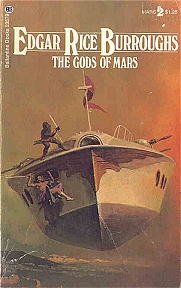 This is the 2nd of the John Carter books and it manages to top the first one. Gods of Mars is pure pulp action. Each chapter has John Carter and friends facing a new threat and greater odds than the one before it, with no time for reflection or thought or meaningful character development. John Carter is the manliest of men, his prowess being almost ridiculous. Not one but three beautiful women are in love with him; not just 3 women but the three most beautiful women on Mars. He can outfight any 10 men, 20 if he is angry. He is as much of a superhero as any in the books I read this month. In fact, with his otherworldly origin and leaping prowess he bears no little resemblance to certain alien rocketed from a dying planet to Earth, where the yellow sun gave him extraordinary powers.

 Skociomatic