Dark Angels, Karleen Koen

Dark Angels is a historical romance novel set in the court of Charles II of England, who ruled during the late 17th Century. It stars a young woman, Alice Verney, who must navigate the treacherous, lecherous court in her attempts to foil a possible assassination plot and secure a marriage with a high-ranking nobleman.
The historical setting is what drew me to the book and I was not disappointed. I have a great weakness for the combination of romances and true-ish historical settings. The court of Charles II is a fertile place for intrigues and plots, and this book doesn’t disappoint. It does feel less dangerous than it could; I never had much fear for the survival of the protagonist (and as this is a prequel to a novel where she was old this is probably intentional) but neither did I doubt the survival of a historical figure who did not die by murder. I can’t say with certainty that Dark Angels is an accurate portrayal of life during these times, but it was an entertaining one.
Unfortunately, Alice is not a likeable protagonist. She is a selfish bully, full of herself and often thoughtless when dealing with her friends. She is smart and beautiful and knows it, lording it over her friends who are somewhat lacking in one or both of those traits. Alice’s annoying arrogance surely intentional, but it does grate some. She is a young person, who thinks she knows much more than she does, but the world, and the novel, still has surprises for her. This is about her growing out of her childish selfishness. But that does not make her any more likeable for the first two thirds or so. Also, several threads are left unresolved at the end of the novel. Maybe these are references to the first volume in this tale, but for just this book, they leave some unsatisfying conclusions.
Dark Angels is a decent read. Come for the history, tolerate the tepid romance. I can’t say I didn’t enjoy it, but neither am I rushing out to pick up the author’s other work
Robert E. Lee on Leadership, H. W. Crocker III
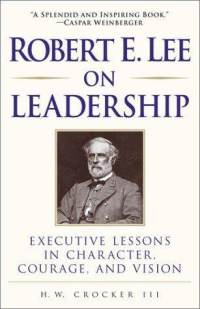
I was gifted this brief biography a few years ago but did not get around reading it until now. While not objectionable bad, it does have some problems. The biggest of which is that it is framed as business leadership advice, giving it a very narrow audience. Lee’s leadership techniques are worth remembering, but it is all put as a way to get ahead at work.
Robert E. Lee is a figure worth remembering. He did lead an outnumbered, outgunned force to numerous victories over their larger, better-equipped foes. However, he did fight for the wrong side and there is no escaping that. The argument that the Civil War wasn’t just about slavery has merit, but the Civil War was absolutely about slavery. There were other factors of some importance, but the one thing that changed the struggle from Congressional arguing to all out war was slavery. Lee, though, was not necessarily for slavery. He was for Virginia. The Stated rights argument is one that rose to prominence after the war was won, but for Lee his decision not to lead the Union armies, a position he was offered, but to join the Confederacy was based on the position of Virginia and the fact that he thought of himself as a Virginian and not an American. He is a complex figure worthy of study and without out doubt a great man.
I guess my biggest problem with this book is that it is not the biography of Lee I want to read. Fortunately, it is short enough that I did not waste much time on it.
An Autumn War, Daniel Abraham

The third volume in the Long Price Quartet really ramps up the scope. The first two books were very small for fantasy. This was a strength of theirs. A Shadow in Summer and A Betrayal in Winter were about specific people, specific places at a specific time. Most fantasy involves events of world changing importance, of grand scope and unparalleled consequences. It is both satisfying and somewhat sad to see this series transition to something more like that.
Through the first half of An Autumn War there is the there is feeling of certain calamity. The word war is right there in the title, the reader knows that the potential war will happen. So the protagonists‘, Otah and Maati, struggles to both prevent the war for occurring and prepare for it if it comes are heartbreakingly futile. And while what he is doing is horrible, one can’t help but sympathize with Balasar Gice’s desire to see the andat, the harnessed magical spirits controlled by the poets of the Khaiem that give them the power to prevent wars, destroyed. The first two books have made it very clear that the society of the Khaiem is corrupt, possibly past the point of saving. It requires brother to kill brother to succeed their fathers; it molds it poets through cruelty. The Khaiem is clearly not a nice place and the world might be better off if it fell. However, it is hard to approve of Gice’s ruthless tactics. Maati, who is content to live in the system in place, is trying to find a way to use that to save them, while Otah is relying on more practical, if not more effective, means.
As it did in the first book, it all comes down to Maati, and he is unable to rise to meet the challenge. Maati is a good man; a decent, faithful and kind man. The times require a great man, but all the world has is Maati. There is a certain inevitability to his failure; he has failed at everything else in his life. Despite his failures, Maati is still the most relatable character in the series. He does not want to be a great man. He does not want importance. But he always seems to find himself in places that need a great man, situations that require a hero. And like always, he tries and fails to meet the needs of his world.
An Autumn War is a great piece of fantasy. Even with it’s more epic scope it is still more personal than most of the genre. This is definitely a series to check out.
 Skociomatic