This was not a good month for me, reading wise. Mostly because all the new handheld games I intend to buy this year came out this month and I used time that would normally be reading time as Tactics Ogre and OkamiDen time. But I still got four books read, so it wasn’t a complete waste.
Fer-de-Lance Rex Stout
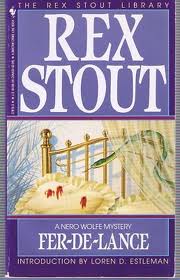
This is the first of Rex Stout’s Nero Wolfe mysteries. I can see why he is considered one of the greats of the genre. This is a terrific mystery. Nero Wolfe seems to be a progenitor of the irascible, eccentric detectives popular today, like TV’s Monk or House (Doctor, yeah, but House is totally a detective). Wolfe’s eccentricities, for those unfamiliar, has him refusing to leave his house to investigate, leaving it all to his assistant Archie Goodwin, who is the narrator. Archie Goodwin does all the legwork, but Wolfe uses his findings to solve the case. It is an interesting, workable good set-up. The actual case they solve is not exactly complex, but it is not too simple. The brother of an acquaintance of Wolfe turns up missing, then a respected man turns up dead with little explanation. Wolfe puts the two together and realizes that they are connected. So he sends Archie to look around. It follows in the standard manner of mysteries, with Archie and Wolfe getting closer and closer to the truth. Though it ends with Wolfe crossing the line from eccentricity to sociopathy. I’d recommend it, and I’ll be reading more of Stout’s mysteries.
Napoleon’s Wars An International History 1803-1815 Charles Esdaile

Charles Esdaile’s Napoleon’s Wars is a thorough account of the Napoleonic Wars. I should have known how annoyed I get with this book when I purchased it. Esdaile is British, I am a Napoleon apologist; should have known his take on Napoleon would be one I did not like. Don’t get me wrong, the book is well written and accurate, but he seems to be trying to equate Napoleon with Hitler and cajole readers into thanking Britain for saving the world from him. Every good thing Napoleon did is set as merely a ploy to get to more war and killing. While no one can argue that Napoleon was not inclined to battle, I do not think the rest of what he did is easily swept aside. The wars of the time were almost as much the fault of the leaders of other nations as Napoleon. Still this is definitely a worthwhile read, though possibly more dense that a casual reader would appreciate.
Mariel of Redwall Brian Jacques

Mariel escapes from the pirate Gabool the wild, journeys to Redwall and then goes back to rescue her father, Joseph the Bellmaker. (Remember the Joseph Bell from Redwall?) Joined by new friends from the Abbey she treks back to the fortress of the increasingly insane Gabool. I actually like the cast of this book more than the ones from Redwall or Mossflower. Martin is kind of boring in life, but as a ghostly protector, he is great. But here we get Mariel and the first more nautically themed Redwall book. Also, the first female main character. It is kind of hard to separate these books after a while, because they all are very similar.
Martin the Warrior Brian Jacques
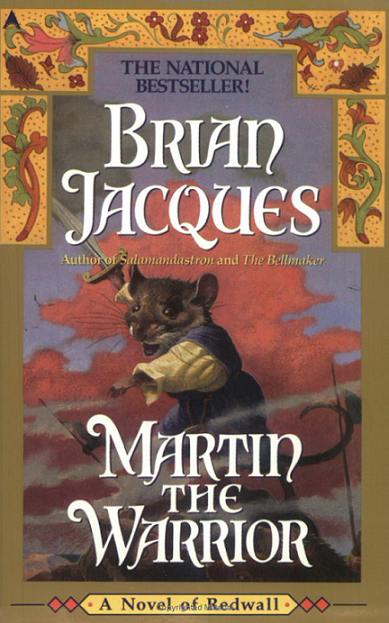
This is my least favorite of the Redwall series so far. The bad guys are ridiculously incompetent, and the knowing what happens next makes the book is predictable. It seems like Jacques realized that Martin did little in his previous book (Mossflower) and needed another book to make him seem as important as he does the books where only his spirit appears. This book details an adventure of Martin’s before he comes to Mossflower. As usual, there is a horde of vermin and imperiled good animals. The most interesting thing in this one it the troupe of traveling performers, who sadly get to do little performing. Martin and his newly met friends escape from , then bring an army back to take him down. You know, the usual Redwall stuff. The fun of these books is not in their plots, which are standard adventure fare, but in the execution. And Martin only slightly under delivers on that.

 Skociomatic