My 10 Favorite Games #10


Chrono Cross

Chrono Cross

Chrono Cross (Photo credit: Wikipedia)

I wrote about Chrono Cross about a year ago, playing it for the first time in a few years. I haven’t changed my thoughts much since then. The one thing I will note is that while the storyline starts out poetic and dreamlike, it eventually starts falling apart at the seams. Square’s team could keep that tone going for a while, but not for the entire length of this 30 or so hour game. That doesn’t really matter to me; the aesthetic of the world and the easy flowing energy of the battle system make the game just easy for me to play.

Gaeas_navel_4

There are definitely games with clearer focus than Chrono Cross. The battle system may flow, but its ins and outs aren’t exactly intuitive. The story starts out kind of vague, then degenerates in incomprehensibility. Compare it to its predecessor Chrono Trigger, which has a seemingly simple battle system that even when the depth of the dual and triple techs is unveiled it is still limited by each characters small spell pool and its plot has a pretty simple through line. Chrono Cross is an utter mess. Still, it is a mess with some fine ingredients. While it doesn’t present itself clearly, I enjoy teasing out what everything means even if ultimately it means nothing.

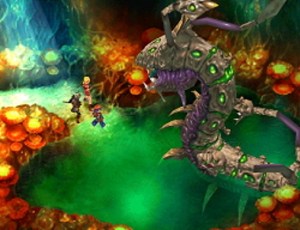
Largely that turns out to be the case with Chrono Cross’s story. Vague foreshadowing resolves into vague, meaningless conclusions. Fortunately, the story in each little set piece largely works. The larger plot is where all the incomprehensibility reigns. Kid gets Serge to help her break in to Viper Manor to steal the Frozen Flame. What the Frozen Flame is isn’t clear at that time, but the breaking in and attempted theft has a pretty clear story. Then you must save Kid by finding a Hydra Humor, so you go to the Hydra Marsh. Again, it is a clear little episode. The connecting tissue for most of these episodes is weak to nonexistent, but the episodes themselves are fine. In the end, though, it doesn’t add up to a truly worthwhile story.

Leene_square_ruin

The plot grand rambling ambitions are not aided by the bloated cast. The cast is one of the things I love about the game, but even I can’t deny that having about 30 unnecessary characters you can get to join your party hampers the game’s ability to tell a story. When you could at any point put a baby dragon and a skeletal clown in you party instead of Kid or Leena or Glenn, then yeah, your story isn’t going to be the same. But there is also no denying how much fun it can be to build a party around said dragon or clown, or maybe a luchador priest or a mushroom man. It is not conducive to storytelling, but it is conducive to wacky fun.

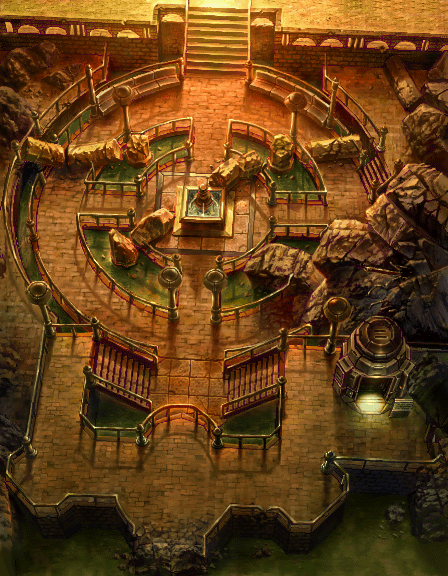
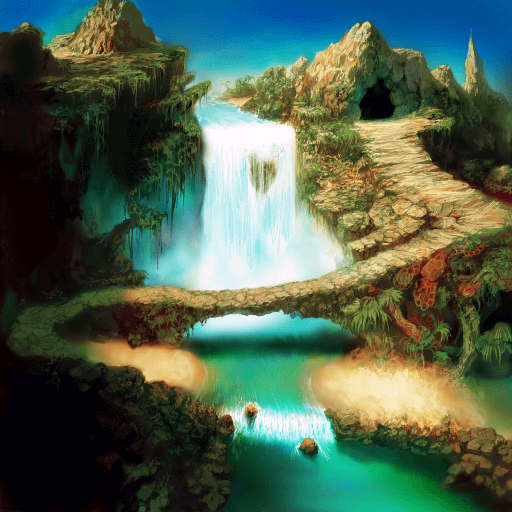
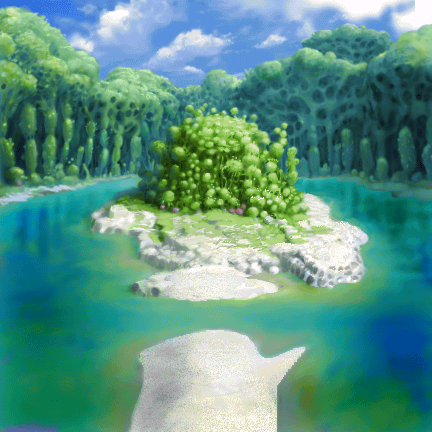
The biggest reasons Chrono Cross is on my Top 10 games list are the music and art. Look at the examples of prerendered backgrounds in this post. Amazing, right? And the music needs no defense. Honestly, no matter what the story was, no matter who the characters were, I would enjoy playing in these tropical locales with the amazing music playing. It is simply perfect.

Home_divine_dragon_falls

The aesthetics combined with the goofy characters and fun battle system, it makes for a game that is simply a joy to play. That is, of course, dependent on one’s ability to tolerate the slowness inherent in PS1 RPGs. They must load. But since I grew up on that, it doesn’t greatly bother me. Chrono Cross is a game that have glaring, numerous flaws. It would never appear if this list were about the games I felt were the best made. But Chrono Cross is better than the sum of its parts. It is like a fragmented dream, it doesn’t quite make sense, but you find yourself endlessly trying to piece it together anyway.

Memories of Chrono Cross

There are few more divisive games than Chrono Cross. While it garnered almost universally terrific review at release, the public at large seems to be split. The reason for this is quite simple: Chrono Cross is an absolute terrible sequel to Chrono Trigger. That is not to say that it is a bad game. Far from it. Chrono Cross gets almost everything right, it only falters when it tries to connect to Chrono Trigger. Nearly every time a part of Cross echoes Trigger is stumbles.

Honestly, I absolutely love Chrono Cross. Both because it is a great game and because of my memories of the time when I played it for the first time. I came to the PS1/N64 generation of consoles pretty late, not getting a 64 until Christmas ‘99 and then a Playstation near my birthday (October) the next year. Chrono Cross was one of the numerous RPGs is bought the next year, flush with money from mowing lawns and too old to ride my bike but still too young drive. Plus, that summer I has home alone. Part of my family went on an RV trip to the west, to see the Grand Canyon and Yellowstone, but anyone who has spent a week in an RV with 8 or so people know why I declined to join them. My two brothers closest in age spent a month or so with an uncle 500 miles away, but I didn’t go with them either. So at home, with my Dad who was working all day, after I finished whatever mowing I had to do that day I had the house, and TV, to myself. The games I played that summer! Final Fantasy IX, Final Fantasy Tactics, Legend of the Dragoon, Lunar 2 and Chrono Cross. Amazing games (save for LoD) and while I still would rate most of them among my favorites in the system, but Chrono Cross is the game I most associate with that summer, if only for the summery tropical aesthetic.

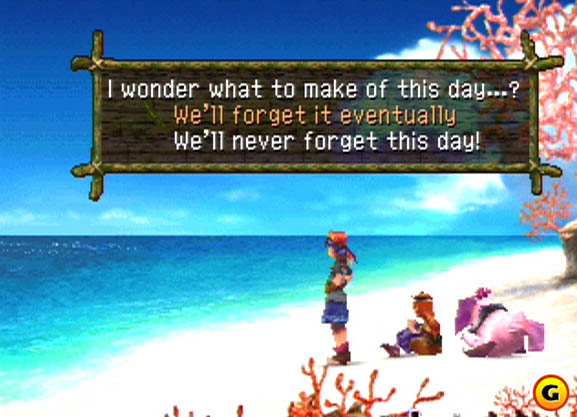
If there is one place where no one can argue that Chrono Cross doesn’t shine, it is the presentation. The music is one of humanity’s greatest achievements (warning, the last statement may contain a small amount of hyperbole.) The graphics, while primitive by today’s standards, hold up better than nearly any other 3D PS1 game. The character designs are great, and the colorful, tropical world is still all too unique. Chrono Cross undeniably looks and sounds incredibly good.

Chrono Cross did carry a few things over from Trigger in a good way. Like the lack of random battles, though it didn’t do as well as Trigger. In Trigger many encounters were built into the map, in Cross there are enemy sprites that when engaged zaps the players to usual battle screen. In another way, though, Cross takes the no random battles further by eliminating experience points. In stead of gaining levels by fighting battles, in Cross players get star levels by beating bosses. Other than for some supplementary stat increases after the five or so battles following a level, there is no reason to ever fight a non-boss battle. The forced level let developers hone the difficulty much more tightly. All players are going to have roughly the same stats, so they know exactly how tough the boss can be. Chrono Cross is one of the tougher RPGs I’ve played, a fact easy to forget after a decade of New Game +. The somewhat higher difficulty is tempered by Cross letting players run from any battle. Even boss battles. This means that there is no good reason to see the game over screen. If your element layout or strategy isn’t working, just run away and reset everything. The system all work together, designed to work in concert rather than just things thrown against the wall. It emphasizes strategy over simply making numbers bigger.
None of that would matter if the actual battle system didn’t work just as, which it fortunately does. Each character has 7 stamina per turn, which can be used to attack or to use an element. Weak, medium and strong attacks take 1, 2 and 3 stamina points respectively, but they each open up the characters grid the corresponding amount if they connect. Casting a spell, or an element as they are called in this game, takes a full 7 stamina, but it can be done as long as the character has at least one stamina point, allowing them to accumulate a deficit of up to 6. Effective strategizing means using using enough attacks to open up the grid, but not letting the whole team fall into a deficit, which allows the enemies a free turn. Despite being a rather novel set up, the battle system is surprisingly intuitive. It never feels overly complicated or different for the sake of being different, despite changing plenty of things from Chrono Trigger . There is no MP and it is completely turn based. Instead of learning abilities, with the exception of 3 unique techs for each character, there are only elements and the grid. Each character has a grid on which the player can but spell elements, each of which can be cast once per battle. Since the player can’t just spam their best attack over and over, they must rely on smart allocation of elements. The battle system is good enough to make you want to fight battles even though there is absolutely nothing gained from doing so.

The story, while not as good as the gameplay or graphics, has its moments. Early on it is terrific. It aims for poetic and actually hits it. There are constant references and allusions to dreams and memories and conflating the two, setting up the nostalgic “what is things were different” yearning that is the tone for the game. The dreamlike state, starting with the actually dream sequence at the beginning, never really goes away. The two realities work because one in not wholly better than the other. Serge is only alive in one world, but in his home world nearly all of the Viper Manor characters have been killed. It actually makes it hard to decide which one is the preferable “real” world. When the dragons show up things kind of go to crap, but there are still plenty of great moments. The dreamy-ness of the plot helps excuse some of its shortcomings, but not all of them. The first six or seven hours or so really work well, but after that it kind of sketchy.
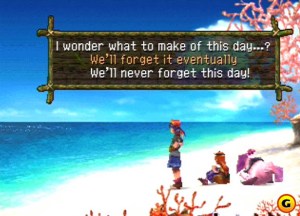
One part routinely pointed out as a weakness is the numerous, thinly developed party. I will not argue that the majority of the party is well-developed, but I will argue that the large party is an asset rather than a fault. The characters that matter, Kid, Lynx and Harle, are all well rounded. Most of the rest have only small windows of importance, and some have absolutely none. However, many have their own stories going on outside of Serge’s. The whole world seems connected, with many of the characters having pre-existing relationships, but it also as though Serge’s search into the mystery surrounding him is not the only thing going on for many of the characters. There is the whole Viper Manor group, which numbers about a dozen character and while most of their story can be uncovered over the course of the game, plenty of the dots are not necessarily connected for the player. The individual characters aren’t particularly well-developed, but they all feel like pieces of a well-developed world.

As I mentioned earlier, the game usually falters when it refers back to Chrono Trigger. While they both take place in the same world, the only mentions of places familiar from Trigger are uniformly insulting and terrible. All the happy endings have been quickly erased, and the sleepy town of Porre is now a warlike empire. Squaresoft did seem to know which dangling plot thread from Trigger players wanted so deal with, that of the missing Schala, but they dealt with it in an entirely unsatisfying manner. The questions of what happened to her aren’t really answered, and Magus doesn’t even make an appearance. Also, Schala is Kid kind of and it doesn’t make sense. The story really goes off the rails the more it tries to be a sequel to Chrono Trigger. The worst part of the battle system, the sparse and useless double techs, is a tacked on hold over from Trigger. It almost seems like Chrono Cross goes out of its way to not be a satisfying follow up to Chrono Trigger.

Removed from the idea that it is supposed to be a sequel, Chrono Cross is one of the absolute best RPGs on the Playstation. It can be hard to separate the two games though, and Cross can only suffer from the comparison. The two games in the Chrono series are both excellent, but they really don’t seem to get along with each other.

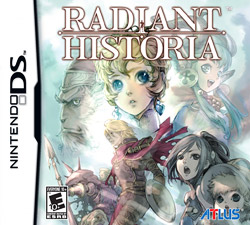
Radiant Historia

Radiant Historia is one of the best original RPGs on the DS.  The system has been a haven for fans of 16 and 32-bit role playing games, but a surprising amount of the systems library is remakes and ports.  Not that that is a bad thing, it is the only way people are likely going to be able to play things like Dragon Quest 5, but the original games have mostly paled in comparison to the classics.  Radiant Historia, though, stands among the best in the genre, managing to feel simultaneously classic and original.

In a lot of small, hard to define ways, Radiant Historia feels like an SNES game.  Which coming from me is the highest of compliments.  Give or take some rough sprites and 3D backgrounds, it looks like an SNES game.  Maybe the feel is in the fact that the game really doesn’t take advantage of the DS’s special features, making it not unlike many of the ports and remakes.  More than anything, though, it is that there is a comfortable familiarity to the game.  It plays exactly like one would expect an RPG to play.  It is accessible and intuitive.

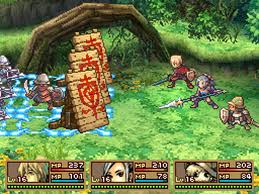
The accessible nature is amazing when you consider that a lot of what Radiant Historia does is pretty novel, at least as far as RPGs go.  It combines the time travel of Chrono Trigger with the alternate realities of Chrono Cross, but in a way that is more in depth than either of those games.  In Chrono Trigger time travel was mostly an excuse for different environments, Radiant Historia uses it for the opposite reason.  It allows the game to reuse the same areas over and over, but in turn they really take advantage of moving through time.  The battle system is not exactly standard either.  It combines Final Fantasy X’s emphasis on turn order with the grid set up of a tactics game.  The end result offers a variety of effective and interesting strategies.  The player can set trap on squares and knock enemies on to them, or manipulate the turn order to build a giant combo or even do both at once.

The end result is a highly satisfying game, the kind expected from the twilight of a systems life, when all the tricks are known and developers have familiarity with the tools.  Perhaps the most satisfying part of the game is actually the story.  Radiant Historia’s story, at least for much of its length, is much more like a piece of Western fantasy than the typical JRPG.  Sure, eventually the anime-influenced JRPG stuff seeps in, with the forgotten pasts, secret siblings and plots of world destruction, but for the first two thirds of the game there is more emphasis on political maneuvering and small scale conflicts.  Much like the rest of the game, it is a refreshing change of pace.

The game isn’t perfect.  For too long it sticks players with party members with the least interesting abilities.  They are fine individually, but Raynie and Marco do not have much synergy. The game also takes a little too long to get going and it starts to fall apart near the end.  Small flaws in an otherwise terrific game.

Though it more likely to be forgotten than celebrated in the years to come, Radiant Historia deserves a place in the pantheon of great DS games.  It is not only probably the best original RPG on the system, it is easily among the best DS games.  I’m not sure if it is still widely available, but players owe it to themselves to give this gem a try.

Once More I Walk this Dangerous Path

Arrgh! Etrian Odyssey! Again!

Don’t get me wrong, I love Etrian Odyssey. However, I would guess that even the series’ most ardent fans (a group I generally consider myself a part of) would agree that frustration is a large part of the series’ charm. Etrian Odyssey is never easy but it is rarely unfair. It gives the player a set of tools, a goal and an obstacle then leaves them alone. Continue reading

The RPG Machine

Anyone who reads this blog should know that I am a pretty big fan of RPGs. A large part of my love of the SNES is due to it being probably the best RPG console to ever exist. The SNES library is glutted with great–and not so great–RPGs. More so than anything else, the SNES is great for RPGs.

That is not to say that subsequent consoles haven’t also had great RPGs. With the exception of the N64 they all have and I guess even the N64 had Paper Mario and Ogre Battle if you squint to make it count. The SNES, though, has an overabundance of all-time great games from the genre.

By my reckoning, there are 4 categories of SNES RPGs. The first are the “disputed” ones. These are the games that aren’t widely considered classics, but so have supporters, often vocal ones. This group covers most of the SNES’s RPGs. Games like the Breath of Fire or Lufia series. These are the games that you know one person who swears they are amazing, but most everyone else could take them or leave them. Some have tried to tell me that Breath of Fire II is a classic on par with the systems greats, but this is just not true. BoF II is too grindy and the translation it too mangled for the game to be anything but mediocre. My personal hobbyhorse in this category is Secret of Evermore. Despite longstanding hatred for not being Secret of Mana 2, I’d say that Secret of Evermore is a damn fine game. In fact, I like it more than Secret of Mana. I realize, though, that I can’t change the established narrative that they are the classic Secret of Mana and Secret of Evermore is its bad, or at the very least misguided, semi follow-up. That is how the disputed group works. History has already judged these games and found them wanting, but there will always be those that claim Final Fantasy Mystic Quest is the “secret best” SNES Final Fantasy game. It makes all the games I’ve mentioned, and many more, worth a look, though you most likely find many of them to be not to your taste. However, there is the chance that you might find one of them to be a hidden classic.

The next group are the “great, but” games. This is a much smaller group than the one before it. These are the games that would be truly great, save for one flaw (or several small flaws). Like Secret of Mana and the fact that you can almost see the seams where large parts of the game were removed and the surrounding part sewn together. Or Super Mario RPG and its goddamn infuriating isometric platforming sections. Or Final Fantasy 2 and the fact that it is not Final Fantasy 3. My experience with FF2 really is a tragedy. After spending years wanting to play that game, I didn’t end up getting the chance to until after I had played FF3 and Chrono Trigger and next to them, it felt primitive and shallow. All of these games are definitely worth playing, though.

The third group is the “unimpeachable classics.” I say there are only three games in this group: Chrono Trigger, Earthbound and Final Fantasy III. Not only are these the three best RPGs on the SNES, I would say they are the three best RPGs, period. There are plenty of games on a similar level, but none that are genuinely better. Chrono Trigger is elegant. It is graphically stunning with a straightforward story and a deceptively complex battle system. Earthbound is truly unique (other than its Japan only sequel) with its modern setting and often absurd sense of humor. Final Fantasy 3 is simply bursting at the seams with game. The party has more than 12 members but never feels bloated, each with unique skills, as if they split each of the jobs from the previous game into its own character. There is a 20-hour game that climaxes before opening before another 20-hour game. All three of the games have terrific music. Everyone should play these three games, as often as possible. I make a point of playing 2 of the 3 every year.

The last group is the “not available” group. There are the numerous, numerous games that never made the trek across the ocean. It is lead by Final Fantasy 5, Dragon Warriors 5 & 6 and Seiken Densetsu 3 (Secret of Mana 2). Many of these games have since made it to America, but they will never be truly part of the SNES experience here. Many of them are great games; some have inflated reputations due to their inaccessibility. No matter the quality, the sheer number of games that we didn’t get–RPGs for the sake of this post, but there are many other games as well–is a tragedy.

Overall, there are so many great or nearly great RPGs for the SNES. I am not one to say that the genre has not evolved since the SNES days, but the games on this system were such a large part of shaping my tastes in video games that I cannot but consider it the best RPG console.

Musings on Death (in video games)

It is the 25th Anniversary of Dragon Quest—in Japan, the first game took three more years to get to America—and since I’m currently playing Dragon Quest VI, I thought it might be a good ides to celebrate one of the series best features. Dragon Quest is the bread and butter of the JRPG genre, with nearly every other game using it at as a starting point or inspiration. For as much as the series is copied, too few other games use Dragon Quest’s no game over strategy.

In most RPGs, as well as most other types of games, if you die you get a blood red “Game Over” screen and it kicks you back out to the title. However, Dragon Quest, even as far back as the first game in the series, just tosses the player back to the last—or only in the case of DQ1—church. All experience and items gained stay with the player, though the gold the player was carrying is cut in half. It doesn’t quite take all the penalty out of dying, but it does severely lessen the blow. Most importantly, it assures the player that they are never wasting their time. In the normal death model, being wiped by a boss means that all the progress through the dungeon has been lost, where in Dragon Quest all is means is you have to fight the boss again. It allows the game to up the difficulty of fights without frustrating the player since progress is never lost.

How do games like Final Fantasy get around to loss of progress problem? By adding more save points, an imperfect resolution at best. With more save points, frequently one just before boss rooms, there is less loss of progress, but it still wastes time. It takes the player out of the game. Sure, you’ll just reload your save and try again; nothing has changed from the last time other than any knowledge of the boss gleaned from the failed attempt. Instead of distressingly punitive consequences, there are none. Why games refuse to adopt Dragon Quest’s elegant death mechanic is puzzling.

Many ill-informed critics don’t seem to grasp the Dragon Quest system and instead deride the series for its draconian saving policy (i.e. at churches, only at churches). That is a feature, not a bug. Though a quick save feature like the DS games have is a welcome feature. By restricting permanent saves to town, it encourages players to reevaluate their approach after a death.

Playing Dragon Quest just really makes me wish more RPGs considered what they are penalizing on death. I love Persona 3, but its death mechanics are unfriendly for the sake of being unfriendly. In the game, there are two separate battle situations. There are the full moon story segments, usually a boss and maybe a small dungeon with a few random battles, where a game over makes sense. There is little progress lost and the fate of the world rests specifically on that time. However, Tartarus, the randomly generated grinding pit, is the opposite. A game over loses all progress on the long trek to the next safe floor. Everything is stacked against the player. If the main character dies game over, many enemies like to spam instant death magic. The battles are not really random, but the enemies in each are.

Very little challenge would be lost if instead of losing everything upon death the player was instead forced out of the dungeon for that day. The floors a randomly generated, so there is no memorizing the layout. The player would still have to start from the last safe/boss floor and make it to the next safe/boss floor in one go. All the player would keep are the levels from the battle that they already won. There is no loss of challenge, just a loss of time wasting bullshit.

I’m not sure the same could be said of the Etrian Odyssey series, where the challenge is to survive in the maze-like dungeon. If dying merely sent the player back to town, with say the loss of all items being carried, most of the challenge would be lost, turning the game into one long tedious, toothless grind. Of course, Etrian Odyssey is much less dependant on gotcha deaths than Persona, at least after the first couple of floors. Instead of no penalty, it could use a rescue system, where the player uses other characters from the guild to go get the ones who fell, but as it is I think it works. While Etrian Odyssey could undoubtedly be friendlier, it at least seems well considered in its hostility.