I’ll Face Myself

p4a

Last summer, for about two months I developed an intense infatuation with fighting games. They were all I played. I wrote a couple of blog posts about them, but apparently never managed to get them posted. Maybe I still have them somewhere, outlining my thoughts on about a half dozen different games, from my ineffectual struggles to become competent at King of Fighters XIII to my drunken mastery of Tekken Tag Tournament 2 to my surprising indifference to Street Fighter 4. Also, my thoughts on the surprisingly single player focused Persona 4 Arena.

I like fighting games, but I am no damn good at them. In fact, with a few exceptions I am downright terrible at them. I was quite good at Soul Calibur 2 at one point and with great effort I’ve managed to attain a level of skill at King of Fighters XI and XIII that I’d call “not embarrassing.” Otherwise, though, I am generally very bad. Still, I love the genre. The simple concept mixed with deep mechanics is interesting to me, even if I am unable to master those mechanics. Plus, they tend have some the most colorful characters and absurdly nonsensical stories around. Persona 4 Arena has a colorful story but not a nonsensical one. For a fighting game fan who is inept enough to unable to really play other people, P4A is just about perfect.

p4a1

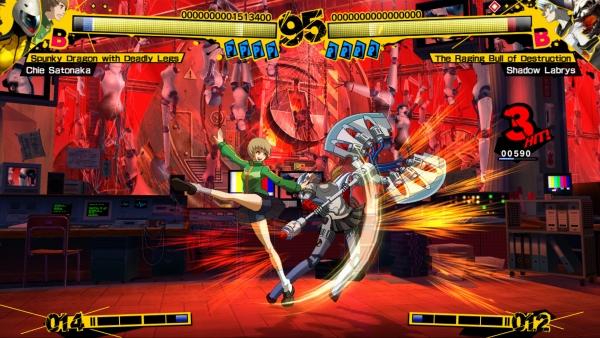
Persona 4 Arena is an extremely accessible fighting game. With its auto-combos and mobile characters, it is very easy to play. It verges on being as much as a button masher as Smash Brothers, but its simplistic surface hides a fighting system with significant depth. Again, I am no expert at exploiting those systems, but I can see them. What is amazing to me is how this game was constructed. Nearly all mechanics in this system are adapted from the Persona RPGs battle system. The Persona’s become some sort of Strikers, popping in to deliver special attacks. Status effects abound, with mute sealing off all attacks that use a persona and poison slowly draining a player’s life bar. On top of that, it does a great job of letting each character’s personality show through their attacks, from Teddy’s goofiness to Kanji’s formless brutality. The game is easy to pick up and play, but there is enough depth for fans of the genre to sink their teeth into.

The big draw, at least for fans of the Persona series, is the story. The story in P4A is a fine, if inessential, addition and an effective bridge between P3 and P4. It plays out largely like a dungeon in Persona 4. Someone is trapped in the TV world, and the investigation team is drawn in to find them. At the same time, part of the crew from Persona 3 ventures in to the TV, chasing a disturbance, which is obviously the same person that the other crew is after. That person turns out to be a prototype of the same kind of robot as Aigis. With help from the other characters, this new robot, Labrys, manages to face her shadow and overcome her problems. Still, the group doesn’t find out who put Labrys in the TV in the first place, leaving a hook for the sequel that I didn’t expect to ever come, though I have been proved wrong.
p4a2

I was surprised that I didn’t hate Labrys. One of the things I liked about Persona 4 in comparison to Persona 3 was that it didn’t have any ridiculous stuff like persona using dogs or shadow fighting robots. Not that I didn’t like Koromaru and Aigis, but their presence kept P3 from having the verisimilitude that P4 had. When I saw that the first thing P4A did was add a robot to the P4 cast I was a little annoyed. After playing it, though, I found it worked well to bridge the two games. The P4 cast would show up when anybody appeared in the TV, finding a stolen, supposedly failed, prototype gives the P3 cast a reason to come running and join the other cast. Plus, Labrys’ story makes for a fine justification for the fighting nature of the story.

Honestly, it was just good to see the P4 cast again. I was much more attached to them than the P3 cast, plus they were fresher in my mind. I actually bought the friendships between characters like Chie, Yosuke and Yukiko. Other than their relationships with the protagonist, I don’t remember that camaraderie between the P3 characters. Did Aigis ever have a conversation with Akihiko? I don’t remember. While this game’s story is not perfect, I was happy for any excuse to see these characters together again.

As fanservice, P4A is basically perfect. It is a fun, accessible fighting game that exists mostly to provide an excuse to revisit the one of the most enthralling worlds to have ever existed in a JRPG. Shockingly, it also succeeds at being a solid fighting game too. It’s story mode it absurdly wordy, but it gives the fans what they want. I am eager to play the sequel, though I am unlikely to drop sixty bones on it.
Bullseye!

arrow

I watched the first season of Arrow on Netflix over the last couple of weeks. I had been told it was quite good, but forgive me if I didn’t believe. People also told me that Smallville was good, and that show, while occasionally enjoyable, was never actually any good. Plus, the team behind it was also the team behind the Green Lantern movie, which was at best a disappointment. On top of that, Green Arrow is generally a tough sell for me. It’s not that I don’t like him, but often comes off as an off-brand Batman. Finally, a genuinely trusted source, my brother, told that the show was excellent, so I gave it a shot. He and that anonymous “they” were right.

It does take a couple of episodes to really get up to speed. Part of that has to do with Oliver’s struggle with what his mask is going to be. He doesn’t know whether to be the disapproving older brother, to be tortured and brooding over his years lost on the island or to be the carefree party boy. From episode to episode he vacillates though these various personas while getting his act together as a bow-toting vigilante. The rest of the cast also takes a while to find their place. That is not unusual for a TV show. The pilot is generally shot apart from the rest of the show, often resulting in a slightly different tone than the rest. And I’m sure there is feedback that is taken into account with subsequent adjustments.

By the fifth episode, most of the show has fallen into place and Arrow starts to be a lot of fun. One big change that keeps complaints about Green Arrow being a Batman clone is the prominence of his family. Batman is famously an orphan. In Arrow, Oliver Queen has a mother, sister and a step-father. It makes it more difficult for him to keep his secret identity secret. Not that he is very good at that, though his failures in that area make the show all the more believable. Outside of his family, he has a handful of other allies. There is Diggle, hired to be his bodyguard and eventually becomes Ollie’s partner in his quest to clean up Starling City. Eventually they are joined by Felicity, a computer expert that works at Oliver’s family’s company. He also has is former girlfriend Laurel Lance and best friend Tom Merlyn, who have started a relationship in his absence.

Honestly, there is a good show here without Ollie’s actions as a vigilante. His struggle to find his place after five years away is a good enough hook to keep things interesting. How does he tell his sister to stop her partying when she is acting no different than he did before he was lost? And she actually has the excuse of suddenly losing her father and brother to a tragic accident. By the middle of the season, the Green Arrow stuff does come to the fore. At that point, the show starts to bring in more elements from the comics. The villains stop being generic corrupt business men; they start to become comic villains. His flashbacks back to the island stop being about just survival and start to be about adventures there with Shado and Deathstroke.

What the show does effectively is show that while Ollie may have matured on the island, that he had been fundamentally changed by his experiences, he is still not a hero when the series starts. He undoubtedly does good, but he kills a lot of people doing it. This turns Detective Lance, Laurel’s father, against him. It keeps Diggle from wanting to work with him and distances him from Tom when he finds out. It also adds a layer of hypocrisy to the whole endeavor. When he meets up with Helena Bertinelli, Huntress from the comics, he tries to teach her that she doesn’t have to kill. While he is right that her goal is vengeance, not justice, it also shows that his quest isn’t quite right. Later, Det. Lance tells Roy Harper, another comic expat, that no one man has the right to mete out lethal justice, he is right. What gives Oliver the right to just kill whoever he determines is a bad guy? Getting that lesson across to Oliver is a journey that lasts all season.

Arrow is pretty much exactly a superhero TV show should hope to be. Yes, it is some low level soap opera, but that is a big part of the superhero formula. And a powerless guy like Green Arrow is a perfect fit for TV because he doesn’t need extensive special effects to do his thing. Every episode has a villain of the week “A” story, but that is augmented by long running subplots. Just like comics, when they are working right. It is often cheesy, occasionally dumb but largely an enjoyable hour. Those same people that told me the first season was good also told me that the 2nd season was better, so hopefully I’ll get a chance to see for myself soon.

One more thing of note, I would guess that whoever is responsible for casting this show is a fan of Dr. Who. Casting John Barrowman is simply a smart move; the man is always entertaining. But while he is around for most of the season, later on Alex Kingston, best known (by me at least) for playing River Song, shows up as Laurel’s Mom it starts to look like it’s not just a coincidence. Again, I can’t fault the casting choices. I, too, like Dr. Who.