Psych Out

For the last couple of years, my favorite currently airing TV show has been Psych. As much as I like it, I apparently missed more than half of season 5 when it aired. Watching those missed episodes have just reinforced how good the show is. It isn’t anything especially terrific or revolutionary. Its just the usual detective show with a bit of fake psychic misdirection and a more comedic bent than usual. However, the cast and writing is strong. While Psych does engage in some of the popular but often lazy trend of replacing actual jokes with references to trivial bits of pop culture from the 80’s, Psych does more than that. It integrates those references into the fabric of the show.

The Holmes and Watson of the show are Shawn and Gus, played by James Roday and Dule Hill. Shawn is the brilliant and highly perceptive, though at times almost sociopath, detective. He poses as a psychic at first to avoid suspicion in the crimes he solves and later because he is stuck in the lie. Actually, after the first few seasons there is much less focus on making Shawn’s psychic abilities seem believable. Gus is Shawn’s often put upon partner. At first he seems just someone for Shawn to bum rides and bounce dialogue off of, but he does bring more to the table than his car. Gus may not share Shawn’s perceptive abilities, but he has a deep knowledge on a wide variety of topics, helping Shawn tie together clues he otherwise wouldn’t know what to do with. What the show does really well is show the two as real friends. Shawn may play constant pranks on us, but Gus gets his in and even if he would never admit it, he actually likes the uncertainty that comes with Shawn’s eccentricity.

The supporting cast is also great. There is Shawn’s retired detective father, who hates Shawn’s refusal to be responsible. He begrudgingly helps out while also trying to teach Shawn lessons. Then there are the actual police. Psych does a great job of not making the cops seem incompetent while also letting Shawn and Gus solve the case. Detective Lassiter is butt of most of Shawn’s jokes, but the show makes it clear that he is normally a terrific officer. His partner, and Shawn’s eventual love interest, is Juliet, who is just as good a detective as Lassiter and more willing to help out Shawn and Gus. Despite the antagonism between both Shawn and Lasseter, there is camaraderie among all member of the group.

Where is shines is in the often inventive crimes. Of course a trip to see an old friends new summer camp turns into a slasher movie inspired episode. Shawn and Gus are nearly constantly referencing old movies and TV shows, but usually in ways that actually pertain to the situation. They made several Karate Kid references in the episode when they were dealing with a kidnapping that involved a martial arts dojo, but they restrained themselves to one when Ralph Macchio guest starred.

While the show is very joke-y, it does get serious occasionally. Like the season finales that feature the Yin/Yang serial killers, though the 3rd one is a bit of a let down. In those episodes the stakes raise and most of the jokes disappear. And the show still works. The base detective show is strong enough to get by without the humor. But the show is about the humor. It can be taken away for special episodes, but those would lose their pop if the whole show was humorless.

Psych is possibly the most pleasant hour of programming on TV. It isn’t really a show to get excited about, but it just so easily entertaining. There is currently only one other show I make sure to watch. (I ain’t got no fancy DVR) I can feel that Psych is nearing the end of its run, it is getting ready to finish up its sixth season, with at least one more to come.  So I want everyone to enjoy it while it lasts.

Its a Monster Tale

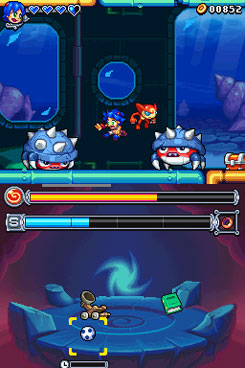
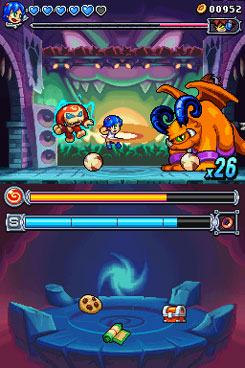
I’ve just beat Monster Tale, a fun little game from the makers of Henry Hatsworth that should be better than it is. Not that it isn’t good. It’s very good. But Monster Tale does a lot of things so very wrong that I have a hard time not feeling disappointed. It had gorgeous 2D graphics, pitch perfect control and mechanics and possibly the worst map I’ve ever seen in a Metroidvania style game. The map is only the start of the games problems. Still, it manages to be simply fun to play.

Monster Tale is about a young girl, Ellie, who is sucked into Monster world and finds a monster freshly hatched out of its egg. So she teams up with the baby to try to find away home, quickly running afoul of the other children in monster world, who are less eager to return home, instead being content to rule over the monsters with an iron fist. It is fun and childish in wonderful video game tradition. The abilities Ellie gains as the player advances all fit seamlessly into her moveset. In the end she is an easily controlled destructive force.

The game is set up like Metroid or recent Castlevania games, with a large connected map rather than separate levels. While running around is fun in and of itself, the map design is atrocious. Instead of the having some exploration available at all times, Monster Tale forces players along the one path that can open up more of the map. The openness is not there to facilitate exploration, but to pad the game length. The game hides power-ups behind doors that you need another power-up to open. Not a chunk of map that also has a power-up, just a room with a power-up. Meaning that to get power-up A, you must acquire power-up B and then backtrack all the way across the map. The game is about 40% backtracking. But as I said, it is a lot of fun to just run through the world.

At least its fun for the first half of the game. After that the enemies start taking so many hits to kill that it becomes a chore. Maybe its because I never got all the purchasable upgrades (because they cost so much) but the enemies take way too long to kill. My problem may also lie in how little I used my monster companion. I did use him some, but while the idea of the A.I. controlled monster is great, he seemed largely pointless through most of the game. I gave him whatever items I found, leveled him up in forms that seemed useful, but mostly I used him to solve switch puzzles that he is required for.

In the end, Monster Tale is a charming, if flawed game. It is more fun than it is frustrating, but it is somewhat frustrating. At times there are glimpses of the great game this could have been, the second coming of Symphony of the Night or Super Metroid. Most of the time it is hard to escape the egregiously bad map design and hit absorbing enemies. It is definitely a game to grab if you find it for cheap, but don’t expect great things.

Reading Some Comics

Over the last several months I’ve been reading a pair of 4 issue mini-series comics: Mystic from Marvel, written by G. Willow Wilson with art by David Lopez, and Bonnie Lass from Red 5 comics, by Michael Mayne and Tyler Fluharty. The two of them share several superficial similarities, like being 4 issues long, having female leads and sharing a similar art style. I also really like the first issue of both series. Unfortunately, as they came to an end Bonnie Lass kept up the quality of the first issue and Mystic faltered badly. Perhaps by comparing the two I can show why one worked and the other didn’t.

Both of them had good first issues. Bonnie Lass sets up its cast and the plot efficiently and effectively. It isn’t an especially complex story, but it gives the reader a quick impression of Bonnie, Ben and Trick as well as their quest. The crew finds a treasure map and are pursued by mercenaries hired by a menacing, shadowy figure. It also sets up Bonnie’s oedipal complex-ish thing. (her father is married to the sea and she wants to take it from him and replace him as the world’s premiere buccaneer.) Mystic starts similarly strong. It introduces Genevieve and Giselle, two orphans who are close as sisters despite diametrically opposed viewpoints. They live in a downright Dickensian orphanage in their flawed steam punk world where the magic that gives the world its wonders are reserved only for the rich and powerful. By the end of the issue, one of the girls has realized the others dream of being chosen to learn the “Noble Arts,” setting up a conflict inequity of the world tears the former friends apart.

Mystic’s story is obviously much more complex than Bonnie Lass’s story. The problems arise with how they follow up on the first issue. After the first issue, Bonnie and her crew search out the treasure on the map and constantly fight with the mysterious shadowy man from the first issue. (I’m trying not to spoil too much because you should read it yourself) Everything from that first issue is followed up on in the next three. Though it is a simple rather simple story, it is executed very nicely. Mystic, on the other hand, gets increasingly muddled and confused after the first issue, squandering the fine set up of the first issue and ignoring the central conflict. Instead, it gives the reader some Mean Girls or Harry Potter-esque magic school hijinks.

Mystic focuses on Giselle, the girl chosen to learn magic and her struggles at the school while almost completely ignoring Genevieve, who is left on the street using her self taught skills to help a group of revolutionaries. The first issue showed that the world is corrupt, that it needs to be fixed, but the rest of the issues ignore that. In the end the story of two friends on opposite sides of a growing conflict is swept aside for a much less interesting story about saving the world from some generic apocalypse. There is no resolution between Genevieve and Giselle, any confrontation or reconciliation is put off.

That is the real problem with Mystic. It is written like the first 4 issues of a supposedly longer tale, setting up storylines and characters that will never have a chance to matter. Because there likely will never be anymore Mystic. Bonnie Lass tells a 4 issue story in its 4 issues. There are hooks for further stories and adventures, but it tells the story it has space for. Mystic has much greater ambitions, but doesn’t have the space to realize them, leaving it a anti-climatic disappointment.

If more of either of these series were to come along, I would probably by them. Bonnie Lass was good enough that I am eager for more. More Mystic might make good on the promise that the first issue showed. But I don’t see people pounding down the doors to get more of something as disappointing as Mystic turned out to be in the end.

Video Game Archaeology 7: Shadow of the Ninja

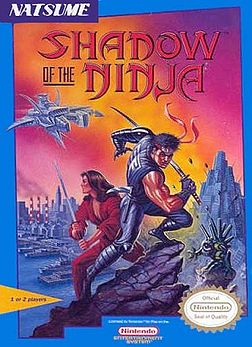
After an unfortunate hiatus, Video Game Archaeology returns!  Video Game Archaeology is my monthly exploration of an artifact video game found during my excavations of various bargain bins and yard sales; an examination of a game cast off and long forgotten.

Natsume today is known mostly for the Harvest Moon series, but that wasn’t always the case. While they were never quite on the level of Capcom or Konami, Natsume published quite a few quality games over a variety of genres for various systems until basically the PS1/N64 era. Like any Japanese game company worth its salt, Natsume published some fine NES games. None of them seem to have been very popular, but the ones I’ve played are solid games. I’ve played a bit of Shatterhand and poured over an issue of Nintendo Power about the unfortunately named S.C.A.T, though I never actually played it. After reading this Hardcore Gaming 101 article, I decided to rectify that and downloaded Shadow of the Ninja off Virtual Console. Continue reading

I Know that Monkey, His Name is Donkey!

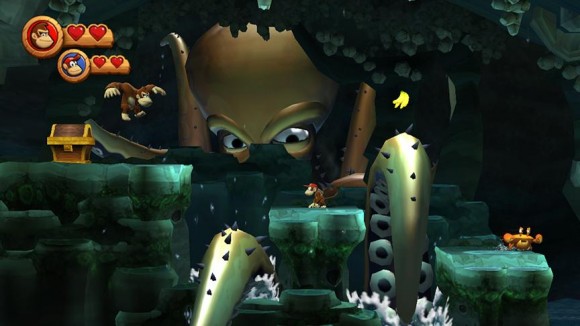
A couple of years ago Nintendo had two big fall releases: Kirby’s Epic Yarn and Donkey Kong Country Returns. I wanted both of them. 2D, and 2.5D, platformers are exactly my thing. Unfortunately, I could only afford one of them. It didn’t take me long to make my choice on which one to purchase. I found the previous Donkey Kong Country games to be serviceable but ultimately frustrating and Donkey Kong 64 was the absolute nadir of collect-a-thons. Kirby, meanwhile, has a bunch of charming and innovative, if a bit easy, games with his name on the cover. I went with Kirby’s Epic Yarn, and I enjoyed it. The lack of Kirby’s usual array of abilities was more than offset utterly charming yarn aesthetic. I was confident that I made the right choice.

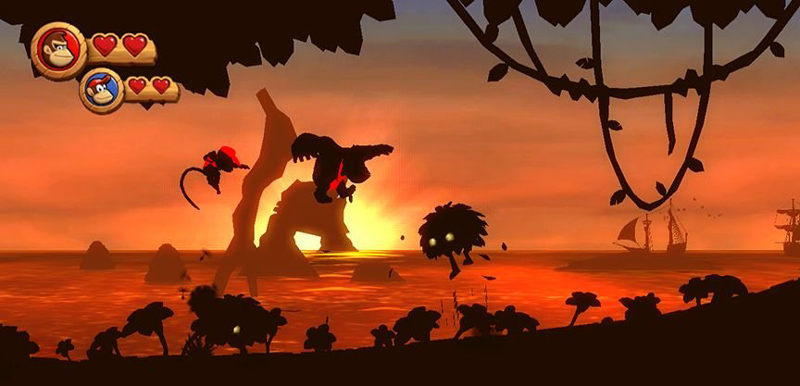
For Christmas this year I received Donkey Kong Country Returns. Within two weeks I had beaten it, and realized just how wrong I had been. Epic Yarn is a pretty good game. Donkey Kong Country Returns is an absolute classic. It is not just one of the best games for the Wii, ranking up there with Super Mario Galaxy and Zelda Skyward Sword, but I would say DKCR is among the best games ever. Which is pretty amazing when you consider that I don’t really like the games that this one is trying to evoke nostalgia for.

First, I need to explain why I didn’t like previous Donkey Kong Country games, DKC2 in particular. (Since I played it most recently and it is still fresh in my mind) DKC2 relies heavily on unfair or arbitrary difficulty. It is not that it is hard to beat stages, though it certainly is. I like a challenge. The unfairness is in meta-game roadblocks. DKC2 is a fairly long game, so Rare of course uses a standard save system. But saving is limited to only to Grannie Kong’s School or whatever it is. The problem is that those save spots are not always available. It makes losing your progress, especially after a boss, a very real possibility. That means if you struggle with a boss, it makes it all the more likely that you will have to fight it again. Unless you go back to a previous world and save. But be careful not to shut off the game, since everything takes coins and coins aren’t saved. The very real threat of losing significant chunks of progress hampers the whole game. The difficulty of the actual stages is forgotten. The half-assed save system encourages players to play as conservatively as possible. It is as though Rare thought they were making a quarter-munching arcade game right up until the last minute, when they tossed on their terrible save system.

The crap is gone from Donkey Kong Country Returns. The game saves after every level. The arbitrary treat to the player’s progress is gone. The only difficulty in the game is entirely based on the level design, which is truly wonderful. Retro Studios has crafted a masterpiece of 2D level design. Each stage, like in the best Mario games, has a certain theme of obstacle. For instance let’s say that a pit, a hole to fall in. It you do you die. First, there will be a single pit, then two. Then a double sized pit. Then a combination of long and short ones. That is the simplest possible example, but the escalation is what the game does so very well. It shows an obstacle, then builds on it and expands it. It teaches the player what to do, then challenges the player.

Donkey Kong Country Return also encourages players to search for secrets and a limited number of challenge collectibles. It does this by first have plenty of checkpoints in stages. Stages aren’t that long, but generally they have one or two checkpoints. When you are only losing a few moments progress it is no big deal. There are also plenty of extra men, and extra men giving bananas around. Dying cost the player practically nothing.

Despite how friendly the game is in some respects, it is still satisfyingly difficult. I probably died more in this game than in any game since the NES. Yet every time I died I knew it was my fault. Each death merely served as encouragement to try again. It is also aided by crisp, clear graphics and pitch perfect controls. The only fly in the ointment are the rocket barrel stages. The idea behind them is sound, but in practice the controls are effectively broken.

Donkey Kong Country Returns is everything people loved about classic platformers without all the crap that used to get in the way. Instead of arbitrary difficulty designed to make the player replay the game and artificially lengthen the playtime, DKCR is all about prefect level design. It is a perfect evolution of games like Mario and Mega Man and Donkey Kong Country. It is a true classic, worthy of being enshrined with all the greats in Nintendo’s library of games and the second one from Retro Studios.

Second Quest Part 1: Legend of Zelda

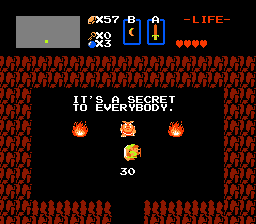
Playing the Legend of Zelda Skyward Sword (see here and here) and hearing the wildly varying impressions of it and the rest of the Zelda series made me want to go back and play all the games. It seems that while most people think that Zelda is going wrong or has gone wrong at some point, but no one can agree how or when. I am of the opinion that the Legend of Zelda is one of the few series that has no real missteps. To see if I am right I plan to replay, or in a few cases play for the first time, the entire Zelda series to see how it holds up. So let me begin the Second Quest, starting of course, with the original Legend of Zelda.

I wrote a thing about Zelda as a part of my 25 Years of NES, but I didn’t play it much before I wrote that. I think the last time I played it back in 2004 or a year or two earlier, on the GBA. I stand by the complaints I made about the game in my previous post, but replaying it recently has given me a greater appreciation of just how good Zelda 1 is, even now.

The Legend of Zelda is deceptively simple. No jumping, no scrolling, slow action. However, the wealth of sub weapon options is staggering for an NES game. It is a thinking man’s action game. The question is not “can I?” but “how can I?” There is combat, hard combat sometimes (screw you blue darknuts!) but it is rarely a question of whether or not the player can defeat the enemies. It is about whether the player can figure out which enemies need to be killed, which walls need to be bombed or which blocks need to be pushed.

Playing it again after so long was like coming home. Everything is smaller and a bit shabbier than I remembered, but after a few minutes it all came rushing back. I knew where to find most of my hearts, though I sometimes forgot which bushes hid secrets from everybody and which hid door repairs. I didn’t have to search for the dungeons, except for dungeon 2, which I can never find. It is still often obtuse, still somewhat primitive, but Zelda 1 is a lot more fun to go back an play than I remembered.

The single best thing about it is how it encouraged players to explore. In a time when most games were reliant on limited lives and limited continues to artificially pump up the difficulty and playtime, Zelda instead used a relatively large and complex game world to keep players in front of the screen. Instead of a ‘Game Over’ screen upon death, players were allowed to restart with all hearts, rupees and items as many times as they wanted. There was effectively no penalty for death, encouraging players to push the boundaries. Since simply reaching a destination was rarely the goal, letting the players get back there easily did not lesson the challenge.

Even now I’d say Zelda 1 is a very good game. It hasn’t aged perfectly, but the core of the game is still as fun and addictive as it ever was. It is actually very similar to Skyward Sword. In both games you are constantly going through a dense, maze-like over world. It is also more combat focused than most games in the series. Despite that, it is still very much a game about the puzzles. Zelda 1’s puzzles are simpler than in the later games, but are still hard by being more vague. Considering that it is more than 25 years old, the Legend of Zelda is absolutely deserving of its classic status.

all pics from vgmuseum


Neither Beginnings nor Endings

Wheel of Time Reread Part 1:  The Eye of the World

Original cover of The Eye of the World

Image via Wikipedia

Sometime later this year, not sure yet as the release date isn’t final but almost certainly sometime in 2012, A Memory of Light will be released, bringing The Wheel of Time series to a close after more than 20 years and 14 books. Robert Jordan’s (with Brandon Sanderson at the end) epic is easily among the best of the genre. To celebrate the conclusion of this monumental epic, I have decided to reread the entire series and post my thoughts here.

I’ll start each book’s review with some general thoughts on the series. To start with, I want to discuss the setting. While at first, the world of the Wheel of Time seems like the same as most generic fantasy worlds. However, while the weaponry might be medieval, the rest of setting is less middle ages and more colonial. The setting is really just late renaissance minus the guns. The lack of guns is what makes the world seem similar to fantasy that takes it inspiration straight from Lord of the Rings. WoT is a world with civilization receding. So society is currently the equivalent of renaissance era, but it is headed towards the medieval. At least until the Two Rivers folks are loosed upon the world, and progress starts going forward.

As for The Eye of the World, it is not one of the better Wheel of Time books. It is a good introduction to the series, being the first book and all, but it is very different from much of the rest of the series. Much of that is on the experience of the protagonists. They are all fresh off the farm here. They can’t defend themselves; they are powerless. Through the whole volume, the protagonists are on the run. Everything is as new to them as it is new to us and it is dangerous. Jordan tries to play coy with who exactly the big hero is supposed to be among Rand, Mat and Perrin, but the first 300 pages or so are all from Rand’s POV, making any sort of mystery all but moot. It is Rand. But on the whole, there is less here to come back to than many of the other books. There are a lot of prophesies and foreshadowing, but the focus is almost wholly on the Two Rivers gang, plus Moiraine and Lan. The main plot is being established for all the primary characters, there is little time for sub-plots. There needs to be introductions before there can be reveals. Still, this is an all but perfect set up for the series.

Notable for The Eye of the World are the parts that faded away soon after this volume. Like talking Trollocs. I can’t remember another time that Trollocs talked, except for maybe one scene in The Great Hunt. Or Trolloc clans. Lan makes a big deal over several Trolloc clans working together, but it isn’t mentioned again. There is Moiraine using a staff as a focus for her channeling. As far as writing goes, all of the dream stuff is more dreamlike than it will be later, more metaphorical and vague. The same goes for Rand channeling. It might just be the fact that Rand doesn’t know what he is doing, but I think it is Jordan not quite being sure how he was going to represent stuff.

Now on to the plot. I had forgotten how much the start of this is playing off LotR. It begins with a celebration; the biggest news in town is that there will be fireworks. Moiraine is one of my favorite characters. She fills the Gandalf archetype (the Wise Old Man) in the Wheel of Time, but she is very different from him. Moiraine is a Wise Old Man that our heroes are never sure they can trust. It is ambiguous as to which side she is on. Moiraine is also not as competent as Gandalf. When Gandalf is with the Fellowship, they are sure of their victory. There is no foe he can’t face. Moiraine can barely keep the gang under control. Though it is not obvious upon first reading The Eye of the World, subsequent readings make it clear that she is in over her head. She is the last line against the Shadow and she can barely handle it.

For the first half of the book it is watch the bumpkins let loose in the world, up until they split at Shadar Logoth. The book really takes off after they split up. Jordan does an excellent job establishing and differentiating his pretty big cast. Rand and Egwene still seem somewhat flat, but the rest get fully developed personalities almost immediately. Mat becomes awesome by the end of book 3, but here he is an immature jerk. I know later it is due to the ruby dagger, but early on it is all Mat. Nynaeve is stubborn and competent. Perrin is quiet and thoughtful. Lan is a complete badass.

Perrin learning about his wolf powers is cool. Egwene is an interesting counterpoint to him. There seems to be almost some sexual tension between him and her, but that never goes anywhere. They also meet the Tinkers, who I’m not a fan of. It like their existence, but as a group I find them tiresome. “Pacifism for the sake of pacifism is the height of arrogance” is something I heard somewhere that fits them to a T. In a world, that has monsters like Trollocs and Myrddral, pacifism makes no sense. I also like Perrin’s sick burn of Aram (“I bet you get to run away a lot”). Then there are the just as troublesome White Cloaks. I like how Jordan showed what Perrin is going to have to deal with in the series going forward, White Cloaks and Tinkers.

Nynaeve with Moiraine and Lan is another interesting pairing. I somehow did not realize that Nynaeve had a thing for Lan the first time I read this. Her feud with the Aes Sedai drives her for several books, but I find it a very shallow motivation.

The bulk of that center portion is Rand and the increasingly deranged Mat. I bought Tom’s death the first time, but I shouldn’t have. Mat, despite growing incredibly paranoid, never seems to consider turning on Rand. There is also that ever-confusing flashback inside a flashback scene. I get it, but I don’t get why it is there.

And at the end, we get the only trip into the blight so far in the series. The Blight is my favorite nightmare wasteland in fiction. That place is straight up scary. Anything and everything can and will kill you. The fact that they went in with a bunch of useless kids is terrifying. I think not returning to it in subsequent books has been a mistake, but I think the place would lose its power with more awareness of it.

The Eye of the World is the foundational work. The rest of the series builds off this one. But the circumstances of the characters make it a hard one to reread. They are all so weak, both compared to their enemies and to what they will later become. The lack of power translates into a lack of options, giving The Eye of the World a more urgent tone than the rest of the series, but also a less expansive one. It is amazing just how much is set up in this first book, though. Even things that won’t pay off for ten books are set up here. It is a good start.

It’s a G-g-g-ghost!

While my relationship with the traditional, PC style adventure game genre is contentious at best, there have been a sizably number of adventure games that don’t quite fit that mold, but that do definitely scratch an itch for me. Most of them are for the DS. Ghost Trick: Phantom Detective may be the best of the lot.

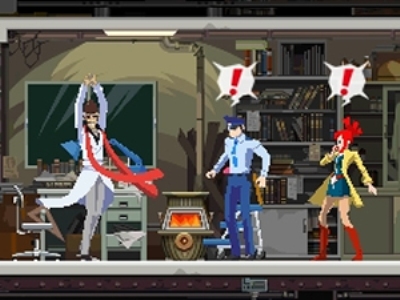
Ghost Trick is very obviously made by the same people behind the Ace Attorney series. They share a dark yet whacky tone, flitting seamlessly from slapstick to grimness. While Ghost Trick is about people being murdered and trying to unravel a conspiracy that has ended the life of numerous people, the characters spend a lot of time joking around. It can be jarring at first, but after a few minutes the tone becomes easier to read. It is certainly helped by some of the best writing in the video game industry.

Most adventure games lose me because I’m never quite sure of my goals. Oftentimes being able to sole a problem requires knowing well in advance that problem exists. Ghost Trick’s unique play systems avoid this problem. While the sorts of puzzles the player faces are largely the same, Ghost Trick presents players with a focused, limited set of options and leaves the player to solve it from there. It is probably easier, but it doesn’t necessarily feel easier. It does a great job of making the player feel like they’ve passed a humongous, difficult trial, whether they have or not.

The closest thing to a problem I can point to is something entirely subjective. I do not like the cast of Ghost Trick as much as the cast of Ace Attorney. I only bring it up because many of the characters have direct analogs. Sissel is not much different from Phoenix, Lynne is much like Maya, etc. It really isn’t a problem, just one way that I liked another, similar game better.

Ghost Trick is a great game. Plain and simple. This is the kind of game that made the DS the best video game system. It is a mostly unique, wonderful experience. Play it.

War Horse Review

To compare War Horse to a pair of other Steven Spielberg directed films, it is like E.T. meets Saving Private Ryan. It is just an awkward a combination as it sounds like. There is the heartwarming story of a boy and his horse, a story of how they overcame everything to be together again. Then there is the war movie, highlighting the dirty, brutal horrors of World War 1, as well as the bravery of the combatants. The two a mashed together into a film that while entertaining, is not as good as either of its parts.

It is all the worse because separately, both of the sides of War horse are good. The first quarter or so establishes the friendship between Albert, the boy, and Joey, the horse. It perhaps a touch too sentimental, but effective nonetheless. From there Joey is goes to war an War Horse becomes almost episodic as Joey goes through owners and wartime adventures. The tone is decidedly grim, but filtered through a PG-13 rating that doesn’t allow too much blood or on-camera deaths. This doesn’t quite allow the war scenes to have the bite that they could have. It also fails to keep it appropriate for children, leaving the whole thing feeling somewhat compromised.

In the last quarter of the film, Albert joins the army to find his horse, which leads to a few more of Spielberg’s expertly filmed battle scenes. Again, the individual ingredients used in this film are all of the highest quality, but they are combined in a less than satisfactory manner. Partly I think this is because of the episodic nature of the middle part of the film, where Joey’s temporary owners all die or have to give him up. This keeps War Horse from building any narrative momentum.

For as odd a combination as War Horse is, a heartwarming family war movie, it is probably better than it should be. But that doesn’t mean it is anything better than good. Though it certainly has its share of moments, War Horse is a good, but far from great film.

*** Stars.

One last note, I must say that, despite me being a wholly heterosexual man, Tom Hiddleston’s eyes are positively dreamy.

Ratchet & Clank

After beating Skyward Sword, I dug out my PS2 and plugged it up (as we say around my house) to my TV. I still have a list of PS2 games I want to play, the top game on it being Ratchet & Clank. I beat it rather quickly. Ratchet & Clank is doubly unfortunate for my timing in playing it, coming right after playing my game of the year by a wide margin and also after I’ve already played two of its superior sequels. Ratchet & Clank is still a good game, but it lacks some of the conveniences, like strafing, and flair of the later games in the series. It is hard to judge it too harshly for not including its sequels improvements, especially since Going Commando and Up Your Arsenal are two of the very best games on the PS2. Despite its shortcomings, Ratchet & Clank is still a very good game.

The series didn’t change greatly in either of its next two sequels. You still play as furry alien Ratchet and his robotic backpack/sidekick Clank. You still fly around the galaxy doing good. And you still collect a variety of inventive and destructive weapons with which to blow up everything. While the focus shifts from platforming in the early games to shooting later on, the fundamentals have remained largely the same. The biggest change is the addition of strafing, which any part of this game that requires shooting sorely lacks.

The weapon selection is sadly rudimentary. There are some interesting toys, like the attack drones, for the most part the weapon selection is bland. Had I played R&C before its sequels, I doubt I would have been disappointed in the selection but it pales in comparison to the later games.

That is the big problem with R&C. Playing it now, nearly ten years after its release, it suffers from being improved upon by its subsequent games in the series. Much like Mega Man 1, the first Ratchet & Clank provided a solid foundation for future great games. The R&C series is probably the closest thing in 3D to the original series Mega Man games (I love Legends, but its something else entirely) so it is an apt comparison. Though I would say R&C is much closer in quality to its sequels than MM1 was. If you’ve already played the later games, then there isn’t any real reason to go back, but if you are new to the series you might as well start here.