JSA Re-Read Part 5 Injustice Be Done

I called the last story the end of the first part of this book, and it is. But the second part starts with a story that is largely a payoff to set up from earlier issues that also sets up the biggest arc of the series, the redemption of Black Adam.

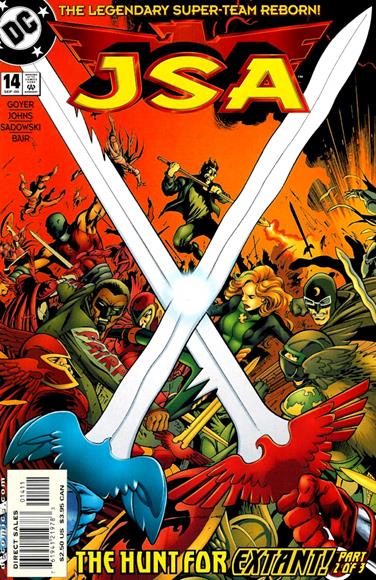
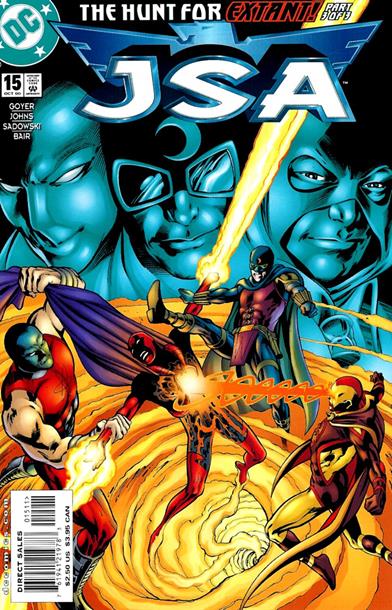
JSA 16: Divide and Conquer
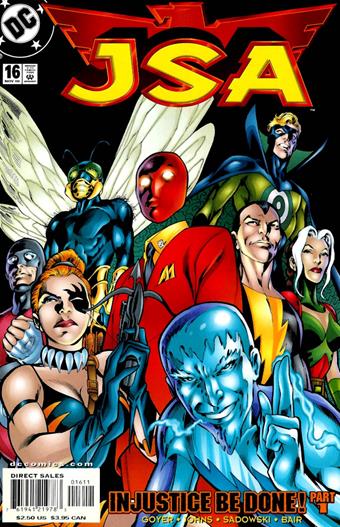
Johns/Goyer and Sadowski/Bair

The rhythm on this title so far, and with most superhero titles in general, is for a sort of cool down issue after a big story, a chance to show the fallout of what has just happened and adjust the relationships in the book. After the big double arc fighting Kobra and Extant this issue at first, if you ignore the cover, seems to conform to that, but instead veers right into the next big story, and the biggest one in the book yet.

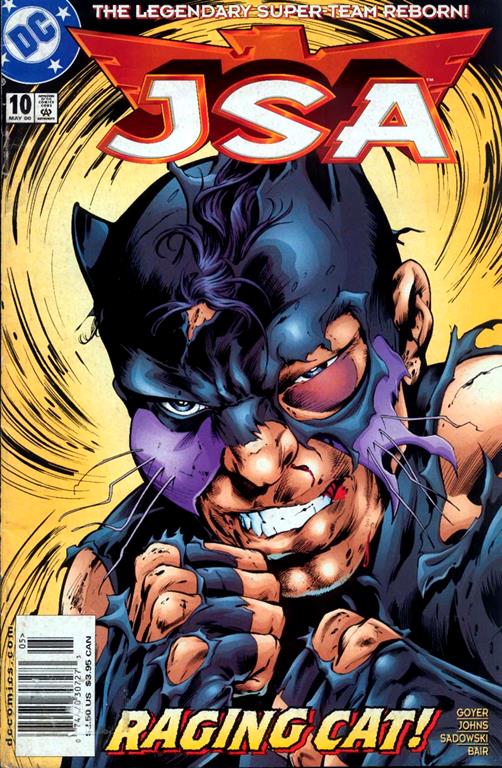
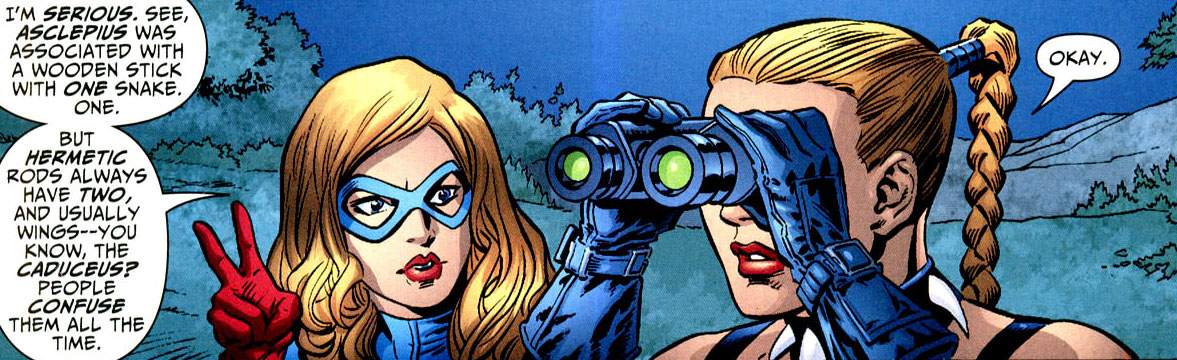
The issue begins with a rogue speedster, like the Flash, killing people around the country. Who or whatever this is, a pretty big body count is racked up in the first few pages. The the scene switches to Dr. Mid-nite and Black Canary out on a date in their civilian identities. A man in a trench coat appears and taunts Dinah about Ollie (Oliver Queen, Green Arrow) being dead. When confronted by Mid-nite, he reveals he knows their secret identities and that he is Count Vertigo, a longtime Green Arrow villain and member of the Injustice Society. He attacks and the scene ends. It moves to Wildcat and Sand watching Raging Bull in a theater. They are accosted by two other patrons who turn out to be Geomancer and Killer Wasp.

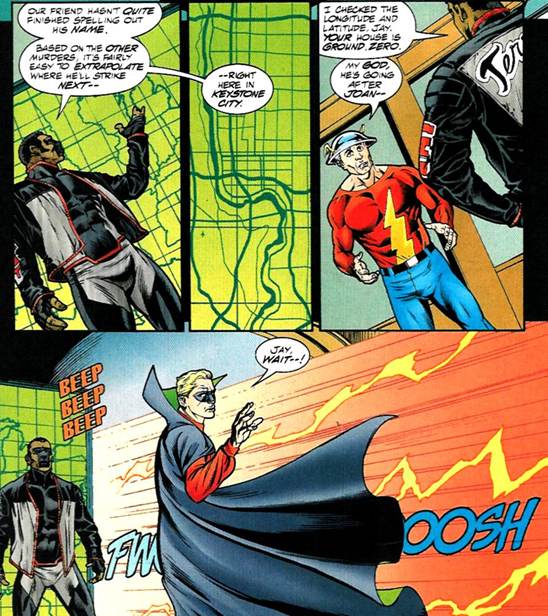
Back at JSA Headquarters, the rest of the team is investigating the deaths by mystery speedster. They realize that he is spelling something out with his kills: Clariss. Flash knows the name, Edward Clariss was a villain he fought back in the 40’s under the name Rival, not dissimilar from the Silver Age’s Reverse Flash. He apparently died when he ran so fast he broke light speed and disappeared, which was then end of him. Of interest here is one of the series few editor’s notes, which states that this occurred in Flash Comics 104, which was the one story about Rival as well as being the last Golden Age appearance of Jay himself. Judging from the pattern, Mr. Terrific knows where Clariss will strike next: Keystone City.
Mr. Terrific gets reports from Canary and Sand about their attacks, when the rest of the Injustice Society shows up. Icicle, Tigress and Shiv. Shiv is a new member, first appearing in Stars and S.T.R.I.P.E., Geoff Johns Star Spangled Kid starring book. She was Courtney’s rival there. They got in thanks to the Thinker. Wildcat mentioned back in issue 10 that the security system at the headquarters was based off of the old villains ‘Thinking Cap’ and patterned on his brainwaves. Shocking no one, the AI gained sentience and turned evil, becoming a new Thinker. Thanks to him, the Injustice Society not only has a counterpart to each JSA member, but also knows their secret identity and weaknesses. They immediately put this information to good use, with Tigress shooting Sentinel in the chest with a piece of Blackbriar Thorn.
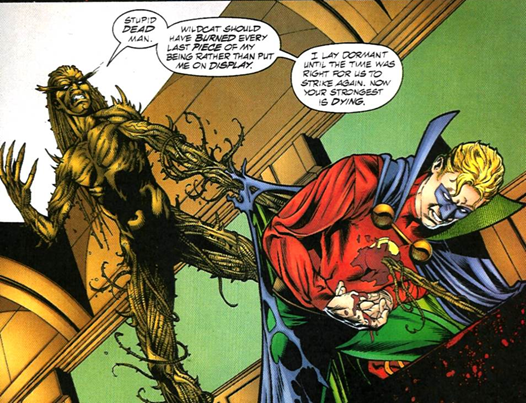
This really changes things. Sentinel is undoubtedly the teams most powerful member, and with him incapacitated, they are really short on power. Mr. Terrific grabs Alan and rushes him to the on-site operating room, usually staffed by actual Doctor Dr. Mid-nite, leaving only Star Spangled Kid and Hawkgirl to deal with the four villains. In Keystone City, Flash catches up to Rival just before he can murder Jay’s wife. With the lovebirds, Mid-nite tosses a blackout bomb to give him and Canary time to change into their costumes and pervs on her a little bit.

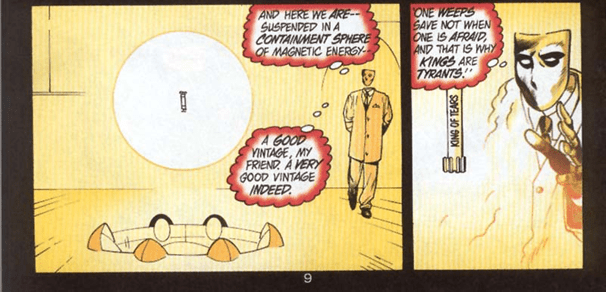
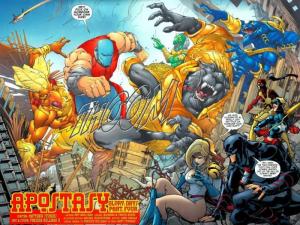
In the theater, Sand and Wildcat fight with Geomancer and Killer Wasp, but the tide seems to turn against them with the arrival of Black Adam. That accounts for all of the Injustice Society, plus some extras, but no sign of Sorrow. At least until the last page, where Johnny Sorrow is breaking into the home of Louis Sendak, the Scarab, last seen in issue 4 of the series, where he is going to unleash the King of Tears.

This issue starts like a small issue, with the team relaxing, but it quickly ramps up into the opening act of a big story. After their defeat by Wildcat alone, the Injustice Society pumped up their ranks, adding Thinker, Shiv and Black Adam. This makes them, despite their earlier defeat, seem like a real threat to the JSA.

JSA 17: Cold Comfort


Johns/Goyer and Sadowski/Bair

This issue opens with Mr. Terrific performing heart surgery on Sentinel, while Icicle freezes the room from the outside and Thinker taunts him with the teams eminent destruction. He recaps the situation, with Sand fighting Killer Wasp and Geomancer, Wildcat fighting Black Adam, Dr. Mid-nite and Black Canary dealing with Count Vertigo, the Flash in a deadly race with Rival and Star Spangled Kid and Hawkgirl stuck in the JSA HQ with the rest of the Injustice Society. Hawkgirl and SSK are having trouble fighting Shiv and Tirgess. Dr. Mid-nite is able to disable Count Vertigo by making him vulnerable to his own power. Jay and Clariss run so fast that they start to disappear into the Speed Force, the power that gives all of DC’s speedsters their speed. One of them comes back.

With that ambiguous ending, the book jumps to Sand, who quickly dispatches both Killer Wasp and Geomancer. Then it is on to Wildcat, being held in the outer atmosphere by Black Adam. Black Adam threatens to kill Wildcat, unless Wildcat has a better suggestion.

Back at HQ, Hawkgirl is still fighting with Tigress while Star Spangled Kid is evading Shiv. Stat Spangled Kid gets the jump on her opponent and takes her out, befreo making her way to the control room for Thinker. Meanwhile, Tigress has gotten the upper hand on Hawkgirl and is about to kill her. Her life flashes before her eyes, but it’s not her life, but many different lives. This is just another note in the “what the hell is going on with Hawkgirl” file. A bright light shoots out of her and knocks out Tigress.

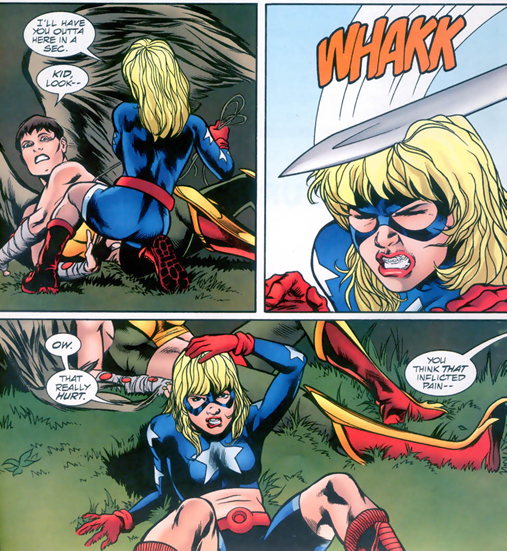
In the operating room, Mr. Terrific has just managed to stabilize Sentinel when the door bursts open to reveal Star Spangled Kid, who had knocked out Icicle and Blackbriar Thorn. There is no greater sign of Johns’ ascendency on this book than Courtney’s increased importance. She manages to single handedly take down some of most powerful Injustice Society members. Back outside the HQ, Sand meets up with Canary and Mid-nite, who have gotten from Count Vertigo that Sorrow is going after the Scarab to release the King of Tear. They head to his home.

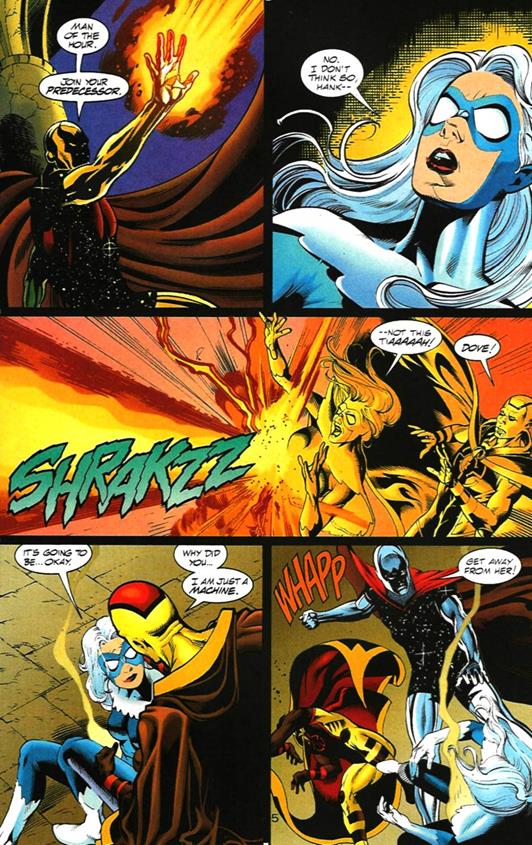
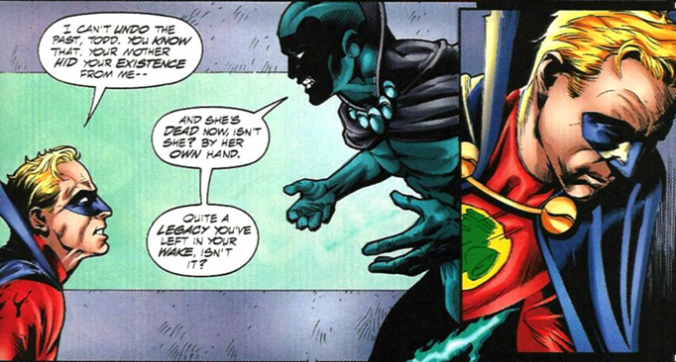
They find Sorrow and Dr. Mid-nite attacks him, but Sorrow removes his mask, apparently killing him.

That is where the issue ends. The team manages to overcome their opponents, but superheroes fighting supervillains with nothing else at stake is not that interesting. There has to be something else going on and there is here, but this issue doesn’t really elaborate on that until the very end of issue. Once it gets into Sorrow and the King of Tears, the payoff to the story hinted at in issue 10, things actually start to get interesting.

JSA 18: Sorrow’s Story
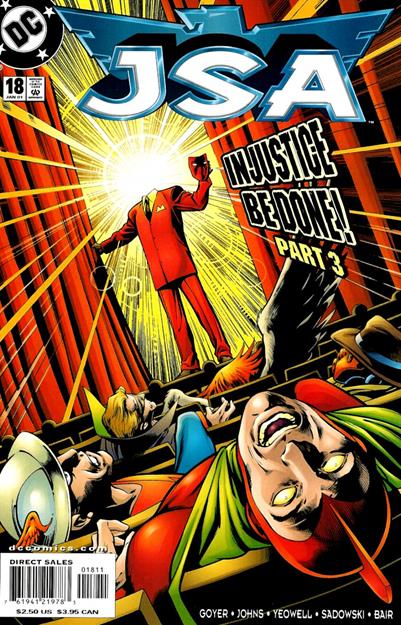

Johns/Goyer and Yeowell and Sadowski and Bair

Like the title suggests, this issue is tells the history of Johnny Sorrow. It does this through his interactions with JSA team leader Sand.

With Dr. Mid-Nite apparently dead, only Sand and Black Canary are left standing to stop Sorrow. As he injects the Scarab with … something so he can use him as a conduit to bring forth the King of Tears Sand recalls the last time he faced Johnny Sorrow, way back when Sorrow was just a run of the mill crook and not a disembodied mask in a suit. Even though Sandman, the hero who Sand used to be the sidekick for, tells him to get away, Sand stays to fight with Sorrow, only to accidently hit him with his little harpoon gun on Sorrrow’s intangible vest and cause him to be apparently killed.
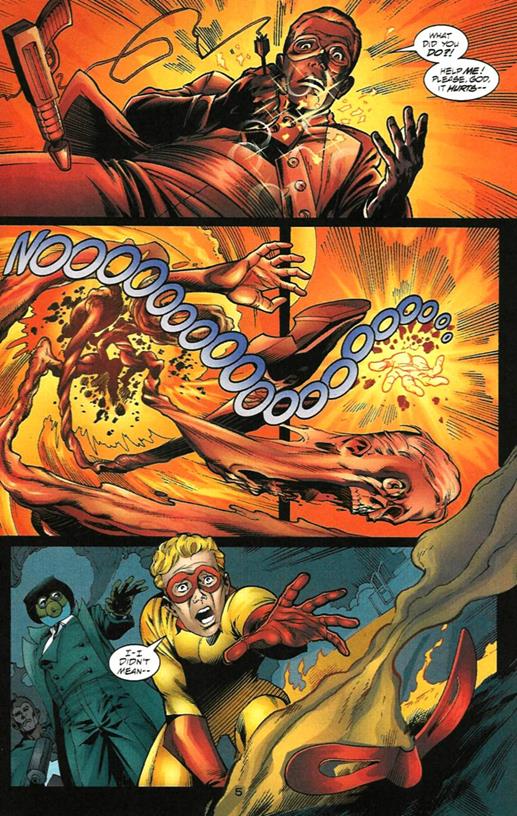
This is the first appearance of the gruesomeness that seems to overpower Johns’ work at times. Here, used as an outstanding moment in a story it is effective. When it happens too often it is just gross. The story then jumps to six months later. Sorrow appears in his current form and kidnaps Sand out of his bed. He takes him to an abandoned theater. There, with the bodies of another superhero team, the Seven Shadows, former team of the Scarab, that Sorrow has killed, he tells Sand his story. When Sand shot him he wasn’t killed, but transported to the Subtle Realms. There he found spirits that turned him into the being his is now and sent him back to secure the way for their king, the King of Tears. Once back he heads to find his wife, but to his horror discovers that showing her his true face kills her. So he took Sand to get revenge. Before he can do anything, the JSA arrives. The Spectre starts to go after Sorrow, so in response he summons the King of Tears.

After that, Sorrow teleports away, and the team tries to fight the indescribable horror that is the King of Tears. Flash and Green Lantern Sentinel fail to take it out, and Hawkman and Hawkgirl try. Knowing what is coming next, that part has more weight, seeing the two Hawks working together, secure in their transcendent love for each other.

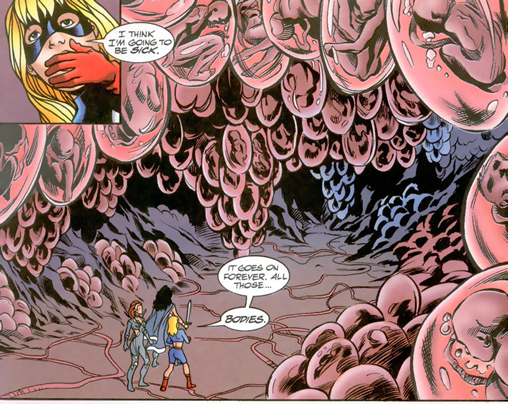
The Spectre then steps in and eats the monster, only to find that he has no real power over it. The Spectre punishes the souls of the wicked, but the King of Tears has no soul. So he cries it out and they trap him as the Spectre’s tears. And so ends the flashback. At the current time, the King of Tears pours out of the poor Scarab and Sand and Black Canary stand alone against it.

This issue doesn’t push the story forward very far, but it does play to the JSA’s strength, their history. Showing the first encounter with the King of Tears in the 40’s and showing how the team defeated it then adds something to their fight with it in the present. Especially after seeing how ineffective the teams most powerful members, Flash and Sentinel, were against it. The only one that had any effect was the Spectre and he is no longer part of the team.

And that is where I am leaving things until next week, when I will go over the second half of Injustice Be Done.
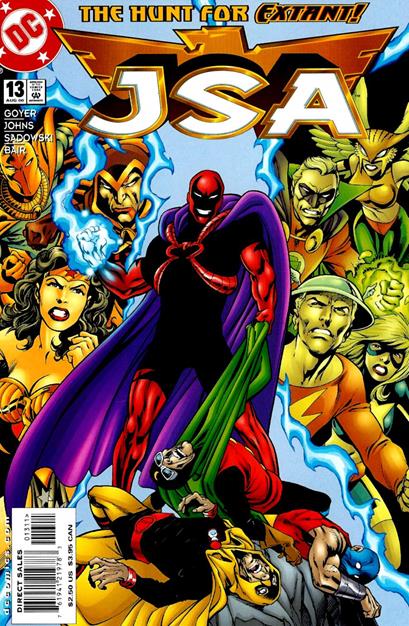
JSA Re-read Part 4

This is the big ending to the first portion of this title, and one of the most disappointing arcs in the series. It isn’t bad, but it feels like a missed opportunity. This is a super team all about history and legacy. When they fight a time traveling villain that is an opportunity to exploit that, but they don’t with these three issues. This is still a fine story, but not one that seems too specific to the team. I think it is telling that Sylvester Pemberton, the original, and dead, Star Spangled Kid mysterious revived played all but no part in this story, other than a few conversations with Courtney. Instead of exploiting available storytelling space, this arc is used to clear the deck for what is to come. That is an ultimately forgivable fault, since what is to come is so good. Let’s get started.

JSA 13: Time’s Assassin

Johns/Goyer and Sadowski

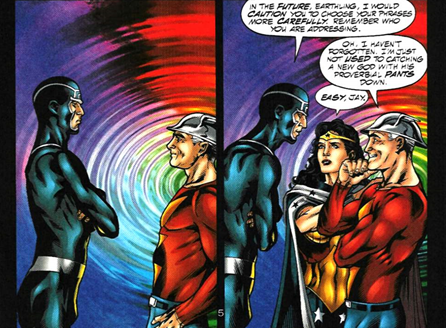
This issue opens with a monologue from Mr. Terrific, who is new to this whole superhero game and not used to dealing with things like time travel and space gods, as the team flies through time in Hourman’s repaired Time Ship. The team understandably wants to know how Metron, the New God who crashed into their HQ, the Brownstone, came to in control of the Time Ship. He explains, through a flashback, that the other team found him adrift in the time stream, his time traveling Moebius Chair having been stolen by Extant. Flash even gets to show a puckish side by taunting him over this.

Metron explains that Extant is after the Worlogog, a map of space and time that Hourman was supposed to be guarding. He felt it too powerful, so he broke it apart and scattered the pieces. If Extant reassembles it, he will have control of the whole of the universe. As Dr. Fate explains who Extant is, formerly the hero Hawk who became villainous because fans figured out the Captain Atom was the hero supposed to turn evil in the crossover Armageddon 2000 his partner Dove was killed by his time traveling future self who had already become evil. Don’t look into it, it’s real dumb. Their conversation is halted when Extant attacks. They have a hard time fighting him because his powers can cause someone to age to dust in a second. Luckily, the team has a few immortals.

Unfortunately, Extant manages to escape after being wounded by Hippolyta. After everyone gathers themselves, he attacks again, using his powers to change history. He stops Jay from being in the accident that gave him his speed, turning him into just a man. He does similar things to Hawkgirl and Dr. Fate, removing them from the battle before Hourman catches on and uses his own time powers to everyone else from “chronal energy,” which sounds like something he ought to have done as soon as they knew they were fighting Extant. They fight back, with Sentinel (man, I really just want call him Green Lantern) making construct version of the heroes he killed in Zero Hour.

It only provides a momentary distraction for Extant, who proceeds to explode the Time Ship, apparently killing everyone except for Metron, who manages to pilot the mostly destroyed ship back to the brownstone. That ends the flashback, with the team now approaching the place in time where Extant is changing everything. Having assembled the Worlogog, he is starting to remake reality, creating a world that seems to be based on his former partnership, with everyone looking like Hawk or Dove.
JSA 14: Chaos Theory

Johns/Goyer and Sadowski

Now the team is on this crazy new world and fighting with the medieval knight looking inhabitants. They have more trouble than just a horde of Hawks and Doves. Sand’s seismic powers aren’t working right and neither is Starman’s Cosmic Rod, because the laws of nature aren’t the same in Extant’s new world, it being made out of just chaos instead of chaos and order. The team is able to fight off the knights, though. Afterwards, the ever helpful Metron tells them they are already doomed, unless they can get the Worlogog or Moebius Chair from Extant. Then, Sand pulls out his secret weapon; Fate’s Amulet.

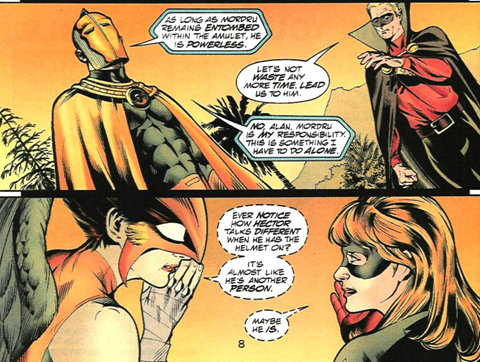
The other team is not dead, before Extant killed them Dr. Fate managed to transport everyone inside his amulet, the same place that they imprisoned Mordru and where Nabu, along with all the previous Doctors Fate, live. Inside, the team is willing to try anything to stop Extant, including seeking help from Mordru. They aren’t happy about it, but they have to stop Extant somehow. It also plays up the difference between Hector Hall and Dr. Fate, though they are supposedly the same, Hector acts completely different with the helmet one.

Dr. Fate meets with Mordru, who tries to play some classic villain mind games with him, guessing that Hector is overwhelmed by being Dr. Fate before giving him two pieces of advice. The first should not have been necessary. Hourman kept a piece of the Worlogog when he split it up, what Extant assembled is incomplete. They didn’t need Mordru for this, Hourman is right there. The other piece is more essential: Extant has stashed Dove, his former counterpart, somewhere in this new world. The team needs to find her to help distract Extant. Before he leaves, Mordru drops one more piece of knowledge on Hector, his wife Lyta is still alive, somewhere. The team outside the amulet has found their way to a castle and inside they found the Moebius Chair. Shocking no one, Extant is also lurking in the castle. He quickly starts to take the team apart, but Sand and Mr. Terrific hang back. When Extant turns on them, he finds he can’t see their future. Sand then springs the rest of the team from Fate’s amulet.

That starts round two for most of the team with the villain. Meanwhile, the rest of the team sneaks off to find Dove, with they do in the castle dungeon. She springs from her chains into her superhero costume, which is where the issue ends.

JSA 15: Crime and Punishment

Johns/Goyer and Sadowski

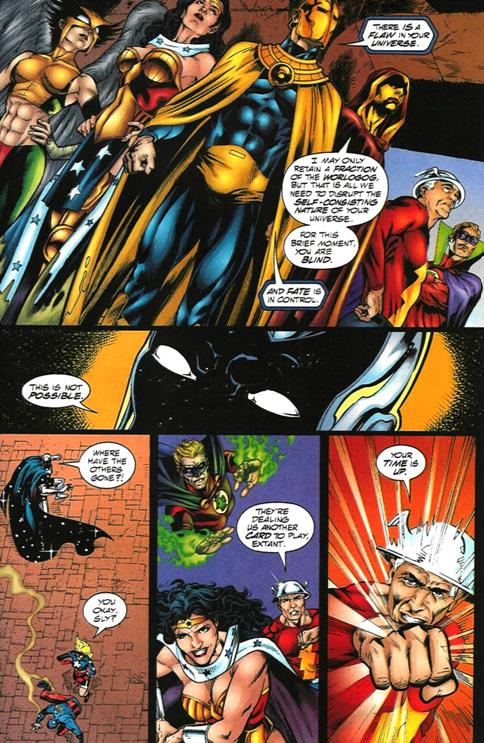
This issue starts with narration from an older Star Spangled Kid, who in this future has married Atom Smasher. That is a relationship that the book spends a lot of time building, with the biggest hurdle they face is that Courtney is something like 15 right now and Atom Smasher is at the very least in his mid-twenties. She is remembering the end of one of their first big turning points, for her and Atom Smasher. She also quickly lays out where things stand, with Extant’s omnipotence momentarily blinded and Dove rescued from the dungeon. They start to fight, with Extant going after Hourman, but Dove jumps in the way.

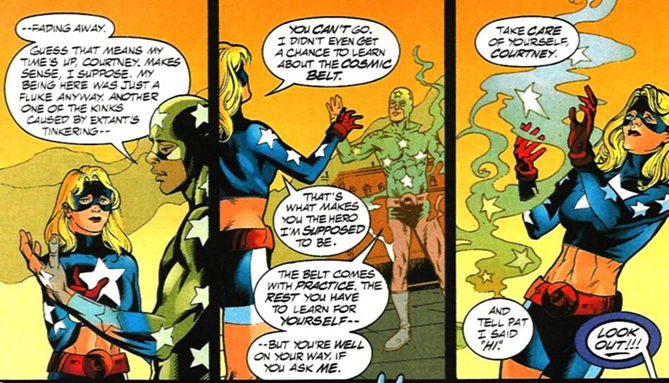
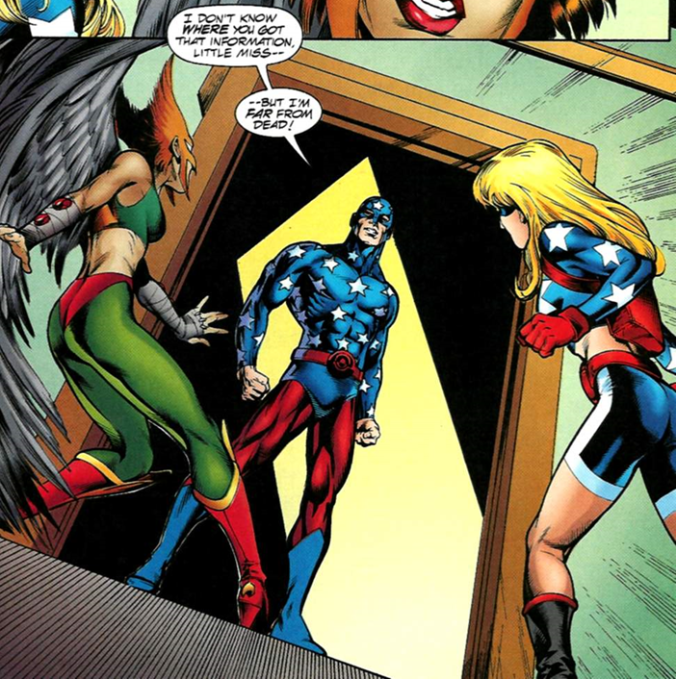
While Extant is distracted by Dove’s death, Dr. Fate and Hourman put their plan into action. They are going to distribute the team throughout time and attack Extant at numerous points in time. Doing so weakens Extant, allowing Atom Smasher to grab him and pull the Worlogog out of him. Doing so reverts the universe back to the way it should be, including having the original Star-Spangled Kid disappearing, but not before he has a little heart to heart with Courtney.

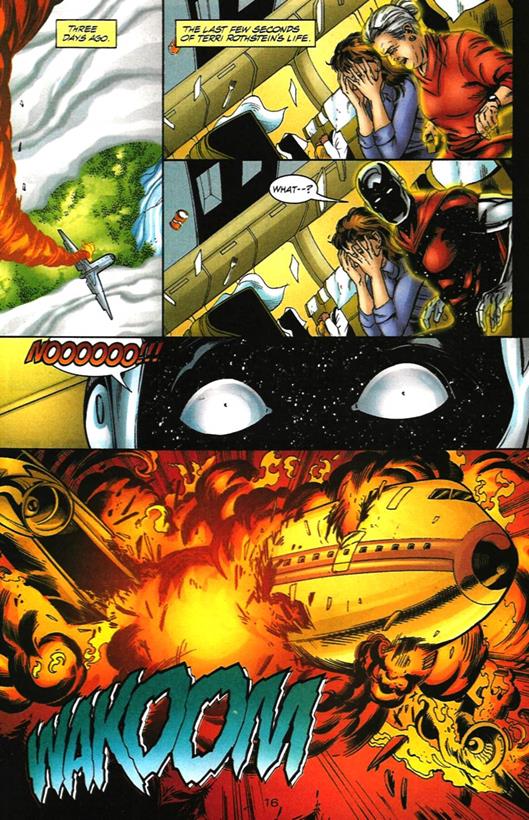
Using the last of his strength, Extant tries to escape into the timestream. Metron and Atom Smasher go after him. They can’t stop, he has already started time traveling, but Atom Smasher has a plan. They head back to the point in time where Al’s mother was killed in the plane crash and they swap his mother for Extant, killing him and saving her.

That is the end of the conflict, now it is just time for the wrap up. Despite proving completely useless in this whole encounter, Metron scolds Hourman about not taking care of the Worlogog before disappearing with it. Good riddance. Feeling he failed, Hourman leaves the team. So does Jack Knight, gearing up for the end of his own title where he retires. Hippolyta goes as well. None of them will return to the team, though Hippolyta has one more story and we’ll see Hourman again. Atom Smasher and Dr. Fate also take a leave of absence, but neither of them stops being part of the team.

This is a turning point for the book. It is the end of Robinson’s JSA. The characters that leave are narrative deadweight for this title. Jack Knight is Robinson’s pet character, on loan but the JSA was never his story. Hourman had his own title; he was never going to be more than a bit player on the team. Hippolyta was only there as continuity quirk, a stand in for Wonder Woman’s Golden Age appearances. They were also characters that the writing team never did anything, or could do anything, with. They were part of the team that Robinson assembled in the first issue, with them gone it clear for the team to make the team their own. It is a change of tone for the title, with more emphasis on the characters and their relationships. This is the end of phase 1 of the title.

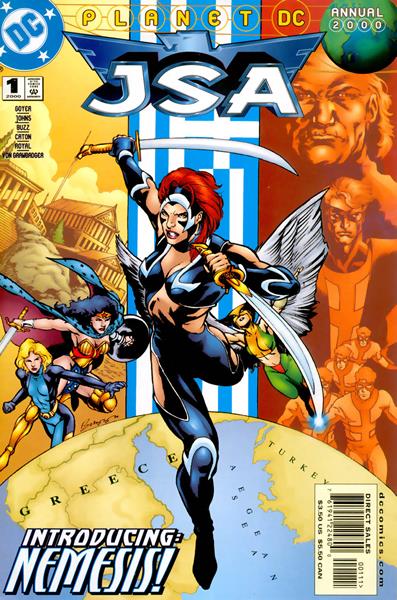
JSA Annual 1

Johns/Goyer and Buzz and Caton

This is hard book to place in this reread. Is the start of the new era or the end of the old? I’m placing it here as a coda to the early tenure of the team, if only because it is the last appearance of Hippolyta as a member of the team. Most of the events of the book don’t come into play in the main series until much later, though. The biggest point of note for this issue is that it features only the female members of the team, Hawkgirl, Hippolyta, Black Canary and Star-Spangled Kid.

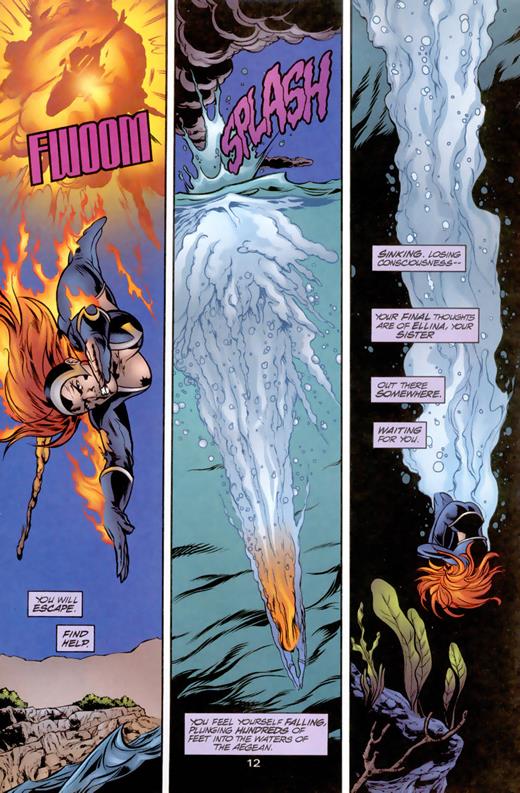
The first part of the book, written solo by Goyer and drawn by Caton, details the origin of the new Nemesis. Nemesis, let’s see if you’ve heard this before, is an old DC hero moniker taken by a new character. Soseh Myrkos is a super-soldier created by “The Council” a shadowy organization ran by her father. When her mother died, her father used preserved eggs to create a pair of children. Then he performed all sorts of experiments on them to make them his perfect soldiers. At the start of the issue, Soseh is fighting the elite troops that sheand her sister were supposed to lead. They are still lead by her sister. They fight and Soseh wins, but is unwilling to kill her sister, so she must escape before being killed The Council’s troops. So she dives off the island into the ocean.

That takes us to the second part of the story, written by Johns and drawn by Buzz, is fortunately more than a fight scene and an origin. It starts out on Paradise Island, with the older team members, Canary and Hippolyta, sparring against the younger, Hawkgirl and Star. The more experienced fighters win, of course, much to the chagrin of Hawkgirl. Hawkgirl is actually showing more desire to be part of the team, along with again pointing out the scars from her attempted suicide.

Then Phillipus, one of Hippolyta’s aides, shows up. They have an intruder on the island. It is Nemesis, of course. There is a fight, of course, and then she goes over her origin again, in case the reader forgot it from the first part of the story. Hippolyta and Black Canary realize that this Council is responsible for several altercations with the JSA, including Sand’s fight with Geomancer in issue 5. Nemesis knows where a base of theirs is, in an abandoned missile silo on Crete, so they team up to go after them. There they find a Council cloning lab.

They also find that the missile silo is not quite as abandoned as previously thought. Black Canary calls on Oracle, her teammate from the other books she stars in, Birds of Prey, to help her disarm the warhead. Hawkgirl stays there to help Canary while the rest set about destroying the clones. Nemesis’s sister reappears and they fight again. While she got the codes to disarm the warhead, but it was rigged with another bomb to go off if the nuke was deactivated. Soseh fights with her sister, finding that she has bought in fully to her father’s schemes with the Council. So she kills her. The JSAers escape one way, but Nemesis disappears another, leaving them wondering if she made it out at all.

The epilogue has Nemesis seeting out to destroy all her father has built, and he threatens to unleash “The American,” a threat I don’t know was ever elaborated on, but his hand is stayed by his ally: The Ultra-Humanite.

Next Week: The Return of the Injustice Society

JSA Reread Part 3

This brings us to the end of the first year of this book, with another one off cool down issue, like issue 6, and the opening act of the title’s biggest story yet. Also thrown in there is a goofy crossover title, that while far from essential in the big scheme does have some worthwhile developments. These are necessary issues to the feel of the title, if not strictly important ones. The fate of the world can’t hang in the balance in every story, there has to be some dramatic highs and lows. This is a bit of a low, though it is only a low by superhero standards.

JSA 10: Wild Hunt

Written by Geoff Johns and David Goyer. Art by Stephen Sadowski and Michael Bair

This issue, a bit of a breather between big arcs, is a solo issue for Wildcat, who had to sit out the last arc after Black Adam broke his arm in issue #6. It also introduces the Justice Society’s opposite counterpart, the Injustice Society. The Injustice Society is an evil version of the JSA. Like our heroic team, their focus is legacy. They are a combination of Golden Age villains and replacements for Golden Age villains. It is led by Johnny Sorrow, a Golden Age villain that can kill with a look. It has the 2nd Icicle, who inherited his powers from his father, and 2nd Tigress, who had two supervillain parents, one the first Tigress and the other the Sportsmaster. Count Vertigo and Geomancer are on the team, as is Blackbriar Thorn, an old GL villain. And lastly is Golden Wasp, who is another legacy villain who hides a secret.

The whole team breaks into the JSA Museum with Wildcat the only JSAer on the premises. In fact, he was taking a bath and maybe having phone sex with Catwoman. While Johnny Sorrow goes after a vial labeled The King of Tears in Flash’s lab, the rest try to take out Wildcat. Using his knowledge of the Museum and their overconfidence, Ted manages to separate and take them down. He runs down Geomancer and Count Vertigo with his catcycle, smashes Blackbriar Thorn in the elevator, traps Icicle on an operating table and knocks out Tigress and Killer Wasp. It also very heavily hints that Killer Wasp has some connection to Ted through Ted’s son who was kidnapped years ago. Of course, while Ted does this, Sorrow gets what he’s after and teleports everyone, other than the smashed Thorn, out. And Ted, knowing what’s really important, tries to get back in touch with Catwoman. The references to Catwoman are not just throwaways because they are both feline themed characters, there is a not terrible Wildcat/Catwoman miniseries (written by Chuck Dixon and Beau Smith and likely existing because they are both feline themed characters) where they team-up to stop/pull off a casino heist and flirt. It turns out that Wildcat trained Catwoman in his gym, though they only know each other as civilians.

Other than introducing the Injustice Society, there isn’t a lot to grasp in this issue. It is a relatively low stakes affair that gives Wildcat a chance to shine and to seed a couple of future storylines. It is a fun issue, but not a particularly important one.

Sins of Youth/Sins of Youth: Star-Woman and the JSA Jr.

Written by Geoff Johns, Art by Drew Johnson

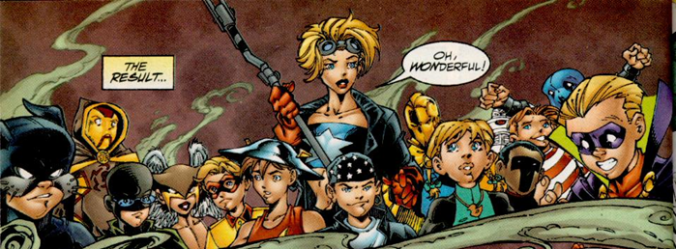
This is a brief detour of a mini-event. Sins of Youth was primarily a Young Justice story, but every DC superhero team gets involved. Through machinations not worth going into, Klarion the Witch Boy manages to turn all of the child heroes into adults and all the adults into children. This affects every superhero and team in the DC Universe. It is gives the heroes and sidekicks a chance to see how things look from the other side of that relationship. The JSA, as the oldest heroes, get turned into the youngest children. Except for Star Spangled Kid, who becomes an adult.

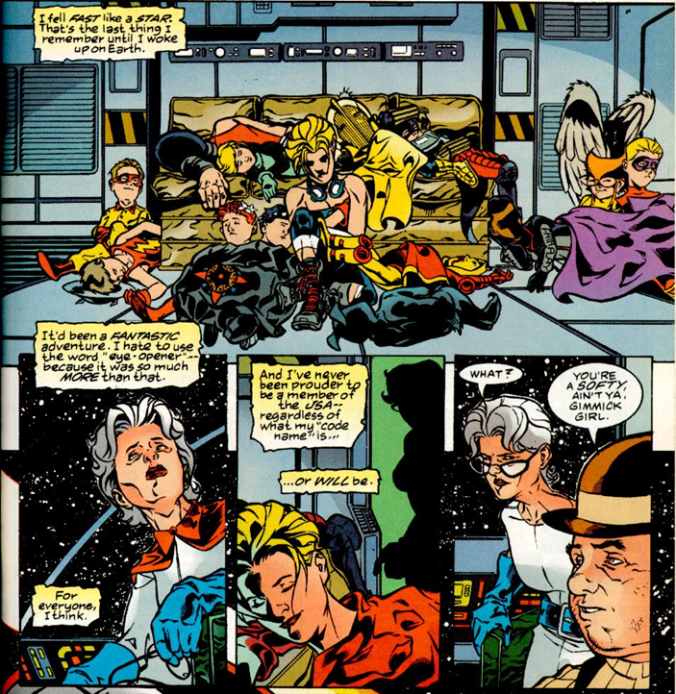
In the JSA’s issue, they go with Doiby Dickles, a Brooklyn cabbie who was Green Lantern’s old sidekick and eventually left Earth to marry an alien princess, to the planet Myrg to get an age changing gun to try to fix everybody. Along for the ride is Merry Pembertonm Gimmick Girl, the sister of Sylvester Pemberton, the original Star Spangled Kid. She hasn’t taken too kindly the current bearer of that title, the JSA’s own Courtney Whitmore. As the lone adult on the team, StarWoman, as the adult Courtney calls herself, has trouble keeping all the toddler JSAers together long enough to help Doiby retrieve another ageing gun.

The only truly important part of this story is that Star Spangled Kid shows that she has the makings of a true hero, holding a team of super-powered children together through space. It is one of her first big steps in going from the bratty kid to a full team member. She also uses Jack Knight’s Star Rod, which he will give to her when he retires from superheroing in a year or two.

JSA 11: Split

Written by Geoff Johns and David Goyer. Art by Bair and Buzz

This issue starts a new two part arc. This is when the title really starts to dig deep into DC universe history. The title has always been about history and legacy, but it now it takes on a wider view than just the team. It brings in ties from Infinty Inc to Zero Hour to Blackhawks.

This one opens on a jet with an elderly woman, who identifies herself as Atom Smasher’s mother. As she chats with the woman seated next to her, the villain Kobra appears on a screen in the plane. He announces that he is taking over control of the plane and blows it up. Kobra is the last of the concepts Jack Kirby created in his time at DC. It was so late in his time there that it didn’t actually come out while he was still there and it was partially redrawn before it was published. Jeffrey Burr is Kobra, the leader of the Terrorist Cult called Kobra. He is a genius and also has a psychic link with his twin brother that makes them share experiences. He’s fought everybody from Wonder Woman to Batman.

Back in the JSA Museum. Mr. Bones, a former villain turned hero turned leader of the Department of Extranormal Operation (DEO) as well as inadvertent killer of the original Star Spangled Kid, is giving the team a rundown of the situation. He explains that Harold Jordan, a cousin of Green Lantern Hal Jordan, who operates as the hero Airwave, has been captured by Kobra. Airwave is just the kind of hero that the JSA, and the old DC Universe in general, overflowed with. In the Golden Age, Larry Jordan was the original Airwave until he got married and retired before training his son to take up his mantle. Kobra is planning on using his powers to take control of all communication and create and Age of Chaos. Kobra has taken over Blackhawk Island, the base of the Golden Age fighter pilot team the Blackhawks, and Mr Bones wants the JSA to take them out. The simple set up for this story takes a turn when Sylvester Pemberton, the original Star Spangled Kid remember, who was killed years ago by Mr. Bones, appears in the building.

Hourman immediately deduces that his appearance is Extant’s doing. Extant is the time traveling villain from the event Zero Hour and formerly the hero Hawk from the pair of Hawk and Dove. In that story he killed a handful of JSAers, the original Atom, Dr. Midnight and Hourman. So they call in all the reserves and split into two teams. Robot Hourman, Sentinel, Hippolyta, Flash, and the Star Spangled Kids board Hourman’s time traveling Viking ship and trek through time to find Extant. They discuss the danger that Extant possess and the SSKs have a little heart to heart. He is glad to see someone carrying on his legacy and offers to help her with the belt. Then they are gone for the rest of the issue and the next one.

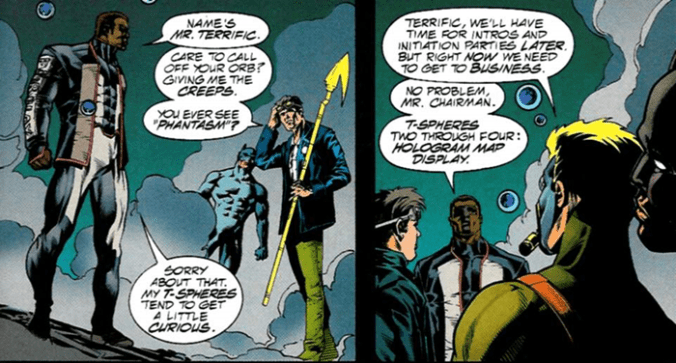
Starman, Dr. Midnight, Sand, Wildcat, Black Canary and an understandably upset Atom Smasher go after Kobra. They infiltrate the island and are soon joined by the new Mr. Terrific. Mr. Terrific immediately shows his worth by using his “T-Spheres” to display a 3D map of the island and outline an attack plan. You’d think an attack plan would be something they had before they showed up on the island.

They split up, with most of the team going to take out the island’s generators. Sand makes his way to where they are holding Airwave, but before he can rescue him he is attacked by Kobra, who uses comic book science to freeze is his sand based body. He then proceeds to use Airwave’s powers to broadcast him executing Sand on Times Square.

JSA 12: The Blood Dimmed Tide

Written by Johns & Goyer, Art by Buzz

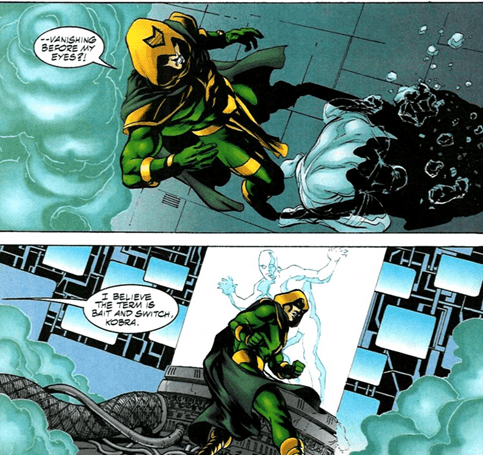
The next issue starts with Kobra gloating over taking out the leader of the JSA, going full villain monologue with how he plans to use killer satellites to destroy every city on Earth. Kobra is not a villain with a strong historical or thematic connection to the JSA. He is just a run of the mill conquer the world supervillain, this time with satellites set up around the world to destroy all major cities with X-Rays. He is quickly disappointed when he finds out that he executed a hologram made by Mr. Terrific and Sand is fine.

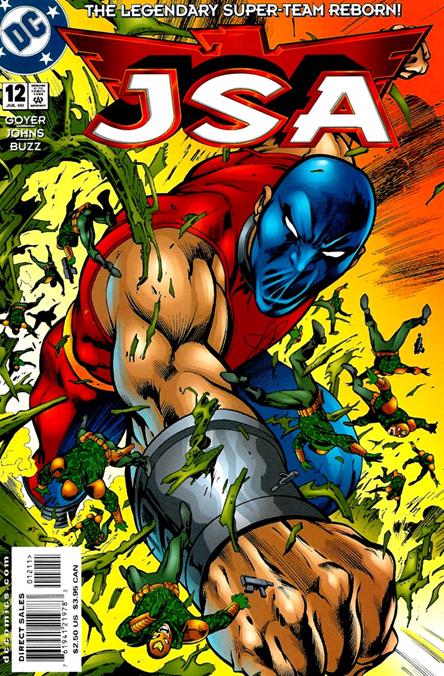
While Dr. Midnite helps Sand, Mr. Terrific fights with Kobra. Though he has the upper hand, Kobra manages to slip away. They free Airwave, who takes out the satellites, but Kobra activates the base’s self-destruct and escapes in a plane. Airwave takes off the stop the satellites, leaving the others to make their escape.Except Atom Smasher grows to as big as he can and snatches the plane out of the air. He then debates killing Kobra to get revenge for his mother’s death, but Jack talks him down. This anger is a problem that Atom Smasher tries to deal with as the series goes on, and Kobra is a villain that will be back later.

The team escapes the exploding island on an old Blackhawk plane and discovers that Blackhawk Island is a DEO base, they were dealing with a DEO created problem to begin with.As they have it out with Mr. Bones, something crashes onto the roof. It is Hourman’s Timeship, piloted by Metron, one of the New Gods. He quickly claims that the other team is dead and that they have only seconds to save the universe.

There big occurrence in this issue is Atom Smasher struggling with reigning in his rage. It is all action, not necessarily a bad thing but it doesn’t leave a lot to discuss. It is pure fun. That is where we stop for now. Next time the team will have to deal with this crisis, as well as the crisis of the swollen ranks.


JSA All-Stars

I would say that DC Comics’ output a few years before their big sloppy reboot was largely very good, at least in regards to their mid and small titles. At the time, DC seemed to be going out of their way to sabotage their top of the line titles. Batman had Grant Morrison’s epic run, it was largely spared, but Justice League got caught in crossover hell and Teen Titans was mostly a farm team for crossover cannon fodder. Superman and Wonder Woman were fine until DC sacrificed them to the fumbling hands of J. Michael Straczynski, who turned in some terrible crap until, presumably embarrassed by what he’d done, he slinked away and handed them to competent writers. I can’t even begin to understand what they were trying to do with the Flash for most of this time. Let’s just say that the top of the line from DC was not at its best. But the rest of their books were largely really good. From 2007 to 2011, they put out a ton of good comics, like Power Girl, Secret Six, Booster Gold, Manhunter, Batgirl and JSA All-Stars. Of course, most of these titles really didn’t sell well, so I can’t blame DC for shaking things up, but I really miss quality books like those. JSA All-Stars may be the one I miss the most, since most of its cast were among the babies tossed out with the bathwater.

jsaa2

JSA All-Stars grew out of the Geoff Johns’ Justice Society of America. When the title was re-launched, changing the title from JSA to the spelled out version, Johns took a more expansive view of the title, putting the focus on the Society part of the title and expanding the team. Most of those new recruits also tied into the expansive follow up to Kingdom Come that the title was doing. A few issues after Thy Kingdom Come ended Johns left title, bringing in Bill Willingham and Matthew Sturges, most notable for their work on Fables and Jack of Fables. Shortly thereafter, the massive team split in two, leaving most of the old characters with Willingham in the main book and Sturges taking the new ones over to JSA All-Stars.

The book only ran 18 issues, all written by Matthew Sturges and, with the exception of two issue bit in the middle, drawn by Freddie Williams II, but they were some excellent issues. The team starts out as a boot camp of sorts, with Power Girl, Magog and Hourman ostensibly training the younger heroes (Stargirl, Damage, Cyclone, Judomaster, King Chimera, Wildcat and Citizen Steel) on how to do their job. That is how it started anyway; the team went through some shake-ups pretty quick. To begin with, though Magog is the Cable that started this title down its X-Force path, he leaves the team after three issues because he is a giant douche bag. He was not missed. It was kind of odd for the character who incited the split was not really a part of the team that formed. For the most part though, JSA All-Stars told big adventure stories that are just a blast to read.

The first page of the series is of a robotic Soviet army marching through New York City. In the first arc the team fights those communist robots, two separate supervillain teams and the King of Tears, a Lovecraftian horror from another reality. It starts on a high note. That first arc also sorts out the team and nails the personal relationships that will develop in the series. There are burgeoning romances between Damage and Judomaster as well as King Chimera and Cyclone. The team adds longtime JSAers Sand and Atom Smasher and couple of new characters. Sarcastic AI Roxy is not exactly original, her general character, that of an annoyed robotic personality that barely tolerates the humans around, has been done before. Still, she is a fun addition. Anna Fortune, a time traveling steampunk wizard, is something new. One of the good thing about working with a lot of new, mostly unknown characters is that the writer has a lot of free reign to do as he pleases with the cast and Sturges takes advantage of it, really building on the limited personalities that a lot of these characters had shown previously.

jsaa

After they defeat the King of Tears, there is a surprisingly touching follow-up to giant crossover Blackest Night, during which Damage is killed. His girlfriend, Judomaster, has to give the eulogy and it has some nice moments for her and King Chimera, who is generally kind of aloof. After that, it moves to the next big arc, which starts with an investigation of some murders in the old stomping grounds of Infinty Inc., the team that several of these characters (Atom Smasher, Power Girl, Hourman) were members of. That leads them to a South American rainforest, where the team fights monkeys riding jaguars and tries to prevent the resurrection of some Incan Gods. They fail, of course, and end up having a big knock down drag out fight in the middle of Los Angeles. This is the best arc of the series, issues 8-11. While most of the JSA is about embracing and celebrating the past, this arc is about learning to let go. The Gods have to let go of the power they once had, and the ex-Infintors have to let go of a team that doesn’t exist anymore and some of the characters just have to put their personal pasts behind them. It is just some really good comic booking.

jsaa4

There is a two issue art fill in at this point by Howard Porter. Porter is not my favorite artist, but his work is generally better than what is on display in these two issues. The story here is a lot of fun, though. Cyclone, injured in the last arc, has lost her powers and must stay home while the rest of the team has an adventure in space. Sturges gives the reader just enough of a glimpse into the space adventure to make it seem really cool, while the arc is really about Cyclone figuring out her powers and life. It is kind of a cheat that most of the team has the greatest space adventure ever, at least judging by the brief snippets shown, while the book is about the mundane, at least by supehero standards, problem of Cyclone’s clones. In the next arc they fight the Puzzlemen, indestructible monster that can only be defeated by playing a certain piece of music that Bach composed to destroy them in the 1720s. In the last two issues they deal with The Prince, who may be a superhero from another reality or may be a crazy person.

JSA All-Stars is just an excellent book. It has some really great high adventure stuff and some genuinely excellent character work. The only real downside is that is it only 18 issues, and that two of them had pretty terrible art. But the rest is so good. Maybe its cast is not the best superhero team, though it does have a handful of standouts. The ex-JSAers Power Girl, Stargirl and Atom Smasher at least have a lot of the Johns/Goyer JSA to look back on for other great stories. And though there isn’t enough time to really build up the new characters, what was starting to develop with Cyclone, King Chimera and Anna Fortune was really great. It was simply a fun superhero book. I believe there are two or three collected editions floating around, take a look sometime.

jsaa3

One last thing, through issues 2-11 there is a back-up story by Jen Van Meter and Trevor Moore starring married JSA members Hourman and Liberty Bell. They travel to Europe to find an ancient Greek artifact that may have magical healing powers and end up in a race with Injustice Society members Tigress and Icicle, who are also a couple. It both lets the reader get to know the heroes better and develops the villains into people rather than just bad guys. The whole thing feels very Indiana Jones, with the heroes working with and against the villains and the whole time being kind of unsure of what is really going on. I’m thinking the early parts of The Last Crusade. I also like that Tigress and Icicle, despite being admittedly villains, are actually on the up and up. They are trying to get the same staff as the heroes by the same means, though how they came by the cash they came to pay for it is probably better left uninvestigated. Much like the main story, it is far from essential reading, but it is still a really entertaining story.


JSA Reread Part 2

I originally expected to cover only issues 6 and 7 for this entry, but I realized that if I only covered 2 issues at a time it would take me more than a year to cover all that I want to cover in this re-read. So now, I am taking on issues 6-9, the first of which is an interlude issue with Black Adam and then the three issue Darkness Falls arc. My plan for the rest of this re-read is to try to cover one arc in each entry, though some of the longer arcs will require more. I have it planned out for 25 Parts total, unless I also decide to cover Johns issues on the re-launched Justice Society of America. So let’s get started on the first four issues of the Johns/Goyer collaboration on the JSA. After the first issue, drawn by Marcos Martin, the rest are drawn by Stephen Sadowski, with inking my Michael Bair and covers by Alan Davis.

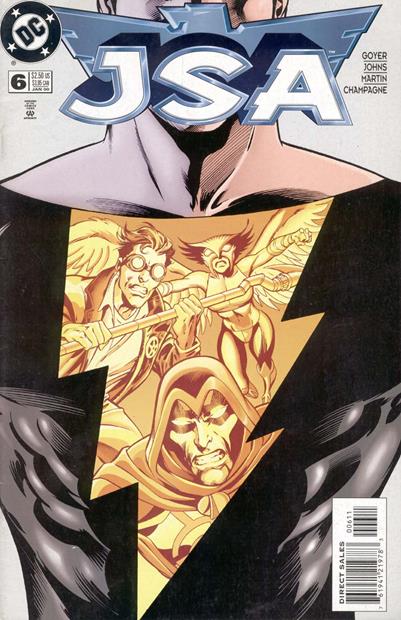
JSA #6: Justice, like Lightning.

This is Geoff Johns’ first issue as co-writer and immediately we are introduced to the character his run centers on: Black Adam. I am assuming most of Black Adam’s arc is Johns’ doing because it is one the few that is not tidied up when Goyer leaves the book around issue 50. Also worth noting is that this issue is penciled by Marcos Martin, who is a tremendous artist. Just look at his work on recent issues of Daredevil or in Batgirl Year One.

The issue starts with the JSA holding a press conference to announce that they have reformed. The superhero press conference is one of the worst ideas in the world of superheroes. Not the idea that a team, like the JSA, would announce to everybody that they are back in business, but that anyone would show up to something like the ribbon cutting in this issue without realizing the obvious would happen. A villain will attack this get together. Every time this scene occurs, a villain will attack. And of course, it happens here.

Johns and Goyer aren’t subtle on this title. Just look at Sand’s speech. The earlier JSA “created a legacy. That legacy isn’t easy to live up to,” he says. That is the major focus on of the book. Sand just comes out and says it. Legacy and the struggle to live up to it or in some cases break free from it. There is another interesting line in that speech, “While others in our line of work are often in the shadows or adventuring beyond time and space, we keep our feet firmly planted on the ground.” While on the surface those are clear references to Batman (shadows) and Superman (time and space), it also foreshadows where the book is going. The next issue starts an arc called Darkness Falls, wherein the entire world is covered in shadow. After that, the team must fight the time traveling villain Extant, a battle the roams over all of time and space. This is a new beginning for this team, and those are the adventures they will have.

Then we get a page of character positioning. Hawkgirl hates the spotlight, Dr. Fate misses his wife, and Star Spangled Kid is a bit self-centered. After Courtney (Star Spangled Kid, soon to be Stargirl) cuts the ribbon, it moves inside the JSA museum. In the middle of the page are three panels highlighting heroes who have passed on. First is Mr. Terrific, the predecessor to the man from issue 5 that Sand offered JSA membership to. Then it’s Dr Midnight, who will join in the next issue and finally Hawkman, whose return is a big arc itself in a few issues.

Then Black Adam attacks. Remember what I said about subtlety or the lack thereof? After the initial wave of JSAers is manhandled by the near Superman powerful Black Adam, Sand opines, “there’s nothing I can do if Black Adam’s feet aren’t on the ground.” An obvious call back to the line in his speech about the JSA being grounded. While most of the team tries to fend off the enraged strongman, Hourman, Dr. Fate and Hawkgirl travel back in time to ancient Egypt to the point when Black Adam received his powers. Using a combination of Hourman’s time powers and Dr Fate’s magic, they channel the magic lightning bolt to the present to drain their foe’s powers. Conveniently, this happens just after everyone on the team had the chance to show off their powers.

Everyone is confused about Black Adam’s attack because they thought he had reformed. For those unaware, Black Adam had been an ancient hero, but now his powers are used by his villainous descendant Theo Adam, though Black Adam had regained control. Sentinel (Green Lantern, really) discovers that he has a brain tumor that may have caused his outburst. Then Agent Chase (of her own short series) from the DEO (Department of Extranormal Operations) shows up and takes custody of Adam, while her boss Mr. Bones thinks some cryptic thoughts about Hawkgirl.

While this issue is primarily a cool down issue between big stories, it does seed a ton of story points for future issues. The most important of which is the introduction of Black Adam, who will play a major role in the series from much of its run. It also marks the first, but far from last, trip the team will make to ancient Egypt.

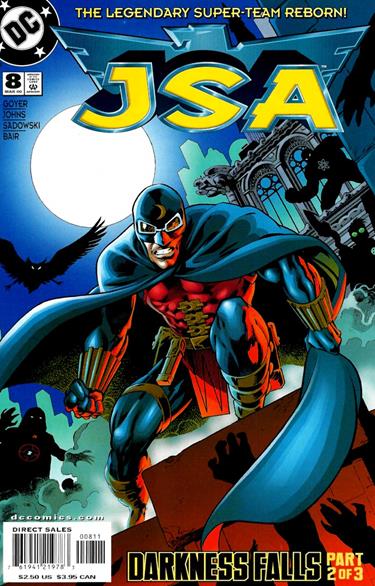
JSA #7: Darkness Falls

Now we start the second big story of this series. The threat was seeded in a couple of scenes in the first few issues, with Alan “Sentinel” Scott’s son Todd talking with shadows. Now we see what he was going on about.

This issue starts in medias res with Black Canary falling from a window. She is chased by shadows of her teammates, which eventually catch up with her.

Then it jumps back to earlier that morning and the apartment of Jade, Alan Scott’s other child. Johns and Goyer make sure you don’t miss this connection. Jade cuts her hand on a photo of her, her brother and her father and reminisces about the connection her and her brother share and wonders about how odd he’s been lately. So she calls her dad.

On the opposite page, Dr. Fate tries to connect with Hawkgirl, who is both his cousin and possibly his mother reincarnated. Very creepy, and it won’t get better. Echoing Jade cutting her wrist on the previous page, Hawkgirl’s scarred wrists are exposed. Her troubled life before the series is slowly explored during the time she is on the team and this is one of the first hints of her situation.

Fate’s and Hawkgirl’s talk is interrupted by a call to see a news report saying that all the shadows in Milwaukee had disappeared. While the team heads for the city, Sentinel info dumps all the back-story and set up for this arc. He just throws it out there.

Once they arrive at their secret underground bunker, we meet Star Spangled Kid’s step dad, who is the team’s mechanic and appears in only 3 or 4 issues of the series. His inclusion here seems like a bit of cross-pollination with John’s Stars and STRIPE book, where he is the co-star. However, it may have already been cancelled by this point. He takes a little guff from old friends and sets the team up with a plane, the Steel Eagle, which aspires to but never achieves the status of the X-Men’s Blackbird. Off they go to Milwaukee.

Why Milwaukee? Because that is the home of Jim Rice, Todd’s stepfather, a drunk who used to beat him. In his apartment, the team finds a shadow man sitting an armchair. As far as they can tell, it is the only shadow in the city. When Sentinel approaches, the shadow sucks him inside of itself; then it expands to cover the whole the city. The heroes try to protect civilians around the city, but the shadows slowly possess the heroes. Inside the shadow, a realm called the Shadowlands, Sentinel sees Jim Rice and the other part of the villainous duo Ian Karkull. There is the only editor’s note in the issue to explain Karkull’s history, referencing a story from 1941.

Outside the only three JSAers left who aren’t possessed, Atom Smasher, Black Canary and Star Spangled Kid, are captured. Obsidian (Todd) begins a classic villain monologue while Atom Smasher argues with him. Kid manages to free Black Canary, bringing us back to where the story started. Just before Canary is overcome by the shadows, a flash of light disperses them, revealing the new Dr. Midnight.

JSA #8: Shadowland

The first seven pages of this issue are introduction to this new Dr Midnight. Quickly we learn that he is an actual doctor, that he has a few light and shadow based gadgets, he can see in the dark and he has one of the best sidekick/pets ever: and owl. The owl is peeking in on Obsidian with the rest of the JSA, and feeding it back to Dr. Midnight via a tiny camera around its neck. It also features the first pairing of Black Canary and Dr. Midnight, which is the only real, possibly sexual, relationship that suns through the first year or so of the book.

Back with Obsidian, Atom Smasher tries to appeal to his shadow possessed teammates, but Obsidian tells him that they can’t help because they are currently living out their worst nightmares in their minds. Flash sees his dead successors come back to haunt him, Hourman is faced with an existential crisis; Hawkgirl relives an apparent murder she committed, etc. Obsidian proceeds to taunt Atom Smasher until Karkull returns with Obsidian’s fathers.

Obsidian then rails against both of his dads with ideological rantings. Nothing is left as subtext. From the juxtaposition of Nature and Nurture, which this story comes down on the side of nurture, to Obsidian flat asking Sentinel what he thinks about the legacy he’s left, with a wife that has committed suicide and a son who has become a super villain.

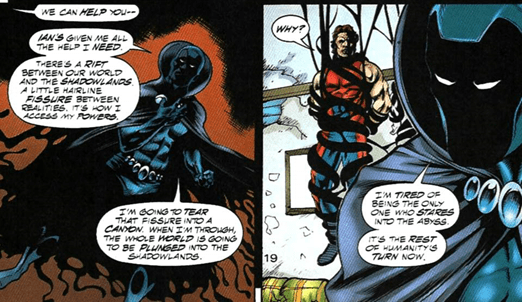
As Obsidian moves in for the killing blow, Canary and Midnight arrive. They free their non-possessed teammates and manage to break Hawkgirl free from the shadows. Atom Smasher manages to corner Obsidian, but despite Obsidian’s taunting about him being weak, he is unable to kill him to save his friends. So the team beats a hasty retreat. Karkull then reveals that he has been playing Obsidian from the start and tries to take him down. Obsidian then turns the tables on him and absorbs his powers. He then uses it to cover the whole world in shadow.

This issue is mostly rising action. It is the team beaten, and held at their lowest point. Their enemies appear triumphant. There are some moments of thematic worth here, though. Like Sentinel realizing the failures in his legacy and Atom Smasher thinking he’s found some of his own with inability to kill Obsidian, his best friend. The middle issue is tough, since the first issue generally establishes the conflict and the last one ends it, but in the middle, it is only rising action.

JSA #9: Black Planet.

Now that the entire planet is covered in shadow, everyone on the planet is going crazy. Because not only is the world dark, but also people are forced to face their inner darkness as well. Sentinel tells the rest of the team that by staying together they can pool their willpower and overcome their dark thoughts. So he leaves them to deal with their possessed teammates and the other possessed inhabitants of Milwaukee while he deals with his son.

Star Spangled Kid and Hawkgirl manage to free Hourman, who slows down Flash enough for them to free him as well. Dr. Fate manages to shake free of the possession on his own. Atom Smasher, with Rice hanging around his neck, seals the rest of the shadow people, including Sand, behind a wall of cars. Rice wants to know why Sentinel doesn’t need to be in contact with anyone else to stave off the darkness and Atom Smasher tells him it is because he is already living his greatest nightmare.

The central conflict of this issue is the conflict of this whole arc. It is Sentinel facing his mistakes and the truth of the legacy that he has left behind him, all in the person of his opposite powered son. So they have one of Johns patented shouting philosophical debate/fights. Obsidian feels as though the world has cheated him, with some pieces of a good point. He was the son of the superhero, but he was raised by an abusive drunk. He did not inherit his father’s light-based powers, like his sister, but instead powers of darkness and well as his mother’s mental problems. Not an actual good point, but enough of one to see why he wants what he wants. Sentinel is facing his most immediate legacy, his son, turned from being a hero (just before this he had been a member of a particularly forgettable JLA team) to a villain. And not an ambiguous villain, he has turned evil for evil’s sake. For the reasons mentioned above, as well as for the obvious symbolism (light vs shadow) and because he is actually crazy. It is not the most spectacular fight in this series, but it is a warm up for later, larger stories.

One interesting note is that Alan is only effective against Obsidian after he recalls his time as Green Lantern. Due to supposed reader confusion, he was going by Sentinel at this time, instead of his original name, Green Lantern. In a series about a character’s legacy, being forced to use a different name is problematic.

In the end, Alan is unable to save Obsidian, though he does stop him. Obsidian flees back into the shadow dimension, taking Jim Rice with him while Alan goes off to break the news to his daughter. The team is kind of down here. They saved the world, but they didn’t save Obsidian On the flight home Flash utters a disgusting sentiment about people being born bad, but it does not seem to be one endorsed by the book. Idly some members of the team wonder what Wildcat got up to in their absence.

Which segues to the two-page coda of Wildcat sitting in the bathtub, possibly attempting to engage in phone-sex with Catwoman only to be disturbed by an attack by the all-new Injustice Society.

I don’t feel that this title is completely up to speed yet. Some characters very important to the run have yet to be introduced and Johns has not yet found his footing. However, this is still a solid arc that sets up plenty of future stories. Yes, there will be more intercalations with Obsidian and Atom Smasher’s willingness to do kill to save people will again be tested.

Next time: Wildcat stands alone, JSA v Kobra and Sins of Youth.

Stars and S.T.R.I.P.E.

You know, I haven’t written about comic books on this blog for more than 2 years now. Why, absolutely nobody might ask? There are several reasons, but I’ll point the finger at DCs’s New 52 reboot. I generally read comics to get superhero stories. I know that is not all that comics have to offer, even excluding the vast expanse of manga there is quite the variety of genres to choose from. But superheroes one can largely only get from comics. When it comes to superheroes, I am a DC guy. It’s not that I don’t like Marvel, but I tend to prefer DC’s stable of characters. I’ll take the Justice League over the Avengers every day of the week and Superman over any of Marvel’s characters. DC’s superheroes tend to be more idealized, Marvel’s more nuanced. Since I tend to like the more mythological aspects of superheroes, the idealized version is just more my style.

Unfortunately, there was the whole NEW 52 reboot for DC. If anyone read my take on that almost three years ago they would remember that I bought into that ill-fated venture. There were warts apparent even from the beginning, but there was still potential for the reboot. When DC did it back in the 80’s with Crisis on Infinite Earths, it led to some of the company’s best output. The same thing when Marvel did a similar thing with Spider-Man, though the story that got them there was an all-time awful one. So I tried out all of the new series (I got a good deal on a bundle of the #1s), finding the good, at least initially, to outweigh the bad. It soon became clear, though, that whoever was supposed to steering the ship was asleep at the wheel. Numerous boneheaded editorial and creative decisions soon made DC the target of widespread internet derision. Nearly all of it was deserved. Creators walked or were forced off books with startling regularity, and subpar writers and artists got more, and high profile, work. The whole thing kind of made reading comics a whole lot less pleasurable. So I stopped. There were still quite a few books I was enjoying, like Wonder Woman and Green Arrow, but it didn’t feel worth it to me. So about eight months ago I stopped entirely. Continue reading

Comic Reviews for May ’12

I have three weeks worth of comics to review instead of only two this time, so there are quite a few more. I also hand out mostly good grades again, because nothing I bought was awful. Maybe I should rate these thing tougher, but I know how bad comics can be and none of these issues are really bad at all.

  • Action Comics 9:  Morrison gives us a fun look at a pair of alternate reality Supermen here, with only a few connections to the overarching run he is building in this title. It is an illuminating look at what makes Superman work, and what doesn’t. The two realities that collide here couldn’t be more different, but that collision makes for a nice done in one story. Gene Ha’s art is always a plus, as is Cully Hamner’s in the back-up story. While this issue seems disconnected from the rest of the run so far, I expect major parts of it to come back and influence this title at a later date. A


  • Animal Man 9:  Lemire continues his dark, weird and awesome run on this title. Steve Pugh’s art doesn’t miss a step from Travel Foreman’s (I know he’s been around for a while now). Here Buddy “dies” kind of, and one of the baddies steals his skin. It is weirdly fun. A-
  • Batwoman 9:  JH Williams III and Haden Blackman continue to experiment with their storytelling, but letting the story in small chunks from a multitude of viewpoints. I’m not sure it is working, but it is still an interesting story. Trevor McCarthy takes over art for Amy Reeder, and it is miles better. His art put this book back on the must read list. B


  • Captain Atom 9:  Another excellent issue. This is easily writer JT Krul’s best work to date, and it is possibly artist Freddie Williams II’s as well. The strands of this series are beginning to tie back together, in what I cynically assume is the beginning of the end, with Cap Atom’s time traveling being responsible for some unexplained parts of previous issues. This series has been largely terrific, as is this issue. A-


  • DCU Presents 9: Savage  This is just Robinson and Chang doing Silence of the Lambs with Vandal Savage and one of his numerous offspring. It is well done, but it doesn’t really go beyond its premise yet. The only real compliant I have is that Sook only does the cover, but that is a complaint nearly every time Sook does a cover. B


  • Earth 2 1:  James Robinson has a whole world to play with here. I question the wisdom of using nearly the whole first issue to spotlight characters that won’t be a part of the series as it goes forward, but I do like the seeds laid here. This isn’t going to be the old JSA, but it looks to be shaping up into an interesting series on it own terms. Still, this issue feels like a lot of wasted pages. B-


  • Exiled 1, Journey Into Mystery 637, New Mutants 42:  This crossover should have been a lot of fun, with the New Mutants and Kid Loki trying to fix a reality altering magic spell, but it really isn’t. This has got to be the most boring alternate reality, with all of the Norse Gods becoming normal people. Not with any sort of interesting twist, just normal. It is an adequately executed story, so far anyway, but not an especially good one. Just like the rest of Abnett and Lanning’s New Mutants run. C


  • Frankenstein Agent of SHADE 9:  Lemire ends his run with a touching and fun tie in to his Animal Man series. Frank and Nina try to track down a cop that disappeared in Animal Man and needless to say things get weird. The monster protecting us from monsters is just a fun concept, I don’t care that they stole from Hellboy. I wonder is the growing concerns about Father Time are going to carry over when Kindt takes over, but I hope that the book remains as fun. A-


  • GI Combat 1:  The first story, soldiers vs. dinosaurs, is exactly what the cover makes it look like: soldiers fighting dinosaurs. It isn’t anything special, but it is kind of fun. The back-up Unknown Soldier story is better. Not great, but it works. This issue is verging on crazy enough to work. C+
  • Green Lantern 9:  This issue is all exposition, all the time. We get a look into Sinestro’s past, and what helped turn him to the villain everyone one has known. We also get the sordid history of the Indigo Lanterns, finding out that they are all forcibly reformed villains. And lastly the Guardians go full bad guy. Not a bad issue, but not the most exciting one. B-


  • Green Lantern Corps 9:  John is on trial for killing a lantern a few issues ago, and it is all revealed to be a further plot by the Guardians to undermine the Earth Lanterns in their ongoing plot to eliminate the Green Lantern Corps. I’m not sure I like where this is going, because the series is best when it is about space heroics rather than pseudo-political hand wringing. C+


  • Justice League 9:  Geoff Johns seems like he is having a lot of fun here, and it shines through in how fun this series has been. He and Jim Lee are starting up the second big arc on this title, trying to give the Justice League another legitimate villain in Graves. I really like what Johns is doing with Steve Trevor, and I sure hope he comes out of this okay. The back-up, starring Shazam, is excellent. Billy Batson may not be the angel he has been in most previous incarnations, but he feels very real and is still a good kid, if a damaged one. I wish it was going faster, but such is the way of 8-page back-up stories. B+


  • Mega Man 13:  A new arc, a new artist. The art looks significantly more sloppy here than in previous issues. This in between games arc is starting better than the previous one, with an interesting debate on the ethics of humanoid robots. It is also sowing seeds for games past 3, with Dr Cossack and Pharaoh Man running around a robotics convention. B
  • Saga 3:  I don’t have a lot to say about this issue. Saga continues to be good, even with its rather juvenile sense of maturity (look at us, we have cusses and boobs!). Characters are fleshed out a little more and the story continues, in a mostly entertaining fashion. B


  • The Shade 8:  Robinson teams with Jill Thompson to take another look into Shade’s past. Shade helps his grandson extricate himself from an indiscrete relationship, by destroying the demon that had taken over his boyfriend. It isn’t an especially complex story, but I don’t think Robinson can tell a bad Shade story. Plus, it is always nice to see Thompson on art. Just an all around great comic. A
  • Supergirl 9:  Mahmud Asrar is rapidly becoming one of my favorite artists. His work on Supergirl has been uniformly excellent. This Supergirl series has been mostly very good too. This issue is about 80% fight scene, which I don’t really like, but it does help flesh out Kara some more, as well as Siobhan, the now possibly heroic Silver Banshee. I’d still like the see Supergirl acclimate to Earth a little faster, but so far this series has been good. B+


  • Swamp Thing 9:  This title has been kind of forgotten, what with Batman stealing all the Snyder attention ( I mean from fans about Snyder, not that Snyder is putting less effort into this series) and Animal Man getting the bulk from the dark line. But Swamp Thing has been really good. This is the end of this story, with Swamp Thing taking on Sethe. It emphasizes that this is a horror love story, and it works. Especially the art from Paquette and Rudy. Good stuff. A-
  • Wonder Woman 9:  I get the feeling that Azzarello is having a lot of fun with his romp through Greek Mythology on this title. I hope to get to see Wonder Woman find a way out of her predicament next issue. I rather like his take on Hades, but I hope he isn’t supposed to be a full on villain. The one thing that this book has established is that the Gods are dicks, with the possible exception of Hermes. I don’t expect Hades to be a nice guy, but I don’t like him as a villain. He isn’t the devil. Akins is no Chiang on art, but he isn’t bad. I would probably quite like him in any capacity except filling in for Chiang. B+


  • Worlds Finest 1:  This is light and fun, preserving a lot of the good stuff of previous incarnations of these characters while telling a fresh story. I like the flashback scenes, if only for Maguire’s art, but the ‘current’ stuff isn’t bad either. Power Girl and Huntress have been forcibly transferred across realities and PG wants to go home while Huntress is trying to create a new life on this Earth. It is a good set up, one where either one could get what they want. I hope this series keeps its peppy attitude. B

Comic Reviews for Late April

  • All Star Western 8: This continues to be a great comic. Palmiotti and Gray manage to make Jonah Hex a complete bastard and somehow still likable. In this issue he gets to play off a group of villains who can’t be faulted for expecting him to side with them, some legitimately good vigilantes as opposed to Hex’s amoral attitude and the still wholly unsuited for crime fighting or police work Dr. Arkham. Moritat’s art isn’t quite as polished here as it has been, though it is still excellent. And the back-up is just the greatest. A
  • Aquaman 8: Reis’s art is perfect superhero art and Johns is as on as he’s ever been. In this is vintage Johns, weaving a simple but satisfying superhero story with great skill. The amount of characterization for both the young Arthur and his team, the Others, is amazing considering the small space Johns has to tell it. John’s young Aquaman is angry and reckless, not quite as heroic as one would expect but young enough that he is understandable. Plus, there are some great moment between Aquaman and Mera. B+
  • Batman 8: Another great issue of Batman from Snyder and Capullo. I get the feeling that the Court of Owls hasn’t been discovered by Bruce because they haven’t been active for some time, given the wide range of targets they are attacking. Things look really grim for Gotham and for Batman and though I know Batman will win because he is Batman, I still like how this is shaping up. It is a great start for this sort-of crossover. B+
  • DCU Presents: Challengers of the Unknown 8: This is a bad comic. I had high hopes at the start of this, even with the reality show backdrop, but this just doesn’t make a lot of sense. It doesn’t even have an ending. It just sort of stops with no resolution. It leaves a significant bad taste. D
  • Flash 8: This is good stuff. Flash explores the Speed Force and meets Turbine, a new version of his old rogue the Top. I liked the explanation for the accidents caused by the speed force and why exactly the Flash can use it. The main draw, as usual, is the art. Manapul is the best. A
  • Green Lantern Corps 8: The start of the trial of John Stewart leaves me cold, but Guy being commended by the Guardians is one of the best twists this title has had in years. Guy is such a jerk I can’t see this lasting long, but his bafflement was worth it for this issue. B
  • Justice League 8: I love John’s more comedic take in this comic. Green Arrow’s attempts to join the league play out like an episode of the old JLU cartoon, though I am less found of the Martain Manhunter part. Even though all of these characters are serious in their own titles, in JL they seem to be cutting loose and having fun. It is a good take. The Shazam back-up is nice so far, but no a lot has happened. B+
  • Kirby Genesis 7: This is still chaotic, but finally there are some answers. I love the chaos. As long as the last issue brings things home satisfactorily this has been one fine series. This is really good. I’ll have more to say when its finished. A-
  • New Mutants 41: I realized something with this issue: I don’t really care about this comic anymore. I liked it when I started reading it. This issue should have been a lot of fun. It was a lot of fun. The team goes to Madripoor for a night out and just party. If I cared at all about the relationships of these characters I would have loved this. But I just don’t care. C
  • Supergirl 8: I think this is the best I’ve seen George Perez’s art look in a long time. It is really good. I also like that this issue starts to integrate Kara into Earth civilization. The reintroduction of Silver Banshee in a possible more heroic role is great. I really like Siobhan as a supporting cast member for Supergirl. Another good issue. B
  • Superman 8: There really isn’t anything here because there is never any doubt that Superman is going to reject Helspont’s offer. The alternate reality is a terrible possible future, but not a likely one. The best parts are the bits with the supporting cast. This book is still much better than the first 6 issues, but there is not a lot worthwhile in this issue. C-
  • Voodoo 8: If this was the route this title was going to take, then they should have done this 3 or 4 issues ago. Fallon was an interesting character, and killing her sucks. It makes most of the first 7 issues seem like a waste. I am still interested to see how this whole thing turns out, but I am mostly staying for the art. Sami Basri just gets better and better. I like him almost as much as Manapul or Chiang. C
  • Wonder Woman 8: Azzarello and Chiang’s trip through twisted myth gets back on track after an off issue. For a superhero title, WW feels surprisingly like anything might happen. This issue is back to the high quality of the first few. As always, Chiang’s art is phenomenal A-

Comic Reviews April ’12 Part 1

One might notice that I tend to rate comics rather highly. That is because I only buy stuff I like, so nearly every thing I review is from a series I like. If a series consistently is of a quality that I would rate a C or lower, the odds are good I will not be buying it for much longer. On with the reviews.

  • Action Comics 8:  Morrison and Morales first arc finally comes to an end. This has been a bumpy start to the new Superman, but it been mostly good. This issue is probably the best since the first. Superman stops Brainiac, of course, and there is plenty of great moments for nearly the entire supporting cast. Morales’s art is the best its been on this title in this issue too. All in all just a great comic. A-
  • Animal Man 8:Animal Man continues to be completely amazing. Jeff Lemire is amazing, and Pugh’s art is almost as good as Foreman’s was. Maxine shows more of her new powers and after an issue off the terror ratchets back up again. I still don’t quite understand how a family/horror comic works, but it definitely does. A
  • Batgirl 8: Gail Simone seems to be nearly done wallowing in the aftermath of Alan Moore’s thoroughly mediocre Killing Joke, finally done dealing with its ramifications on Babs and there are signs of moving on. For this series so far Simone has seemed determined to make Babs’ return from as painful for readers as it was for the character, but anytime the focus goes elsewhere Simone is at her usual high quality. There are some good scenes between Barbara and her mother, and the return of a great new villain. This issue is mostly good. B-
  • Batman and Robin 8:  This has been the secret best Batman book of the relaunch. Batman gets all the accolades, but B&R has been just as good. Here we get the aftermath of Damian killing Nobody at the end of last issue, and amazingly it is intelligent and reasoned rather than loud and melodramatic. This is a quiet, recovery issue where we see that the realtionship between Bruce and Damian may be strained, but it isn’t broken and neither is either of them. Plus, Pat Gleason continues to be awesome. B
  • Batwoman 8:  The second arc of this series has not been anywhere near as good as the previous one. Partially it is the loss of JH Williams III on art, part it the scattered nature of the story it is trying to tell. I applaud Williams and Blackman trying to push themselves, but so far I would classify this as a failure. Reeder recently left the book due to creative differences, and I can’t say I’m sad to see her go. Her art is normally great, but here it has been inconsistent and kind of bad at times. I’ve read some reviews that blame it on the inker, but whatever it is, the art just doesn’t look as good as it should. C
  • Frankenstein Agent of SHADE 8:  I really do not likes Wong’s inks over Ponticelli’s pencils. Instead of looking distinct and scratchy, it merely looks bad. The story here is much more personal than anything in this series so far. Frank and Lady Frank go on the hunt for their child, who they presumed dead but is actually missing. We get to see what drove the wedge between Frankenstein and his Bride, as well as see the manipulations of Father Time start to turn on him. Frankenstein is just a great character. This is a great book. A
  • Green Arrow 8:  Another issue that is interesting if not particularly good. The big problem here is the art, which occasionally looks really good but often fails to tell the story effectively. It took me several reads to parse some of the pages. There is a lot of weird going on here, with hive-mind triplicates and genetic experiment and a midget with a sniper rifle. I’m sticking around for at least a few more issue to see how this turns out, but I don’t think I could recommend this with any conviction. C
  • Green Lantern 8:  I enjoyed the first arc of the relaunched Green Lantern, but this issue feels like the first time Johns has been on track since before Blackest Night. We are finally getting some answers about the Indigo Tribe, plus Hal actually uses his ring to make some constructs. Mahnke’s is great as always. I thought Johns might be running out of steam on this title, but now I think he is back on track. B+
  • Justice League International 8:  I still really like Lopresti’s art. It has a simply a good, classic superhero look. Too bad the story here is just so painful. There are a few nice character moments here, like the little bit between Guy and Ice, but mostly it is stupidity on top of gruesome stupidity. It is lingering on the desperate, “look at how extreme we are” blowing up of the whole team while setting up a cliché new bad guy and adding in pointless new teammates. Other than the nice art, JLI is an insultingly bad book. D
  • Kirby Genesis 6:  The only flaw in this issue is that it has been too long since the previous one. This series gets better and better. At first the sheer number of heroes and monsters popping up can seem bewildering, but other than some clearly defined major players, the rest are just there to show that this is a world gone made with crazy awesome ideas. The tenous alliance of villains is showing cracks, but they may have already won. Which of course they haven’t, but those are the stakes we are playing at here. The fact that these are largely Kirby’s rejected ideas just shows how many awesome stories he had to tell. A
  • Mega Man 12:  I love this series so much. This issue manages to cover the entire Wily’s Castle section of Mega Man 2. It is non-stop action that can’t help but put a smile on the face of anyone who is familiar with the game. It manages to tell a story that anyone can understand while also tossing out some nods to old school Mega Man fans. I especially love Guts Man angrily taking down the Guts Tank and Mega Man learning how great Metal Blades are. This is pure fun. A
  • Men Of War 8:  If this is a preview of what Frankenstein is going to be like when Matt Kindt takes over for Lemire, then I think the book is in good hands. This issue is downright manic. For better or worse this feels like 2 or 3 issues worth of story crammed into one. Frankenstein and GI Robot have a fairly generic superhero team-up, they meet and fight then join forces to take down a larger threat, but it is set against the backdrop of WWII. The only problem is that it is jittery, trying to cram so much in that it just jumps from scene to scene. Still, it is a hoot. B
  • Saga 2:  I’m not quite as sold on this as the rest of the comics reading world seems to be. I like it, but I don’t love it. Some of it feels like it is trying too hard to be clever. Again, though, I do like it. There is good chemistry between the two lead characters and as goofy as the names for the bounty hunters are, they are interesting at first glance. Still, this issue feels far too brief. It is over almost as soon as it starts. I’m still on board, probably for the long haul if Saga gels into a consistent tone. B
  • The Shade 7 (of 12):  James Robinson has been at his best with this series and he continues to be. The Shade allows him to let is sometimes verbose writing go, as it fits with the character. This is probably the weakest issue of the series so far; it is a bit unclear as to how exactly things go down at the end. Or maybe its just been too long since I read the last issue and I do not quite remember what was going on. Either way, it is still enthralling, if a bit foggy. A-

Comic Reviews from late March

These comic reviews are about a week later than I wanted, but my comics came about a week late. Still, there was plenty of good stuff in this half of last months releases.

  • All-Star Western 7: Palmiotti and Gray get Hex out of Gotham for a while, and it mostly works. Nighthawk and Cinnamon are fun characters and the new villains, the August 7, have potential. The only problem is that the back-up story is nowhere near as good as the previous one. A-
  • Aquaman 7: This books is back on track after a somewhat too heavy handed previous issue. Reis’ art is some of the best superhero work around, and Johns is on his game with his Other League he is starting. Its too bad he has to fall back on having his villain kill one just to prove how dangerous he is. Still, a solid issue. B+
  • Batman 7: This is something of a comedown from the rest of rest of this series so far. Not that this is a bad issue, but it is certainly lower key than most that have come before it. There are finally some explanations, but at the expense of not having that much actually occur in this issue. B+
  • Captain Atom 7: This continues to be one of the most underrated books DC is putting out. This take on Cap. Atom has drawn comparisons to Dr Manhattan, which is accurate, but Nate Adam is neither as intelligent as he was nor as distant. Here we get his origin, as well as a little more inside Nate’s head. Another solid issue in what has been a solid series. B
  • Flash 7: This continues to be one of the best looking books out of DC, and is also one of the least dark. While Captain Cold’s powers have changed, his character really hasn’t. There is also an effective superhero love triangle, or maybe more of a pentagon, at work here. This is just a really good traditional superhero book. A
  • Flash Gordon Zeitgeist 4: Maybe it is just because I am still new to being a Flash Gordon fan, but this series has been really entertaining so far. While it is using all the same parts as the classic 1980 film, the only version I am familiar with, it still feels remarkable fresh. I would be outright gushing about it, except that near the end there is a page with the wrong speech bubbles on it. It really breaks the reading experience. C
  • Green Lantern Corps 7: While I have largely been a fan of Tomasi on this title, even since the relaunch, but this is an issue that didn’t need to happen. It is almost entirely John Stewart returning the body of the lantern he killed to save to corps home, and being really heavy handed laying on the guilt. Plus, the art is nowhere near as good as it usually is. C-
  • John Carter: The Gods of Mars 1: The previous Marvel Barsoom mini was very good, and this one starts out on the same level. This biggest change is in the art. Perez’s art is a big change from Andrade’s and while they are both excellent, I thing Perez is a better fit. This is just an all around great issue. B+
  • Justice League 7: I have to say that I like Gene Ha’s work much more than Jim Lee’s. Otherwise, this is more of a slice of life issue than the rushed adventure of the first six issues. Johns is building tensions between the League, the government and the populace, as well as doing more interesting with Steve Trevor than anyone in at least 25 years. The best issue yet. B
  • My Greatest Adventure 6 of 6: This anthology title sadly comes to its end. I think I am only of the only people reading this, but it is really good. The Robotman story is poignant, and Garbage Man is a not quite as good take on the same story. Tanga’s story is completely different, but not especially original. Still, there were some good weird stories with really good art. B
  • Supergirl 7: This is one of the best issues that is mostly a fight scene I’ve seen in a while. Kara is out numbered and trapped, but she fights smart. Asrar’s art is still really good. The world killers are some interesting new villains, they feel like a match for someone of Supergirl’s power and are connect to her, not Superman. B+
  • Superman 7: Giffen and Jurgens get Superman. There is plenty in this issue about boring Wildstorm villain Helspont, but the parts about Clark and Superman are really good. If The writing team can maintain that tone when they get to tell their stories, then this title should move up to be among DC’s best. B-
  • Wonder Woman 7: This has been one of my favorite titles since DC relaunch, but this issue is just a miss. It is a well written, well drawn miss, but a miss nonetheless. This issue answers a question that no one ever asked because it doesn’t make any sense to ask. Where do immortal warrior women get their children? It has been long established that they don’t have children, so there was no question to ask. I hope they quickly put this frankly stupid misstep behind them and get back to the great story they were telling. C-