Reading Some Comics: Queen Crab and The Ray

Since I started reading comics again four or five years ago, the writing team of Jimmy Palmiotti and Justin Gray has become one of my favorites. I have enjoyed nearly everything of theirs that I’ve read, from Power Girl to Freedom Fighters to Jonah Hex. A week or so ago I got a couple comics by them. Or at least one written by the pair of them and one that was a Palmiotti solo project. The first is the Ray, written by Gray and Palmiotti with by Jamal Igle and Rich Perrotta, is a classic superhero story with modern sensibilities. The second, Queen Crab written by Palmiotti with art by Artiz Eiguren, nearly defies description. They are both good books, though they are very different.

In some ways the Ray, the last issue of which came out a few weeks ago, is a very traditional superhero comic. It has all the pieces of the basic superhero story, but with some progressive touches. The Ray is a comic that features a very ethnically diverse cast, but it doesn’t do so in a pandering, distasteful way. Lucian Gates, the new Ray, is a Korean American but this isn’t a story about an Asian superhero, this is a story of a superhero who happens to be Asian. His friends and family are from a variety of backgrounds, but for the most point that is never the point of their character, just a simple fact.

That supporting cast is one of the things this book does so well. In many superhero books nowadays the heroes life out of the costume is disappearing, but the life Lucien Gates takes prominence. The comic introduces his supportive if not particularly helpful adoptive hippy parents, his best friend Darius and his girlfriend Chanti. As much as the book is about Lucien learning how to deal with his new powers, it is about how they affect his relationships. The slightly different focus makes this book very refreshing.

The other refreshing thing about The Ray is its more light-hearted tone. Since Ray is a hero with light based powers, his adventures tend to be very light. He mostly deals with personal trouble and big monsters. In contrast to the usual superhero book, The Ray is fun. At least until issue 3, when it all goes horribly wrong. The big change in the tone of the book in that issue is especially jarring. Going from fun and light to dark and terrible feels wrong. It works, at least in light of the ending. The big villain of the book has the powers to make his imagination real. After (spoilers!) fails to defeat him and Chanti shoots him, Lucien uses hypnosis to make him fix the past.

In all, The Ray is a fun new superhero. One that I am not especially hopeful of seeing around much in the future. But this story at least does a good job of setting up the hero’s status quo for what could be an entertaining ongoing, even if this is all we ever see from him.

Queen Crab is certainly a strange comic. I’m not quite sure how to describe it. It definitely has some elements of horror, but I wouldn’t call it a horror comic. I guess it is a surreal character study. However you would classify this book, it is certainly interesting and even very good, I would say.

Queen Crab is about Ginger Drake, a woman who gets thrown overboard by her husband on their honeymoon cruise. Only instead of drowning, she wakes up on the beach with crab pincers in place of arms. It is a set-up that could be used for a horror story, especially if the story were told from the point of view of Murray, Ginger’s new husband. It would be a story of a man’s sins coming back to haunt him, a monster in place of his murdered wife. But this isn’t Murray’s story, its Ginger’s and she isn’t a monster. No Queen Crab is a story about a woman, about a terrible event that forever changes her life.

Really, Ginger’s life is kind of a mess at the start of the book. She is cheating on her fiancé, her fiancé is cheating on her and she is being sexually harassed by her boss. Ginger mostly accepts her life as good enough, that it is as good as it gets. Though she does seem to hope that her marriage to Murray will be an improvement. Though as the plot set up indicates, it isn’t. After her transformation (caution: spoilers ahead!) Ginger does get revenge on Murray, but that is far from the end of the story. Were this the simple horror story it appears to be, that would likely be the end of it. She got her revenge, but the monster must be killed. Instead, she leaves her old life behind and goes to build a new one. Ginger didn’t come back for revenge. At least not wholly. I’ve probably given too much away already, but it really is an intriguing read. It is strange, it is different, but it is also thought provoking.

Comic Reviews for Early March

I have some more comics this week. Most of DC’s best stuff hits early in the month, so I have a load of good stuff from that company.

Action Comics 7
Morrison moves back to his Brainiac/Superman introduction story and it is a strong as it has been since the first issue. This young Superman is brash and a bit reckless, but he is still the character readers have loved for 80 years. Morrison’s take on Brainiac is as brilliant as one would expect. After a few months of great back-ups, this one is completely pointless. This title still feels like the deleted scenes from All-Star Superman, but even a pale shadow of the greatest Superman story is still pretty good. A-

Animal Man 7
Lemire is working wonders on this title, and doing it in a way completely different from the previous well-loved take on this character. Animal Man is somehow a family horror comic. The horror is never far from the front of this comic, only ever a few pages away, but there is still tons of true family moments, this has some nice ones between Buddy and his son Cliff. This issue is still in cool down mode after the frightful first arc, but it is no less entertaining. A

Kirby Genesis: Captain Victory 4
After last issue’s surprise attack, this issue of Captain Victory follows his aquatic lieutenant Orca as he tries to raise their ship from the ocean it crashed into. It is also an origin story for the character. There really isn’t much surprising or original, except for a micro-troop attack, in this issue but it was well executed. Still, it is largely enjoyable. C+

Frankenstein: Agent of S.H.A.D.E. 7
What a difference an inker can make. Not a good one in this case. No offense meant to Walden Wong, but he smoothes Ponticelli’s scratchy lines, making for a comic less appealing looking than either Ponticelli’s usual look or something more traditional. The story is still the same outrageous fun that its been from the start. The only problem is that the threat doesn’t really feel threatening, not after what Frank and the gang have dealt with. A-

Green Arrow 7
The addition of Ann Nocenti to this comic immediately elevates it to being worth reading. While I don’t think this issue is especially good, but it is interesting and intelligently written. The art isn’t quite as good, but I don’t hate it. New villains Skylark could go either way, but at least they are something fairly new and original. This isn’t the best start, but it is good enough to get me back for the next issue. C

Huntress 6
This was a 5 issue mini that went on for an issue too long. There is nothing really wrong with this comic, but there is really nothing too it. Huntress’s mission was wrapped up last issue and there aren’t really any loose ends. This is mostly a twenty page prologue for the upcoming Worlds’ Finest comic. Fortunately, this comic looks good enough that is still is a largely pleasant read. C-

Justice League International 7
Eughh. After six issues of turgid team building, Jurgens decides to blow it all up. Even Lopresti’s art can’t save this mess. Though there are a few moments that are redeeming, like Guy’s worrying over the injured Ice, but mostly is it a lot of death and destruction for no reason effectively erasing all the character work over the last six issues. I tried, I really did, but I’m done with this. I just can’t. D

OMAC 7
Didio and Giffen’s romp through the Kirby created portion of the DC Universe, this time with a loose take on the Kamandi mythos. It is pure comics magic, even if the overall story is barely anything. It is sad that next issue is the last of this. Giffen’s art is very Kirby like, though it is not just a pastiche. This is the kind of story that only happens in comics, with talking Zoo animals and evil underground factories. Good stuff. B+

Saga 1
There is a lot of buzz about this comic right now, and I don’t really have anything to add. It is good. Not quite great I don’t think, but its well written with nice art. A good start to this magical sci-fi story. B

The Shade 6
In some cases I would be annoyed with a comic where the main character even admits that the current story has little to do with the main story. But the current side story in The Shade is so good that I can’t feel bad about it. Shade and his vampire daughter are still trying to track down the Inquisitor, La Sangre’s arch nemesis, in Barcelona. Robinson introduces more foreign superheroes and quickly and effectively sets up La Sangre’s status quo. Plus great art by Javier Pulido. I love this comic. A+

Swamp Thing 7
This vegetarian counterpart to Animal Man is still almost as good as that title. After nearly 7 full issues, Swamp Thing finally appears. Paquette’s art is amazing, as always, and Snyder is working his usual magic. Underneath all the creepiness, there is something of a love story brewing. Another one of DC’s best titles. B

The DCnU after 6

It has now been six months since the DC relaunch, time enough for the shock and the new car smell to wear off, time to get enough issues out to really assess the quality of all of the books. At this point I am relatively satisfied with DC’s offerings. Some of the books have been disappointing, but those books have been offset by a similar number of positive surprises. Because I hate myself, I guess, I … acquired … and read the first six issues of every single one of the New 52. Then I rated them from best to worst. Actually, I’m going to go over them in the opposite order.

52) Hawk and Dove: This series is a mess. I don’t know what hold Leifeld has over DC that they keep giving him books not just to draw but to write, but they really need to put a stop to it. This is an incoherent, ugly comic with absolutely nothing to recommend about it. The original writer Sterling Gates ducked out early, and it only got worse from its miserable first issue.

51)Batman: The Dark Knight: There are two legitimately good Batman books in the relaunch and even the pedestrian Detective Comics is much better than this pile. It seems to be an artist showcase for David Finch, which is baffling because his art is aggressively terrible. He is also writing, or co-writing later, and the story is a muddle. Avoid.

50) The Savage Hawkman: I’ll give the Savage Hawkman credit for at least having interesting, if not especially good, art. But the story is a jumbled mess and Hawkman is still as big a mess as ever. Continue reading

Comic Reviews for Late February

So I guess I’m doing comic reviews again. We’ll see if I can keep this consistent or if it is doomed to be a sporadic thing. Not too many titles this week.

Justice League #6: The new Justice League’s first story comes to its cacophonous conclusion. I’m not jumping on the rapidly filling up hate train for this title, but I would say that this story didn’t quite come together as well as it could have. In the end it is all empty noise and confusion. Lee’s art is as explosive as usual and John’s has a strong handle on the team’s various personalities, so its not all bad just a touch incoherent and soulless. C+

The Flash #6: The art in this titles remains as impressive as it has been since Manapul took over drawing it at the start of the previous Flash title. The story, while less exceptional than the art, is solid. The Flash is one of the few books on the shelves that actually lets the hero’s out of costume life actually play a part as of late. The love triangle among Barry, Iris and Patty is as entertaining as the quite good superheroics, even though I am fairly certain that Barry will end up with the woman who was until recently Mrs. Flash. A-

Aquaman #6: Prado does finishes over Reis breakdowns instead of just inking this issue, but it is not that significant a departure other than some wonky faces. Aquaman takes an issue off as we focus on his wife Mera. Johns really needs to turn the volume on this issue down. In big hero v villain fights his eschewing of subtlety is often a plus, but this issue could stand to be much less bombastic. Mera breaking the wrist of a handsy pervert would be more effective than her crushing all of the bones in his arm. For all its overloud warts, this is an effective if blunt bit of character work for Mera. B-

All-Star Western #6: This issue reinforces that Jonah Hex is an awful bastard. He is cowboy Punisher, a man the reader can only root for because his enemies are even worse than he is. The highlight of this issue is the extended gunfight between Hex and some child slavers, where Palmiotti and Gray step back and let Bernet tell the story with his art. Which he does beautifully and gruesomely. The back-up story is just as good as main one, bringing this story about the Barbary Ghost to a close, but leaving the door open for her to return in either another back-up or in the main story. This is an excellent comic. A

The Ray #3: This series has been a bright spot amongst a sea of darker titles. A ray of light, if you will. This issue turns a bit darker, but is still primarily fun, classic superheroics. The villain is a man who makes reality his own movie, a fitting villain for a book set in Southern California. I’m sad that this is only a four issue series. Good stuff here. B

The Shade #5: This is one of the best books on the stands. Robinson, teamed with a variety of excellent artists like this issue”s Javier Pulido, has recaptured the magic of his Starman run from a decade ago. His work since has been hit-or-miss, but he has yet to go wrong when writing the Shade. Here we meet La Sangre, the Shade’s adopted vampire daughter, and have an adventure in Barcelona searching for a vial of the Shade’s blood. The art is beautiful and the writing is intelligent and highly literate. A

New Mutants #38: Marvel’s double shipping policy means a change of artist, but it is not that big of a problem. This series is on the verge of being as fun as it should be, but for some reason I’m just not engaged. Maybe it’s the cast. I’m a fan of the classic New Mutants, I like Doug, Dani and Bobby and I’m okay with Amara, but I just don’t care for Warlock or Nate Grey. Warlock is supposed to be a joke character, but even with his goofy way of speaking he isn’t that funny and Nate is just aggressively boring. Plus, this issue tries to bring back Bird-Brain, one of the worst characters in X-Men history, which is saying something. C+

Voodoo #6: This title always seems to be just on the verge of taking off and being truly good. But it never quite gets there. Still, at the end of every issue I’m eager for the next one, ready for everything to fall into place so I can proclaim this series truly excellent. Basri is a terrific artist with a clear, fine style. With Williamson taking over for Marz the title has shifted from being a Sci-Fi tinged spy story to a spy tinged Sci-Fi story. Hopefully soon Voodoo will get it together and give readers some answers. B-

Next week look for the next VGA and for my reread of The Dragon Reborn, as well as some musings on my present video game playing and lack thereof.

Reading Some Comics

Over the last several months I’ve been reading a pair of 4 issue mini-series comics: Mystic from Marvel, written by G. Willow Wilson with art by David Lopez, and Bonnie Lass from Red 5 comics, by Michael Mayne and Tyler Fluharty. The two of them share several superficial similarities, like being 4 issues long, having female leads and sharing a similar art style. I also really like the first issue of both series. Unfortunately, as they came to an end Bonnie Lass kept up the quality of the first issue and Mystic faltered badly. Perhaps by comparing the two I can show why one worked and the other didn’t.

Both of them had good first issues. Bonnie Lass sets up its cast and the plot efficiently and effectively. It isn’t an especially complex story, but it gives the reader a quick impression of Bonnie, Ben and Trick as well as their quest. The crew finds a treasure map and are pursued by mercenaries hired by a menacing, shadowy figure. It also sets up Bonnie’s oedipal complex-ish thing. (her father is married to the sea and she wants to take it from him and replace him as the world’s premiere buccaneer.) Mystic starts similarly strong. It introduces Genevieve and Giselle, two orphans who are close as sisters despite diametrically opposed viewpoints. They live in a downright Dickensian orphanage in their flawed steam punk world where the magic that gives the world its wonders are reserved only for the rich and powerful. By the end of the issue, one of the girls has realized the others dream of being chosen to learn the “Noble Arts,” setting up a conflict inequity of the world tears the former friends apart.

Mystic’s story is obviously much more complex than Bonnie Lass’s story. The problems arise with how they follow up on the first issue. After the first issue, Bonnie and her crew search out the treasure on the map and constantly fight with the mysterious shadowy man from the first issue. (I’m trying not to spoil too much because you should read it yourself) Everything from that first issue is followed up on in the next three. Though it is a simple rather simple story, it is executed very nicely. Mystic, on the other hand, gets increasingly muddled and confused after the first issue, squandering the fine set up of the first issue and ignoring the central conflict. Instead, it gives the reader some Mean Girls or Harry Potter-esque magic school hijinks.

Mystic focuses on Giselle, the girl chosen to learn magic and her struggles at the school while almost completely ignoring Genevieve, who is left on the street using her self taught skills to help a group of revolutionaries. The first issue showed that the world is corrupt, that it needs to be fixed, but the rest of the issues ignore that. In the end the story of two friends on opposite sides of a growing conflict is swept aside for a much less interesting story about saving the world from some generic apocalypse. There is no resolution between Genevieve and Giselle, any confrontation or reconciliation is put off.

That is the real problem with Mystic. It is written like the first 4 issues of a supposedly longer tale, setting up storylines and characters that will never have a chance to matter. Because there likely will never be anymore Mystic. Bonnie Lass tells a 4 issue story in its 4 issues. There are hooks for further stories and adventures, but it tells the story it has space for. Mystic has much greater ambitions, but doesn’t have the space to realize them, leaving it a anti-climatic disappointment.

If more of either of these series were to come along, I would probably by them. Bonnie Lass was good enough that I am eager for more. More Mystic might make good on the promise that the first issue showed. But I don’t see people pounding down the doors to get more of something as disappointing as Mystic turned out to be in the end.

Comic Reviews for late November.

The Flash 3. Francis Manapul and Brian Buccellato.

Manapul’s and Buccellato’s Flash is one of the best titles to come out of DC’s New 52 initiative. The third issue further solidifies it among the very best books being published by ant company.

This issue picks up right where the last one left off, with Keystone and Central City in a mysterious blackout while the Flash ad his friend/partner Patty Spivot by to get to the bottom of a mystery involving Barry’s old friend Manual Lago.

The creators are telling their tale at a relaxed pace. Not that the Flash seems at all relaxed, he is in constant motion as the fastest man alive should be. However, they allow the central plot about Mob Rule and the blackout to move somewhat slowly as Flash deals with a multitude of smaller problems. Which allows the creators to experiment with how they show superspeed on the page.

That is where this book really shines. It is the perfect synthesis of art and writing. Better than any other comic out now, the Flash’s art and writing blend together to tell a story, which is what comics are supposed to do.

[****½]

Daredevil 6. Mark Waid and Marcos Martin.

Another great comic is Waid’s and Martin’s Daredevil. Like Flash, the art is superb. Marcos Martin is leaving after this issue (I believe) and he will be missed, even with the equally skilled Paolo Rivera is coming back on. It blends perfectly with Waid’s story. Daredevil again faces off with Bruiser. And again the way they show how Daredevil’s radar-like vision works is perfect comics. Bruiser’s powers are interesting, as is how Daredevil finally defeats him.

I do have some qualms about the story. It just seems too easy. I’m sure that this story will continue in a satisfactory manner, I have faith in Waid, but here the story seems to end just because the issue is ending. Also, there is little to no time for Matt Murdock in this issue. Still, it is a great read.

[****]

Quick Reviews:

  • Aquaman 3. Johns and Reis. Really good superhero stuff. [****]
  • Herc 10. Pak, Van Lente and Hahn. Marvel’s great Hercules saga ends with a dull thud. [**]
  • All-Star Western 3. Gray, Palmiotti, Moritat and Bernet. Not as good as previous issues, but still not bad. [***1/2]
  • Fury of Firestorm 3. Simone, Van Sciver and Cinar. The art is fine, the story should be better from this team. [**]
  • Flash Gordon: Zeitgeist 1. Trautman and Indro. Flash’s origin doesn’t really get to the good stuff. [***]
  • The Shade 2. Robinson and Hamner. Robinson’s return to Opal continues to shine. [****½]


Comic Reviews From Too Long Ago

These reviews are from the shipment of comics I got 2 weeks ago, but didn’t have time to review because I was busy with other things.  But here they are now.

Captain Victory 1.
Sterling Gates and Wagner Reis.

Sterling Gates crafts a fine introduction to Captain Victory with this first issue. The bulk of this issue is spent showing the reader exactly who Victory is and what he is fighting for, without sacrificing the immediate action. While it is primarily focused on the title character, Gates still manages to instill personality in several of this crewmen.

The primary action of the book is an assault on a planet by the forces of the evil Blackmass, under the command of one Batteron, with Captain Victory fighting against them. Weaved in with that are scenes from Victory’s youth, being raised by his grandfather’s, Blackmass, men. His lessons are juxtaposed against the current situation to show exactly what he has learned.

If there is a weakness to the issue it lies in Reis’ art. Not that it is particularly bad, but there are some rough spots. The armor worn by many characters never looks right. It seems too small, or their heads too big. Other than that there are some moments that look stiff, using signature Kirby poses that do not gel with the other panels.

All in all a fine first issue. Nothing mind blowing, but a set-up for what promises to be some satisfying superhero tinged space opera.

Mystic 4 of 4
G. Willow Wilson and David Lopez.

What an utter disappointment. Not the art, Lopez does just a phenomenal job as he has done all along on this title. But the story, what a disappointing ending to what began as a wonderful mini-series.

Instead of the climax to the brewing conflict between former friends, it deals with a much more generic and much less interesting calamity involving a magical eclipse. It brings the two friends together, sets the conflict up, then just brushes it aside, seemingly postponing it for a later story that does not seem likely to ever be written. This issue renders much of the previous ones completely useless. All that time spent of Harry Potter-esque hijinks seems completely wasted, as that came to nothing. There is nothing to this story, no central theme or conflict built to a satisfactory resolution. Just many small conflicts quickly forgotten rather than resolved. Please, don’t waste your time on this.

Bonnie Lass 3 of 4
Michael Mayne and Tyler Fluharty

This excellent series is showing no signs of letting up until the last issue ends. I don’t want to give much of it away, but Bonnie and her crew have found their treasure, now they must fight for it. The majority of the issue is taken up by a fight between Bonnie’s crew and a group of mysterious adversaries. The art is wonderful, cartoony and expressive and it is a perfect fit for the story being told. And while some bits of dialogue clank, the villain’s big monologue fell flat for me, the story is well told.

I gushed about the first issue of this series, but I missed reviewing the 2nd. I’ll just say that taking a chance on this was one of the best comic buying decisions I’ve made. It isn’t deep, but it sure is fun. Pure exhilaration until the last page. I can’t recommend this enough. I’ll probably have a review of the whole thing after I get the last issue.

Deathstroke 2 & 3
Kyle Higgins and Joe Bennett

I thought the first issue of this series was decent, but it didn’t really get me interested in continuing to read the title. But I heard good things about the next issue, so I went ahead and picked up both issue 2 and 3.

Both issues are delightful, full of ridiculous, over-the-top ultra-violence. Slade is a crazy anti-hero Clint Eastwood, who kills and maims with wild abandon. He is out to prove that he is not over the hill, as many people seem to believe him. And his method for achieving this is to make his contracted kills as violent and public as possible.

Joe Bennett’s art is crisp and chunky, far enough away from realism that every time Deathstroke chops off someone’s had with his giant sword it comes off as less gruesome gore and more cartoony absurdity. It works well with the very comicy stories that Higgins is writing, like in issue 2, the fight with Road Rage, a hired killer on motorized roller-skates. There is also some underlying mystery with a briefcase that I don’t really care if it is ever revealed. It doesn’t matter what is in the briefcase, only that it pissed Slade off.

As long as it keeps up the level of crazed ludicrous violence, more humorous than gruesome, this is a title worth reading.


Comics Reviews October, Part 1

Action Comics 2. Grant Morrison and Rags Morales. [****]
I loved the first issue of Morrison’s revitalization of Superman. He deftly fused some of the best of the golden age Superman with choice pieces of Byrne’s reboot and later versions. It had an energy that most comics, let alone most Superman comics, lack. It was great, this brash young Superman fighting for the little people and against the studied hate of Lex Luthor. This second issue doesn’t lose the energy, but it does lose control of it some.
Captured at the end of the previous issue, Superman is subjected to torturous tests by Lex and a cadre of military scientists, defended only by Doctor Irons, who in previous continuity was the hero Steel. It is still a magnificent re-imagining of the Superman mythos, with as many warts as possible sanded off. However, the plot of this issue falls into the trap that people often erroneously claim Morrison’s stories fall into. Somewhere in the ideas and the big moments, it loses cohesion and any sense of actual narrative. While that is usually a bogus claim of those whose reading comprehension is poor, I believe this issue strays into incoherence. It feels like 30 pages of story crammed into 20 and that compression leads to a story that feels like some important parts are missing. Still, the ideas underlying the carry it well enough, as long as this is a one-issue blip and not a continued problem.

Frankenstein: Agent of S.H.A.D.E 2. Jeff Lemire and Alberto Ponticelli. [****½]
The first issue of this series promised much, but didn’t quite deliver it. This issue does. It cleans up the action from the first, throws a few more big science fiction concepts onto the page and manages some deft characterization of the monster fighting crew of monsters that populate this book.
Frankenstein is a no nonsense man of action. Griffith, the werewolf, is an eager young soldier. Mazursky, the sea monster, is a committed, possibly mad scientist with a combination of determination and damage. Velcoro, the vampire, has gotten the least characterization so far, but he seems to be a bit of a sociopath. Then there are the scientists of SHADE, who supply the team with support and crazy tools. It is like a monster sci-fi James Bond. Ponticelli’s scratchy art is a perfect complement to the black humor of the story. It all adds up to a terrific comic.

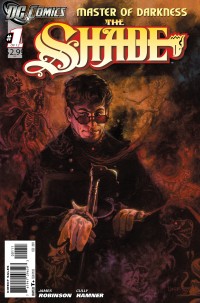
The Shade 1 of 12. James Robinson and Cully Hamner. [*****]
James Robinson returns the world where he really made his name. Back to Opal City and to the Shade, one of the biggest characters from Robinson’s seminal Starman run. The villain turned hero, sort of, Shade was easily the best character from that series, save for maybe its star.
Despite it being ten or so years since Starman ended, Shade manages to pick up right where it left off but not be alienating to new readers. All information needed is on the page. Shade is jovial and verbose, though he claims to be in the dumps. His girlfriend, police officer Hope O’Dare, suggests an adventure to perk him up. Interspersed in between Shade scenes in an encounter between one Von Hammer and a group of hit men. What he learns from them points him to Shade. There is an undeniable charm to the Victorian born Shade. He is acts like a man who has lived for more than a century might act. He is calm and never surprised but also not jaded. At least not anymore. This is just a great book. I look forward to the rest of it eagerly.

QUICK REVIEWS:

Continue reading

JSA Re-read Part 1

This is the first entry in a new weekly — hopefully — series I am writing about the Geoff Johns/David Goyer (later just Johns, who is the writer of focus here) JSA, which is hands down my favorite comic series. This series is the reason I went from someone who liked superhero movies and had read some X-Men comics long, long ago to a someone who actually buys and reads comic books. JSA is not a book that would normally be considered a good series for new readers. It is the reason I am never convinced that that continuity is the reason comic sales are in a prolonged funk. (I’d finger general awareness and physical accessibility.) JSA is not just a book with some reliance on continuity, it is a book steeped in it; it revels in it. JSA is about history, it is a book looking back at and remembering the past. That the JSA was dropped, at least temporarily, in the re-launch makes sense. The series focuses on the legacy of a world with superheroes and DC seems intent on jettisoning that, for better or worse. Without history, there is no Justice Society.

Despite the title’s reliance on history, JSA was still a new reader friendly series. Each arc, if not each issue, is comprehensible to people who have never read the book before. That is impressive especially with the fact that most recognizable character in the series is probably Hawkman. Maybe Captain Marvel or Black Canary, I’m not sure which one is best known. C-list characters at best no matter how you look at it. Much of this is thanks to the writing team. While he is certainly never subtle, Johns (I’ll credit him since he has done this on more books than this. Goyer certainly contributed as well) has a knack for distilling characters down to a core idea that drives all their stories. Not that the characters are one note; it gives them a central, relatable theme. As he does this for each of the numerous characters, he also does it for the team as a whole. And the theme of JSA is legacy. They are a team built on remembering the past, on how that past affects the future. They are about carrying on an ideal and a specific legacy; it is about the importance and dangers of following in the footsteps of parents/mentors/teachers.

Before we got to the run proper, there are the first 5 issues of the series to deal with. Because while Goyer was on to start the book, his co-writer is James Robinson for the first arc rather than Geoff Johns. Robinson was at the time closing in on the end of his wonderful Starman series and was at the time a superstar. Since Goyer was co-writing, I am going to cover it. It is part of the run; it sets up much of what comes later, even though it isn’t Johns work. That being said, I am not going to give it quite the same level of focus that I do the later issues. So let’s begin with JSA issues 1-5
Continue reading

DC’s New 52 Final Thoughts

Now that I’ve read and reviewed all 52 of DC’s New 52 comics, I feel the need to look back at my original predictions about all these books. Reading them all wasn’t an ordeal as some places on the internet are trying to make it seem. They are comic books for Christ sakes; they are quick, easily digested entertainment. But I did pay for all of those things, so I am going to get my fair share out of blogging out of them. Also, I am going to decide which titles I will continue to purchase and which I will gladly never have to look at again. To finish, I am going to rank all 52 from best to worst.

When I first looked at these books, I had not yet decided to buy the whole lot for the first month as some sort of crazy experiment. Plus, all the cool internet people were doing it and I wanted to be cool. So I rated the books on whether I was: excited for them, which meant I expected them to be great, intrigued by them, which meant they sound like they could be good but I wasn’t quite sold, dubious about them, which meant I thought there was some nugget if interest to be found but doubted it would be worth it, or that I would pass on them, which meant I saw little reason for that book to exist. So how did my initial predictions fare, at least with the first issue? Let’s see.

The Justice League.


For the Justice League books, I was Excited for Justice League, Wonder Woman and Aquaman. All three were pretty much what I expected, though Justice League was slower than I had hoped.

I called Justice League International, Fury of Firestorm, The Flash, and DCU Presents Intriguing. Flash was much better than I had hoped, while Fury of Firestorm was disappointing. I had hoped Gail Simone would tone down the darkness that she has used to great effect in books like Secret Six, but that was not the case. The jury is still out on DCU Presents since its anthological nature has yet to be shown. And JLI was a decent superhero book.

The only book I called Dubious was Mr. Terrific, and that was about right. There was a glimmer of some quality in it, but I’m not sure Eric Wallace can polish it into a quality series. And the artist changed to the fluid Gianluca Gugliotta, who I like a lot.

I was set to Pass on Green Arrow, Savage Hawkman and Captain Atom. While I didn’t think they were outright terrible, that would have been the correct choice on Green Arrow and Hawkman. Captain Atom was one of the surprises of the month, delivering some of the best art and a solid start to the series.

So as a whole, I was spot on for this portion of the re-launch. Except for Captain Atom, which it turns out was just short of great.

The Dark

I was probably most interested in this group. I was Excited for Swamp Thing, Animal Man, Frankenstein and Demon Knights and all of them were great. Those four books are worth the re-launch on their own.

I was Intrigued by Justice League Dark and that seems spot on too. The seeds are here for something great, but the first issue wasn’t quite there.

I was dubious on Resurrection Man and even then, it disappointed. It just wasn’t very good at all.

And a Pass for I, Vampire, which was way off. This book was nearly as good as the top four in this group. The Twilight fake-out cover fooled me.

Except for I, Vampire, I had this set called. It was easily the best group of books DC put out, and probably the most likely to get cancelled.

The Edge

I was not looking forward to this set of books, and I was probably the most wrong about it. One title got an Intriguing, All Star Western, and it turned out to be really great.

I handed out a lot of Dubious guesses. Stormwatch, Blackhawks, Men of War, OMAC, Suicide Squad and Voodoo all got that designation. Men of War, Blackhawks and Stormwatch all lived up, or down, to that. Though Stormwatch should get better. I ended up liking OMAC and Voodoo much more than I expected. Both were good to very good. Suicide Squad was one of the worst books of the re-launch and I should have given it a pass. I do not know why I didn’t.

I called for a Pass on both Deathstroke and Grifter and only Grifter really deserved it. That book was a mess. Deathstroke was a good Deathstroke comic. I have no interest in reading more, but fans of the character should be reasonably pleased.

I underrated this group. With OMAC, Voodoo and All Star Western, and maybe Stormwatch, there were some high quality books here.

Young Justice

Like with The Edge, I wasn’t very big on any of the Young Justice books in my predictions, either. The only book I even called Intriguing was Blue Beetle, and that was possibly a little high. It was okay, not great.

Static Shock, Legion Lost and Legion of Superheroes all seemed Dubious to me. Static turned out to be pretty good, so I had it pegged a little low, but both of the Legion titles turned out pretty sour.

I said Pass on Hawk and Dove and that was absolutely right. I called for my one fan boyish Uber Pass on Teen Titans and that turned out to be too harsh. Tough to be fair, DC’s Teen Titans promotional art was terrible. In the end, it was an okay book.

Except for Teen Titans, I was close on this set. I didn’t think it would be very good, and it wasn’t.

Batman

The Batman group is I think the biggest group of books in the re-launch, and I spread my predictions around pretty well. Only two Exciteds, Batman and Batgirl. Batman lived up to that, Batgirl did not.

I was Intrigued by Nightwing, Batwoman and Batman & Robin. Nightwing and Batman & Robin are both solid second tier books, but Batwoman was one of the best of the relaunch. I should have been excited for it.

Predictions of Dubious on Birds of Prey, Batwing and Red Hood and the Outlaws. I was right on Red Hood, over on Batwing and under on Birds of Prey, but for those two I wasn’t far off.

Passes for Batman: the Dark Knight, Catwoman, and Detective Comics. Right on all three, they were terrible.

I think I had a good handle on the much-unchanged Bat books. I think Batgirl will get better, so I don’t feel bad about that one.

Superman.

I had one entry for each on the four Superman family books, and I was only right on one of them. I was Excited for Action Comics, and it was great. I thought Superman was Intriguing, but it turned out to be a slog. Since I wasn’t sure on the direction of Supergirl it got a Dubious, but it turned out to be pretty good. A Pass for Superboy, which I was all set to just ignore, but was another great surprise. I had predicted the art would look good, but I didn’t expect the writing to be as solid as it was.

So I guess I didn’t have a very good read on this family of books.

Green Lantern

I was Excited for Green Lantern Corps, and it was good. Tomasi writes a great Guy. I had been slipping on Green Lantern, calling it only Intriguing, but it was a return to form for Geoff Johns on the title.

I was Dubious about both The New Guardians and Red Lanterns, which looks pretty correct so far. Neither are travesties, but neither are they actually good.

It was easy to get a read on the Green Lantern books since they changed so little in the re-launch. I had their number.

Conclusion

I think the re-launch turned out better than I had expected. Some books I thought might be good weren’t, but more books I thought would be terrible turned out to be pretty good. My biggest disappointments were writers Gail Simone, Paul Cornell and Peter Milligan. Other than Demon Knights, none of their six combined series lived up to my expectations. I’m not writing them off, but all three have done better work and I fully expect all three to do better work in subsequent issue. They all simply stumbled a bit out of the blocks. My biggest surprise was Scott Lobdell. Sure, there is much furor around Red Hood, but his other two books had better starts than I expected.

So what am I going to keep buying? My budget won’t allow me to buy more than about 15 o these, even with the discount they give with dcbservice. So I’ve bolded 18 in my top to bottom rankings that I at least intend to keep purchasing. Not the first 18, though certainly many of them, because even though some series had a good start and are certainly going to continue to be good I am just not that interested in the subject. Or because I’d rather support a less popular good series that a more popular very good one. DC isn’t going to stop publishing Batman. I don’t have to worry about seeing more good Batman stories made. But Frankenstein or Demon Knights? Those aren’t like to last much more than a year, no matter how popular they are.

Top to bottom rankings

  1. Action Comics
  2. Animal Man
  3. Wonder Woman
  4. Batwoman
  5. All Star Western
  6. The Flash
  7. Batman
  8. Aquaman
  9. Frankenstein
  10. Swamp Thing
  11. Green Lantern Corps
  12. Green Lantern
  13. Superboy
  14. OMAC
  15. Justice League
  16. Demon Knights
  17. Supergirl
  18. Batman & Robin
  19. Justice League Dark
  20. Nightwing
  21. I, Vampire
  22. Voodoo
  23. Captain Atom
  24. Justice League International
  25. Static Shock
  26. Deathstroke
  27. Batgirl
  28. Blue Beetle
  29. Fury of Firestorm
  30. Mr. Terrific
  31. Stormwatch
  32. Birds of Prey
  33. DCU Presents Deadman
  34. Superman
  35. Red Hood and the Outlaws
  36. Teen Titans
  37. Red Lanterns
  38. Men of War
  39. Green Arrow
  40. Savage Hawkman
  41. Green Lantern: The New Guardians
  42. Resurrection Man
  43. Grifter
  44. Legion of Superheroes
  45. Legion Lost
  46. Batwing
  47. Batman: The Dark Knight
  48. Blackhawks
  49. Catwoman
  50. Detective Comics
  51. Hawk and Dove
  52. Suicide Squad