All Roads lead to Helldorado

I have a treat for readers today! Since the late 80’s DC Comics have labeled many of their intentionally out of continuity stories as “Elseworlds.” While great deals of these stories, like all comics, are crap, there have been some standouts. Mark Waid and Alex Ross’s Kingdom Come is a true classic, and Batman Year 100, Gotham by Gaslight and The Golden Age are all good. (Some are probably clamoring for Superman: Red Son, but I’m not a huge fan of that one.) However, the best Elseworlds that DC ever published has to be Justice Riders.

Written by Chuck Dixon with art by J.H. Williams III, Justice Riders re-imagines the Justice League as cowboys. While the high-concept is good, it would have been easy to just crank out a passable but forgettable story with little effort. Nevertheless, Dixon wrote a western that if stripped of its Superhero trappings would still be compelling, if overly supernatural, tale.

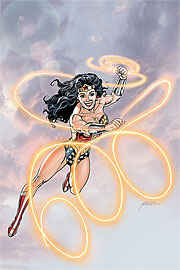
It may come as a disappointment to some that the Justice League in Justice Riders does not feature Superman or Batman. There is a simple reason for this: in the 90’s they were most often not part of the Justice League. The exception being Grant Morrison’s spectacular run on the title that started the same year that this comic was released. No, the League used for Riders is most of the rest of DC’s big 7¾besides Superman and Batman, the big 7 includes Wonder Woman, The Flash, Green Lantern, Aquaman and the Martian Manhunter¾plus some favorites from the very popular, and also spectacular, Justice League International. The star of this book is Wonder Woman, re-imagined here as Sheriff Diana Prince.

After leaving her town, Paradise, to catch some horse thieves, she returns to find it destroyed. With the dying words of her faithful deputy, Oberon Sheriff Prince vows revenge on the people who destroyed her town. So she goes recruiting. The first gunslinger to joiner is Kid Flash, the fastest gun in the west.
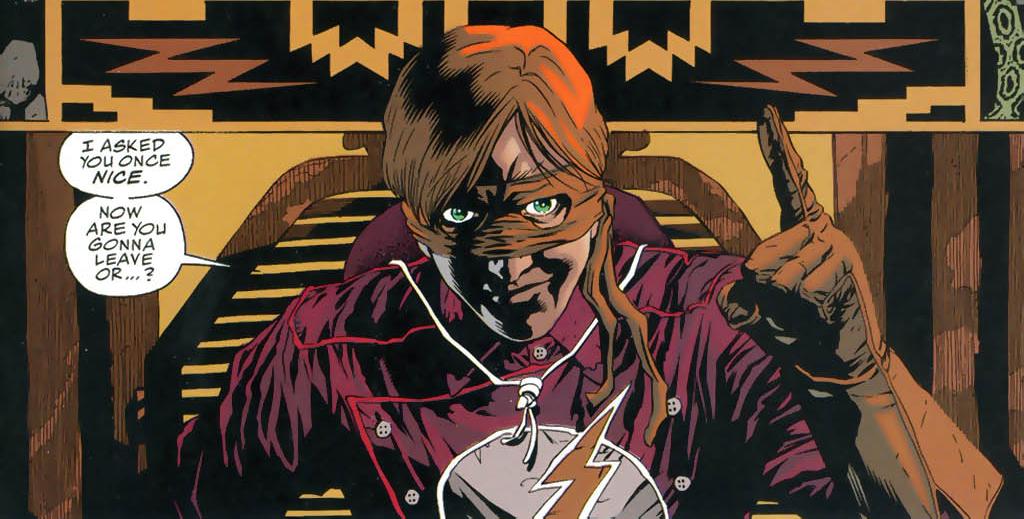
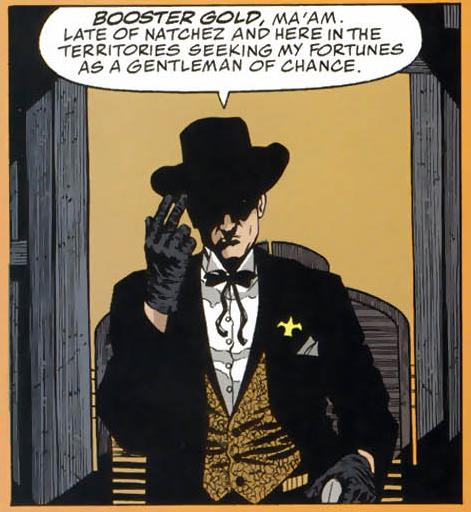
Young Wally West, who still has his super speed, quickly agrees to join Diana, though he does question her recruiting a man with his reputation. She also turns down Booster Gold, a gambler who looks exactly like Bret Maverick, preferring to decide for herself who joins her posse.
Her next target is Katar Johnson, a Native American who joins no questions asked. All he needs is his gear, which includes hawk wings, a loincloth and a shotgun. Honestly, Native American Hawkman may be the best Hawkman.

Meanwhile, still wanting to help, Booster enlists the eccentric Beetle to give him an edge over the speedy Flash. The possibly insane Beetle has just what he’s looking for.

We also get our first look at the villains, of this tale, the murderous railroad kingpin Maxwell Lord, the otherworldly Faust and their army of killer robots.

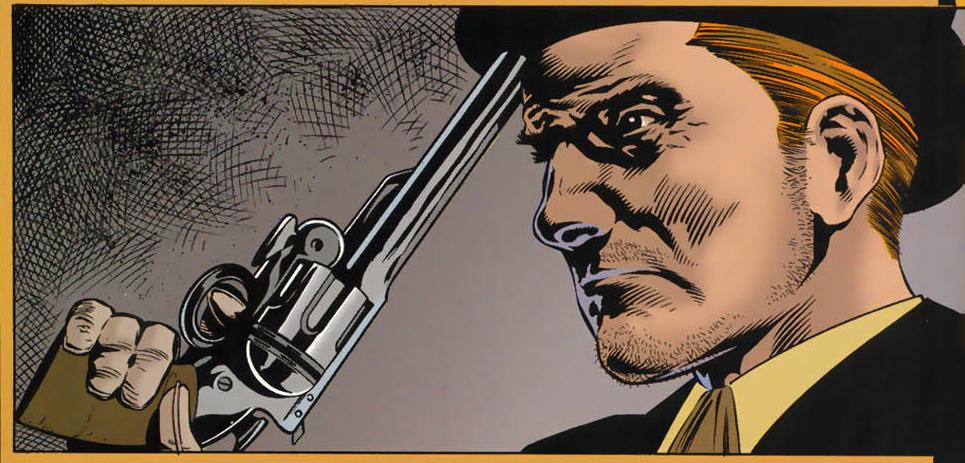
So perhaps I oversold how true of a western this is. That doesn’t matter. What does matter is that Justice Riders is a comic where the Cowboy Justice League fights an army of killer robots. All beautifully drawn by the great J.H. Williams III. It is terrific. I simply can’t emphasize enough how great the art is, as the included pictures should attest.

There aren’t many true surprises in this book, and there doesn’t need to be. Aside from the plethora of supernatural and science fiction elements, Justice Riders is a straightforward revenge western. Sheriff Prince and her group, who eventually number 7, chase Max Lord across the Southwest before the final showdown in Helldorado. There are several sumptuously drawn gunfights, and some inspired appropriations of Superhero concepts into the western framework.

There is one more wrench thrown in, one that is what puts it over the top. Kid Flash is wanted for murder in Texas and there in only one man who can track him down. The incomparable Kid Baltimore, the bowler wearing Pinkerton Detective Guy Gardner. As is always true, Guy Gardner is awesome. And his appearance in this book is just a glorious cherry on this delicious, western sundae.
It shouldn’t be hard to track a copy of Justice Riders down; I highly recommend you do so. You can get it for about $10 on Amazon. I found it for less than 5 at a local comic shop. It is bound like a paperback, so it will sit perfectly on a bookshelf. Really, go get it.

The Brave and the Bold

So DC Comics has been making some pretty big news last week, huh?

Personally, I really like the idea. While it may turn out to be just a bigger version of the usual post-event shake up, I think this is a genuine attempt by DC to sell comics to more people than the usual comic book readers. There is overwhelming evidence that the general public not only likes superheroes; they love them. From blockbuster movies to video games to toys to clothes, comic book properties sell just about everything but comic books. DC, a perpetual number 2 in market, appears to have finally decided to bite the bullet and change the way they do things. So whether fans like it or not, DC is re-launching their comic line and pushing hard into the digital sales market. DC might save the dying comic industry with this endeavor, it is just as likely they flame out spectacularly. It is a brave and bold risk.

Fan reaction has been hilarious. It is the sort of petulant, entitled complaints one would expect from “comic book geeks.” (Which are not any worse than other sorts of geeks. For instance, check all the LeBron talk during the recent NBA finals. We are all geeks, the only difference is the subjects of our geekdom.) Not that there haven’t been thoughtful, insightful responses, but many fans are just angry about what DC is doing to their characters. Reading lots of reactions this week tells me that the fan base is septic, reacting to every proposed change with pessimism and bile. Kudos to DC for trying to break free from the anchor currently sinking comics.

Not that I’m convinced it will necessarily be successful. Is the audience actually there of for digital comics? Will DC ruin any chances of success by trying to have their cake and eat it too? This things make this a big risk.

DC’s pricing strategy is the only one that makes sense. People say they will only buy digital if it‘s $.99 , but most of those would probably not buy any no matter the price. But keeping them the same as print to start, 2.99, and dropping to 1.99 after a month is a good compromise. 1.99 is not too much, that is about the same as a bottle of soda.

DC has also claimed that they are actually going to try to market Comics to a wider audience. The Green Lantern App is a good start, but if they are really serious they should put an add in the trailers for the coming Green Lantern movie. With comics being available in more bookstores, like Barnes and Nobel and Hastings, it should be easier than it has in a long time to get comics. I have nothing against comic shops, but if they are the only way to get comics then the comics market will continue to shrink.

When every thing is said and done, though, what really matters is how good the books DC puts out. Below are my thoughts on each and every one of the 52 number ones as well as a quick rating of my interest in each title (Excited, Intrigued, Dubious, or Pass): Continue reading

Thoughts on Green Lantern: Rebirth

A week or three ago I posted this picture as a part of my lazy Month of Gardner. It is from a pair of pages in Green Lantern Rebirth #6, written by Geoff Johns and drawn by Ethan Van Sciver, which shows the differences in how each of these Green Lanterns use their rings. Although I think these distinctions largely started there and have been used at best sporadically since then, I do really like the idea of each Lantern having a different style.

The rest of Rebirth can be problematic. For the record, I am pro-Rebirth. I like what it did and I mostly like how it did it, but there is no getting around the fact that it is a six issue long retcon or that Johns writes Hal Jordan as though he were Batman. I understand how that could grate on those who did not want to see Hal redeemed. However, I thought Emerald Twilight, the story where Hal goes bad, was somewhat terrible and I would rather have a functioning Green Lantern Corps than Kyle Raynor as Luke Skywalker. Geoff Johns also did a good job of not diminishing Kyle in bringing back Hal. Yes, Hal, not Kyle is the Green Lantern, but even in Rebirth Kyle, John, Kilowog, and Guy get their chances to shine.

However, the reader feels about the “fix” that is Green Lantern: Rebirth, these two pages are really good.

Johns is the master at shaping years of often contradictory or confusing stories, revitalizing tired characters and giving them relatable hooks for future stories. In just a few pages, he manages to get to the heart of all five of the main Green Lanterns.

First John Stewart. His constructs are actually constructed. He builds them, uses his knowledge as an architect to use his green powers more effectively. He is thoughtful and careful in how he uses his ring. Next is Guy Gardner. Rather than John’s careful approach, Guy is reckless. He is all heart and no control. Then there is Kilowog. The only non-human in this group, his ring sends out constructs that are bigger than the others are. That his ring booms shows its raw power. Kyle Raynor is an artist, and he uses flourishes and constant refinement. He is never satisfied and he never gives up. Last is Hal Jordan, who uses precision and focused power.

It really shows what every one of them is about. John and Kyle are thoughtful and somewhat introspective. Their actions are carefully considered and they are rarely rash. Guy is the opposite. He is just held back from action at all time, with almost no thought past his initial instincts. Hal is somewhere in between. He tends toward reckless and instinctive, but is more careful than Guy and choosing his targets. Kilowog’s explanation is probably the least illuminating. His booming ring shows that he cannot be ignored, but it really tells the reader little about who Kilowog is. Still, Johns goes at least 4/5 on explaining who these Green Lanterns are.

I just really like how someone who has little knowledge of these characters before reading this, like me not that long ago, would have a decent grasp of all of them from just these few pages.

A Question of Character: Hank Pym

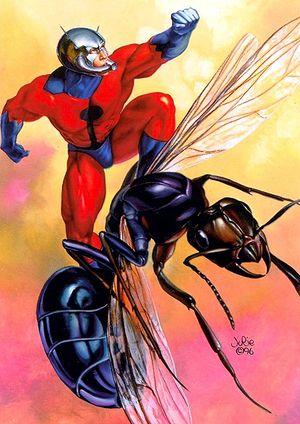
I’m going to kick off my grand (ehh?) new monthly–hopefully–blog series, A Question of Character, with a study of a Marvel hero that it appears that only I like: Dr. Hank Pym, also known as Ant-Man, Giant-Man, Goliath, Yellow jacket and The Wasp. With A Question of Character, I intend to post an examination and explanation of some comic book character or another every month. I’m willing to take requests, but I’m going to start with my favorites as well as somewhat lesser known characters. Like Pym, an original Avenger who has almost no pop culture penetration.

Continue reading

A Month of Gardner 1

The old nursery rhyme, or whatever the hell it is, goes “April showers bring Mayflowers.”  Well, with all those damn flowers popping up everywhere what is needed now is a gardener.  That is why–or it’s a tenuous rationalization for me doing whatever the hell I want to do, but hey, it’s my blog I don’t really need a reason–everyday in the month of May I am going to post a comic panel of the incomparable Guy Gardner, Green Lantern.

So 31 days of panels featuring the one, true Green Lantern that need no explanation.  Or maybe are just not getting one.  I may add a supposedly funny caption, but we’ll see.  Here’s todays:

from JLA Classified #4, pg 22

Why Superman is the best.

It’s been a while since I’ve done so, but I’m getting a hankering to write about superheroes.  At first I was going to write a defense of that most unlovable of heroes, Marvel’s Ant-Man, but if I’m going to write about superheroes, I should write about the best superhero.  Since I can do that and write about the best comic at the same time, I decided to write about Grant Morrison and Frank Quitely’s All-Star Superman.  Specifically All-Star Superman #5, my personal favorite comic book ever.

As everyone should know, the only superheroes that actually matter are Superman, Batman and Spider-Man.  Sure, lots of the others are great–I like Guy Gardner and Thor– but the three I mentioned are the ones that set the standards for the rest.  Spider-Man is the perfect teenage superhero, with a simple reading being the spider powers stand in for puberty.  Batman is the man who makes himself a myth, with one of the greatest fictional locales to run around.  But Superman is the original and best superhero.  He represents the best that humanity–and in some ways America– can hope to be, an ideal to strive to.  No story better illustrates this than All-Star Superman.

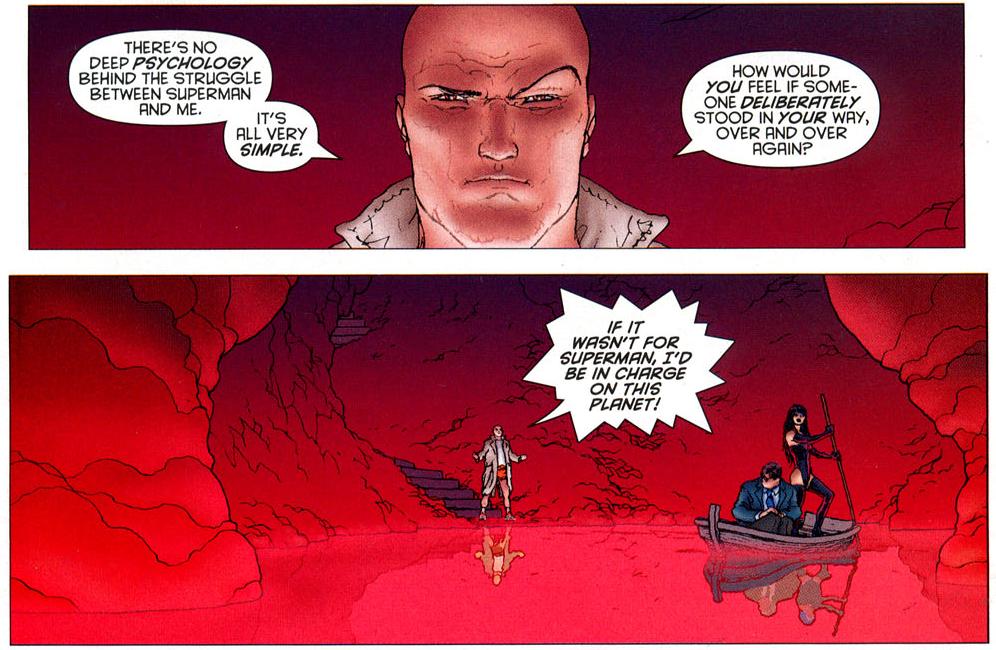
All-Star Superman #5 is a story titled “The Gospel According to Lex Luthor.”  On the surface, it is a simple comic; Lex Luthor, condemned to death, allows Clark Kent to interview him in prison, to give the world his side of the story of his war on Superman.  The irony immediately obvious to every reader is that Clark Kent is Superman, which despite being the smartest man on Earth Luthor has not figured out.  However, there is much more going on here than that.  While this comic is about Luthor’s side of the story, is as perfectly contrasts the values and principles of Superman and his greatest enemy.

First, a brief explanation of Lex Luthor.  Whether in his original identity of a standard mad scientist or his revised (Post Crisis on Infinite Earths) power-mad CEO, Luthor has generally been Superman’s foremost adversary.  He has appeared in every modern Superman movie.  Luthor is, simply, Superman’s opposite in most ways.  Luthor is smart, rich and powerful as well as completely self-centered.  While his is undeniably intelligent, Luthor’s real defining trait is his narcissism.   If not for Superman, Luthor would be the most powerful person on Earth.  Superman’s superiority, instead of being an example to follow, makes Luthor insanely jealous.  While he is smart enough to gain any accolade he desires, he cannot accept Superman’s supreme physical advantage over him.   Luthor is easily one of, if not the, best comic book villains.

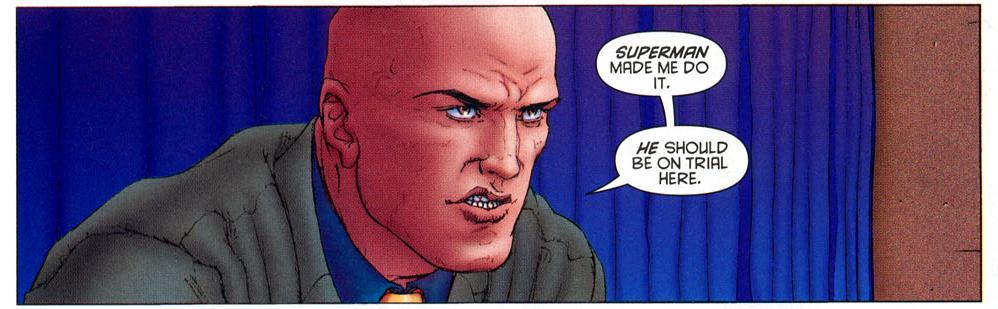
The Gospel According to Lex Luthor starts with Lex being sentenced to death for his recent (Issue 1) attack on the first manned mission to the Sun.  His defense?

He is so blinded by his personal war with Superman that he believes he needs no defense for his actions.  Before his execution, he allows one reporter to interview him: Clark Kent.

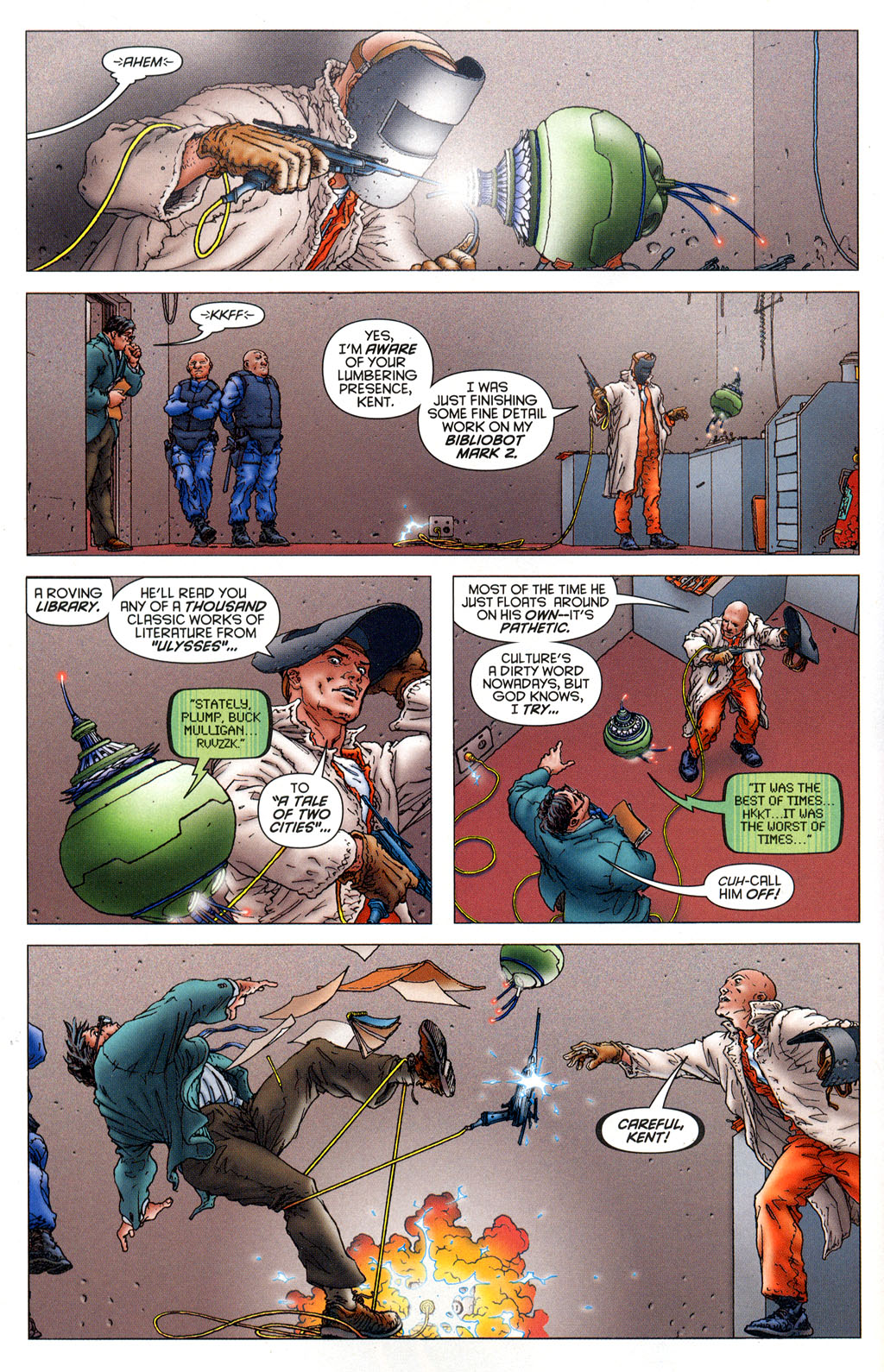
The Clark Kent of All-Star Superman is not the competent figure that he has been since John Byrne’s reboot in the 80’s. Morrison’s Kent takes the mild mannered reporter shtick much further than just mild-mannered he is a complete pantywaist.  While I prefer the version of Superman where Clark Kent is who he is and Superman is the disguise, in order to really believe no one suspects he is Superman the other way actually works a little better.  I can see why no one suspects, or even believes when confronted with it point blank, that Clark Kent is Superman.  But one of the most amazing things about All-Star Superman is how Kent’s clumsiness is just another tool in his crime-fighting arsenal.  Case and point page 4:

This also illustrates one of the fundamental differences between Superman and Lex Luthor:  Luthor spends all of his time trying to destroy his enemy; Superman goes out of his way to save him.

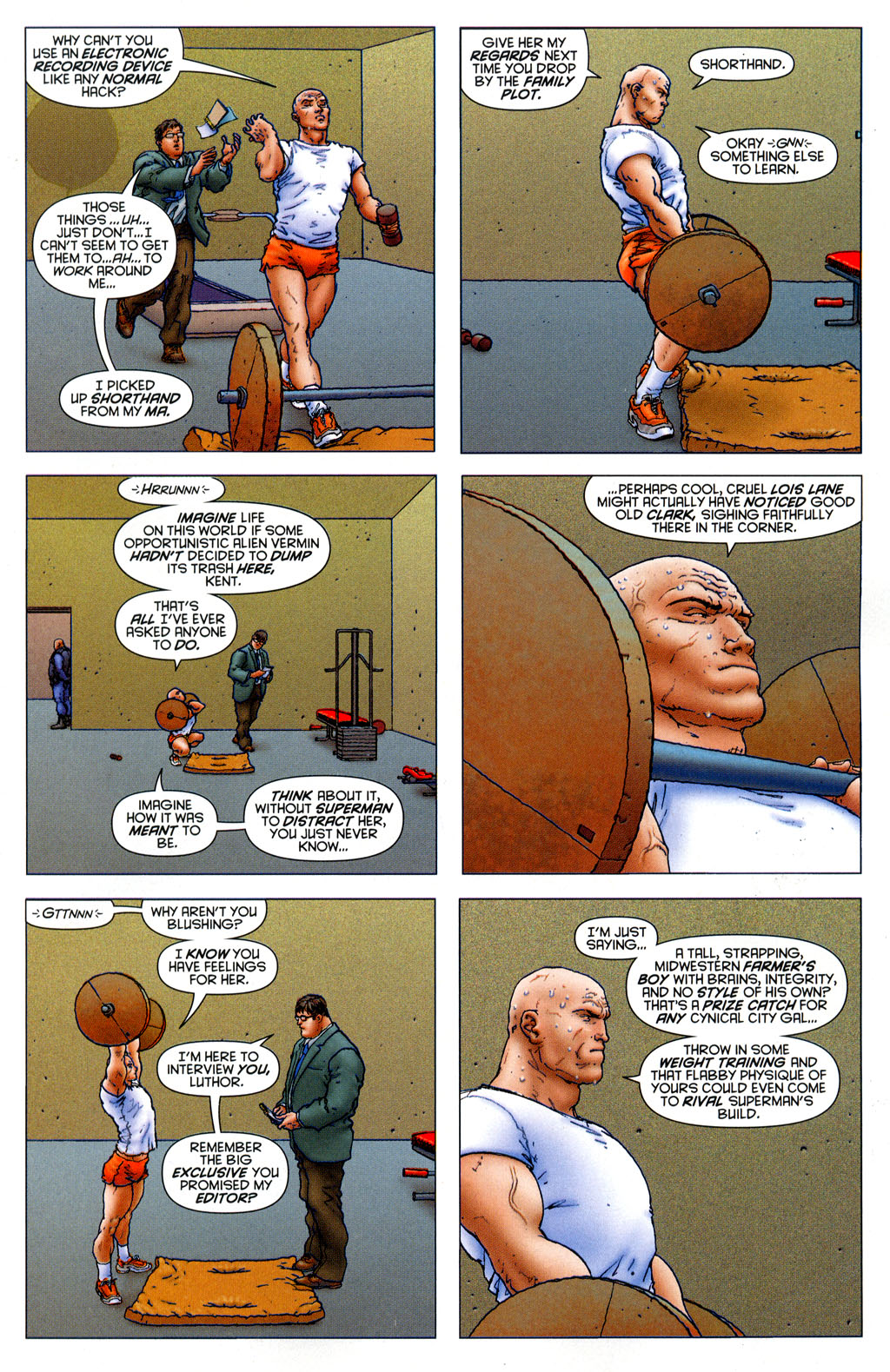
The next few pages really show how Luthor thinks, both about himself and about Superman.  He calls his guards “fat girls” and asks Clark if he feels “diminished by [Superman’s] very presence.”  While in the midst of a strenuous work our routine, Luthor focuses on questioning Clark’s masculinity.  He displays his own insecurities about Superman’s physical prowess, with the focus on Clark’s masculinity and his own hard exercise regimen.  There is some validity to Luthor’s anger here; there is no way that any person could match Superman’s strength.  But he is so focused on it that he can’t even begin to fathom that Superman could be posing as a man that appears as feeble as Clark Kent does.

We then move on to the communal area of the prison, where Lex outlines his utopian vision of society, which he calls “survival of the smartest”, while being completely oblivious to the angry stares he is getting from every other inmate. He has no fear; even of the occasionally super powered Parasite (he sucks the power out of other people, including Superman).  “Brain beats Brawn every time,” Luthor says, which he believes makes his victory inevitable, though it proves to be the opposite.

Parasite starts to absorb Superman’s powers and breaks free from his restraints, which starts a riot.  While pretending to blunder into the fray, Clark manages not only to save Lex’s life again; he also saves all the guards caught up in the riot.  All while not breaking his cover as Clark Kent.  While Lex and Clark make their escape to Luthor’s cell, they are pursued by the increasingly immense Parasite.  Superman causes a convenient earthquake, and Lex:

Note how quickly Luthor abandons brains for brawn.  He doesn’t even question the earthquake, he doesn’t try to think of an escape from the Parasite, he hopes for a miracle.  Then as soon as his enemy is down, he starts kicking him. Once they get to Lex’s cell, he simple continues on his tirade against Superman.  His petty grudge has completely consumed him.  He gloats about how he’s turned the newspaper and the prison against Superman, and then shows Clark his escape route.  Lex has no intention of escaping; he merely wants to show how little power the law has over him.  Here Clark almost loses it.  He does not understand how Luthor can focus only on his personal war with Superman, when together they could do so much to help the world.  But Luthor is determined to throw his life away in his maniacal quest to destroy Superman.

He also drops his final bomb:  Superman is dying.  The readers already know this, but they did not know that it was an intended part of Luthor’s plan.

While this comic defines Lex Luthor, it also defines Superman.  While incredibly intelligent, Luthor thinks only of his own quest for power.  Superman on the other hand, despite having no reason to feel anything but hate for a man who has spent his life trying to kill him, does everything he can to save Luthor from himself.  Superman’s faith in humanity is such that he thinks even the worst of us are worth saving.

Scott’s Almost on Sunday Comic Book Review

Superman 701: written but JM Straczynski and drawn by Eddy Barrows.


Part of me wants to make a spirited defense of this issue against the ridiculous reaction its gotten from around the internet, like I should have done for JMS’s Brave and the Bold 33, but I just can’t bring myself to when it’ll only amount to “it’s not that bad.”  But it’s not that bad.  Superman walks through Philadelphia, helping people along the way.  Most people have chosen to interpret his help as examples of “superdickery” but they really are not.  Superman tells a man his heartburn might be something more, but he doesn’t immediately fly him to a hospital.  So that makes Superman a dick?  He cleans a diner’s storeroom to pay for his lunch; fly’s an obnoxious reporter into the air to prove he still has his powers and cleans some drug dealers out of a neighborhood by lighting their drugs on fire with his heat vision.  All small things and fairly well done.  He also talks a jumper down off a ledge.  Grant Morrison did this better in All-Star Superman, but as that is the best Superman story ever it is forgivable.  The fact that he would have let her jump if that were what she really wanted is good.  He is there to save her if she wants to be saved and his power his convincing her she does.  It ends with Superman jabbering at some dog walker about being a hero.  That part, and much of his talking the woman down are done poorly, but overall Superman 701 is good, if a little disappointing.

Batman 701:  written by Grant Morrison and drawn by Tony Daniel.


Morrison continues his brief return to Batman proper by telling a story that doesn’t need to be told.  This and the following issue tell the story of what happened to Batman between the RIP storyline and Final Crisis.  Judging solely on this issue the answer to what happened is “not much.”  Batman escaped the chopper crash and went home to get a call from Superman about the inciting incident of Final Crisis.  I do not mean to say that this is a bad issue, just a pointless one.  If the next one tells a meaningful story ,this one will be fine as the set-up, but as of now I have a hard time forming any feelings about it at all.

Avengers Academy 2:  written by Christos Gage and drawn by Mike McKone.


The training of some would be heroes/villains by some third rate heroes continues.  This issue focuses on Finesse, who is basically a young Taskmaster.  I am not sure what to make of this comic.  Hank Pym, the former Ant-man, Giant-man, Goliath, Yellowjacket, and current Wasp, training youngsters who could possibly become villains is a good idea.  Despite his long career as an Avenger, Pym hit’s many marks on the villain checklist. (mad scientist, jealous of the heroes, possibly truly insane)  And the only story anyone remembers about him is that one time he smacked his wife.

(Mini-Rant:  Why can people not forget this story?  It wasn’t that good a story and in it, Pym can barely be called an abusive husband, as he is clearly not in his right mind when he smacks Janet.  His back-story includes multiple mental breakdowns and he is obviously in the midst of one there and not in his right mind.  Not that that wholly excuses his behavior, but crazy makes one not guilty in court.  Spidey wasn’t crazy when he smacked Mary Jane and I am sure I could find other examples of other Superhero husbands being dicks to their wives, but Pym’s only story is wife-beater.)

Still, this issue is okay.  I’m not sure what Finesse wants to learn from Quicksilver, but her struggles to fit in could be interesting.  I can’t say I’m in past the next issue, though.

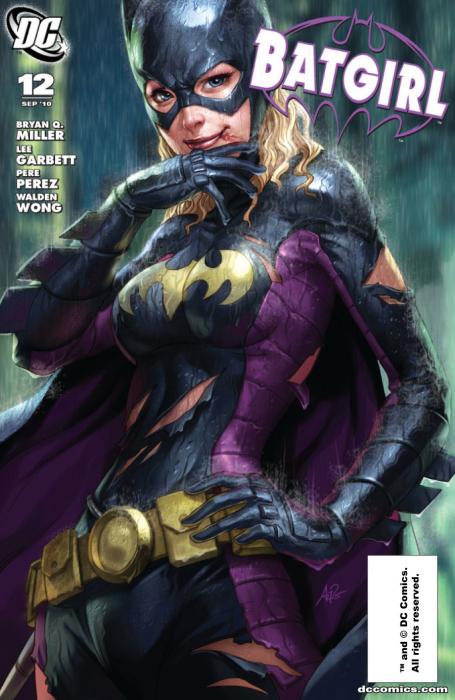
Batgirl 12: written by Brian Miller and drawn by Lee Garbett and Pere Perez.


So ends the first year of Stephanie Brown as Batgirl and it’s been one pretty good year.  This title got off to a fairly rough start, but it has really hit its stride lately.  This was another great issue.  Batgirl and Wendy, the Calculator’s daughter and friend of Oracle, save Oracle and Gotham City from the Calculator and his techno-virus.  A satisfying conclusion to this storyline.  And Wendy gets set up where it was obvious she would be since this comic started; as Oracle’s official protégé Proxy.  I really like how Stephanie’s confidence and competence has grown so far and I’m really looking forward to more of this series.

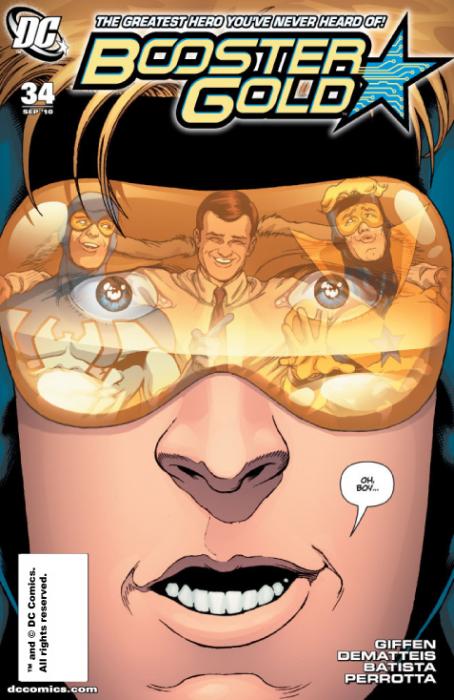
Booster Gold 34: written by Keith Giffen and JM DeMatteis and drawn by Chris Batista.


The writers continue to go back to their glory days with the Justice League International, with great results.  Booster’s sister returns to hear Booster and Rip Hunter talking about getting rid of the little girl Booster saved a couple of issue’s ago and immediately bonds with the girl.  Booster, meanwhile, goes looking for proof of Max Lords existence in the JLI again.  This time he gets roped into a mission with Blue Beetle, Mr. Miracle and Big Barda.  The fact that all three are currently dead is mildly morbid and the writers seem to desperately want Blue Beetle back alive to write a Blue and Gold comic, but it’ll never happen.  By a slim margin over Batgirl, this was the book of the week.  Mostly because it is hilarious and Barda punches out a dragon.  That is hard, nay impossible, to top.

Significantly Delayed by the 4th Sunday Comic Book Review

The week of the 4th of July has really messed up my ability to get together posts for my fledgling blog, but this week I plan to review at least one more season 1 episode if Futurama and the new episode, with a mention of last week’s new ep.  Also at least one more installment of 25 Years of NES and one movie review.  There are many other things near completion that I hope to get out, but we’ll see.  On the the comics.  It was a big week for me buying comics and all in all a good one.
Flash 3:

Written by Geoff Johns and drawn by Francis Manapul and Scott Kolins.
The new Barry Allen Flash series continues to be one of the best books coming out.  This issue continues the Flash’s struggles with the Renegades, doppelgangers of Flash’s Rogues from the future, and with the resurrected, original Captain Boomerang as he escapes from prison.  The art is distinct.   I do not possess the vocabulary or knowledge to accurately describe it, but I do know that it is unlike most other comics.  Johns is also doing a good job of setting up Barry and Iris Allen.  I would agree with the complainers that so far there is no reason the series could not have starred Wally West, but it doesn’t.  There have been 20 years of Wally stories, if the man who writes the best of them wants to write some great Barry stories more power to him.  And these have been 3 really good issues.  Barry is a hero through and through.  Instead of focusing on all of the implications that paint him as a murderer, he is helping someone else who has possibly been wrongly imprisoned.  Iris is helpful and equally busy.  Yes, so far, Barry has acted like Superman, but since DC has Superman doing other stuff, maybe Barry can become the moral center of their universe.
Green Lantern 55:

Written by Geoff Johns and drawn by Doug Mahnke.
It’s big, loud, dumb and almost perfect.  Hal, Carol, Sinestro and Atrocitus fight with Lobo.  The leaders of four of the seven color corps throw power ring constructs all over the place in an over the top fight with one of superhero comic’s most over the top characters.  Lobo is a character, much like Marvel’s Deadpool, that is great in small doses but is easily over used.  His one issue appearance here is definitely a good thing.   Mahnke’s art is as over the top as the story.  This issue is just pure fun.  And the ending with the origin of Dex-Starr is both silly and somewhat touching.  While I was not a huge fan of Blackest Night, the Green Lantern book has come out of it still being great.
Justice Society of America 40:
written by Bill Willingham and drawn Jesus Merino.
This is the rather lackluster end to what has been a pretty good alternate reality story.  Obsidian returns and the JSA beats the bad guys.  I really do not know what to make of this issue.  It seems like it is either the last couple of pages of epilogue from the previous story extended to a full issue or 3 issues condensed down to one because after this James Robinson is taking over for three issues for a JLA/JSA crossover and Willingham could not set up the next story or fully finish this one.  So what is here is a few fun moments and lost of Obsidian monologue telling the reader what happened.  Everyone knows how this was going to end, so the least I expected was to be shown it in an interesting way, not having is flatly recited to me.  Not a good issue.  I’m growing increasing shaky on what is my favorite superhero team, especially since most of the interesting characters, Power Girl, Star Girl, Liberty Bell, Hourman, are going or gone.
Justice League of America 46:
written by James Robinson and drawn by Mark Bagley.
Robinson’s JLA/JSA team-up ramps up.  The story itself is actually pretty good.  The Starheart, a chuck of which is the source of Green Lantern‘s (Alan Scott) powers and through him powers his children Jade and Obsidian, is on Earth and driving many super powered individuals crazy.  It is an interesting start to the team up and a good way to involve both teams.  But his dialogue is terrible.  Jesse Quick, up until recently known as Liberty Bell, only thinks of her dad.  All the time.  Donna Troy rambles idiotically in what I believe is supposed to be funny dialogue.  Mr. Terrific talks down to Power Girl and she takes it.  Any of the instances could be forgotten, but they pile up enough to leave a bad taste in the reader’s mouth.  I’m sticking with this title through the team up out of love for the JSA, my interest in the line-up Robinson has for the JLA and my previous enjoyment of Robinson’s writing in Starman and JSA.  After that, I may drop both Justice team titles.
Thor 611:
written by Kieron Gillen and drawn by Rich Elson.
This is my attempt to get back in to Marvel after a series of terrible events, culminating in the horrendous Dark Reign, thoroughly destroyed most of my interest in the line.  But the “Heroic Age” sounds good, so I’ll look.  And seeing how Thor is the best Marvel hero, I started here.  Not bad.  The Asgardians mourn Loki; they question the leadership of Balder and the Desir plot to destroy the dead Asgardians.  I do know of the bulk of the events from Siege even though I did not read it and I read most of JMS run on the title, so I’m not completely lost.  This issue is not great, but it is pretty good.  If the next issue pays off the set up in this one I’ll be happy, but this is not getting me too excited.
Wonder Woman 600:
So to cap off the month we get Wonder Woman’s big anniversary issue to go along with Superman’s and Batman’s.  It is also the start of Straszynski’s run on the title.  The first story is written by outgoing writer Gail Simone and drawn by the person responsible for Wonder Woman when she was the best George Perez.  It starts with a team up of numerous super heroines to defeat the “Cyber-Sirens.”  It shows how all of them look up to her and how Wonder Woman is the greatest.  Then she skips out on the President to attend Vanessa Kapatellis’ graduation.  I really liked this story.  Perez is one of the best artists in the business and Gail Simone has few misses on her record.  I can’t help but see the end of this as a bit of delayed backlash against the writers who came after Perez (Messner-Loebs and Byrne used other characters, Jimenez destroyed them) that ignored the great supporting cast he set up.  To see Vanessa recovered from the indignities put upon her in bad stories that made both her and Wonder Woman look bad feels great to those who read and loved Perez’s WW.  The next story is written and drawn by Amanda Conner and is the best thing in any book this month.  Power Girl, (I love me some Power Girl, especially drawn by Amanda Conner) Wonder Woman, and Batgirl beat-up Egg-fu (basically super villain Humpty Dumpty) then PG and WW go to PG’s place so WW can tell her what’s bothering her cat.  It’s cute, funny and gives me hope for more WW PG team ups.  Next is Louise Simonson and Eduardo Pansica’s story where Superman and Wonder Woman team up to take down a terrorist who stole Zeus’s lightning.  It’s adequate.  I had to reread it even after taking some review notes to really remember it.  It is followed by Geoff Johns and Scott Kolins’s pointless lead-in to JMS’s story.  This was the most disappointing story because I really wanted to see Johns write Diana.  No writer is better at distilling why a character is cool into one sentence that can be used for years worth of stories.  Sure, his takes are often simplistic, but they lay great groundwork for other he and other writers to build on.  When he’s used Wonder Woman, it was generally in stories that were not about her and she did not feel right.  There was not enough to this story to even get that feeling.  Though the panel of young Diana staring out to sea wanting to see what else was out there was great.  Also in the issue were some great pin-ups by Adam Hughes, Francis Manapul and Phil Jimenez and one truly horrible one by Jock.
Then there is JMS’s highly anticipated debut.  I don’t like it.  The story could have potential.  It is going to end with the majority of her history restored to normal, maybe all of it, but the how could be intriguing.  The marketing is turning me off, as is the new costume.  WW old costume was just as messed up as Superman’s and Batman’s.  They are Superheroes; they are inherently ridiculous.  That is the fun of the stories.  And WW wears a patriotic one-piece bathing suit.  She looked like some sort of magical hooker.  DC decided to change this by making her look like an actual hooker.  They did not take out the suggestive part, they took out the magic that makes it okay.  And it’s not like this an original story.  Writers since Perez, except Simone, have destroyed Themyscira and the Amazons, only to return them with their version.  I see no reason to believe that this will be different of better.

Scott’s Sunday Comic Review

So sometimes I buy comics (mostly on Thursdays) and because no one is dying to know what i think, I will jot down my thoughts as weekly reviews.  This first week actually contains more comics than I usually buy, but it was a heavy week for me.

Green Lantern Corps 48: This is Tony Bedard’s 2nd issue after taking over for Peter Tomasi and it is okay.  Not as good as Tomasi was, but Tomasi’s GLC was one of the better books over the last few years.  This issue deals with the complete failing of another of the Guardians great plans: the Alpha Lanterns.  Everybody knew that the Alpha Lanterns were going to go bad as soon as they appeared, so their corruption/defection is no surprise.  Still, the execution is pretty good.  Ardian Syaf’s art is not great, but it tolerable.  There are no real twists here, except Cyborg Superman being the one who takes over the Alphas, but this is revealed on the first page.  The only question is when this is resolved are any of the Alpha Lanterns going to be saved?

Justice League: Generation Lost 4:  With issue 4 of this 26 issue story we finally get to the starting point.  Max Lord is losing control of his powers and he has engineered the return of the JLI.  The players are assembled, now lets see what they do.  Like the previous issues, I liked this one.  The fact that it is a set number of issues means that even if the first few issues are slow they are going somewhere.  I was leery of this due to Judd Winick writing because his stuff tends to range from mediocre to terrible, but here he has done a pretty good job.

Superman 700:  This anniversary issue is light on classic feeling moments.  The first story, by James Robinson, is a nice coda to his run on the book.  Nothing great, but enjoyable enough.  The next story is by Dan Jurgens.  A nice story, but has as much Batman and Robin as Superman.  The last is the start of J. Michael Staczynski’s “Grounded” storyline.  The idea of Superman traveling around the United States to get back in touch with the country after spending the last year away is not a bad idea, but how he decides to do this is done in a stupid and off-putting way.  A woman accosts him and asks why he could not help save her husband from his brain tumor because he was too busy saving the world.  So Superman should feel bad because he he can’t save everyone?  That’s hubris.  If that is the point of the story, that Superman needs to feel less responsible for every bad thing that happens it could be good.  And the idea of Superman traveling the country is decent.  But not a good start.  Still a decent anniversary.

Zatanna 2:  This second issue written by Paul Dini and drawn by Stephane Roux is pretty good.  Zatanna fights a dream corrupting imp and the big villain plots.  I really have nothing to say other than this is pretty good.

Power Girl 13:  I was especially leery of Winick’s usually awful writing here, on my previously favorite book.  And the new artist is not Amanda Conner.  Sami Basri’s art is actually very good.   Not Conner good, but nothing is. It is different enough that it feels less disappointing a change than someone who tries to do something similar or generic superhero art.  Winick tries to maintain the humor, but does differently than Gray and Palmiotti.  I did like that is ties PG into Generation Lost and shows why she was such a dick to Booster Gold in the first issue.  I am still scared that he is going to destroy all that the previous writers built, but through one issue it is really good.

Batman: The Return of Bruce Wayne 3:  Pirate Batman!  Well not really, but close enough.  This whole mini-series is slightly less good than it should be, but that does not mean it’s not great.  In this issue Batman sword fights Blackbeard on a bridge made out of bones.   No matter what slight failings it may have, that alone is enough to redeem it.  Not that it really needs redemption.  Yanick Paquette’s art is really good and the plot is coming together nicely.  I am still really excited for more of this, especially because the next issue is cowboy Batman.

Reading Some Comics: JSA 52-53

If you read my Top 5 DC Comics heroes piece, then you know that I love Wildcat and Power Girl.  So it should come as no surprise that a story that has those two great heroes turn up would be one of my favorites.  The story in question takes place in JSA issues 52-53, written by Geoff Johns and drawn by Don Kramer, and is nearly as good as it should be.  So when these two illustrious Superheroes team up you get action, mystery and romance.