2nd Quest Part 3: Link’s Awakening

In the circles I frequent, both online and in real life, The Legend of Zelda: Link’s Awakening is considered by many to be one of the premiere games in the series, mentioned up there along with A Link to the Past and Ocarina of Time. For the longest time I could not understand the love Link’s Awakening received. It was just a smaller, talkier LttP. Plus, it was on the dark often blurry original Gameboy screen. I was never able to push through and really get started in large part because it was just so hard to see. For my 2nd Quest, I played the Gameboy Color’s DX version on my 3DS. Playing it when I could actually see what I was doing made a ton of difference. Now that I’ve beaten it, I still don’t understand the hyperbolic love this game gets. Link’s Awakening is phenomenal for a Gameboy game, but it is greatly hampered by the limitations of that system.

Link’s Awakening does an admirable job cramming what is essentially A Link to the Past on to a Gameboy cart. However, there are some drawbacks. Some come from elements abandoned from the original Legend of Zelda that Link’s Awakening decided not just to bring back but to expand upon, like the side scrolling rooms where new items were hidden. Those are more numerous and larger in LA and they are not particularly good. Most of those segments could have easily been removed. Then there is the limiting, at least after having played later Zelda games, A Button and B Button weapon set up. Sure, Link’s Awakening makes the sword optional, but I still spent way too much time in the menu changing items. This is partly due to the games laudable attempt at more complex puzzles by mixing a variety of items into their solutions. Puzzles have more steps to their completion, but in between each of those steps is pausing the game, going to the menu and changing equipment around. It seriously breaks the flow of the game.

Some of this could have been alleviated by not having the power bracelet be an equipable item. It is the same with the shield. The shield could have just been automatically equipped, like the original LoZ. Really, Link’s toolset is pretty lackluster here. There are the usual tools: bow, hookshot, and bombs, with only a few new or interesting ones. Link’s Awakening is the first appearance of the ocarina, which would play a large part in several games to come. There is also the Roc’s Feather, which allows Link to jump. It is an interesting tool for the 2D games, but Ocarina’s auto jump made it superfluous to most future games. Because of the limited tools, Link’s Awakening feels like the most generic Zelda game.

At least the dungeons are largely good. The first couple are pretty basic, for obvious reasons, but after that they get to be really good. Except for Level 5, it relies on making the player fight the same mini-boss, an exceptionally easy mini-boss, four times. Which in and of itself wouldn’t be so bad, but he only appears in the four fighting rooms in a specific order, meaning that a player who takes the wrong route through the dungeon might have to run through it as many as four times. It is some tedious crap. That is just a small hiccup, ignoring that these are some really good dungeons.

People also talk about how charming LA setting is, the island of Koholint in place of the usual Hyrule. I’ll agree to that some, but not to any real extent. With one exception, the “charming” townsfolk are just mostly the same as the residents of the average video game town. Okay, that is too harsh, the game does give several of them a little more than that, but for the most part they are just townsfolk. Marin, Link sort of love interest, is well realized. She is a genuinely interesting character. There are other supposedly charming moments, including a wealth of references to Mario games. Those are pretty neat, but a quick picture of Peach or stomping some Goombas really doesn’t do a lot for me. Though I did like the appearance of Wart from Super Mario Bros 2, since it is at least thematically appropriate. There are more references to other games, like an enemy that looks suspiciously like Kirby, which does add to the whole dream world feel.

One of the biggest problems I had with the game was how often it would stop the player to give them some useless piece of advice. This is a complaint often leveled at newer entries in the series, especially since Twilight Princess onward, but I think it is worse here than in other games. It is worst with rocks and other lift able things. If the bracelet is not equipped, then every time it stops the player to tell them its too heavy. It is absurdly easy to bump up against something and have to go through that. I found it infuriating.

 
Some of my complaints are admittedly rather nitpicky, but there are enough to hamper my enjoyment of the game. Link’s Awakening is still a really good game. Especially when compared to other gameboy games. It is head and shoulders above most of them but compared to most of the Zelda series, it feels like something of a runt. This one belongs squarely in the liked, not loved category. It was certainly better than Zelda 2, though.
 

Memories of Chrono Cross

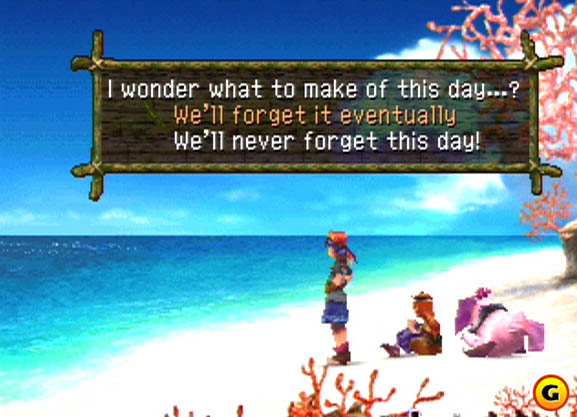
There are few more divisive games than Chrono Cross. While it garnered almost universally terrific review at release, the public at large seems to be split. The reason for this is quite simple: Chrono Cross is an absolute terrible sequel to Chrono Trigger. That is not to say that it is a bad game. Far from it. Chrono Cross gets almost everything right, it only falters when it tries to connect to Chrono Trigger. Nearly every time a part of Cross echoes Trigger is stumbles.

Honestly, I absolutely love Chrono Cross. Both because it is a great game and because of my memories of the time when I played it for the first time. I came to the PS1/N64 generation of consoles pretty late, not getting a 64 until Christmas ‘99 and then a Playstation near my birthday (October) the next year. Chrono Cross was one of the numerous RPGs is bought the next year, flush with money from mowing lawns and too old to ride my bike but still too young drive. Plus, that summer I has home alone. Part of my family went on an RV trip to the west, to see the Grand Canyon and Yellowstone, but anyone who has spent a week in an RV with 8 or so people know why I declined to join them. My two brothers closest in age spent a month or so with an uncle 500 miles away, but I didn’t go with them either. So at home, with my Dad who was working all day, after I finished whatever mowing I had to do that day I had the house, and TV, to myself. The games I played that summer! Final Fantasy IX, Final Fantasy Tactics, Legend of the Dragoon, Lunar 2 and Chrono Cross. Amazing games (save for LoD) and while I still would rate most of them among my favorites in the system, but Chrono Cross is the game I most associate with that summer, if only for the summery tropical aesthetic.

If there is one place where no one can argue that Chrono Cross doesn’t shine, it is the presentation. The music is one of humanity’s greatest achievements (warning, the last statement may contain a small amount of hyperbole.) The graphics, while primitive by today’s standards, hold up better than nearly any other 3D PS1 game. The character designs are great, and the colorful, tropical world is still all too unique. Chrono Cross undeniably looks and sounds incredibly good.

Chrono Cross did carry a few things over from Trigger in a good way. Like the lack of random battles, though it didn’t do as well as Trigger. In Trigger many encounters were built into the map, in Cross there are enemy sprites that when engaged zaps the players to usual battle screen. In another way, though, Cross takes the no random battles further by eliminating experience points. In stead of gaining levels by fighting battles, in Cross players get star levels by beating bosses. Other than for some supplementary stat increases after the five or so battles following a level, there is no reason to ever fight a non-boss battle. The forced level let developers hone the difficulty much more tightly. All players are going to have roughly the same stats, so they know exactly how tough the boss can be. Chrono Cross is one of the tougher RPGs I’ve played, a fact easy to forget after a decade of New Game +. The somewhat higher difficulty is tempered by Cross letting players run from any battle. Even boss battles. This means that there is no good reason to see the game over screen. If your element layout or strategy isn’t working, just run away and reset everything. The system all work together, designed to work in concert rather than just things thrown against the wall. It emphasizes strategy over simply making numbers bigger.

None of that would matter if the actual battle system didn’t work just as, which it fortunately does. Each character has 7 stamina per turn, which can be used to attack or to use an element. Weak, medium and strong attacks take 1, 2 and 3 stamina points respectively, but they each open up the characters grid the corresponding amount if they connect. Casting a spell, or an element as they are called in this game, takes a full 7 stamina, but it can be done as long as the character has at least one stamina point, allowing them to accumulate a deficit of up to 6. Effective strategizing means using using enough attacks to open up the grid, but not letting the whole team fall into a deficit, which allows the enemies a free turn. Despite being a rather novel set up, the battle system is surprisingly intuitive. It never feels overly complicated or different for the sake of being different, despite changing plenty of things from Chrono Trigger . There is no MP and it is completely turn based. Instead of learning abilities, with the exception of 3 unique techs for each character, there are only elements and the grid. Each character has a grid on which the player can but spell elements, each of which can be cast once per battle. Since the player can’t just spam their best attack over and over, they must rely on smart allocation of elements. The battle system is good enough to make you want to fight battles even though there is absolutely nothing gained from doing so.

The story, while not as good as the gameplay or graphics, has its moments. Early on it is terrific. It aims for poetic and actually hits it. There are constant references and allusions to dreams and memories and conflating the two, setting up the nostalgic “what is things were different” yearning that is the tone for the game. The dreamlike state, starting with the actually dream sequence at the beginning, never really goes away. The two realities work because one in not wholly better than the other. Serge is only alive in one world, but in his home world nearly all of the Viper Manor characters have been killed. It actually makes it hard to decide which one is the preferable “real” world. When the dragons show up things kind of go to crap, but there are still plenty of great moments. The dreamy-ness of the plot helps excuse some of its shortcomings, but not all of them. The first six or seven hours or so really work well, but after that it kind of sketchy.

One part routinely pointed out as a weakness is the numerous, thinly developed party. I will not argue that the majority of the party is well-developed, but I will argue that the large party is an asset rather than a fault. The characters that matter, Kid, Lynx and Harle, are all well rounded. Most of the rest have only small windows of importance, and some have absolutely none. However, many have their own stories going on outside of Serge’s. The whole world seems connected, with many of the characters having pre-existing relationships, but it also as though Serge’s search into the mystery surrounding him is not the only thing going on for many of the characters. There is the whole Viper Manor group, which numbers about a dozen character and while most of their story can be uncovered over the course of the game, plenty of the dots are not necessarily connected for the player. The individual characters aren’t particularly well-developed, but they all feel like pieces of a well-developed world.

As I mentioned earlier, the game usually falters when it refers back to Chrono Trigger. While they both take place in the same world, the only mentions of places familiar from Trigger are uniformly insulting and terrible. All the happy endings have been quickly erased, and the sleepy town of Porre is now a warlike empire. Squaresoft did seem to know which dangling plot thread from Trigger players wanted so deal with, that of the missing Schala, but they dealt with it in an entirely unsatisfying manner. The questions of what happened to her aren’t really answered, and Magus doesn’t even make an appearance. Also, Schala is Kid kind of and it doesn’t make sense. The story really goes off the rails the more it tries to be a sequel to Chrono Trigger. The worst part of the battle system, the sparse and useless double techs, is a tacked on hold over from Trigger. It almost seems like Chrono Cross goes out of its way to not be a satisfying follow up to Chrono Trigger.

Removed from the idea that it is supposed to be a sequel, Chrono Cross is one of the absolute best RPGs on the Playstation. It can be hard to separate the two games though, and Cross can only suffer from the comparison. The two games in the Chrono series are both excellent, but they really don’t seem to get along with each other.

Radiant Historia

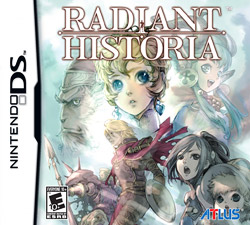
Radiant Historia is one of the best original RPGs on the DS.  The system has been a haven for fans of 16 and 32-bit role playing games, but a surprising amount of the systems library is remakes and ports.  Not that that is a bad thing, it is the only way people are likely going to be able to play things like Dragon Quest 5, but the original games have mostly paled in comparison to the classics.  Radiant Historia, though, stands among the best in the genre, managing to feel simultaneously classic and original.

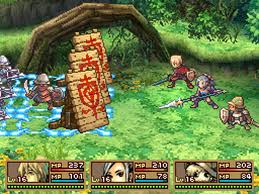
In a lot of small, hard to define ways, Radiant Historia feels like an SNES game.  Which coming from me is the highest of compliments.  Give or take some rough sprites and 3D backgrounds, it looks like an SNES game.  Maybe the feel is in the fact that the game really doesn’t take advantage of the DS’s special features, making it not unlike many of the ports and remakes.  More than anything, though, it is that there is a comfortable familiarity to the game.  It plays exactly like one would expect an RPG to play.  It is accessible and intuitive.

The accessible nature is amazing when you consider that a lot of what Radiant Historia does is pretty novel, at least as far as RPGs go.  It combines the time travel of Chrono Trigger with the alternate realities of Chrono Cross, but in a way that is more in depth than either of those games.  In Chrono Trigger time travel was mostly an excuse for different environments, Radiant Historia uses it for the opposite reason.  It allows the game to reuse the same areas over and over, but in turn they really take advantage of moving through time.  The battle system is not exactly standard either.  It combines Final Fantasy X’s emphasis on turn order with the grid set up of a tactics game.  The end result offers a variety of effective and interesting strategies.  The player can set trap on squares and knock enemies on to them, or manipulate the turn order to build a giant combo or even do both at once.

The end result is a highly satisfying game, the kind expected from the twilight of a systems life, when all the tricks are known and developers have familiarity with the tools.  Perhaps the most satisfying part of the game is actually the story.  Radiant Historia’s story, at least for much of its length, is much more like a piece of Western fantasy than the typical JRPG.  Sure, eventually the anime-influenced JRPG stuff seeps in, with the forgotten pasts, secret siblings and plots of world destruction, but for the first two thirds of the game there is more emphasis on political maneuvering and small scale conflicts.  Much like the rest of the game, it is a refreshing change of pace.

The game isn’t perfect.  For too long it sticks players with party members with the least interesting abilities.  They are fine individually, but Raynie and Marco do not have much synergy. The game also takes a little too long to get going and it starts to fall apart near the end.  Small flaws in an otherwise terrific game.

Though it more likely to be forgotten than celebrated in the years to come, Radiant Historia deserves a place in the pantheon of great DS games.  It is not only probably the best original RPG on the system, it is easily among the best DS games.  I’m not sure if it is still widely available, but players owe it to themselves to give this gem a try.

Second Quest Part 2, Kind of

If you remember, a few months ago I said I was going to beat every Zelda game, spend the year taking in the series. But after putting up my thoughts on the original Legend of Zelda, I haven’t had anymore ready to go. That is because I was playing Zelda II: The Adventure of Link. It had been nearly 20 years since I had last played Zelda II; I had only vaguely pleasant but confused recollections of it. Playing it again lately has been a largely frustrating experience. Not so much because Zelda II is a bad game, it has its problems but it is mostly well made, but because its flaws are almost perfectly suited to pissing me off.

Since I didn’t even come close to beating Zelda II, I only reached the second dungeon, I am only going to go over a few things that made me put it away. The first is the how slow getting information out of townsfolk is. This is something that only makes me mad because I am already kind of fed up with other things, but this doesn’t help. It’s like torture. Another is how the game gives out experience. Like the fact that not all enemies give experience or that some actually take it away. And last of all, is that Zelda II did not fix the unknowably arcane crap from Zelda I. That seems like all they actually kept, things like knowing exactly where to go in the woods to find Bagu or whatever his name is to get across the river. I only found out by using a guide, which I was trying to avoid.

It simply comes down to the fact that I just do not like Legend of Zelda II: Link’s Adventure. More power to the people who love it, I won’t say they are wrong but I’ll be damned if I’ll waste anymore time playing it myself. So there is at least 1 Zelda game I will not beat this year. On to A Link to the Past!

Samurai Nonsense

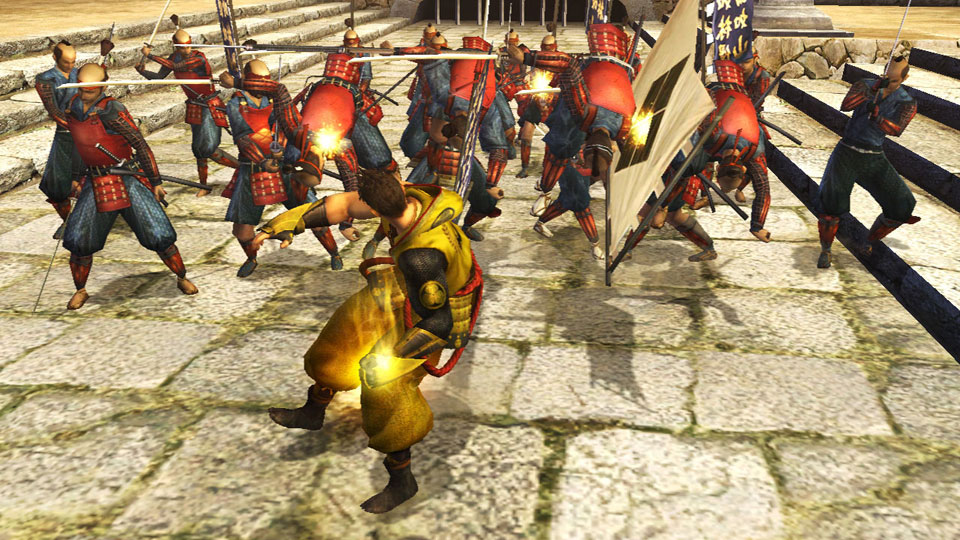
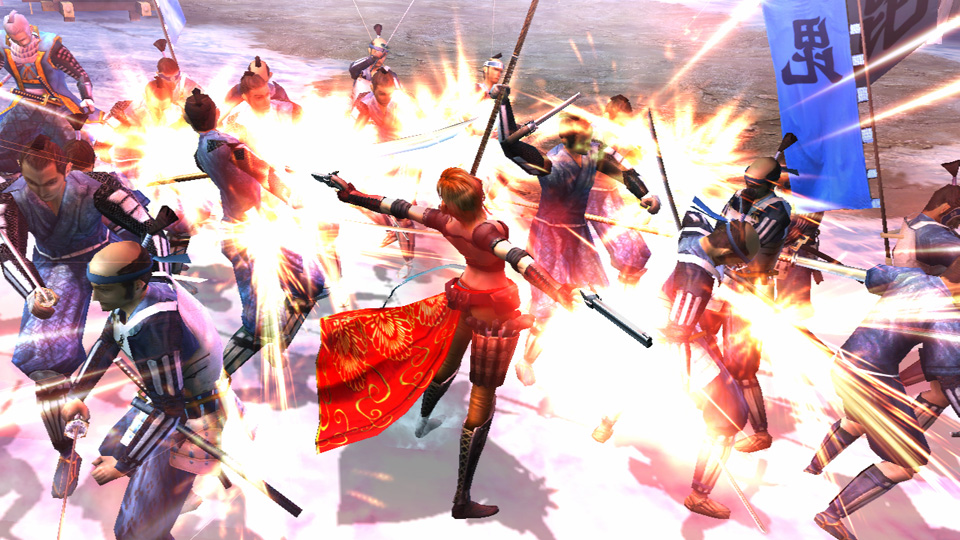
Lately my Wii gaming time has been taken up with Sengoku Basara: Samurai Heroes. Not a classic by any means, but still a solidly fun game. In many ways, it seems to be a modern version of the brawler. You choose your character and beat up tons of generic dudes with boss battles interspersed. If you’ve played Dynasty Warriors then you know exactly what to expect. It isn’t a perfect game, but there is plenty of mindless fun to be had with Sengoku Basara.

When I say it plays like Dynasty Warriors (and Samurai Warriors), I mean that Sengoku Basara’s gameplay is stolen wholesale from Dynasty Warriors‘. I haven’t played much Dynasty Warriors in a long time, but Sengoku Basara basically steals its lunch. While there are some differences, they play about 90% the same. The big difference between the two series is in how they are presented. Dynasty Warriors has this veneer of historical accuracy. Not that it is accurate, but it seems like it could be. The Warriors series are like the Hollywood version of Chinese and Japanese history. Sengoku Basara takes some names and scenarios, but throws out anything that seems even remotely historically accurate. It is the anime version of the same events.

The style of Sengoku Basara is complete nonsense and I love it. Magoichi Saica blazes across the battlefield, blowing about Samurai with a variety of shotguns and automatic weapons. She keeps a dozen or so pistols in some sort of Gatling garter around her thigh. It is hilariously ridiculous. Ieyasu fights with his fists, even on horseback. There is nothing quite like galloping across a battlefield, leaning out of the saddle to punch dudes in the face. And Masamune Date wields his six katanas like Wolverine’s claws. Every battle is filled with ridiculous stuff, the kind of half-translated insanity one would expect from an NES game. Even with how simple the gameplay is, the craziness keeps it fun for quite a while.

There are a couple of problems. The first is that battles go on a little too long. Each map takes about 20 minutes to clear. That is just a shade too long. This isn’t a big problem, but after a few levels it does get tiring. If they could have cut that down by about a third, I think it would have greatly helped the pace of the game. The other problem is that there are only about 30 levels, so after playing about five characters you’ve probably seen about all of them. Maybe I’m being too hard on the game, since it is far from light on content. I first played as Ieyasu, then as Mitsunari. After that, everyone I played as had basically the same options as those two. Playing as Magoichi had me repeating 7 of the 10 levels of Ieyasu’s path, though I did have a choice of following him or Mitsunari. In the end, it just seemed like I was playing a lot of the same levels over and over. Since the levels are slightly too long, it made the whole thing stop being fun a lot faster than it should have.

Though I am calling Sengoku Basara: Samurai Heroes beaten, my completion percentage right now sits at about 10%. There is a lot of game I apparently haven’t seen, but I’ve had my fun with it. Rather than keep playing and get burnt out, I’ll put it back on the shelf. If it is truly the heir to Streets of Rage and Double Dragon, and I think it scratches a very similar itch to those games, then I’ll occasionally pick it back up for a play through for a long time. Sometimes you just want to hammer one button and see your enemies fall.

Video Game Archaeology: Dino City

It is time for more Video Game Archaeology! Video Game Archaeology is my monthly exploration of an artifact video game found during my excavations of various bargain bins and yard sales; an examination of a game cast off and long forgotten. This month’s game is Dino City from Irem for the SNES.

This game was given to me as part of a Holiday gift exchange with the intention of me covering it here.  One look at what is quite possibly the best boxart ever and I knew that I had to play this game. Dino City is possibly the least known game that I’ve covered for VGA.  The internet at large seems to have little to no recollection of it.  There are a few videos on youtube, but that is about all.  The few people that do remember this game seem to like it quite a bit and wikipedia tells me that it got fairly good reviews back in the day.  However, I have no idea why.  This is a pokey, awkward and too hard platformer with little in the way of personality.  I’m being kind of harsh, it wasn’t terrible, but neither was Dino City actually any good.

Dino City is loosely based on the straight to VHS movie Adventures in Dinosaur City.  I actually saw this movie, and if my 20 year old memories are to be believed it was not too bad.  I suspect that my memories are suspect, though.  The plot is that young Timmy and his friend Jamie try to watch TV on one of Timmy’s Dad’s experiments, who I guess is some sort of scientist possibly the mad sort, and get sucked into some sort of dinosaur land.  There they team up with some Dinosaurs to fight evil Neanderthals.  And to get back home, I guess.  This is a platformer, there really isn’t a lot of story.  The game was developed by Irem, famous mostly for R-Type and other shooters.  They also developed one of my favorite games, Steambot Chronicles for the PS2.  Honestly though, much of their output, especially on consoles, is rather mediocre.  For every R-Type, there is a Deadly Towers or Spelunker.  Still, they are at least competent creators of video games with some classics to their name.

The player can choose from either Timmy riding Rex the T-Rex or Jamie riding Tops the Protoceratops.  There is actually significant differences between the two, as Rex can only punch while Tops throws some sort of darts or something.  There is no advantage to Rex, Tops is better, as he seems to do as much damage as well as have enough range that the won’t constantly be being hit.  Which brings me to my first big problem with this game. Many enemies take two or three hits to kill, which is just unfeasible with Rex’s tiny punching range.  You can jump on enemies a la Mario, but that still takes several hits to kill them.  This leads to the player character taking plenty of extra hits.  At least the developers compensated for this, in the early levels I played at least, by leaving plenty of life refilling hearts around.  This is certainly less of a problem with Tops, since most enemies can be dealt with from a distance.  It is a completely different game depending on which dino you choose, and Tops is the right choice.  I couldn’t even hurt the fist boss with Rex, but I didn’t have much of a problem with Tops.

Another place where the game falters are the controls.  They often feel sloppy.  Your character doesn’t quite move like you would expect him to move.  Everything seems to happen in slow motion.  Maybe I am just lamenting a lack of Mario-esque momentum, but Mario is the gold standard for the genre.  But while I played, it just felt right.  It wasn’t helped by the way too high (read: cheap) difficulty.  It might be a mindset thing.  I expected it play like a Mario game, which are usually designed to allow players to build momentum and sprint through levels, but Dino City has a slowed, more precise pace.  I didn’t like it.

Dino City is actually pretty solid on the presentation side.  The graphics, while not mind blowing, are pretty good.  Especially some of the changing backgrounds, like the sunset in the third stage.  The sprites are big and colorful, just as you would expect from an SNES game.  And the music is not too bad either.  There are some decent tunes, but again, nothing much better than good.

I guess I can see some nostalgic love for this game from people who played it new, but it hasn’t stood the test of time too well.  It is hard in the least fun ways, having enemies that take forever to dispatch and tiny platforms with imprecise controls.  Really, it is the cheap difficulty that really sinks it.  Still, I would say it is worthy of remembrance for the majestic box art alone.  It is likely a game that is better than the movie it is based on, but we needn’t set the bar that low for our entertainment.

images taken from the vgmuseum.

SMT Devil Survivor, with no “witty” title

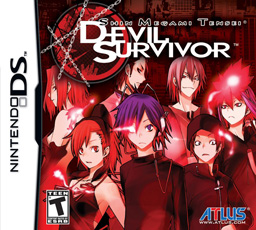
Shin Megami Tensei Devil Survivor is a game that, on paper at least, I should really enjoy.  I like strategy RPGs, I like Shin Megami Tensei and its rock/paper/scissors-esque battle system, and I like games with branching paths and different endings.  However, despite being made up almost entirely of things I like, Devil Survivor ended up being much more frustrating than fun.

It took me a while to figure out just why that is. It wasn’t because it is difficult.  I’ve played harder games than Devil Survivor, and though it was far from easy, Devil Survivor was far from too hard.  Actually, the difficulty is just about right.  It wasn’t the at times off putting character designs and characters.  Yeah, Yuzu’s boobs are weird and she’s kind of annoying, but for the most part the story stuff is pretty good.  After beating the game (taking Amane’s route out of necessity rather than choice) and thinking on it for a while I’ve realized what the problem it.  Devil Survivor needs a map.

I don’t mean an explorable map, like DQ VIII and nearly every other classic RPG.  That is not part of the game for a reason; it simply does not fit with what the game is doing.  I don’t necessarily mean a true map.  I just want some way of navigating the various game systems. I want a map of map of each character’s progress, some way of charting my progress towards the various endings.  Chrono Trigger had multiple endings, but its endings are dependent on big obvious things.  It is never hard to tell what ending you are going to get.  I don’t mind making tough decisions with real impact in games like this, I just want to know that I’m making such a decision.  With Devil Survivor, I really never knew where I stood.  I decided early on which ending I wanted to get: Atsuro’s.  I kissed his ass for four or so days in the game, only to get to Day 7 and realize that somehow I failed to unlock his ending.  I only had Amane’s and Yuzu’s endings to choose from. It was frustrating, and that frustration could have easily been avoided with a touch of transparency on the game’s part letting me know how about my progress.

It is not just in the story mechanics that need a map.  Even though Devil Survivor has the SMT series’ usual collection of demons, it lack the usual compendium.  The player can’t catalog and buy back old demons.  That makes the fusing process a constant move forward.  It doesn’t make it impossible to repeat specific builds, it doesn’t really even make it harder to do so, it merely makes it a longer more tedious process to do so.  Also, you can’t just look through a list for the demons with the right attributes for a tough battle, you have to get lucky with the auction house or fusing.  Just as with the story, Devil Survivor’s party building mechanics drops the player into the wilderness with no way to find their way around.  And for me at least, that is a big problem.

I love maps.  I doubt I would have enjoyed Super Metroid or Ocarina of Time without them.  I loved drawing maps in the Etrian Odyssey series.  Those are literal maps, sure, but the concept is the same.  I like to see where I have been and plan out where I am going.  Radiant Historia uses a timeline so the player knows where and when they are in the game’s time traveling, reality switching story.  Throughout almost all of Devil Survivor, I felt lost and I hated it. Which is sad, because otherwise it is a really good game.

Ignoring the Backlog

Sorry about how dead its been around here lately. There were some changes to my work schedule and some rethinking of my writing priorities has left me with less time and drive to write. The time part of the problem was unfortunate and unavoidable and really shouldn’t be a problem anymore. The loss of motivation is harder to shake. Near the end of last year I realized that writing on this blog was feeling more like a chore and less like a hobby. SO I tried to shake thing s up at the start of the year. Unfortunately, my planned changes actually made writing seem more like a chore.

This whole thing has been part of a more general malaise I’ve been in for the last month and a half. I’ve felt no desire to read or play video games, let alone write about what I’ve been reading and playing. Finishing a book I wasn’t quite liking and starting one I do like, along with taking a short break period, has helped me get back into reading. My indifference to videos games has two root causes I think. The first and most easily fixed is that I didn’t like the games I was playing. Coming on the heels of Zelda: Skyward Sword and Donkey Kong Country Returns any game is going to seem weak. Going from those new classics to middling slogs like Glory of Heracles and Lost in Shadow is just asking to hate video games. (Its not that those 2 games are particularly bad games, just games that are much longer than they are interesting.) But I’ve since put those games aside, soon I’ll find something I actually like.

The second problem I’m having is one I’ve caused myself, a mindset that keeps me coming back to games that I have long since stopped liking. I caught myself up in what I am calling backlog syndrome. Backlog syndrome causes players to play crappy games just because they already paid money for them, and playing a game they’ve already beaten would be wasting their time. I got into that mentality with he help of the really cool website backloggery.com, which allows you to compile a list of all of your video games by system and my how much progress you’ve made in them. At fist this site was a big help to me. A few years ago, while I was buying games all the time, I found myself barely playing them and spending most of my time replaying a few favorites, like Chrono Trigger, Final Fantasy 6 and Ocarina of Time. But once I saw how many games I had bought and played little if any, I decided to slow my purchasing until I had played most of the games I had already purchased. For a few years the goal of beating all the games I own kept me playing new and interesting games that I probably wouldn’t have had time for otherwise.

Now, however, I have all but run out of games to beat. The few that I have left are left because they are terrible. Or are fine but for some reason I just don’t like them. I do have a couple of supposed classics sitting untouched on my shelf, Super Mario Sunshine and SMT Nocturne for example, but I’ve found myself spending too much time lately trying to push through drek.

So I am trying to break out of this backlog eliminating mindset that I’ve been in for so long. I am no longer going to pay attention to what I “need” to beat. I have no more goals of cleaning out my backlog. In what is probably not a revelation to anyone else, I am going to play what I want to play just because I want to play. Since I’ve made this decision I have felt a weight lift from my shoulders. Not a particularly heavy weight, but there is a definite difference. Playing video games no longer feels like a chore. I’m still playing new games on my DS, games that I would be playing anyway but now the motivation is just to play games, not to tick off a mark on a checklist of games I’ve played. And I’ve stared replaying Chrono Cross, a favorite of mine from a decade ago that I’ve felt a hankering to revisit. Hopefully this keeps me playing happily for some time.

Sky Crawlers

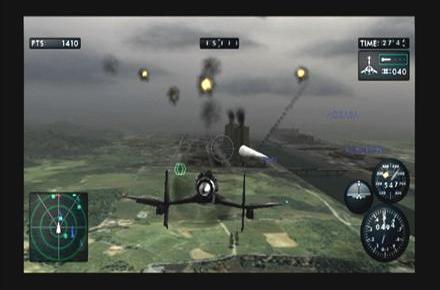
I’ve only got a few missions left before finish the story section of Sky Crawlers: Innocent Aces (since writing this I’ve finished) and I’m somewhat at a loss for what to say about it. This is partially due to my not really having a reference point to judge it against. I haven’t played too many flight sims. I did enjoy Sky Crawlers, for the most part, but I could believe that other games do the flight thing better than this one. I also don’t have much to say about the story. I haven’t seen the movie this is based on, though I understand that the stories aren’t really connected. (Is the movie still on Netflix? I should watch it.) Its anime nonsense. Enjoyable anime nonsense, but nonsense nonetheless. I just can’t take a story seriously when it features pubescent super-pilots called ‘Kildren.” Its just not possible.

I can at least make a note of the controls. I think it would be fair to call me a fan of the Wii’s motion controls. For most games they add to the experience despite the inherent slight loss of precision. So listen to me when I say that the default controls in Sky Crawlers are an unforgivable crime. Their problems are numerous and glaring. First, the game wants the player to put the Wiimote into their left hand and the nunchuck in the right. Yes, it wants you to hold it opposite of every other Wii game ever. Its akin to an NES game telling the player to play with the controller upside down. In Sky Crawlers, the wiimote operates as the throttle. The actual steering is left to the nun chuck. But the nunchuck flat doesn’t work as its supposed to. No part of this control scheme is useable, let alone intuitive. It is simply awful. After the tutorial, I realized the complete failure of the motion control and switched to a wavebird and never looked back.

The only other thing of note are the tactical maneuvers. If you can stay close enough to an enemy long enough you can execute a special maneuver the puts the player right behind them. There are three levels, but I have never found a reason to wait past the first one. Sure, higher levels actually get you behind some of the tougher enemies, but for 90% of the game you could have shot down the enemy 4 or 5 times while you wait for the meter to fill up. I don’t like the system because instead of letting the player pull off amazing moves, like flips and barrel rolls in Star Fox, the player pushes one button and the game does it for them. Still, even with it the dog fights are fun.

Sky Crawlers is a decently enjoyable game. Not worth full price, but its worth digging out of a bargain bin. Its not like there are a lot of flight sim options out there for the Wii. And who knows, you might like this games nonsensical anime stylings.

Its a Monster Tale

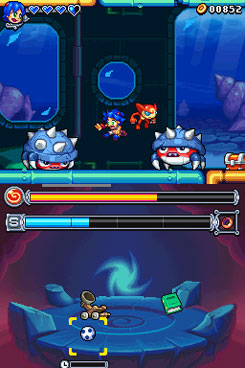
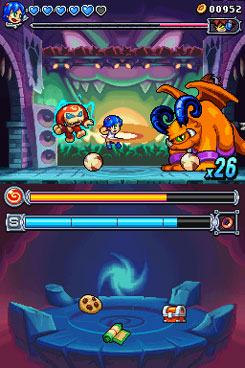
I’ve just beat Monster Tale, a fun little game from the makers of Henry Hatsworth that should be better than it is. Not that it isn’t good. It’s very good. But Monster Tale does a lot of things so very wrong that I have a hard time not feeling disappointed. It had gorgeous 2D graphics, pitch perfect control and mechanics and possibly the worst map I’ve ever seen in a Metroidvania style game. The map is only the start of the games problems. Still, it manages to be simply fun to play.

Monster Tale is about a young girl, Ellie, who is sucked into Monster world and finds a monster freshly hatched out of its egg. So she teams up with the baby to try to find away home, quickly running afoul of the other children in monster world, who are less eager to return home, instead being content to rule over the monsters with an iron fist. It is fun and childish in wonderful video game tradition. The abilities Ellie gains as the player advances all fit seamlessly into her moveset. In the end she is an easily controlled destructive force.

The game is set up like Metroid or recent Castlevania games, with a large connected map rather than separate levels. While running around is fun in and of itself, the map design is atrocious. Instead of the having some exploration available at all times, Monster Tale forces players along the one path that can open up more of the map. The openness is not there to facilitate exploration, but to pad the game length. The game hides power-ups behind doors that you need another power-up to open. Not a chunk of map that also has a power-up, just a room with a power-up. Meaning that to get power-up A, you must acquire power-up B and then backtrack all the way across the map. The game is about 40% backtracking. But as I said, it is a lot of fun to just run through the world.

At least its fun for the first half of the game. After that the enemies start taking so many hits to kill that it becomes a chore. Maybe its because I never got all the purchasable upgrades (because they cost so much) but the enemies take way too long to kill. My problem may also lie in how little I used my monster companion. I did use him some, but while the idea of the A.I. controlled monster is great, he seemed largely pointless through most of the game. I gave him whatever items I found, leveled him up in forms that seemed useful, but mostly I used him to solve switch puzzles that he is required for.

In the end, Monster Tale is a charming, if flawed game. It is more fun than it is frustrating, but it is somewhat frustrating. At times there are glimpses of the great game this could have been, the second coming of Symphony of the Night or Super Metroid. Most of the time it is hard to escape the egregiously bad map design and hit absorbing enemies. It is definitely a game to grab if you find it for cheap, but don’t expect great things.