What I Read in December 13

I had a little more free time than usual in December so I managed to actually hit what had been my average, though I hadn’t got close most months in 2013. Really, 2013 was a disappointing year as far as quantity of books read goes, but I did read some really good books, so I guess it balances out.

race

The Race

Clive Cussler & Justin Scott

I’ve generally enjoyed this duo’s Isaac Bell adventures. They aren’t groundbreaking, but they are generally well-plotted and entertaining. The time period, in turn of the 20th century America and a decade or so thereafter, is of great interest to me. The series also tends to focus on cutting edge technology of the time, with this one being focused on a biplane race. Issac Bell, the protagonist, is a little too good to be believed, but no more than many adventure protagonists.

As the title suggests, this book focuses on a race. A cross country airplane race. While Bell and the Van Dorn Detectives are there to investigate a specific threat to the race, there are a handful of other mysteries ongoing at the same time. One of the racers, Josephine Frost, is being hounded by her crazed and vengeful husband, so the race’s sponsor hires the Van Dorns to protect her and the race. The husband, Henry, is a mobster that Bell had an encounter with early in his career. There are some parts of this entry I really liked. Since his fiancé Marian is photographing the race, there is more time for her’s and Issac’s relationship than usual, which allows the reader to see more of somewhat off the job Isaac. There are times when I wish the book was more focused on the race rather than the manhunt since the racers and their stories are more interesting and believable than the villain. That apparent villain, the husband, is almost superhuman. He shrugs off bullets, beats everyone to their destination and survives what should be fatal accidents. But there isn’t much to him other than the fact that he is angry over his wife’s apparent betrayal. Josephine and her lover/mechanic are more interesting, but the whole plot comes off as less than inspired outside of the actual race itself. Then there is the fact that Bell teaches himself not only how to fly, but how to fly as well as the racers in all of twenty minutes. This wasn’t my favorite entry in the series, but it is a fine addition. I’ll likely pick up the remaining Isaac Bell books before the end of the year.
rye

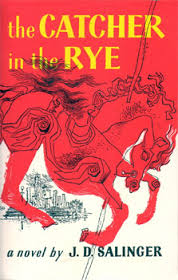
Catcher in the Rye

J.D. Salinger

I subbed for an English teacher and pulled this off the shelf to read while the kids read. I never encountered it in school, but reading it now, and quite quickly, is seems juvenile. Not necessarily in a bad way, though. Holden is a teenager and he acts like it. He is the perfect expression of teenage angst and rebellion. There is a strong note of self-loathing in him. He hates “phonies” and calls himself the biggest liar. He is one of the “phonies” he hates. He is troubled and desperate and confused. Like many teens. Of course, my reading may be facile, I didn’t have much time with the book, reading it in about 5 hours while supervising jr. high students. I probably need to give it a more careful read.

luke

The Legend of Luke

Brian Jacques

Of the Redwall books I’ve read, somewhere between five and ten, this is one that strays the furthest from Jacques’ usual formula for assembling these books. The usual story, the part actually starring Luke, only takes up about a third of the book. The rest is kind of an amorphous trek for Martin and some of his friends. The problem is that there is no pressure on Martin’s group, no stakes. They don’t have an adversary and nothing stopping them from going home and trying the trek another time. Luke’s story is more in line with the average Redwall story and while free of surprises still has a solid structure. Luke does have a real goal and trial. It makes for easily the weakest Redwall I’ve encountered. There is just no tension for large parts of the book, the biggest draw seemingly the lure of returning characters Martin and Gonf. I have derided some Redwall for sticking too closely to the formula, but The Legend of Luke shows the dangers of straying too far from it. This one is just kind of dull.

welltime

The Time Machine

H.G. Wells

This is a classic for good reason. The unnamed time traveler goes to the far future, where humanity has evolved into two separate and equally inhuman races. The Eloi are the frail placid surface dweller and the Morlocks, who live underground and appear and act monstrously. This is a rather pessimistic take on the future of mankind; Wells basically supposes that we have no future. That is softened by just how far into the future the events of this story take place. As far a cautionary tales go, it is certainly better than many, such as the bafflingly highly regarded movie Idiocracy. This is a parable designed to strike fear in the low class, not wanting to become monsters, and the upper class, not wanting to become useless. The end result of the imbalance is not good for anybody.

mop

Mysteries of Pittsburgh

Michael Chabon

I have loved everything else by Chabon I’ve read, but this left me cold. Actually, I pretty much hated this novel. The writing is mostly as good as Yiddish Policemen’s Union or The Amazing Adventures of Cavalier and Klay. There are frequently sentences that make me a little sick to my stomach at just how good they are. They make me embarrassed by my attempts at writing. In that way, The Mysteries of Pittsburgh is just as good as previously read Chabon. What killed my enjoyment is the story. This is the story of a handful of self-centered douche nozzles and their interactions near the end of college. They are not likeable, they are not relatable. They are insufferable. It hurts more because I wanted so badly to like them, to like this book. Maybe it’s just that the experiences of the people in this book are so human, yet so unfamiliar to me. I’ve never encountered people like the ones in The Mysteries of Pittsburgh yet they seem real. They are alien and strange and completely self-absorbed. The central character, Art is at the very least bi-curious, but he seems not usure ofhis sexuality but of himself completely. He seems drawn to the strongest personality in the room. When he is with the other Art, his gay friend sometimes lover, he is entranced with Art. When he meets Phlox, her needy, loud persona grabs him. His vacillation between them seems to be based on which is the least familiar at the time. Maybe I missed something. I hope I did because I want to like this. But I didn’t like the characters so I didn’t care about the things they did, no matter how well written their adventures were.

Now Playing in December

Beaten:

Kirby’s Adventure:
I just had a hankering for some Kirby and this was sitting right on my WiiU. It is such a great game, which I have written before. Good times.

Rocket Knight:
This is the PSN game from a few years ago. It is pretty great; just a solid update of a long dormant franchise. It has that old school edge to it. It just doesn’t rise above good. It is missing that spark to make it really memorable. Still, it’s well worth the time.

NES Remix: Oh man, this game. Sure, it’s just a Nintendo sanctioned rom-hack, but it is a fun rom-hack. I hope it is a sign of things to come. Because as much fun as this game is, it has some stinkers it uses for its challenges. Ice Climbers and Clu Clu Land in particular are terrible, no fun pieces of crap. But Super Mario Bros, Donkey Kong and Donkey Kong Jr. work great in this bite sized format. It is just a wonderful dose of full Nintendo nostalgia. At some point I am going to get all the stars, but I’m fun calling it done with some stars left unearned.

Crimson Shroud: I picked this up a long time ago on my 3DS and just sort of lost track of it. It is excellent. For as small a game as it is, there is a ton of world building going on. There is enough going on in this game to sustain a full-fledged RPG, something 30 or 40 hours in length, but it is all crammed into a game that lasts about 10. I am actually shocked that no has made a game so blatantly based off a tabletop game until now. I hope Matsuno is working on something else after this, since he is about the best maker of RPGs.

Bioshock: I just wrote about this. A game as great as its reputation.

Yakuza 3: This is a game that I could see a lot of people just not liking. It is ostensibly a game about Japanese mobsters, but the play spends at least half the game running errands for orphans. I loved it, though I don’t know I have enough to say about it to sustain its own post. The Yakuza series just feels like a modern version of the beat-em-ups I like so much back in the 8 and 16-bit days. I’d call it the modern day River City Ransom. It is pretty much everything I love about video games, including running errands for orphans. I really need to get Yakuza 4 and finally play Yakuza 2.

Orion’s Odyssey: This is the first Kickstarter game that I’ve backed that I’ve actually received. It is a puzzle game with an absolutely charming story mode. You use small shapes to form bigger shapes. It starts off pretty simple, but once you get into the challenge mode it can become downright infuriating, in a fun way. I’d recommend anyone with a DSi or 3DS to go ahead of buy this. It is a pretty great little game.

Final Fantasy XIII-2: Somehow they managed to make a game with a plot that made less sense than FFXIII. That is quite the accomplishment. Still, they did fix some of the problems with the first game. The big one is that they gave the player a lot more freedom. After few hours, large chunks of time are open to the player to explore as one sees fit. The battle system is still a lot of fun and it is surprisingly fun to put hats on monsters. Honestly, though, I think I liked the first game better. Lightning is better than either character in this game, so is Fang and hell even Snow. Still, this is more of a game rather than an experience.

Ongoing:

Popolocrois: This is a fun and charming little PSP game. I’m not sure I am going to stick with it, though. It is something of an amalgam of 2 games and is set into distinct chapters. I finished the first chapter and I’m having a hard time finding the desire to go back and start the next one. It is just clunky enough to be off putting, no matter how charming it is.

Trauma Center: New Blood: Good God this game is difficult. I played through the first three chapters and I’m not sure I am going to be able to beat it. It will be the only Trauma Center game I haven’t beaten.

Earthbound: I finally got going on this. I’ve finished Twoson and got Paula on my team. This game is so damn great. I am intentionally taking it slow because I want to savor it.

Upcoming:

Xenoblade: A half-finished game that I plan to finish off this year. I am slowly recalling just how to play so far this month.

Paper Mario Sticker Star: Another half-finished game that I plan to finish off this year.

Ratchet and Clank Future: The whole Future trilogy is up. I am going to beat all of them in the next few weeks.

The Legend of Zelda: A Link Between Worlds: I got it for Christmas and can’t wait to dive in.

Final Fantasy Crisis Core: I’ve got a well thought of FF game for my PSP and I am going to give a go.

Bioshocked

I played Bioshock recently. Not Bioshock Infinite, this year’s critically acclaimed FPS with a unique setting and a politically charged story, but 2007’s FPS with a unique setting and a politically charged story. Of course, with a game so acclaimed and talked about when it was new, I have little to add to the discussion now. What was most surprising to people that know me is that I played Bioshock at all. I play all kinds of games, just about everything except FPSes. My disinterest in the genre is longstanding; even back when my brother and I found Doom on our uncle’s computer I got bored much more quickly. Still, I like games and Bioshock is so seminal a game that it is hard to be a part of the conversation without playing it. That is how I approach it, as an obligation. I won me over though. Bioshock is a game worthy of its reputation, even for someone who has a decided disinterest in FPSes.

I have played a handful of first-person shooters in my time. My friends moved from multiplayer game to multiplayer game, so I played plenty of Goldeneye, Perfect Dark and Halo 2 at times. I never even pretended to like those games. I rarely complained or anything, I like to play with my friends even if it is a game I don’t particularly enjoy. So I played, having a reasonably good time mostly just due to hanging with my friends. I’ve also played the Metroid Prime games, which are first person, but aren’t really shooters. The last FPS I played was Metroid Prime 3 more than five years ago. The point is, these sorts of games aren’t really my thing and I am far from an expert on them. Still, Bioshock was a wholly enjoyable experience.

Unlike the little bits of other FPSes I’ve sampled, Bioshock’s movement has weight to it. When you swing the wrench, there is heft behind it. Each of the limited, unique weapons has a specific role and feel. The player character doesn’t feel like an unstoppable warrior, he feels like a guy who kind of knows how to shoot a gun. And while the number of weapon are limited, combined with the different kinds of ammo and plasmids gives the player a wealth of options. It really lets the player find their own strategy. I favored a combination of wrench enhancing powers and the fire plasmid. While there are tons of options, any choice the player makes is viable, making for a game that fits to the player’s preference.

The big moral dilemma of the game, whether to harvest or save the Little Sisters, is truly a non-choice. The bonus for harvesting them rather than saving them is small enough that anyone who gives two craps about the story is going to rescue them. To do otherwise is to be a monster for the slightest benefit. There is no dilemma there. One answer is obviously right morally. Anyone looking at it as a moral choice can only do one thing. It is an interesting world building and narrative device, but it is not a moral choice.

The setting is the true star of the game. Rapture is a place unlike anything else in gaming. Looking around the ruins of the great submarine city is entrancing, as is getting to the bottom of just what happened to turn Ryan’s Utopia into the terrifying wreck that it is. Each area makes sense in terms of the construction of the city and is visually interesting. Even if the rest of the game was crap, the setting would be enough to make Bioshock a memorable experience. While I wasn’t as floored by the actual story of the game as most seem to have been, the fact that there seemed to be thought put into it pushes it ahead of most games.

It is really just a truly great game. Even someone who has no interest in shooters should find a lot to love here. I will likely look into the other games in this series, but I’m still not on the shooter boat. They are just not for me.

The Hobbit: The Desolation of Smaug

It is difficult to examine this film without comparing it to its direct predecessor. Unfortunately, it is not a comparison that does the film any favors. The Desolation of Smaug doesn’t quite have the same energy as An Unexpected Journey. That really isn’t a flaw, it’s not supposed to have that energy. That unexpected journey is nearing its end and the party of dwarves and hobbit and sometimes wizard is tired. That makes this movie somewhat less enjoyable than the first, especially since the existence of the third film keeps it from having any conclusions either. Still, there are moments that have just as much kinetic fun as any film and the gravitas that the first one failed so spectacularly with works better here.

It is more Hobbit. The first half hour or so could have easily been part of the previous film with no one noticing. I am going to assume people have read the book and know the general flow of the story, so if not beware spoilers. It starts with encounters with the bear-man Beorn, then they get lost in the Mirkwood, captured by giant spiders and once they get free are captured by elves. It is the same sort of roller coaster ride feeling that made the first film so enjoyable and it peaks with the wonderful, funny escape via barrel. That is definitely the high point of the movie. It is kinetic and fun; it just brings a smile to the viewer’s face. The dwarves are stuck, for the most part, in their barrels while the Elves try to thwart their escape. At the same time, a pack of Orcs show up trying to kill the dwarves. So the dwarves float in the barrels while the Orcs and Elves fight each other to get them. It is cartoonish in the best way. After that things take a turn for the somber, though the movie never loses its comedic bent.

The additions and changes in this one seem more fundamental than in the first movie. There was some rearranging and plenty of additions in An Unexpected Journey, but it was mostly making background stuff explicit and giving the movie an antagonist that the first half of the book lacked. In The Desolation of Smaug, the changes are greater. Yes, the Hobbit never let the read know exactly what Gandalf was up to, only that he had to deal with a Necromancer. This film shows us that. Not a problem, especially since they made the decision to split this into three movies. Then there is the appearance of Legolas. Logical, since the dwarves go through his home, but his role is greatly expanded from anything that was in the books. Then there is Tauriel, a laudable attempt to balance the almost wholly male cast before this. Honestly, she fits right in. None of the changes in and of themselves are bad, but added up the changes make it feel like the film was getting too far away from the book at times.

The film greatest failure and its greatest triumph is the dragon, Smaug. Bilbo’s encounter with the dragon had the opportunity to mirror his encounter with Gollum from the first movie. Again he is separated from the dwarves and must get by on his own. His whole encounter with the dragon is wonderful. Then the dwarves get involved. It is the same problem that the first movie had, that at the end the dwarves had nothing to do, but the extended escape sequence not only loses the point of having Bilbo at all, but also lack the energy that made the barrel ride scene of goblintown s enjoyable. It feels flat and padded and greatly lessens the threat that Smaug supposedly is. If he is so dangerous, how do a double handful of dwarves evade him so casually? It really is a letdown.

I haven’t lost my faith in Peter Jackson. I eagerly await the third and final film. The dreary nature of the second half of this movie makes it hard to come out with as good a feeling as the first film. It does a great job of hammering home how selfish the dwarves quest is at its heart. The first film paints it as a noble attempt to reclaim their homeland, this one makes it clear that there are other considerations. The Desolation of Smaug is a film with significant hills and valleys and unfortunately, it ends at its lowest point.

What I’ve Been Playing Nov ‘13

November was a big gaming month, but not so much for me. I know the current generation of consoles has been the longest lasting ever, but I’m not really ready to move on. Maybe that’s not right. Its not that I’m not interested in new hardware; I’m just not interested in any of the games for those consoles. As this generation has gone on, my tastes have drifted further and further from the mainstream. Again, that’s not quite right. I still like the same kind of games I’ve always liked, they are just not the mainstream at all anymore. So I am not likely to drop the big money on a PS4 or an XBone any time soon. I’m more than happy with my 3DS and WiiU. Plus, there are still plenty of good PS3 games I haven’t had the chance to play yet. Luckily for me, Nintendo keeps pumping out games that are right in my wheelhouse. So let’s rundown what I played last month.

Beaten

Super Mario 3D World: I’ll try to have a full write up of this soon, but suffice to say I liked it a whole bunch. It is the best Mario game since Super Mario Galaxy 2 and is maybe better than that. Maybe.

Phoenix Wright Ace Attorney Dual Destinies: I’ve already wrote this game up. It is an excellent entry in this series. I haven’t got around to the DLC case, but I’ve powered through the rest and loved it.

Legend of Zelda: Oracle of Ages: Another game I’ve already written up. It’s good, not great.

Ongoing

Final Fantasy XIII-2: I’m making progress. I’m still liking it, despite the story being, amazingly, worse than the first FFXIII game.

Pokemon HeartGold: I’m steadily making progress in the only Pokemon game I’ve never beaten. It is hard to go back to the DS games after playing the 3DS one. Its slower and uglier. The other problem I’m having is that I’m having trouble building a team that fits my style. I like fast, hard hitting Pokemon and there just don’t seem to be many of those around early in HeartGold. Maybe I’m just making bad choices, but everything seems to be slow and /or defensive. It’s just not my style.

Pokemon Y: I am so close to finishing up my competitive team. I’ve been making really slow progress on this. Still, until recently this has been the game in my 3DS cartridge slot.

Etrian Odyssey Untold: I finally maxed out my team on the Demo and moved on to the full game. I’m trying it with the story team, and it is a different experience. Through the first Stratum, I’d say not as good an experience. It still fun, but I miss being able to truly customize my party. Right now it feels limiting, though the personalities are a fun addition. I expect my progress to be slow, but steady.

Legend of Zelda: Oracle of Seasons: I’m about halfway through this already. So far I’m finding this game much better than the other Oracle game. Its just faster, more compact. I might like it more than Link’s Awakening.

Wii Fit U: I got the free version of this, through Nintendo’s deal for people who own a balance board and are willing to buy the pedometer. It is a useful tool if not a true weight loss answer in itself.

Upcoming

Ratchet and Clank All 4 One: I really want to finish this up soon. Me and my brother are real close to the end, though we haven’t played since summer.

Pikmin 3: It’s in my WiiU right now. I just need to turn it on.

Earthbound: I promise this time.

Super Princess Peach: I tried to buy this off of ebay a few years ago, but ended up with a bootleg cart. I’ve kind of realized I’m never going to see this in the wild, so I’m just going to play that bootleg.

Rocket Knight: I bought this when I first got my PS3, played about 2/3s of it but then kind of lost track of it. It shouldn’t take me too long to finish.

What I Read in Nov ‘13

Yep. This is a low volume year for me. I’ll likely end on a decently high note, as I should finish 5 or 6 books in December. But November was a 1 book month. Unless I forgot a book. Which has happened before, but it doesn’t say much for the book or my reading abilities.

The Pastures of Heaven

John Steinbeck

I found a weathered, beaten copy of this after my basement flooded a few months ago. It was printed in the mid 40’s and was in the local library through the 60’s. The mysterious appearance of this old copy of this book is as interesting as the book itself. The Pastures of Heaven is the first I’ve read of Steinbeck. Somehow I never managed to read Of Mice and Men or The Grapes of Wrath. After reading this, they have moved up my to read list. The Pastures of Heaven is not considered one of his better works, but it was good, if slight.

The Pastures of Heaven is a connected short story collection. Each chapter is its own story, but together they tell the larger story of the town in the valley known as the Pastures of Heaven. The stories deal with small town life, poverty and family. It tells the story of the town as well as the people who live there. The themes aren’t really strong enough to tie the stories together, though. It is just a collection of loosely related stories, none of which are that interesting on their own. Still, its short, easy read that is just interesting enough to be worth it.

That is the only book I finished in November.

2nd Quest: Oracle of Ages

It took a few months, but I finally finished up Oracle of Ages. I then jumped right into Oracle of Seasons. I’m also working on Majora’s Mask again. Hopefully I’ll have this series replay finished up in the next few months. Though Twilight Princess and Skyward Sword are both lengthy endeavors, so that could slow things down again. And I guess I’ll be adding A Link Between Worlds to the list, since I am sure to get it by the end of the year. Now, on to Oracle of Ages.

If anyone remembers, assuming that anyone actually read it, I was not too impressed with Link’s Awakening. I thought it was too simple and hampered by the limitations of the Gameboy. Playing Oracle of Ages has helped me appreciate just good Link’s Awakening really is. Because this game has many of the same flaws but is all around less charming. Most of the problems have actually grown worse. It is still a Gameboy games, the limitations of the system are still in place.

Still, Oracle of Ages manages to have some really good dungeons. Many of them are simply great. They are complex mazes that require both skill and logic to complete. Any time you are in one of the eight dungeons the game is simply great. The available tools are very limited, but they are all good for multiple uses. The game also trusts the player to figure it out on their own, which is always good in a game well enough designed that the player can figure it out.

Where the game falters is in the overworld. That is one of the most tedious, boring things ever put in a Zelda game. There are some interesting characters, Ralph, Queen Ambi and Nayru, but most of them are just generic villagers. To get into each dungeon the player needs a key and to get it the player must solve some problems in the world, usually by warping back and forth through time. A lot of it is needless filler just there to pad out the game. It is what made me put down the game for so long and by the time I finished I began to dread completing a dungeon because I would have to go do stupid stuff like dance with Gorons or barter with Lizards to get my tools back. It is not fun.

What it feels like is Oracle of Ages is an attempt to bring the 3D style Zelda game to 2D, without the creators realizing that just like some things had to change to make the game work in 3D, so must some things change to make it work in 2D. I found myself voicing a lot of the complaints that many people have about 3D Zeldas, ones that I don’t tend to agree with, while playing Oracle of Ages. It really feels like a game made out of the worst parts of the Zelda series.

Still, the game isn’t that bad. It’s passable. Uneven is probably the best descriptor. When the game is good, like in the dungeons, it is really good; when it is bad it is truly bad. Link’s Awakening looks better in comparison, but it is still an enjoyable experience. If the first half of Oracle of Seasons and my memories of Minish Cap are true, this is the weakest Zelda on a Gameboy.

Another Reason to Shout Objection!

Playing Phoenix Wright Ace Attorney: Dual Destinies has shown me just how much I’d missed this series. Sure, I’d played Ace Attorney Investigations earlier this year but that game is a pale shadow of the real thing. It’s mostly a different beast altogether. It has been a long time since the last real Ace Attorney game. It is really good to have the series back. I hope there is more after this.

Dual Destinies has all the Ace Attorney stuff one would expect, diabolical criminals and crazy weird witnesses and an even more crazy weird legal system. There are five cases of increasing difficulty and complexity and this time you jump between three different lawyers. Apollo Justice is back, and thankfully so is Phoenix. New to this game is Athena Cykes, who can detect emotions and use that to get more out of testimony. The only thing it is lacking is a good sidekick, since the other lawyers tend to play that role. It works, but I liked Trucy and Maya.

The return of Phoenix to the courtroom is a big deal for me. I liked the last game; I liked Apollo and Trucy. However, I was never comfortable with how the game treated Phoenix. They broke him down as a part of someone else’s story instead of his own. Here, Phoenix is still not the main character. He takes a back seat to both Athena and Apollo. But he is allowed to play the thoughtful mentor and go about his own business when they are out on cases. The next game could easily use any of the three lawyers as its main character should they choose. Phoenix doesn’t need to be broke down so Apollo or Athena can rise up.

I don’t want to spoil the game, so I’ll just say that I liked all the cases and I liked that they fixed some problems. The biggest change is adding a to do list to the investigation portions, so you will always know where you need to go to advance the story. And the stories are largely good. If anything they are all too personal. All the cases have a personal tie for at least one of Wright Anything Agency team.

The only real downside is Athena. She gets better as the game goes along, but I didn’t initially like her as much as Phoenix or Apollo. A big part of that was how bad a lot of her dialogue is when pressing witnesses. She reacts like a sidekick, often arguing on tangents instead of sticking to the case. I know the other lawyers did that too, but I found Athena to be worse. She seemed to forget what she was doing. I also wasn’t too big a fan of Prosecutor Simon. There’s just not a lot to his character. I hope the next game a truly great adversary, on the level of Edgeworth or Godot. Also, I would be remiss to not mention that there are tons of spelling and grammatical errors. This is a big problem in a game that is 80% dialogue.

The biggest actual improvement in the game are the graphics. The new 3D models turned out fantastic and they animate really well. I was concerned because I didn’t think Professor Layton’s conversion to 3D worked out at all. The art for that game did not translate to 3D well at all. However, here it worked out perfectly. Things look just as crisp, but now there is a wider range of motion. They characters are even more expressive. The graphics are very good.

Dual Destinies is still largely the same game the rest of the series. It is a visual novel with some trappings of an adventure game. It lives or dies on the writing. Fortunately, typos aside, the writing is really good. The new characters aren’t the best, but that is made up for by not including a lot of the tired gang from the first three games. Still, I’d to have a Gumshoe or especially Maya appearance, but I’m glad they stuck with a mostly new crew. I don’t see this game changing the minds of anyone who didn’t like the series already, but it is a treat for fans and likely to draw some new fans. It is the best thing Capcom has done is some time.

Taking the Pokémon Gold

I get this urge when I play a new Pokémon game to play other Pokémon games. Sometimes, like with White, I don’t get around to it but usually I feel a desire to play older Pokémon games I haven’t played or haven’t played enough. While I make a decent effort at completing the Pokedex in Pokémon Y, I decided it’s finally time to play the one Generation of Pokémon I’ve never really played. So I started up the copy of Pokémon Heart Gold I bought a year or so ago.

The most important thing with Pokémon games for me is the experience of playing. While they all play largely the same, somehow I get vastly different things out of them. Nothing has matched my first encounter with Pokémon Red. I got into Pokémon early, using the money from my 13th birthday to buy a copy just a few weeks after it was released. I was already savvy to the whole RPG thing, having played Final Fantasy III and Chrono Trigger among others on my SNES, but seeing an ad for it running on the kiosk at Wal-Mart convinced me to splurge with my birthday money.

While not as complex as those SNES games, the first time through Pokémon Red was a revelation. There were no guides and no previous games to base my expectations. Each new area was a discovery. First there are just simple animal Pokémon, birds, rats and bugs. Then it gets to the more outré ones, poisonous rabbits and electric rodents and the like. I was hooked. My already well trained video games sense paid off. I just knew the useless fish Pokémon would turn out to be useful. I played that game forever and came as close to completing the Pokedex as a boy without a link cable could.

Then came Silver and Gold. I was excited. My brother and I pooled our money and bought a copy of Silver as soon as we could. Unfortunately, sharing a copy of Pokémon game worked out about as well as one would expect. Which is to say one player got left out. That player was me. I was annoyed, but I was getting too old for Pokémon. Or so I thought. I sat out Ruby and Sapphire. I never really considered buying it. I was too busy with “mature” PS1 RPGs to waste any time on that kiddy stuff. The same went for the remakes of Red and Blue. I was done with Pokémon. Sure, I’d spend hours playing Final Fantasy Tactics Advance, but not Pokémon.

Then in college, my roommate bought a copy of both Diamond and Pearl. I thought he was stupid, so I took Pearl and starting playing it. And didn’t stop, not for almost 400 hours. Maybe it was just enough time had gone by, maybe I was just eager for an excuse not to do my homework. I also bought copies of Fire Red and Emerald, just to help me complete my Pokedex. So I played through those as well. Pearl was the only game since Red to really pull me in like that. I nearly completed the Pokedex again, coming up just short a few stragglers and a depressing number of event only legendary Pokémon. It also was the source of my proudest Pokémon memory, beating the Champion with a team a full 15 levels lower than hers.

But then I was out again, again skipping the Gold and Silver games, as well as the improved Platinum. I did hop right on Pokémon White and enjoyed it for the fresh experience of playing through a game with no guide and all new Pokémon to use. While Pearl was the culmination of three generations worth of cruft, White cleaned it all away for a fresh game. White 2 brought all that stuff back. Now Pokémon Y gave the whole thing a seismic shock.

High off that experience, I am finally jumping into HeartGold. I am two gyms in and … it’s Pokémon. It is a little slower than I’m used to, the leveling up a lot more difficult than Y, but still fun. It definitely has a much better selection of starters than Y did, that’s for sure. Cyndaquil and Totodile are both awesome through all three evolutions and Chikorita is okay. It will feel good to finally have played every generation of the series, but the main draw is to build up a stable of Pokémon to transfer into the Pokémon Bank and fill out my Y Pokedex.

2nd Quest: Wind Waker

Yes, I know I’m jumping around like crazy instead of beating these games in order, but I play what is available. I’ll get to Majora’s Mask and the Oracle games soon, but Wind Waker HD just came out and I was excited to play it again. So here it is.

ww2

Wind Waker is an odd, contradictory game. More than most games in the series, it feels as though it were created with a specific vision. A vision somewhat different from the rest of the series. The original, A Link to the Past and Ocarina were all variations of the same on progressively more powerful hardware. Link’s Awakening and Majora’s Mask were very clearly side stories. Wind Waker has all the trappings of the main games: Zelda, Gannon and the fate of Hyrule in the balance, but the rest of the game is wildly different like the side games. It feels like a real evolution for the series. This feeling is helped by the divisive art style. This is the Zelda team changing the rules of what it means to be a Zelda game. At the same time, this game seems compromised on a fundamental level. There are spots where dungeons appear to be missing. The wide open seas feel lifeless and empty. It feels rushed, which is generally not the case with Nindendo’s “delay it until it is done” policy. Still, despite its occasional compromised bits, Wind Waker is far from mediocre.

ww4

Calling the graphics divisive is giving the brainless naysayers too much credit. The graphics are terrific. They are timeless, as the HD rerelease really showcases. Sure, there are some touch-ups and new lighting, but it still looks excellent even after ten years. The squat, expressive Link is the series’ most memorable. Likewise for the tough, sea-faring Zelda and somewhat tragic Gannondorf. Despite its somewhat empty sea, the world feels more real and lived in that most. This is largely due to the colorful, expressive graphics. Sometimes the characters in a Zelda game are just freakishly weird. Like Twilight Princess. This may be my favorite version of Hyrule.

ww3

Honestly, Wind Waker is my standard answer to what is my favorite Zelda game. I might actually like some others better, but I never felt like Wind Waker got the love it deserved. The response to Wind Waker HD has been overwhelmingly positive, though. It really warmed my heart. That is the reaction that the game deserves. It still feels fresh. A lot of that is because the reaction to this game caused Nintendo to overcorrect and hew too closely to the Ocarina model for the next games. Nintendo’s attempt to move the series beyond its initial trappings was rejected. On the negative side, it does suffer from a lack of dungeons. The first couple are a little basic, but the latter ones are really good. There just aren’t enough of them. There are two sets of two dungeons that really feel like they should be sets of three. Still, the last couple dungeons are really great. The HD version really sands down the original games rough edges. Speeding up the speed bump triforce hunt is greatly appreciated and the swift sail makes exploring a lot of fun instead of a somewhat tedious hassle.

Wind Waker hammers home that with one exception, the Zelda series is great all around. I love this game.