Better off Ted is better than all of us

I spent the majority of last weekend watching Better Off Ted on Netflix and I feel terrible. Not because I wasted a whole weekend watching TV. I mean, I did do that, but I also did other things while watching it and most of my time is pretty much wasted to begin with anyway. I feel terrible because I bemoan the lack of quality television programs but then I find gems like this on Netflix that I never watched until after it was cancelled. After watching the 26 mostly brilliant episodes I think I might just be including Better Off Ted on my short list of favorite TV shows.

Better Off Ted is something like a crazier version of The Office. Both shows take jabs at corporate culture, though The Office is more focused on the soul crushing dullness of it while Ted is more about a cartoonish disregard for humanity. Better off Ted follows main character Ted, head of a research and development team for a giant corporation, as he corrals his team and tries to please his capricious bosses. His team is mostly a bunch of essentially mad scientists and an attractive product tester. The comedy comes from the problems his weirdo colleagues get into and the crazy orders Ted tries to deal with from above him. Immediately above him is Veronica, the epitome of corporate heartlessness. Also, Ted’s occasional lover.

What really works in this show is the main characters struggle to maintain his humanity and continue to do a job he genuinely loves. His struggle is the same as his attraction to both Veronica and Linda, the attractive product tester. Veronica is all about the job, and there is little personal connection in their relationship. Linda does the job because she must, but is all human rebellion. Ted wants to think that the humanity is more important to him, and as the show goes on I think he proves that it is, he still loves the job. So he flirts with Linda, even approaches as relationship at times, but he can’t let go of the job and he can’t let go of Veronica. This struggle is the moral center of the show, what is beneath the zany humor and crazy science stuff.

The creator of Better off Ted is Victor Fresco, who was also responsible for Andy Richter Controls the Universe, and similarly styled and similarly great show. He also wrote for My Name is Earl, another show I am a big fan of, though its last season wasn’t so good. Andy Richter Controls the Universe suffered a similar fate to Better off Ted, but at least that time I watched it when it was on. I completely missed Better off Ted. It kind of makes me hate humanity when garbage like Two and a Half Men runs forever despite never once being funny and great shows like Better off Ted struggle to get a second season. But I also wish that the advertising for TV shows did a better job conveying the show they are advertising. I missed BoT because I don’t tend to watch that much TV. I can’t watch every show to see if it’s for me, but some shows that I love disappear as soon as I find them.

Still, now I know about Better off Ted and I am glad to have watched it. I consider it a classic. Now I am going to try to find a DVD copy of Andy Richter Controls the Universe, because I didn’t realize that it had come out on DVD.

Kid Icarus: Uprising is pretty good

Kid Icarus is something of an oddity in Nintendo’s expansive library of games. It is often remembered as being among the best of the early NES first party games, along with the first Mario, Zelda and Metroid games, but it is significantly more flawed than any of those games. The fact that it is remembered at all, rather than forgotten like Ice Climbers was until Smash Brothers, is a testament to the appeal of the game. However, unlike those other classics, Kid Icarus has gone more than 20 years without a sequel. (There was a Gameboy follow up, but I know little about it) It feels like another great Nintendo franchise that was abandoned before it could blossom. Like Nintendo’s big 3, Kid Icarus started with a well-made if primitive game, like SMB, LoZ and Metroid. The each had a divergent follow up, a sequel vastly different in gameplay and divisive in reputation. Mario, Zelda and Metroid 2 all fall into this, maybe Myths and Monsters does too, I don’t know. Then came the codifying classic third game in the series: Super Mario Bros 3, Legend of Zelda A Link to the Past and Super Metroid. Kid Icarus never got this third game, the one that could have made the series a true classic. Now twenty years later, Kid Icarus: Uprising is not that game. It is a great game, but other than being drenched in the flavor of the NES original it is something completely different.

Kid Icarus: Uprising is a shooter, with the old Kid Icarus characters and enemies painted on. It is actually very much like Star Fox Assault or Rogue Squadron 3, with try to balance flying missions with on foot ones. Kid Icarus is better than either of those two games, though. Each of its numerous missions are divided into a flying segment and an on foot segment. While the flying parts are much better than the on foot ones, the disparity is not so great.

While in flight the game is brilliant. It looks wonderful, with a wide variety of enemies and formations. It is strongly reminiscent of Star Fox 64, both in gameplay and in the chatter between characters mid-battle. The controls are perfect in the air, but they suffer on the ground. While they are highly customizable, the default controls have the player controlling Pitt with the control pad and aiming with the stylus and shooting with the left shoulder button. It is a control scheme that is pure torture for a lefty. It works a lot like an FPS. It takes some getting used to, but they actually work, though there are some enemies that require some finer controls than the system is capable of. (I’m looking at you, Cragalanche.) On the good side of the foot battles, there are the different weapons and the bosses. There are 9 different weapon types and they all play uniquely. The clubs have no ranged attack, but are very powerful, while the bows aren’t as powerful but have homing attacks. Choosing the right weapon for the level and your playstyle is a big part of the game. The bosses, for the most part, do no fall into the find weak point, hit weak point pattern (again, Cragalanche is an exception.) The bosses are targets to shoot. Sometimes they require special tactics, but they are mostly just impressively strong enemies. It is different and fun.

While the gameplay has its control flaws, there is a lot to love outside that. There is a surprisingly deep weapon crafting system and a multiplayer mode I didn’t touch. Most of the extra stuff is similar to that in Smash Brothers Brawl, which is no surprise since the same people are behind it. It gives plenty of incentive to replay and experiment with the game. This is aided by the story. While it isn’t anything more than some cartoony anime trappings, it is wholly enjoyable. The constant banter between Pitt and Palutena and their enemies makes even the most frustrating mission enjoyable. Really, the while the story itself isn’t great, the way it is told really is. They got the characters right, in that the characters are just entertaining in action.

The only sticking point with this game is the controls. If you don’t find them too difficult or too painful, there is much to love in this game. Those controls are an unfortunate sticking point, though. They are useable, but there is no ideal control scheme for how this game plays. However, the graphics, music and the once used to the controls actually playing are great. This is games one big flaw is too big to but it up with Nintendo’s best, but it is still a very good game.

Golden Sun Dark Dawn won’t Shut Up

Golden Sun: Dark Dawn has just about everything I love in a JRPG. It reminds me at times the late NES, early SNES games that I enjoyed. Games like Dragon Quest IV and Breath of Fire. Unfortunately, Dark Dawn wants desperately to be more of a PS1 vintage game instead. It attempts to be more like something from that Tales series by adding tons of chatter. The result is a game that emphasizes its weaknesses at the cost of its strengths.

Golden Sun plays great. The battle system is speedy with plenty of strategic options, most of which are unnecessary due to how easy the game is. Changing stats and skills by swapping Djinns gives the characters and battles plenty of flexibility without costing individuality. If the player desires, they can come up with an intricate, carefully considered set up of Djinn. Or they could just put Djinns on characters of the same element and brute force through the game. Each strategy is valid. The dungeons, and the towns to a lesser extent, are a joy to navigate. Instead of just samey corridors and the like, Golden Sun has dungeon more like something out of Zelda, with the characters Psynergy powers replacing Link’s tools. There is usually a fairly easy straight path through the dungeons, with most of the more difficult puzzles used to screen off treasures and hidden Djinn. I am a sucker for puzzle dungeons and Golden Sun is full of them. Really, the game gets a lot of things very right and is a lot of fun.

The trouble with the game is in the story, or more specifically in how the story is told. The plot, at least the first half or so, is a simple adventure, with youngsters leaving home to see the world and right wrongs and eventually get caught up in some world threatening conflict. The characters are paper thin, which in and of itself are not a problem. There really isn’t much to the cast of Dragon Quest IV, but they were a fun bunch to go exploring with. The same is true of FFIV. Besides what is necessary to the plot, they have little to say. This may be due to cartridge space, but the player is left to fill in some very wide blanks. That contrasts with something like Tales of Symphonia, whose characters are incapable of shutting up. They have tons of scenes and dialogue for their personalities to flesh out their personalities. That doesn’t make the cast of Symphonia that complex, they mostly fall into well used archetypes. The player ofFFIV doesn’t know how Cecil gets along with Yang, but the player of ToS can’t help but know how Lloyd and Raine get along. The problem with Golden Sun: Dark Dawn is that the characters have the depth of the first example, but talk as much as the second. The characters talk and talk and talk but never actually say anything. Cutscenes that should take a few minutes drag on with loads of extraneous banal dialogue.

Still, Dark Dawn is more enjoyable than not. The core of the gameplay is strong enough to carry it through the pointless chatter. This is one of the best games that every got me to yell at my DS. It is so frustrating to have what is normally a fun experience broken up by loads of nothing, but it doesn’t really make the fun parts less fun.

I’ve got the Pokemon Blues

I just now realized, by which I mean I realized about a week ago when I started writing this, that Pokemon Black/White 2 is coming out soon. Thinking about that has caused me to catch the Pokemon bug (Weedle, I think) yet again. Luckily, I did not have to wait for my pre-order to arrive; I still had the post-game of White to play through. I powered through White right as it came out, enjoying the freshest Pokemon experience since I first played Red way back in the day, but the big level jump after the big fight with Ghetsis helped me put it down for other things. But an hour or two of exploring the newly opened areas helped me clear the level gap, and I was on to finishing the game up.

I’m a long time Pokemon fan. I picked up Pokemon Red soon after it came out, using money I got for my 13th birthday in October 1998. I hadn’t heard of Pokemon before, but seeing a commercial or something about it in Wal-Mart prompted an impulse purchase. The crazy around Pokemon was something amazing from my point of view. Since I played it beofer any of my friends, I felt like I had gotten in on the ground floor, that me showing the game to my buddies somehow helped the juggernaut. I played that game over and over. When a friend told me about the cartoon, I did something unprecedented: I got up before school to watch it. My interest faded about the time Silver/Gold came out, but I’ve still played all the games in the series and gotten at least a modicum of enjoyment out of them. White 2 is the first time I’ve ever actually double dipped on one generation. I skipped Yellow, I skipped all of the GBA generation at the time, I didn’t play Platinum. Framing the game as a sequel, though I don’t have any idea how sequel-y it really is, is just enough to get me to buy again. That and my Pokemon addiction relapse.

The post-game in White has actually turned out to be more fun than expected. Sure, I haven’t quite managed to beat the Elite 4 for the second time, but I have explored the rest of the White world and caught all the available legendaries. At first, I hated the huge level jump that occurs after the first run through the elite 4, and I still think that it could have been smoothed out somewhat, but now that I’ve caught up I appreciate the high level of competition available. I should be able to take down the Elite 4, and maybe beat Cynthia, before White 2 arrives in the mail. I hope so. I wish I could finally catch the legendaries in Pearl. I played that game for more than 300 hours, caught nearly every normally obtainable pokemon and played though Sapphire and Leaf Green to get the legendaries there. But for some reason, I never went through the effort of catch the Cresselia or any of the legendary Pokemon in that game. Unfortunately, sometime in the year or two since I last played it, it has disappeared. It’ll turn up, I’m sure.

I’ve also been watching the anime. I did get up early to watch it when it first started, but at that time I was already verging on too old for morning cartoons. I saw plenty of the first 60 or so episodes, but after that I stopped paying attention. I did go see the first movie as part of my younger brother’s birthday party. It isn’t particularly interesting, but it is fine as background noise as I read or level Pokemon or fight with Kid Icarus: Uprising. Maybe my opinion will change when I’m more than 15 episodes in.

I am actually excited for White 2. I plan on changing up my play style this time through. Usually I pick 6 monsters as fast as possible, forming a team that I stick with for the majority of the game. So my starter and the bird that is almost always available right away, then the first lightning and fire (or grass or water, depending) along with something like a fighting Pokemon. This time I am going to trade over this Keldeo I just picked up and use a legendary for the first time since Moltres. It should be interesting.

What I Read in August

I read what is basically my monthly average this month, four. Three of them are from the same series, Jacqueline Winspear’s Maisie Dobbs series of mysteries. While I did read three of them in a month, I’m not sure I really liked them all that much. They are easy reading on my Kindle at work, and I didn’t not like them, but I’m not going to be gushing about them like I did about Japser Fforde’s Thursday Next books for example. Also, I’m having a hard time separating some parts of each of the Maisie books since I read them so close together.

Maisie Dobbs

Jacqueline Winspear

This is the first Maisie Dobbs book and it reads like it. It is very much like a comic book origin story, with only a halfhearted attempt at a mystery. That being said, I did enjoy it quite a bit. Maisie is an interesting character, and this exploration of her was a good read. It just wasn’t the mystery I was expecting. It helps that I am a sucker for that time period. I love to read about Pre-WWII 20th century.

The novel moves back and forth from the life of young Maisie, from when she goes to work as a maid for the Comptons, to when she opens her own private investigators business. She is solving the mystery of what happens in a commune filled with WWI vets disfigured by the war. The emphasis is greatly on the life of young Maisie, with the mystery being little more than an afterthought. Maisie’s personal history is a good read, though the ultimate outcome is predictable. There isn’t a lot of investigation to be done as far as the case goes.

Birds of a Feather

Jacqueline Winspear

This one is about a runaway heiress which turns into a murder investigation, which also is heavily reliant on aftermath of WWI. This one is actually a mystery. The woman who Maisie is searching for, who may be a potential victim or the criminal herself, is not a very likable person neither for the reader nor Maisie. Maisie has to solve the mystery, though. This one is much more interesting as a mystery than the first book.

Pardonable Lies

Jacqueline Winspear

Another missing persons case, actually a few of them, where all the missing persons supposedly died during WWI. She is hired by a father to look for his son, the last request of his recently dead wife. She also agrees to look for the final resting place of the brother of one of her friends. She also has to deal with her own recollections of the war. I was a little less enthused with this one than the previous ones.

I read these three books really close together, so some of the details run together. I’m not quite sure one book ends and the other begins. But the overall they paint a consistent portrait of Maisie as a character. She is independent, to the point of fault. She is thankful for the help of her friends, but no longer wants to except that help. Maisie exists at a place between classes in a time when long held prejudices are eroding. She has to square her loving, dependable lower class father with the upper class education she has received. It makes for some compelling reading besides the mysteries, which were the real draw for me.

First Among Sequels

Jasper Fforde

The title here is not just a marginally amusing pun, it is also accurate. While this is the fifth Thursday Next book, it is definitely a break from the previous four. The last book, Something Rotten, effectively tied up most of the series loose ends. First Among Sequels picks things up 15 years later. The amusing wit has not changed one bit. It is still a lot of fun. However, it seems that the longer we spend in Thursday’s world, the more it loses its magic. Of course, the more time we spend in the world, the more we grow to know it and therefore formerly strange things become normal. That is not what I am feeling here. With the events in this book, Fforde has drained much of the weird out of his universe. It is not the strange becoming familiar, the strange is being syphoned right off the pages. Despite my misgivings, First Among Sequels is still a lot of fun. Plus, all the next Next book has to do is a small infusion of weird to right the ship.

The mystery this time involves a reinvigorated Goliath Corp conspiring with the council of genre’s to take over fiction, as well as the plot that goes right to the heart of the Chronoguard. It is much like the previous books in the series, with a very tongue in cheek look at the conventions of fiction mixed with a satisfying in its own right story. As long as Fforde can keep up the this love letter to literature, I will probably to continue to enjoy it. Thursday is an appealing character, and the addition of Thursday Next (fictional) to the cast is a good one.

Summer Movie Review and Indiana Jones Marathon Thoughts

While there are still some movies that I think qualify as summer movies coming in the following weeks, most notably Dredd, since I don’t really plan on going to see any of them, I decided to look over the movies I watched over the last few months. Plus, I am excited to relate my recent experience going to see the entire Indiana Jones series on IMAX yesterday. I made fewer trips to the theater this year than I did last year. There were slightly fewer films I wanted to see, but also I was just unable to see all that I wanted to. The big omissions for me were Moonrise Kingdom, which looked excellent, and the Bourne Legacy, which I thought looked interesting. So I am going to rank the movies I saw this year from worst to best.

9: Amazing Spider-Man: I really didn’t care for the new Spider-Man. It doesn’t really have anything over the previous one, and has to cart around a mediocre villain.

8: Prometheus: This film was undeniably a mess, but it was an entertaining mess. I would consider watching it again, but the only thing I would guess it has to reveal is more plot holes.

7: The Three Stooges: This was actually pretty damn entertaining. The reason it is so low on my list is that I had forgotten I had seen it until I was nearly done with this list. So it is apparently forgettable.

6: Men in Black 3: This was some light and fluffy fun. Just like the first in this series, and unlike the unwatchable mess of the second. Definitely worth seeing.

5: Expendables 2: This was a flawed movie, but it’s exuberant display of testosterone was hard to really dislike.

4: Brave: Brave is not one of Pixar’s best, but it is far from the worst. It probably falls somewhere near the middle. Still, middle of the road Pixar is still great.

3: Avengers: The Avengers was nearly the perfect culmination of the last five years or so of Marvel movies. It feels a little empty at times, but it is perfectly fun.

2: John Carter: While it may not have been a financial success, John Carter was the best science fiction movie I’ve seen in years. It gets a little muddled in the middle, but Mars felt real.

1: The Dark Knight Rises: a great conclusion to a great series of films. This movie is everything anyone could want in a superhero movie. It is really just the best.

Yeah, not only is Avengers below Batman, but it isn’t even second. It wasn’t perfect.

On to Indy. Seeing the series was a wonderful experience. I’ve of course seen the movies before, (see here1, here2, here3 and here4) but I couldn’t resist seeing them all, save Kingdom, on the big screen for the first time. An IMAX big screen. As good as the Indiana Jones movies are, they are better on the big screen. Raiders of the Lost Arc is basically the perfect adventure movie. The Last Crusade is more of a comedy, but it is just as good, and if the theater I was in is anything to go by more of a crowd pleaser. Temple of Doom is very uneven, with some genuinely great moments and as many unbearably moments of Willie Scott screaming. Kingdom of the Crystal Skull has some parts that are almost painful to watch (Tarzan) but for the most part is a solid entry in the series. At the cinema, everything seems bigger. The shadows in Raiders, the bridge in Temple, etc. Also, the bad special effects look even worse. Many think I am probably referring to Kingdom’s CGI, but that actually looks fine. Much better than nearly any effects shot in the previous three movies. I think the bad special effects are part of their charm, but the flaws that exists are even more apparent on a bigger screen. Raiders and Crusade are two of my all-time favorite movies, and I am glad I got to see them in a theater. The ticket cost 25 dollars, and it was probably the best 25 dollars I’ve ever spent.

The best movie going experience of the summer was the Indy marathon, but a wide margin. And the best new movie was The Dark Knight Rises, by an equally larger margin.

Video Game Archaeology: Burai Fighter

It’s back, hopefully as something regular. Video Game Archaeology is my monthly exploration of an artifact video game found during my excavations of various bargain bins and yard sales; an examination of a game cast off and long forgotten.

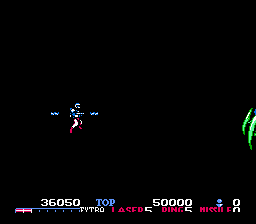
This entry in VGA is Burai Fighter, yet another NES game. I discovered it while looking up information on Low G Man. Both games were made by KID, a smaller NES developer whose output I am coming to really appreciate. Once I turned the game on, I realized I had played it a little at some point in the past. Probably at a friend’s house for a birthday party. Burai Fighter is a solid NES game, not quite spectacular, but definitely better than the average. Burai Fighter was published in America by Taxan in 1990. It is a shooter with less of a focus on the shooting and a greater emphasis on navigation. KID, the developer, also made the GI Joe games, as well as Low G Man and more recently some visual novels. They never really had that big breakout hit, but all of their games that I have played are good. KID also developed the well-regarded shooter Recca, which I have never played. One thing worth noting outside the game is its amazing boxart. The cover to this game looks awesome. According to the game’s manual, the Burai are the are Super-Brains bent on conquering the universe.

Burai Fighter is quite a bit different than the average scrolling shooter. Instead of the usual ship, you play as a man in a flying space suit. Instead of just scrolling to the right or up, Burai fighter scrolls in all directions. Usually it does go in just one direction, but there are places where if you push against the screen at the right time the direction will change. Unfortunately, looking for these can get you squeezed into trap corners. Still, the way it does it is pretty neat. Stage 5, I believe, is kind of a trick stage, where the game scrolls a little way before changing direction and trying to trap the player. Like most shooters, it requires some memorization to beat, but for the most part you can just play. Stages 3 and 6 are completely free scrolling. At the start of the stage it shows the player where the boss is on a grid and it is up to the player to go find it. Those stages are interesting in theory, but the best that can be said of them is that they are better than the bulk of NES special stages.

The controls take some getting used to. You shoot the direction you were pushing, eight possible directions, when you started shooting. As long as you hold the shoot button you will shoot that way. To change you aim you must stop shooting. The other button unleashes a screen clearing attack as long as you have collected enough red whatevers. There are three different weapon upgrades, with a well thought out system behind it. There is the ring, which isn’t very strong but does shoot through walls. Then there is the missile, which shoots right all the time but us very strong. Finally there is the laser, which can shoot through multiple enemies. You collect upgrades and the game saves all the upgrades you get, with three different levels of power for each weapon. When you die, you only lose the one you currently have. The only way to change weapon is to pick up an upgrade for that weapon.

There are a lot of friendly features in Burai Fighter, at least for an NES game. Infinite continues, fairly regular checkpoints, multiple difficulties, keeping weapons after death. Those are all good things. The problem with the game is that the levels are rather simple. Outside of some scrolling tricks, there is just not a lot going on. There aren’t many different enemies and few different patterns. The game is largely simple. It looks good, it plays good and it sounds good. The music for level 2 is especially good. Fans of 8-Bit games should at least give it a try.

Wheel of Time Reread Part 6: Lord of Chaos

Lord of Chaos is the volume when things fall apart for Rand.  Before this things have been going pretty well.  Sure, the odds are stacked against them, but each book seemed to end with Rand taking another step forward on his quest to save the world.  Lord of Chaos at first appears to end in a similar way, but when one really looks at it, it really doesn’t.  Rand’s victory at Dumai’s Wells is as pyrrhic as they come.

Lord of Chaos is also the last great WoT book, at least for a while.  Crown of Swords is really good, but not quite on the level of the four books previous, and the three after that are troubled to say the least.  LoC is the end of what I like to think of as the second trilogy of the series.  The first three books work well together, and the next three, Shadow, Fires and Lord of Chaos, aren’t quite as well tied but still work.  They cover the rise of Rand as a leader, up to the point where the wheels fall off the wagon.  It is also the last book, until maybe one of the last two, to have all the major characters active in the story.

Rand has two big problems at the start of this book, and together they are making each other worse.  The first problem is in his head.  After seeing many of his friends nearly killed, and some actually killed, at the climax of the last book, he wants to send everyone away from him because it is too dangerous.  The other is that too many of his friends have already left him.  His rise to power has been sudden and there are few people he can trust.  More and more of his close allies are being taken away from him.  He is aware of this problem, but since he knows that being around him brings trouble he is still eager to distance himself from them.

This forces him to do things that are pretty obviously stupid.  Like putting Marzim Taim in charge of his goal to bring in male channelers.  The idea of finding other men who can channel and training them is a good one.  He needs help, and he needs help he can trust.  One thing Aes Sedai have proved themselves so far is untrustworthy.  So a cadre of male channelers loyal to would be a definite plus.  But Taim is obviously bad news.  Jordan could not have made that more clear outside of having him just state it.  Rand, unfortunately, doesn’t have the time to do it himself nor anyone else to turn to.  He uses the tools he has and hopes for the best.  It is the same with his ruling of Cairhien and Andor.  He has truly conquered Cairhien, but he hold little more than Caemlyn in Andor.  He has only the Aiel to rule them, and the society difference and racial animosity between them and everyone else makes that difficult.  Especially since everyone would love to see him gone.

The only friends from Emond’s Field he has left are Egwene and Mat.  Mat he sends away as part of his strategy in his fight with Sammael in Illian and then sends him away again when he finds the Rebel Aes Sedai in Salidar.  Egwene has made herself doubly suspicious to him.  While until this point has always been on his side, she is now both Aes Sedai and Aiel.  While he trust her, he can’t really afford to use her in his planning.  Mat has probably the least going on of a major character in this book.  Rand sends him south, and he goes south.  He does find Olver on the road south, an important wrinkle in Mat’s growth as a character.  Then Rand sends him to Salidar, and he goes.  Mat is always entertaining, but he doesn’t have a big effect on the plot.

Egwene’s story takes a big turn in this volume, though.  In the first half, while recovering from her assault at the hands of Lanfear at the end of the last book, she finally starts her romance with Gawyn.  Midway through the book, though, she is summoned to Salidar to be the Rebel Amyrlin.  This is also a big change for Siuan.  Siuan is fighting to remain relevant without the ability to channel, and influencing the ruling council in Salidar to choose an Amyrlin.  Egwene is the one they choose as an agreeable alternative to giving someone else power or putting their own head on the block.  Egwene accepts, but is determined not to be a puppet, at least not longer than she must.  Siuan soon realizes this and, too her credit, is immediately on board.  Especially since Egwene doesn’t treat her like an invalid.  Even from the start, Egwene fights to show her independence, if just in small ways. The pomp and ritual of the ceremony is something that Jordan does especially well.  It is strange and alien and still somehow familiar and understandable.

After Rand sends Mat away, he does get the bonus of having Perrin return.  Perrin missed the entire last volume, and has little to do for the first two thirds of this one.  I do love the family drama of Perrin meeting his in-laws, as well as Faile being jealous of Min.

Min’s arrival in Caemlyn is part of the biggest plot thread of Lord of Chaos, Rand’s struggles to deal with Aes Sedai.  First, there is his meeting with the girls who came from the Two Rivers along with Verin and Alanna.  Alanna bonds him without permission, something that is akin to rape in the Wheel of Time world.  This is nearly a sundering of Rands trust of any kind in Aes Sedai.  Then he meets with the ambassadors from the rebels in Salidar.  Things with them are going largely well until one of those sisters is assaulted by what she thinks is an Aiel, and therefore at Rand’s order.  In truth, it is one of the remnants of Padan Fains Whitecloaks.  Their retaliation really rubs Rand wrong.  Which is unfortunate, because until that point it had been the most honest the Aes Sedai have been.  Rand retreats to Cairhien, along with Perrin.

In Cairhien he had been meeting with Aes Sedai from the Tower.  They have been treating him with absolutely no respect, as though he his is a stupid country bumpkin.  Rand does not have much more than that for them, stringing them along and playing to their preconceptions.  They aren’t stupid, though, so they eventually grow tired of his games and that leads to disaster.

I almost forgot to go over Elayne and Nynaeve.  Their story is one of the best parts of Lord of Chaos.  They are back with the Aes Sedai in Salidar and are having trouble dealing with no longer being in charge of themselves.  This is offset by their use of the captures Moghedien to help them find lost weaves from the Age of Legends.  Of course, they also have some new ones of their own.  If Nynaeve’s awesomeness was still in question, her discovering how to heal stilling is amazing. It is one of the best segments in the book.  Especially when she heals Siuan and Leane.  That is as genuine emotion as you get in fantasy novels.  By the end they have convinced Egwene to send them away again on what they hope is an important mission.  It seems to me that it is mostly to escape the strictures of the other Aes Sedai.

That leaves us with the big climax of the book, Dumai’s Wells.  The Tower Aes Sedai kidnap Rand, as well as Min, and escape the city.  Once Perrin and Aiel catch wind of this, they gather what loyal troops they can find and go to rescue them.  Along the way they meet the Rebel Aes Sedai, along with the rest of Perrin’s men, and join up.  Meanwhile, the remnants of last books bad guys, the Shaido Aiel, have betrayed their Tower allies and make an attempt to take Rand for themselves. It all culminates in a terrible three way battle.  First of all, how the kidnappers treat Rand is reprehensible.  The fact that several of them are Black Ajah is not surprising.  With the Shaido attacking, Rand is able to escape, but he remains trapped between two groups of awful people.  Also, his captivity was obviously damaging to his psyche.

That last battle has everything going on.  Aiel Wise Ones joining the battle, irrevocably changing their culture.  Perrin and the hodge podge army he leads wading into the already started conflict on a desperate attempt to save Rand with little hope of coming out alive.  Rand running free within the enemy camp, more after revenge that escape.  Gawyn having to weigh his two sets of ideals against each other.  And it ends with the arrival of Taim and the Asha’man.  I said putting him in charge was a bad idea, but it pays off here.  The mechanical precision of how they take apart their enemies is scary, doubly so since you know they are fated to go crazy.  The final image of the novel is Rand forcing what should have been his ally Aes Sedai to kneel before him.  While Rand is saved and complete disaster is avoided, he is damaged, as is the image of his power.  Rand is measurably worse off than he starts and his true enemies, the shadow, have lost nothing.

This is an amazing book.  It is the fall of Rand.  I would liken it to Empire Strikes Back, with it being a near complete loss for the good guys but still awesome.  This volume has some of the biggest changes to the cast since the first book.  While Rand has assumed his power, this book has Egwene’s rise, as well a more ascent from Nyneave, Elayne and Perrin.  While it is bad for Rand to be without allies, it is important for his allies to get away from and grow so they can truly help him.  The fall in quality after this book is inevitable, since the cast is now so spread out.  The first six volumes of this saga is the best such segment in any books series.

I Want to Live in a Mario World

Lately Nintendo has held onto its crown as King of Platformers largely by default. Though Sony made a bid for it in the PS2 era, there has been nothing in the genre to compare to Nintendo’s excellent Wii games. (Kudos, though, to Indie game makers for mastering techniques Nintendo pioneered two decades ago.) Super Mario 3D Land further secures Nintendo’s as the best. Mario’s first 3DS outing captures much of the joyous perfection of Mario Bros. 3, World and Galaxy. While it does execute the usual Mario formula to near perfection, it lacks the imagination and invention that sets the outstanding Mario games apart from the merely great ones.

Other than some gimmicky tricks with the 3D capabilities of the 3DS, there is nothing in Super Mario 3D Land that players haven’t seen before. There are power-ups, like the trusty Fire Flower and the less familiar Hammer Bro suit, to go along with the Tanooki suit, which was used by Nintendo as a selling point. That is despite it lacking much of the functionality that it had in SMB3. (after beating the game you do get a more complete one) Still, it functions perfectly in the context of this game. All of this, though, is familiar territory. Nintendo does nothing clever with the story, which is far from unexpected and not a flaw at all. Some games, even some Mario games, benefit from clever, well-written stories, but there is no shame in ignoring it for straight, pure gameplay. Especially gameplay that is as amazing as it is in a Mario game.

Super Mario 3D Land flawlessly executes the Mario formula. It is a formula, though. One gets the feeling that Nintendo could churn out near classics like this regularly. Mario games thrive on their level design, and Mario 3D Land has some excellent levels. There are minimal water levels, the one place Mario games struggle, some clever uses of power-ups and one of the most epic boss battles in the series. Only one, though, because the only other place where 3D Land struggles, apart from originality, is in its repeating dull bosses. It controls flawlessly. Nearly every other platformer feels awkward unless it controls like Mario. And the slight problem with the camera that has been present since Mario 64 is eliminated with the more focused view. The game really feels like the perfect blend of the 2D and 3D Mario, despite being definitely a 3D game.

Like so many other Mario games, Super Mario 3D Land is a proof of system. A Nintendo console isn’t usually worth owning until there is a Mario game. Anyone with a 3DS should own Mario 3D Land.

2nd Quest 4 Swords

This series hasn’t really turned out liked I had hoped. Not the Zelda series, but my series of blog posts as I attempt to replay them all this year. I am about halfway through Link to the Past and have put some time in on Majora’s Mask, but I haven’t really had the time to sit down and play them that I had wished. It doesn’t help that I have been playing them on my Wii and it is currently unavailable to me. I have managed to play the free download version of 4 Swords on my 3DS, though. I know it really doesn’t come until much later, but I’ve played it and I might as well go over it while it is still fresh.

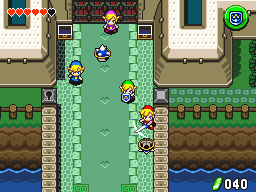
4 Swords began as a link up extra in the GBA port of Link to the Past. Nintendo was trying to sell connectivity, and 4 Sword was their way of shoehorning it into LttP. The version I played was rereleased as a free download as part of the Legend of Zelda’s 25th Anniversary. Essentially, it is Legend of Zelda: The Arcade Game. It is a mix of traditional Zelda dungeons with some Gauntlet like sensibilities.

Gone from 4 Swords are all of the series overworld and story parts. It is just dungeons. There is also no gradual accumulation of tools; you have a maximum of two at any given time. The emphasis is on getting the best use out of limited tools and on cooperation. 4 Swords is ideally a multiplayer game. I, unfortunately, was unable to play it that way. It is playable in single player, with one person alternating control over two Links. It is actually a lot of fun. The dungeons aren’t particularly complex, they are randomly generated, but there are some novel cooperation puzzles. The arcade game comparison comes in with 4 Swords goal of collecting Rupees. The player is scored on how many Rupees they collect. In multiplayer this adds a touch of competition, with each player trying to get the most Rupees, but in single player it just makes collecting the Rupees more important than usual.

It is certainly not the full Zelda experience, but there is certainly a lot to love. While the initial dungeons fall into the usual Fire/Forest/Ice variety, the bonus dungeons are neat. They are done in the style of previous Zelda games. One looks like LttP, another Link’s Awakening and the last looks like the original Legend of Zelda. It is really cool. This is a fun distraction rather than a full game. Definitely not an essential experience, but a worthy addition to the Zelda series.