Dora and the Lost City of Gold

I am way too old to have memories of Dora the Explorer, but I am unfortunately old enough to have memories of babysitting children who are now teenagers who likely have fond memories of Dora the Explorer. For some reason, I found myself wandering into the theater to watch the live action adaptation of a cartoon for toddlers. I was shocked at how much I enjoyed it. It is still a movie for kids, this time more for the pre-teen set, kids that still have that naivety of youth and are anticipating/dreading high school. This move is just about perfect for them; both thoroughly fun and entertaining and entirely wholesome.

The first place this movie shines is with its entirely overqualified cast. Saving the kids for a second, this is a movie with spots for Michael Pena, Eva Longoria, Benecio Del Toro and Danny Trejo. These adults all have small roles, but they make the most of their short time. The most meaningful presences there are Pena and Longoria, who play Dora’s parents with a just the right amount of encouragement and concern. Dora, played by Isabella Moner, is the engine that drives this movie. She is perpetually upbeat, but not stupid. The movie does a great job of showing her competence in the jungle before uprooting her for the city and having her look like a doof. Then, it flips it again to put her back in the jungle. The other kids, Diego and two new characters (I guess, I’m not a Dora expert) are pretty fun. Diego is Dora after having the exuberance sanded off by years with the more cynical city folks. Randy is a somewhat dorky everyman, who knows the tropes of the adventure stories Dora riffs on. And Sammy is the classic alpha smart girl, who is simultaneously jealous, dismissive and competitive with Dora. It isn’t anything new or groundbreaking, but it is fun. Finally, there is Eugenio Derbez, who guides/is guided by Dora through the middle portion of the movie. He is not quite incompetent but also not quite adept, and mostly serves as the butt of jokes for the kids.

Some of the most fun parts of Dora are how the movie adapts the specific hallmarks of the show into this live action format. There is a big change of perspective scene near the end that plays with this, but there are also moments throughout that do similar things. Dora’s talking to the camera asking 3 year olds to count to 4 is now her talking to her audience (it is unclear if she actually has one) for youtube videos she is making. Boots the monkey is just a monkey, though he is a horrible CGI creation rather than an actual monkey. Inexplicably, Swiper is a talking CGI fox who just so happens to be working for the bad guys. It is weird, but it somehow works.

The plot is just complex enough. To start with, Dora’s parents are sending her to live with her cousin in civilization after she grew up in the jungle with them, a pair of college educated archaeologist. This is both for her development and because they think they found a lost city and can’t take her with them. So the first act has Dora trying to adapt to live in the big city. Then she loses contact with her parents, and is kidnapped during a trip to the museum. Along with her is her group of not quite friends. From there, they try to find Dora’s parents, escape the dangerous jungle and find the lost city. It nails that Indiana Jones like personal bickering while dealing with external threats tone perfectly. It is really just a fun adventure.

Dora and the Lost City of Gold is not going to knock anyone’s socks off. It is a perfectly good movie, especially for adults with kids the age of the intended audience of this movie. It is entertaining enough that they will not be bored and good enough that the kids will hopefully be enthralled. There is something to say about selling nostalgia to progressively younger movie watchers, as usually they are selling the entertainment of youth back to adults, here they are selling memories of babyhood viewing to pre-teens, but I am not the one to talk about that.

***1/2

The Kitchen

I wanted to like The Kitchen movie more. I really wish it was better. However, The Kitchen is too muddled and rushed to really be worth seeing. That is despite strong performances from all three of its main characters.

Melissa McCarthy, Tiffany Haddish, and Elizabeth Moss play the wives of mobsters who in the opening scene of the movie are caught and sent to jail. The family agrees to take care of them, that promise turns out to be less than expected mostly thanks to the general fecklessness of the men. So the three women start to take things into their own hands. It starts with taking protection money for local businesses, but starts to expand from there. Things really take off when Domhnall Gleeson shows up. He had to skip town after doing a hit, but is back now that things have cooled. He also has a thing for Elizabeth Moss and no problem being their muscle. The three women not only survive after taking over, they thrive.

They do so in different ways. McCarthy takes charge and mostly keeps her quiet PTA mom persona, but is clearly more in control. The abused Moss almost gleefully takes to her new power, reveling in her role as the wild card. And Haddish stops playing the mousey little wife starts to show her real intelligence and ambition.

There is a lot of stuff that looks good on paper. It is like a lesser Scorsese mob movie in some ways. Good performances from its central characters. It just doesn’t know what to do with them. We get their evolution, but we don’t really see what that means every day for them. We don’t really know what they were like before. We don’t know what they are like after, for that matter. The movie refuses to show things. Moss was abused by her husband, but the movie doesn’t show it, it shows the aftermath and you have to draw conclusions. It will show a lot of murders, but not that. It is one thing to have twists and revelations, this movie makes every development feel like a twist by not giving the viewer enough information to understand the situation.

One problem with the movie is that it doesn’t seem to know what to do with the fact that for all their power, the women are becoming monstrous. That is no different from their husbands or the people they interact with, but the movie refuses to reckon with this idea. McCarthy’s father starts very opposed to what they are doing. He is the only person in the movie that seems to display any discomfort with crime or murder. Other than blood being gross, I guess. The problem is the movie raises these concerns; in part by having her dad brings them up. We, as viewers, want to celebrate the held down Moss finding some control of her life. But are we not to feel disturbed that she shows her growing confidence by killing people? Maybe I misread the movie, I was watching it as something with one foot in realism, but the way it deals with things is more of a cartoon.

The Kitchen just feels like a big a missed opportunity. Some refinement to the themes or a better focus could have turned into a really good mob movie. Instead, we got this scattered mess

**

Fast & Furious Presents: Hobbs & Shaw

The best parts of the Fast & Furious franchise have always been the nonsense parts. That is why no one cared about the first couple of entries in the series; they were at least partly trying to be movies. The problem with the last couple of movies isn’t that there was too much nonsense, it was that too much of the nonsense wasn’t as fun as it should be. This was a much bigger problem with Fate of the Furious than Furious 7 (hey, rankings are fun, see the bottom of this post), but some unwieldiness has been creeping into the series since just after Fast & Furious 6. This spin-off is the most ludicrous film in the series yet, but thanks to its two stars and some fun sequences, it also manages to be one of the best in the series.

Two stars is kind of misleading, as this is really a movie with three. Yes, Dwayne Johnson and Jason Statham’s characters are named in the title, but Vanessa Kirby is just as integral to the film as the two of them and is a more than credible action star. But back to the named stars. This movie makes me fear for future F&F movies, as the two most charismatic performers in the series are now confined to their own spin-off. I am very on the record for my love of The Rock, and this movie plays hard into his best traits. I am also a big fan of Jason Statham. They are both playing essentially to type, but they are fun in their usual personas. The movie doesn’t quite sell their animosity to alliance as well as it could, but if you want me to not like a buddy spy movie starring The Rock and Jason Statham you are going to be disappointed. Last but not least is Idris Elba as the villain Brixton Lore, a cybernetically enhanced super-soldier.

The plot is pure nonsense, but really no more nonsensical than the average James Bond or Mission Impossible movie. There is a deadly virus, which for complicated reasons Kirby’s Hattie Shaw injects into herself to keep it away from Lore. Luke Hobbs and Deckard Shaw are dispatched to find her. Soon they do and the three of them have to go on the run from Lore. What sets it apart is just how ridiculous it lets itself be as they solve these problems. The Rock jumps from a high rise to chase villains repelling down. Statham drives a Lamborghini underneath two trucks. There are many other things that I really don’t want to spoil, from cameos to actions bits. Suffice to say, Hobbs & Shaw is stuff with amazing, fun, nonsensical stuff.

The dialogue, mostly, is the same kind of ridiculous fun. They try really hard for banter between Rock and Statham, but their hyper-masculine posturing has fun elements. It still manages to feel like a Fast & Furious movie. Cars play an outsized role in everything. It all comes down to family, though the movie seems to forget that Statham’s character had a brother.

Fast & Furious Presents: Hobbs & Shaw is everything I’ve liked from the recent F&F movies. It is big, dumb, explosive fun. It is a tone that few other movies manage at all. Bring on Hobbs & Shaw 2.

9. 2 Fast 2 Furious

8. Fast & Furious

7. Fate of the Furious

6. Fast & Furious 3: Tokyo Drift

5. The Fast & the Furious

4. Furious 7

3. Fast & Furious Presents: Hobbs & Shaw

2. Fast & Furious 6

1. Fast 5

Once Upon a Time . . . In Hollywood

Every new Quentin Tarantino movie is an event. His reputation has taken something of a hit over the last year or two, but none of that has anything to do with the quality of his films. Once Upon a Time…In Hollywood is simultaneously something of a culmination of all of his previous movies and a departure from them. For the bulk of its nearly three hour run-time, it eschews the violence that tends to permeate Tarantino’s work, as well as his distinctive dialogue rhythms. It still feels very much like a Tarantino movie. (By the way, I am going to end I am going to include a ranking because everyone loves rankings.) Once Upon a Time…In Hollywood is somewhat difficult movie to explain, but it is certainly a movie worth watching.

This movie is a pure hangout movie; a movie you just want to put on to hang out in the world and with the characters. Many Tarantino movies are hangout movies to some extent, but none are so thoroughly as Once Upon a Time…In Hollywood. It seems almost plotless, though that isn’t really accurate the movie does feature a lot of its stars just going about their business. Leonardo DiCaprio’s Rick Dalton takes a meeting with an oily producer, played by Al Pacino, then works a day on the set of a western TV show. Brad Pitt’s Cliff Booth drives Rick around and fixes his antenna. He also picks up a hitchhiker who leads him on an adventure to Spahn Ranch, where he comes face to face with the Manson Family. Then there is a thread of Sharon Tate, played by Margot Robbie, who goes about her business, doing a little shopping and, in one of the standout sequences of the movie, sitting anonymous in a theater taking in the audience reactions to recent movie she was in.

It is also a movie about Hollywood mythmaking. Aside from the real actors portrayed in the film, there are its two leads: former TV cowboy Rick Dalton whose transition from TV to movies failed and he is scared he is on his way out of the industry, as well as his stunt double and gopher Cliff Booth. Most of the action is handled by Booth, while Dalton is something of a mess. Dalton’s primary concern seems to be his personal myth. He is concerned about what playing the villain of the week on various TV shows will do to his leading man credibility and the public’s perception of him and his most famous character Jake Cahill. He knows losing fake fights makes him seem like less of a tough guy. It is all about managing how he is perceived. Cliff, for all that he is the doer of the pair, has his own concerns with perception. While Rick’s star might be fading, Cliff is basically unemployable because of his reputation. There are rumors that he killed his wife, and the movie deliberately leaves the truth of those rumors ambiguous. He also remembers getting fired off of the set of The Green Hornet after fighting with Bruce Lee. While the event occurred, the truth of Booth’s recollection is suspect. Then there are the movie’s run ins with actual historical figures. Sharon Tate gets the bulk of the screen time, but others appear as well. Other than the ending, the scene that most plays into the overt mythmaking nature of the film is when Robbie as Tate is in the theater watching actual Sharon Tate on screen in The Wrecking Crew. It puts the artificiality of it all in the viewers face. This, however, is a movie that revels in that artificiality. What is important isn’t what actually happened, but having fun imagining your version. Leonardo DiCaprio as Rick Dalton didn’t appear in The Great Escape, Steve McQueen did. And not Damian Lewis as Steve McQueen, actual Steve McQueen. Hollywood is a place where you can make whatever story you want happen, so why shouldn’t a movie do that. It feels like what Tarantino has been playing with in his last four or so movies, at least.

Saying more feels like it would spoiling the events of the movie. This isn’t really a movie that depends on being unspoiled, but I am tempted to run down a list of my favorite scenes rather than reviewing it. I guess I’ll finish by saying the movie has a very good dog and Pitt and DiCaprio are charming.

*****

Rankings

9. Death Proof

8. Reservoir Dogs

7. Django Unchained

6. Pulp Fiction

5. The Hateful Eight

4. Kill Bill Vol. 1 & 2

3. Once Upon a Time…In Hollywood

2. Jackie Brown

1. Inglourious Basterds

The Lion King

I didn’t like The Lion King (2019). My complaints are essentially the same I’ve had with other ‘live action’ remakes of Disney’s animated movies like Beauty and the Beast and The Jungle Book. Not only is there nothing about the movie to recommend it over the original, it add feels saggy and tame on its own merits.

Everyone knows The Lion King. It is the tale of cat Hamlet, a young prince must loses his father and fights for his throne against his treacherous uncle. The story works in the broad strokes as well as it ever did. There is still a big break in the middle of the movie that doesn’t quite work. But it still does a good job of setting up its characters and their philosophies and having them come into conflict. It is too bad there is a strictly better version of this movie that already exists.

There is a clip running around comparing the new version of “Hakuna Matata” with the old one, with the comparisons illustrating just how lacking the new one is. That is illustrative of the entire movie. The animated version has a lot of energy, a lot of coming because it is not limited by what actual animals can do. They could draw a lion doing anything, like swinging on a vine or standing on pyramid of singing animals. Real, or realistically animated, animals cannot do that. So instead of anything interesting, characters just walk around while singing. It feels like all the personality is gone. It is hard to create human emotion in a realistic cat face, let alone a warthog. The hyenas all look the same. The baboon mystic Rafiki can no longer do kung fu, Timon can no longer hula dance. Nothing interesting can happen. In making the lions look real, it makes it a lot harder to tell Scar and Simba apart in their big climactic fight scene. It is just two tawny beasts in the dark batting at each other.

The problem with this movie is that unless you are completely enamored by the digital effects wizardry, there is absolutely nothing about that makes it worth watching over the original. It is the Lion King, with less personality, less energy, just simply less. The movie tries to find more for its female characters to do, but it mostly fails. Giving Nala and Sarabi a few more lines really changes nothing. The only thing that I would even consider calling an improvement is Billy Eichner as Timon, who makes him a little more acid that Nathan Lane did. But even then, Lane was great.

The Lion King has made a bunch of money for Disney. So we’ll get more of these. And I’m part of the problem, I guess, because I went to see it. But I am tapping out. I’ve enjoyed exactly one of these remakes and The Lion King is likely the last one I’ll see in a theater.

**

Toy Story 4

I was not too excited for Toy Story 4. It seemed really unnecessary to me. That is not usually a term I like to throw at movies; what movie is necessary when you get down to it, but it seemed to me that Toy Story 3 really wrapped things up for these characters and there really wasn’t anywhere to go. I am not sure Toy Story 4 changed my mind, but it showed that, if it were somehow in doubt, Pixar can still delight with fun and emotionally resonant movies that work for people of all ages.

Toy Story 4 deals with endings in a different way than Toy Story 3. Toy Story 3 was more about mortality. With Andy grown, the toy characters’ lives were essentially over. They were being boxed up and placed in the attic, never to be played with again. Or at least not until Andy had kids of his own. While the toys spend the movie reconciling themselves to their fate, including a harrowing scene in an incinerator, the movie becomes about Andy passing the torch to Bonnie. They are her toys now, she decides how to play with them.

The themes of Toy Story 4 mostly seem to overlap with those in Toy Story 2 and 3 without actually duplicating them. It feels a much more gentle movie than the previous entries in some ways. The villain of this movie is reminiscent of Stinky Pete from Toy Story 2. Like Pete, Gabby Gabby is a toy who has never had a kid, who has never been played with. Pete had turned bitter about it, tying his worth to his status as a mint in box toy. Gabby, on the other hand, wants nothing more than to be played with, and she lets her desire to be useful justify some abhorrent actions. Ultimately, the movie finds empathy for Gabby it’s refreshing and satisfying conclusion. That a toy is meant to be with its kid idea echoes TS2 without just retelling that story. It also echoes TS3 in how it deals with toys moving on from owners who have grown up.

One problem I had with this movie is how much most of the returning cast gets sidelined. That is a difficulty in doing sequels; if you do not add new characters, then it all feels the same, but if you do the new guys can overwhelm the old favorites. Toy Story 4 definitely goes the latter route. Woody is the star, and Buzz is given a decently large subplot, but most of the rest is focused on newcomers. And yes, I am including Bo Peep with the newcomers, as she is essentially a new character here. Forky is the most interesting and somewhat terrifying new addition. He is a toy Bonnie made in kindergarten, constructed out of a pile of trash. He sees himself as trash and wants nothing more than to return to the trash. Once Woody takes the time to talk with him and learn his motivations, they come to an understanding. Forky never really quite gets to seeing himself as a toy, but his motivations ultimately align with those of Woody. Bo Peep gets a significant reimaging here. In previous Toy Story movies, though not 3, she was mostly just a concerned voice. She was kind of Woody’s love interest, but that thread was never really explored. Here, she takes on a more active role and is essentially a new character. Part of the that is what happened between when she was separated from the rest of the toys and now, and part of that is just actually making her a realized character. She works amazingly well as a foil and counterpart to Woody. Sure, she is now a badass survivalist, but she shares Woody’s loyalty and sense of responsibility. Making her work as a character was essential to making the biggest moments of the movie, especially the ending, work and Pixar really made her work.

The thing is, even though I would call this a more definitive ending than in Toy Story 3 in some ways, it also leaves many avenues for future Toy Story movies, should Pixar wish to pursue them. The less enticing option is to follow Woody’s new adventures as a lost toy, as he helps other toys find homes. While I can imagine a full on Western themed Toy Story movie using this set up with Woody as the central figure, that route is less enticing because we have four movies of Woody’s story already. Let him have his ending and let’s see what a Toy Story movie looks like focused on Buzz or Jessie or any of the rest of Bonnie’s toys. Toy Story 4 is mid-tier Pixar. That still means the movie is hitting a high bar of quality. As much as I prefer it when Pixar is exploring new stories, if putting out a Toy Story movie every half decade is part of the deal, then I am all for it.

****1/2

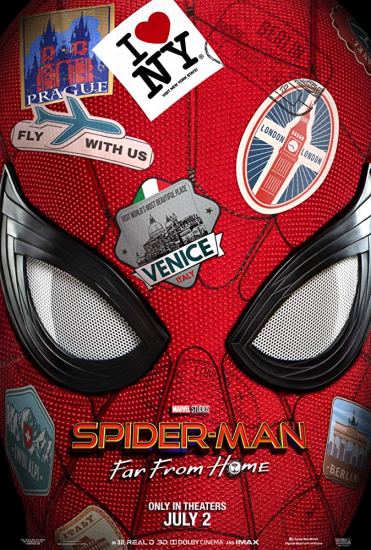
Spider-Man Far From Home

I guess I am just not as much of a Spider-Man fan as most people. I like the character well enough, but I didn’t gush over Homecoming like a lot of people did, and I certainly didn’t feel as strong about Into the Spider-Verse as many people. I enjoyed both movies, but I’d be lying if I said they had really stuck in my mind past a week or so. I think I feel the same way about Spider-Man: Far From Home. I liked it well enough; it is a solid entry in the ongoing Marvel saga. It is a coda to the story that wrapped up with Endgame, a movie that furthers Spider-Man’s adventures while dealing somewhat with the aftermath of the big movie.

One thing that is excellent is Tom Holland as Spider-Man. He does a great job of selling him as a teenager trying to do the right thing while being somewhat in over his head. His classmates are all really fun as well. Zendaya’s reveal as being MJ at the end of the last movie was groan inducing, but she is just about perfect as his love interest and eventual ally here. (To be clear: I did not like the end of movie call me MJ moment; Zendaya is great. It is the same problem as with The Dark Knight Rises’ Robin bit at the end. Don’t do that crap; just have the character be the character the whole movie.) Jake Gyllenhal mostly makes Mysterio work, though he remains kind of an empty shell of a character at the end, with his motives and personality largely just gaps that were never filled in.

One thing I haven’t liked with the current iteration of Spider-Man is making him Iron Man’s side-kick. Which is exactly what he has been in every MCU movie so far. The dynamic works well enough; I think DC should take notes for their next Batman movie and any attempt to integrate Robin. But to me it takes away from Spider-Man some. The fact that he is on his own is part of the appeal. Sure, in the comics he gets help from various sources, like the Fantastic Four, but the fact that he was the young hero that was not a side-kick always seemed to me to be a key element of his popularity.

Far From Home pushes Spider-Man’s limits. The first movie was all about Peter accepting his role as the friendly neighborhood Spider-Man; this movie pushes him immediately out of that neighborhood. The world has changed since he fought Vulture and Peter has to change with it. I just don’t know that this movie really works on the macro level. Him dealing with the legacy of Tony Stark doesn’t really feel like Peter’s responsibility. It only happens because Tony was apparently a mad man, creating tons of weaponized drones with few safety features. Nick Fury and the agents formerly known as SHIELD are so out of place I thought they were part of Mysterio’s illusion.

Stronger are the parts that deal with Peter’s personal life. His struggles to admit his feelings for MJ and his struggles with keeping his identity secret are both great Spider-Man stuff. That is what I wanted to see more of.

My complaints from a few years ago about MCU movies being all polish and not substance kind of went away for a bit, but that is exactly what this movie feels like. It feels polished to the point where it loses a lot of its personality. I don’t hate, I liked it, but it feels a lot like one of those MCU movies that people are going to forget exists in a few years, only coming up when someone throws is smack dab in the middle of Marvel movie ranking. Bring on the next phase.

***1/2

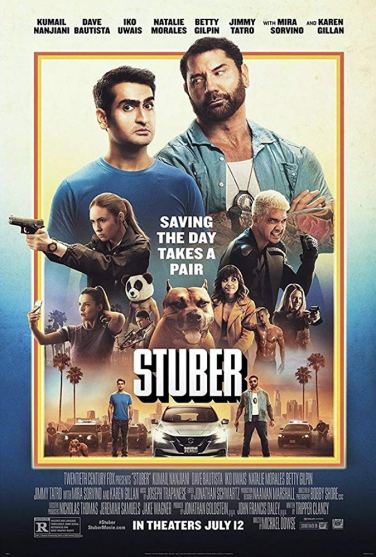
Stuber

I wanted to like Stuber. I really did. Kumail Nanjiani is a funny guy. Dave Bautista has really developed into a great screen presence. I love buddy cop movies. This one, though, never quite got up to speed. It is somehow less than the sum of its parts, with just enough scenes and jokes that work to keep me from actively disliking it but enough dead space and repetition that it ended up being not particularly enjoyable.

Stuber opens with Vic (Baustista) and his partner, played fellow Guardian of the Galaxy Karen Gillan, attempting to arrest a drug dealer in a hotel. Things go badly after the aging Baustista loses his glasses and can’t see to take a shot. A year later, Bautista is still on the hunt for this drug kingpin. The movie then introduces Stu, a hapless sporting goods store employee and part time Uber driver who is about to enter into business with his longtime friend and equally longtime crush. In order to cover his portion of the start up investment, he is spending his evenings as an Uber driver. He gets matched up with Bautista, who had just had eye surgery and gets roped into driving him all over L.A. after a lead in his hunt for the drug dealer comes to light.

It mostly plays off the different energy of Nanjiani and Bautista. Bautista is hyper-masculine, an old school man’s man. Nanjiani is more of a sensitive modern man. It is not a new set up at all, but big parts of it work because the actors involved. It helps that, to the script’s credit (or maybe at my memories fault) both characters have something of a point. Stu’s romantic troubles are all his own doing for not having the courage to tell Becca his feelings. Meanwhile, Bautista’s repressed nature is destroying his relationship with his daughter.

While none of them get much to do, Stuber has a solid supporting cast. Natalie Morales plays Bautista’s frustrated artist daughter. Mira Sorvino makes an appearance as Bautista’s supportive Captain and Betty Gilpin has an underdeveloped run as Becca.

At times, Stuber really brought Hot Fuzz to mind. It pulls some of the same tricks, like setting up buddy cop cliches as ridiculous before happily engaging in them. But that comparison shows how Stuber is lacking. Compared to the masterful Hot Fuzz, Stuber feels sloppy and unfocused. It takes a long time to even get its buddy pair together, let alone to get them acting as any kind of team. Stuber gets into a kind of unfortunate rhythm where it will have a genuinely good and funny scene, but then just kind of reset everything. Stu will make the same jokes about Vic, Vic will lob the same insults at Stu and then the movie will arrive at its next destination. Some of those are good, some aren’t, but there is no real sense of building momentum.

There are too many talented, funny people involved in Stuber for it to be a complete waste, but it feels like a missed opportunity. There are glimpses of a really fun movie, but that movie just can’t seem to get out of its own way for any sustained period of time.

**1/2

Men In Black: International

In most ways the fact that Men In Black International landed with a widely ignored thud was predictable. Yes, it has two movie stars in Tessa Thompson and Chris Hemsworth at the front, but I get the feeling that no one wanted this. It is continuing a series that, for all that the third installment was quite successful, seemed to have run its course. It is also continuing that series without any of the cast that made that series a hit, a problem for movies largely sold on the mismatched buddy cop pairing of Will Smith and Tommy Lee Jones. Which is why I was surprised that MiB: International was actually quite fun.

To be clear, the movie isn’t breaking any new ground, nor does it appear to be trying particularly hard. Instead, it jumps into the playground set up by the previous movies and just sort tells a story in it, relying on the charm of its stars to really sell things. The only real difference between this movie and the original is that you’ve seen all of this before.

The weakest part of the movie is its nested opening. It starts in 2016, when Agent H and High T (a joke that certainly doesn’t get old), played by Chris Hemsworth and Liam Neeson, arrive at the Eiffel Tower to repel an alien invasion. Before we see them victorious, we cut to 20 years earlier, when young Molly witnesses an alien and her parents getting their minds wiped by Men In Black agents. Then it cuts to the present, with the now adult Molly trying to join the Men in Black. It is more disorienting than it needs to be, though all of it is relevant by the end of the film.

Without spoiling much, Molly, played as an adult by Tessa Thompson, does eventually find the MiB, gets recruited as an agent, her designation being M, with her first mission sees her sent to the London office, for training and because O thinks there is something wrong there. While there, she is teamed up with Hemsworth’s Agent H, whose reputation is some combination of prodigy and wash-out, to first babysit an alien dignitary and then investigate why that alien was attacked. That investigation takes them around the Mediterranean and the Middle East as they learn about a renewed threat from the aliens that H and T defeated at the start of the movie. This is compounded by M learning that there is a double agent within the London branch and not knowing who that is.

The movie mostly coasts on the charm of Thompson and Hemsworth, and a movie can get pretty far on their charm and chemistry. Hemsworth, as always, is much more interesting as a talented, overconfident screw up than just a traditional hero, and Thompson works as the level headed outsider. It is like a strange inverse of the Smith and Jones pairing, with the experienced agent being the brash one and the newcomer the calmer one. At times the movie hints at a romantic pairing between the two, which us unsuccessful and does not work. The movie also kind of loses the secretive nature of the organization. It is still nominally secret, but that secrecy is hard to maintain with how blatant they are about the alien’s existence at times.

Men in Black; International is perfectly serviceable summer fare. It is light, charming and not insultingly stupid. It is a movie I have a hard time seeing as someone’s favorite, but it is also a hard movie I have a hard time forming any truly negative opinions about. It is just a sort of comfortable middle ground of quality.

**1/2

Yesterday Review

Yesterday mostly wastes an interesting premise telling a largely enjoyable little love story. Sure, it is just as much Boomer nostalgia bait as Bohemian Rhapsody or Rocketman, but Yesterday tries something slightly interesting. Yesterday plays with an alternate reality concept and a little with the nature of fame. It ends up being just slightly more on the side of a success than a failure.

The high concept premise is that after a worldwide blackout, everyone except struggling musician Jack Malick forgets about the Beatles. Armed with his memory of Beatles songs, he begins to sell their work as his own. There are a lot of fertile story telling ground to go from here, about separating the art from the artist, about the specific circumstances around the Beatles success, about the effect art can have on the world. Yesterday is not interested in any of that. Any other blackout difference are only there for jokes.

Instead, Yesterday focuses on the stillborn romance between Himesh Patel as Jack and Lily James’s Ellie. She has operated as his manager and roadie for him for years, but once he starts to be a success with the Beatles music, their paths diverge and he has to choose between being a rock star and her. He keeps choosing stardom, until the end. There is a lot to criticize about this development, but I found that the love story largely works. It is clear from the beginning that both of the characters love each other, but both are afraid to jeopardize the friendship they have for the romance they might have. It is not a new story. But I find that it works in the context of movie, if only because Lily James is adorable.

A lot of the movie’s humor lands, especially Kate McKinnon as Jack’s new manager/Svengali. She doesn’t have any illusions about being there for anything other than the money, outright telling Jack that she doesn’t care about him, he is a product to her. Also, his incredibly incompetent and drugged out roadie Rocky is a lot of fun as he bumbles though just about everything.

The way the movie deals with the music is also fraught. It just takes that someone showing up with about two thirds of the Beatles’ hits would immediately translate into musical stardom as assumed. It does not acknowledge the passage of time between when The Beatles were popular and now. People would love the music in this alternate reality because they love it now.

There are also some just plain strange turns. Like a late movie encounter with a couple of other people who remember The Beatles and a visit with a man who gives some insight.

I am being somewhat harsh on what is, for the most part, an enjoyable little trifle. Yesterday is an excuse to watch a little romance while hearing a lot of Beatles covers. It succeeds on those very limited terms. Any other implications or insights are completely beyond the scope of the movie, making it feel more disappointing that it is.

***