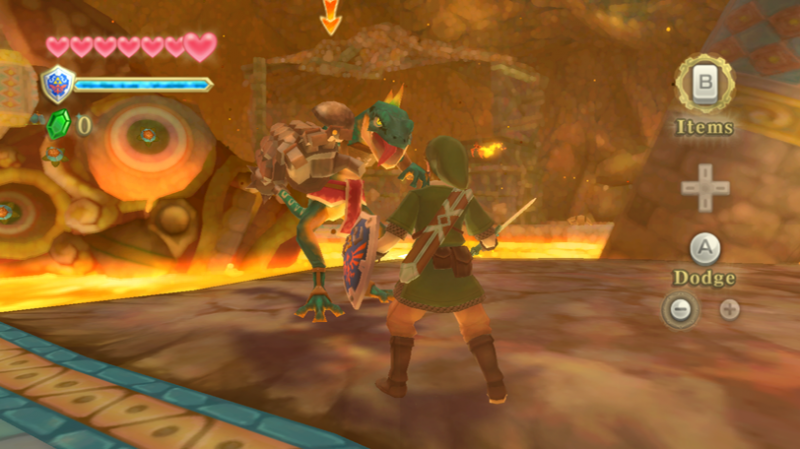
Blogging plans for 2012

Yeah, I took a week off with the new year. I have plenty of big things planned for the blog in 2012. My goal for the year is 150 posts, which is actually a few less than last year. I just don’t see myself having the time I had last year to write here. Also, I think aiming for slightly fewer posts will help me make the rest better. We’ll see about that.

I intend to continue my monthly projects, like Video Game Archaeology and What I Read. I would like to bring back the comic book character spotlights, but those are a lot of work and will probably have to wait until the second half of the year. There will still be movie reviews and frequent video game thoughts. Most of the stuff I did last year. I don’t plan to continue doing comic issue reviews. I’ve just never been comfortable reviewing incomplete chunks of stories. I do want to keep writing about comics, but I don’t like the review format.

As far as new things, I have planned a complete reread of Robert Jordan’s Wheel of Time series to coincide with the release of the final book later this year. I also am planning a series of posts as a complement to VGA that will look at popular, important games, starting with a replay of the entire Legend of Zelda series. Another new thing is my planned continued reread of the Johns/Goyer JSA, the first part of which I’ve already posted.

One last change is that I’d like to make my blog a bit more personal. It is my blog, damnit, I want to write about me. I still plan to focus on video games and other supremely unimportant things, the subtitle to this blog is still my mission statement, but possibly a more me-centric way.

Top 10 Games of 2011

With 2011 coming to a close, I am looking back on the games that I played this year and like all great minds, I am making a top 10 list of my favorite games. Now, I am limited to only Wii and handheld games, since those are the only systems I own and I only played about 20 new games this year. Most of what I played was several years old at least. So this is a somewhat limited list. Let’s get on with it.

10. The Legend of Zelda: Ocarina of Time 3D
This is still a phenomenal game, even after 15 years. The only reason it isn’t higher on the list is that it is an only barely touched up port of a 15 year old game. Still, it is a good port of a great game. If you haven’t played Ocarina of Time, what is wrong with you?

9. Okamiden
If I had stopped this game halfway through, it would probably have been 4 or 5 spots higher on the list. Okamiden started out a delightful romp, but the longer it went on the less fun it was. It looks and sounds great, but the early simplicity is replaced not with increasingly complex difficulty but with sheer tedium. It is hard not to compare Okamiden to the DS Zelda games and find it lacking. It has a cohesive, explorable over world, but it stumbles nearly everywhere else in comparison. Still, it is a very good game, if not a great one like its predecessor.

8. Pokemon White
It is a new Pokemon game. There are a number of changes on the periphery, but the core gameplay remains unchanged. I plowed through to main game right as I got this, but haven’t felt the need to go back for the post game yet. Still, it’s a Pokemon game, you already know it you like it or not. I do like it.

7. Kirby: Return to Dreamland
This doesn’t quite reach the magical heights of Nintendo’s best games, but it is still a terrific co-op plat former. This is the game Kirby fans have been waiting for since Kirby 64 and it didn’t disappoint.

6. Professor Layton and the Last Spector
More Layton is always good. There is little new in this fourth entry (except for London Life, which I’ve barely touched) but as long as there are new puzzles, I’ll buy new Layton games. Plus, newcomer characters Emmy and Inspector Grosky are some of the best new characters of the year. Good, good stuff.

5. Solatorobo: Red the Hunter
Solatorobo is a game that whatever its faults, of which there are several, it is so earnest and heartfelt that is it hard to hold it against the game. It is a delightful romp through a charming, fantastical world. Sure, the game never really moves beyond picking up things and throwing them at enemies and the plot goes off the rails near the end but the bulk of the game is pure cheerful fun.

4. Kirby: Mass Attack
While Return to Dreamland was a classic Kirby platformer, Mass Attack is one of the pink blob’s experimental games. One that worked out better than most. It is a surprisingly intuitive combination of platformer and RTS that is simply a blast to play. If you own any sort of DS you should own this title.

3. Ghost Trick: Phantom Detective
This comes from the makers of Ace Attorney, and obviously so. It has the same wacky yet dark story and some top notch writing. The story is really great and the puzzle-y gameplay is nearly perfect.

2. Tactics Ogre
I love a good TRPG, and this remake of Tactics Ogre may be the best I’ve ever played. It comes from the same stock as the classic Final Fantasy Tactics and it shows. I put more than 60 hours on this thing and didn’t quite beat it. This game is nearly perfect.

1. The Legend of Zelda: Skyward Sword
This isn’t even close. I loved Skyward Sword. I loved every part of it. The new run button, the motion controller sword fighting, you name it. Plus, Groose is the best new character of the year. Every part of this game is great.

LoZ Skyward Sword Review

This post was supposed to be more of a well-considered review than the unabashed gushing that was my previous Zelda: Skyward Sword post but now that I’ve beaten the game, I realize that all I want to do is gush about it some more. I absolutely loved The Legend of Zelda: Skyward Sword. There are some flaws, there are with every game, but they are tiny, negligible things barely worth mentioning and only worth noting so that they might be cleaned up in the eventual sequel. Skyward Sword is exactly what I love about video games.
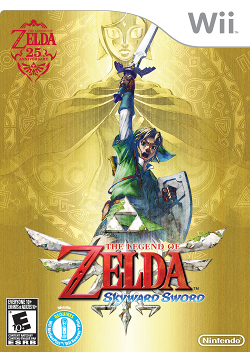
Among the game’s many strengths, perhaps the greatest is that it never forgets that it is a video game. Unlike most of the series 3D entries, Skyward Sword is more closely descended from the original Legend of Zelda, rather than from Ocarina of Time. Ocarina and its ilk, as good as all of those games are, try to make Hyrule seem like a real place. OoT’s Hyrule Field is big and empty, impressive for its time and great hub for that adventure, but ultimately barren. Skyward Sword dispenses with the notion that this is a place that could exist outside of the confines of the game. The areas are no longer one large, connected place, but discreet sections. This may seem a blasphemy to longtime Zelda fans, but what it loses in cohesion, it more than makes up for in playability.

Each of the games 3 main overworld areas feels more like a section of Zelda 1’s world that any other game in the series. It isn’t just a path to lead you to the next dungeon, with the odd puzzle and token enemies to deal with. They are intricately designed gauntlets of puzzles and foes that are nearly as meaty as the dungeons themselves. There is a fine attention to detail apparent when you return to each area later in the game, armed with new items and able to discover new shortcuts and areas previously unavailable. While exploring the worlds of previous Zelda’s was fun, they were always empty, even with the number of secrets hidden about. (While something of an exception for Majora’s Mask, that game too was dense.) In Skyward Sword, any time you are on the overworld it is game time. No more running straight through an area, at least not the first time. This makes each section feel as intense and satisfying as the dungeons themselves.

The dungeons, the most important part of any Zelda game, are satisfying as well. After the first few simple dungeons, they really expand into true meaty obstacles. They also have some of the best, most innovative designs in the series. The dungeons feature effective use of the item found there, but aren’t wholly reliant on them. There are a few straight dungeons, but there is also an old abandoned pirate ship and dilapidated factory. The best dungeon is probably the Ancient Cistern. There are only two floors, but one represents heaven and the other hell, with completely different challenges on both floors. And the boss is one of the best in the series. Which makes it an anomaly in this game. If there is a weakness to Skyward Sword, it is in the boss battles. Several are repeated, several are boring, and one is downright laughable. Many of them are still decent from a gameplay perspective, but their look and how easy it is to beat them make sure they are a disappointment.

On the presentation side of things, Skyward Sword also excels. The graphics are some of the best I have seen, no need for qualifications about that being for a Wii game. Regardless of what it lack in technical power, Zelda looks good. The art design covers any deficiencies it might have. The soft, impressionistic backgrounds are magnificent, popping with life in color as it goes from vague dots to full clarity. I wish all games could look this good. The music is amazing as well, which is no surprise. Every Zelda game since the first has sounded wonderful.

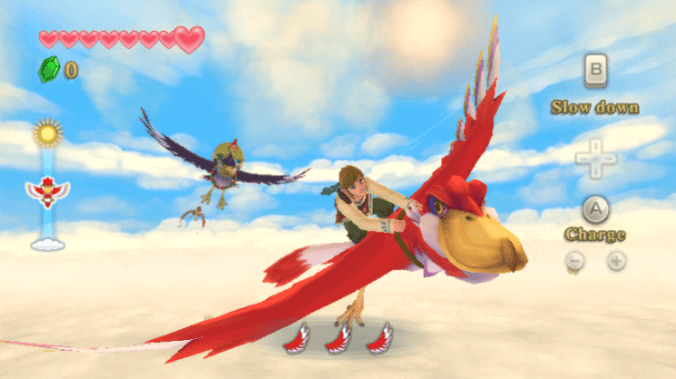
The story and setting are likewise excellent. It is the usual Link must save Zelda stuff, but it is better told than normal. The first hour or two of the game, which are a bit slow, are used to set up an actual relationship between Link and Zelda. It also sets up the people of Skyloft, who are easily the best incidental characters of the series. Each of the townsfolk is well characterized and feels more real than most games, despite Zelda’s lack of voice acting. With just a word or a grunt, Skyward Sword imbues its characters with more life than games with hours of cut scenes, whether it is Peatrice’s bored grunts or the nervous jittery Fledge. The real star is the buffoonish, bombastic Groose. He starts as the school bully, who has a crush on Zelda and is jealous of Link. Over the course of the game, he develops into one of the greatest ally any Link has had. While the town of Skyloft in not especially big, the characters therein fill it with amazing life.

It all comes together into a game, that while not without flaws, is one of the greatest gaming experiences of the year, if not the generation. It shows that Nintendo still is the best at crafting exciting, innovative, lengthy adventures. No one comes close to offering an experience similar to Zelda.
Tap, Tap, Tapping away!

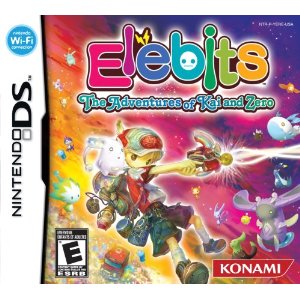
Still playing my DS all the time? Damn straight. After I positively devoured Kirby Mass Attack, I expected to get to jump right into the second of the three DS games I am anticipating this fall, Solatorobo. Unfortunately, for some reason Amazon did not ship the game until Thursday, though it was released on Tuesday. No big deal, but I don’t pay for Amazon Prime to get my pre-ordered games a week after they come out. (Actually, I don’t pay for Amazon Prime at all, but that is beside the point) During the interminable wait, I had to play something, so I broke out Elebits: The Adventures of Kai and Zero, a game I picked up out of a bargain bin, probably during one of GameStop’s “Buy 2, Get 1 Free” sales.

I am enjoying it much more than I expected. There is no escaping the fact that this is primarily a kid’s game, what with the childish graphics — by which I do not mean 2D, but that the sprites are large, simple and big headed — and complete lack of difficulty, but there is enough substance under the candy coated exterior to keep me playing. Elebits is a rather clever mix of Pokemon and The Legend of Zelda tied around an annoying central mechanic. I cannot fathom why the game is built around tapping the DS’s bottom screen constantly, over and over and over. In order to power special skills and various contraptions around the game world, the player must collect charge. This is done by tapping on little creatures, the titular Elebits, which pop out from under rocks and out of trees. It isn’t hard, but it is tedious. It is like a Zelda game that is half collecting Rupees that try to run away from you. This stupidity drags the first hour or two of the game to an anti-fun halt.

The rest of the game has been fun. Easy but enjoyable nonetheless. Despite not having actual dungeons, Elebits plays like a Zelda game. That is a huge compliment. The biggest difference is that instead of finding new tools and magical items, the player finds Omega Elebits. These Omegas function identically to Zelda’s tools, with each one having a unique puzzle-solving ability. The Fire Omega, for instance, can spew fire clearing away path-blocking brush and the Ice Omega can create ice platform to let the player cross rivers. To further add to the Pokemon-ness is the fact that the player can evolve most of the Omegas, provided you feed them enough charge, that is.

You will be constantly interrupted from your pleasantly easy Zelda-clone to poke at the little Elebits on the bottom screen. The emphasis on charging does lessen as the game goes on. Your collection tank gets bigger, evolved Omegas cost less to use and the game start providing you with more high charge creatures to capture. Still, front-loading tedium is never a way to hook players. I put Elebits down when Solatorobo arrived in the mail, but one I finish that, and probably Professor Layton 4, I will be back to take on the last third of Elebits.