Tales of Vesperia

My rocky relationship with the Tales series continues with playing Tales of Vesperia. I believe I’ve written before about my experience with this series. Tales of Symphonia hit at just the right time for me, with its relatively bright tone contrasting with the PS1 rpgs I had been playing before that. I haven’t revisited it in the fifteen years or so since, but I have very fond memories of it. I had those same memories in the late 00’s when I tracked down copies of Tales of Legendia and Tales of the Abyss. Tales of Legendia is pokey and awkward, but honestly I found it largely charming. Tales of the Abyss, as I have previously explained, just rubbed me the wrong way. It may have been an improvement over Tales of Symphonia as far as systems go, but the plot and characters made me angry in ways that almost no other game has. Tales of the Abyss left such a bad taste in my mouth that I largely wrote off the series since then. I picked up a couple of games for the PS3 when they were dirt cheap, but I never really felt the desire to play them. A few hours of Tales of Graces f was all I played before deciding it just wasn’t doing it for me and putting it away. However, when I got my Switch, Tales of Vesperia just so happened to be on sale, so I thought I’d dip my toe in this series once again.

Tales of Vesperia mostly works, but everything good I have to say about it will be followed by something negative. Those negatives are easy to ignore in the early going, but by the time you invest fifty plus hours into this game they start to loom larger and larger. To start with one that is all on me, it appears that there is a lot of depth and strategy to the battle system. While I beat the game, I honestly can’t say the more intricate parts of the battle system ever really clicked for me. I mean, I generally understood it, but the harder I tried to work combos or use the overlimit system, the more I got destroyed. So I stuck with pretty basic combos and mixes of arts. It mostly worked. I am sure that people who took the time to learn the ins and outs of burst arts and the over limit gauge could do amazing things, but I had neither much aptitude for nor interest in learning how it worked. So getting annoyed at 50 hours of tame combos is largely on me. I admit that and I don’t really hold it against the game. However, I do not think the game does a good job of teaching the player how its systems work. The game just kind of throws all of its mechanics out there and leaves it to the player to figure them out. It might be better than weighing the game down with tutorials, but some more explanation would have been appreciated.
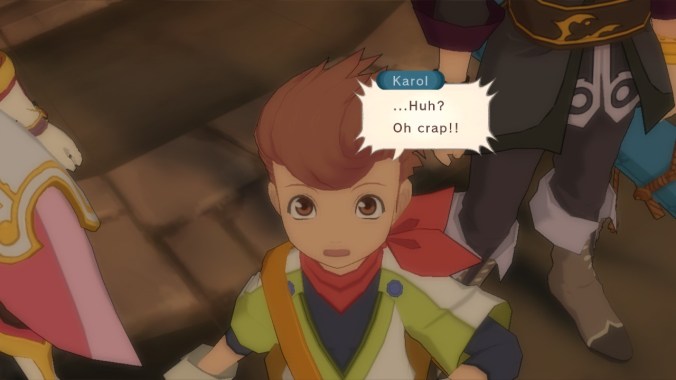
I do really like the characters in this game; the player’s party, which contains about eighty percent of the worthwhile or interesting characters in the game, is truly excellent. They fit pretty neatly into well worn tropes, at least to start, but the game does good and interesting things with them. For the most part. JRPGs, especially Tales games I’ve played, frequently seem to be working with a finite number of character traits that are shuffled and distributed at random amongst the cast. I am not sure Tales of Vesperia gets away from that, but with one glaring exception, the characters all feel well realized. The big exception is Patty, who is fine. She has a convoluted backstory and it is clear that she is a late addition to the rest of the cast. I think protagonist Yuri does the edgy badass thing better than any other character has done it, largely because of the parts of that character archetype he avoids. At first blush he’s not unlike so many other rebellious leads. There are shades of Squall from FF8, Ryudo from Grandia 2, and Yuri from Shadow Hearts in Yuri’s character, but he is much softer than any of them. He genuinely seems to want to connect with his fellow party members. He is not eager to deal with inanities, but there is a version of his character that is much harsher than the one in the game. It makes it that much more impactful when he actually does dark and edgy things.

The negative that pairs with my love of the characters is that the game’s plot is garbage. The game refuses to build any story momentum or execute any sort of rising action. It is split into three distinct arcs, each one ending like some slowly letting the air out of a balloon. It keeps the player in the dark as to what is going on and what actually matters for way too long, then concludes in a hurry. It is just a badly told story.

I think part of that comes from this being a relatively early HD release, and the game tries its best to mask how small its world actually is. It looks nice. But there are like 3 consequential towns and the game keeps the player running back and forth between them, while occasionally going to new dungeons. The player will have seen about two thirds of the world by the twenty hour mark and the rest of the game just feels like padding things out with reused assets. I don’t mean to be too harsh, as I said the game mostly works. It is just a game that really seems to wear out its welcome by the time it ends. It is a great 35-40 hour game that unfortunately takes about 50 hours to beat.
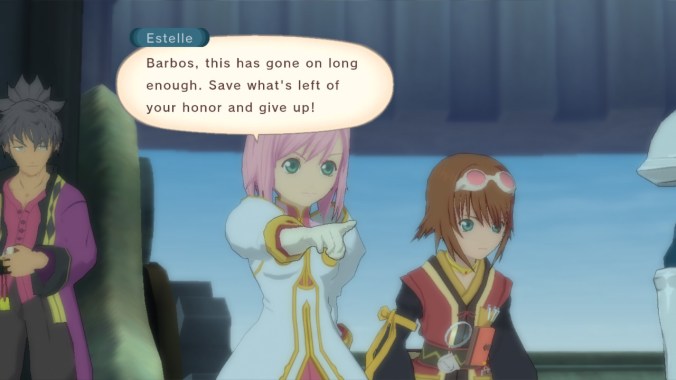
The most foolish thing is, despite me not having genuinely liked a Tales of game since my first experience with Tales of Symphonia back on the GameCube, I made a detailed plan to do a tour of the series. It didn’t cost much. I already owned most of the games. I picked up Tales of Berseria and Tales of Zestiria for a combined total of about twenty dollars. That left only Tales of Xillia 2 and Tales of Hearts as the US released Tales of games to which I did not have access. But the last ten hours I spent with Tales of Vesperia kind of killed my desire to do that. I still might do it. Right now I am split by several competing interests. The first is that I also planned out a Final Fantasy series replay and that sounds a lot more fun to me. Also, I’ve got a couple more Yakuza games to replay. Finally, I am torn on revisiting Tales of Symphonia. On the one hand, I want to see how the game holds up fifteen years after I first played it; on the other, none of the other games in the series have grabbed me like it did and I’m afraid to have my memories tarnished.

Super Mario Odyssey

This is going to be a short one. I don’t have a lot to say about Super Mario Odyssey that isn’t unrestrained gushing about how much I loved it. Because I did love it. The Mario series has more stone cold classics than disappointments. And even the disappointments are only disappointments in comparison to those classics. While it might be a little early to judge, Super Mario Odyssey seems to be squarely in the classic category.

There are two games that most prominently come to mind when playing Super Mario Odyssey: The Legend of Zelda: Breath of the Wild and Super Mario 64. Like Breath of the Wild, Super Mario Odyssey shows Nintendo looking backwards and finding a new path forward. Super Mario 64 is the game that Super Mario Odyssey is clearly looking backwards to. Breath of the Wild turned away from decades of increasingly restrictive Zelda titles to find something that strongly reflected the exploratory origins of the series. The original Legend of Zelda was a game that dropped the player down in the middle of a relatively large world and let the player explore at their own pace. Breath of the Wild does the same thing, but without bringing along many of the good things the series had done in the intervening years. (This is not the place for this argument, but I would say the moment to moment gameplay of Breath of the Wild is very similar to Skyward Sword.) Super Mario Odyssey does something similar. It eschews the more limited levels of the last couple of decades and deliberately fashions its game after its earliest 3D adventure.

While this might be interpreted as a jab at Super Mario Galaxy and Super Mario 3D World, I don’t think that is accurate. Super Mario Odyssey is very much a product of that lineage. Super Mario 64 burst onto the scene with this big, immersive playgrounds, but Galaxy its successors honed those into smaller, more focused levels. They also honed things like the controls, the moveset and the challenge structure. Super Mario Odyssey takes all of those things, and brings back the more expansive levels. There are only a dozen and a half stages here, but each one is big and varied. Each one is a world of itself, and provides a broad and interesting set of challenges. Each of these stages is beautifully realized. There are classics like the ice world, the water world and the fire world, but even those are done in an interesting way. The fire world, for example, is set up as a cooking world, and the lava is fire beneath the pot. The rest are highly inventive, from the prehistoric world to the slightly unsettling New Donk City.

Super Mario Odyssey is, in pretty much every way, the realization of everything that Super Mario 64 tried to be. Super Mario 64 is the first great 3D platformer. Super Mario Odyssey is the latest and greatest such game. I have nothing to criticize; not the way it looks, not the way it sounds, not the way it plays, nothing. I am sure there is more to say about this game, but I am still too overwhelmed to say it.

Mario + Rabbids

Of all the games I thought to buy when I got a Switch, Mario + Rabbids: Kingdom Battle was not one that came to mind. Even ignoring the WiiU ports, which as one of the few owners of the WiiU I had already played most of them, there were still quite a few games to get me started. The new Pokemon, Super Mario Odyssey, and Fire Emblem Three Houses just for a start. But those games are still full price, while I was able to get Mario + Rabbids for song. I like Mario and I like strategy games, so I thought I’d give it a try.

Mario + Rabbids is a strange game. I mean, from conception it is odd. There is not a lot of overlap in sensibility between the Mario games and the Rabbids. Mario is Mario. The Raving Rabbids were kind of a proto-Minions that spun out of the Rayman series all the way back in the early days of the Wii/fading days of the PS2. They starred in a series of chaotic mini-game collections, starting something of a craze that lasted for a while, but by the time of the Switch launch they had largely been banished to mobile for half a decade. Still, it wasn’t much of a surprise to see Ubisoft try to resurrect them with a new game for a new system. I think its says a lot about where Nintendo was after the failure of the WiiU that Ubisoft was given the keys to Mario Kingdom to help relaunch these characters.

On top of the weirdness of mixing the two franchises is the genre of game that Mario + Rabbids is. It is not a reflection of either Mario or the Rabbids, both of whom at their hearts come from platformers. Mario is known for showing up in absolutely anything; he’s been in sports games, racing games, rpgs, you name it. The Rabbids have mostly been in party games and mini-game collections. So, of course, Ubisoft went with a strategy game. And while it never stops being weird, it mostly works.

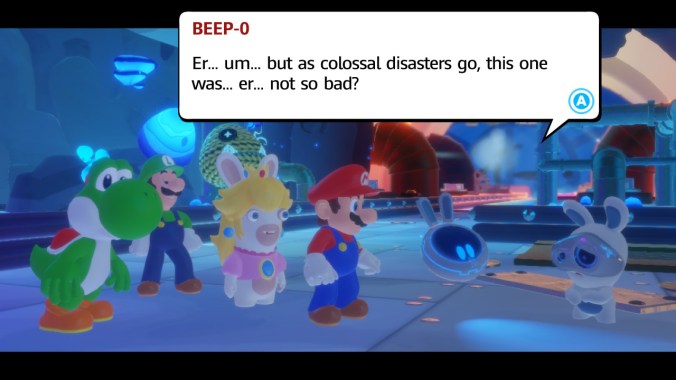
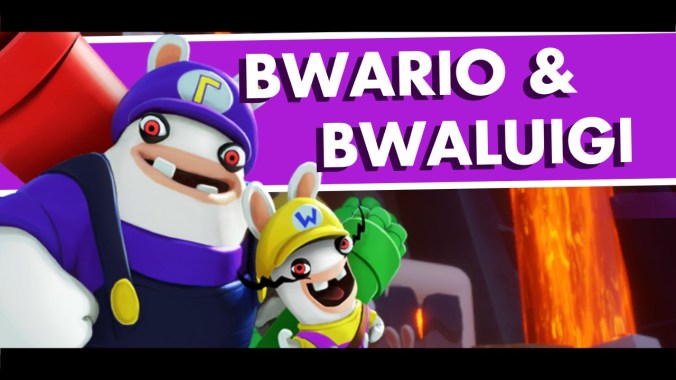
The game has got a good mix of characters with some real tactical choices to make once you get a full party. The game eventually gives you the central Mario crew: Mario, Luigi, Peach, and Yoshi. They are joined by Rabbids versions of each of the four. You start with just Mario, Rabbid Peach and Rabbid Luigi, and the others join one or two per chapter. Each version of each four characters fill similar roles, but each of the eight characters is pretty different. Mario is forced on the player for every battle, but fortunately he is good enough that you will likely want to use anyway. He is the all around character. The others have more specialized roles. Rabbid Peach has an actual healing ability; regular Peach has a defensive boost, a shotgun and a healing ability tied to her jump ability. Rabbid Luigi is a pure support character, great at weakening and giving status effects to enemies. Regular Luigi is the team’s sniper. Every character has maps where they shine, where their skills are absolutely essential.


For the most part the game works. Where I thought it kind of fell flat was how it tried to integrate Mario’s platformer roots into the tactical battles. Each character can move a certain number of squares on the grid map, but instead of actually being able to only move, for instance, 6 squares, the game gives a character a range of 6 squares. This makes for some weird choices with the available movement attacks. Each character can perform at least one run by melee attack per turn, but since your movement is based on range, your best choice is generally to run around bumping into every enemy near you before settling in where you want to shoot from. Then there are the warp pipes; these reset a character’s range to a specified number of squares, for some characters nearly the same as their initial movement range. In maps with a lot of pipes, some characters can pretty much go anywhere. It makes things very unpredictable if you don’t know exactly how far enemies can move, both pre and post pipe.


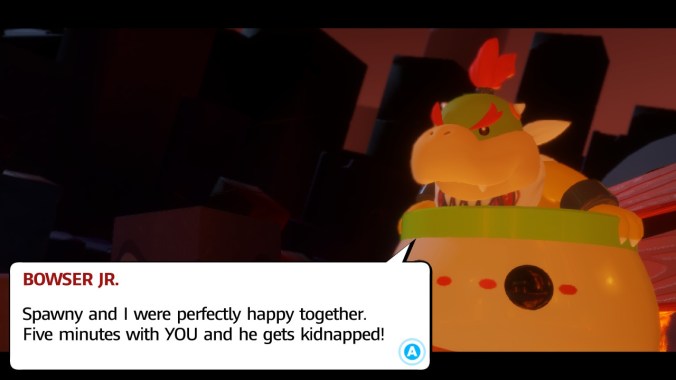
Also kind of awkward and unsatisfying are the parts in between battles where you find chests and solve simplistic puzzles. They feel vaguely in the Mario vein, but mostly end up feeling like padding. I guess there needed to be some connective tissue between stages but these puzzles mostly feel like they are just taking up your time.  It does nail the tone of the Mario series. I am far from an expert when it comes to the Rabbids, but the Mario characters feel about like they would in a Nintendo developed game. I would say I can’t imagine seeing Mario wielding a gun in a Nintendo game, but Smash Bros exists. Mario is the can-do hero, Peach alternates between being sidelined and wanting to get in on the action. There are various goofy Toads. Luigi is the weird schlub also-ran to Mario. Bowser doesn’t make an appearance until late, but he is on brand and honestly this is about as enjoyable as Bowser Jr. has ever been. The highlight is the opera ghost boss, who opens with a song.


Mario + Rabbids is just a strange enjoyable little game. Its creation reeks of desperation on both companies behind it, but the result is a good time.