25 SNES #2: Radical Dreamers

The second game in my quest to explore more fully the SNES video game library is a strange one. A good one, but it is truly one of the oddest games that I have ever encountered. Radical Dreamers is a visual novel with some light RPG elements. Honestly, it is pretty light on the visual part of visual novel as well. It is also a sequel of sorts to Chrono Trigger, which is quite possibly the best game on the system as well as my personal favorite. So in making a sequel to a popular game, Squaresoft chose not only to change the genre, or to release it only on a little used platform, but it also buries the lead so deep many players are likely to not get ever realize what they are playing. Still, it turned out to be a fairly entertaining game, especially with the fan-translation by Demiforce.

Radical Dreamers - Nusume Nai Houseki (Japan) (BS) [En by Demiforce v1.4] (~Radical Dreamers - Le Tresor Interdit) 0000

That Squaresoft would make a sequel to Chrono Trigger is not odd. Especially one that follows up one of the biggest dangling plot threads from the game. That the perfect storm of factors that lead to Chrono Trigger’s creation weren’t able to be recreated wasn’t a surprise; that they got the minds behind the two biggest RPG franchises together to make it in the first place was something of a minor miracle. Still, that it was not really an RPG is a strange choice. It was also only released on Satellaview, an early attempt by Nintendo for some sort of online gaming, is also a curious choice. I am sure Nintendo was eager to get other companies to support his endeavor. A fairly short visual novel was probably a good choice for that platform. These two choices are compounded by not being upfront that this is a follow up to Chrono Trigger. Players were likely an hour or more into the game before the oblique references to Chrono Trigger added up to enough make it clear that it takes place in the same world and it is most of the way through the game until Magus reveals himself.

Radical Dreamers - Le Tresor Interdit 0014

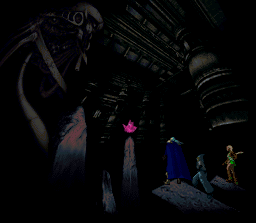
Still the game itself is a lot of fun. It follows a trio of adventurers, Kid, Serge and Magil, as they break into Viper Manor in an attempt to steal the Frozen Flame from the villain Lynx. Most of the main scenario of the game consists of running through the mostly abandoned mansion trying to find where the Flame is hidden. It really builds the characters well in its rather short running time. Serge, the player character, is somewhat inexperienced, which means that Kid and Magil spend a lot of time helping him out. The center of the game is the relationship that develops, aided by the player, between Kid and Serge. Magil holds himself somewhat separate. In all, it is a compact, fun adventure, though some of the battles can get annoying. The music is quite good, and the few instances where it really uses graphics they look pretty nice.

Radical Dreamers - Le Tresor Interdit 0007

After the main scenario is completed players can activate a handful of others. Those are mostly comedy or just plain weirdness. In one Magil falls in love, in another he is a space cop and even a mecha pilot. I didn’t complete all of them, but they fit in with the title. They are all something like dream sequences, fitting for a game called Radical Dreamers.

If the main scenario sounds familiar, that is because it was expanded to be the opening part of the eventual “real” sequel Chrono Cross. The broad strokes are the same, though many of the details are changed and it serves merely as the opening of a much larger adventure. Really, the only thing that was lost in conversion was that Magil was secretly Magus. The Viper Manor portion of Chrono Cross was probably the best part of that game; the rest seems a little lost.
Radical Dreamers - Le Tresor Interdit 0017

Still, the existence of Chrono Cross and this game’s scarcity condemn it to be little more than a footnote in the grand scheme of things. It is a small little project that served as the basis for something much better. The game is still worth playing, even if just for an excuse to see the weirdness.

Radical Dreamers - Le Tresor Interdit 0021

25 Years, 25 Games #1: Super Bomberman

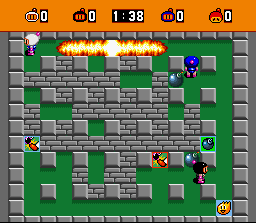
I decided to ease myself into this 25 Years, 25 SNES Games project with Super Bomberman. More so than any other game on my list, this one I knew what I getting going in.  It’s Bomberman.  Everyone’s played some version Bomberman before. Right?

sbm1

Maybe not everyone has played Bomberman, but since his last game came out more than a half decade ago, maybe people don’t know Bomberman.  Well, they should; his games were great. They spanned most consoles from the NES all the way to Wii, Xbox 360 and PS3. While Hudson Soft other supposed mascots, the one that stuck around throughout the history of the company was Bomberman.  The games, at the heart of their most important mode, can trace their style of play back to Pac-Man and other single screen character action games.  Players control a little robot in a maze, trying to clear paths or trap monsters/other players with their bombs.  On the surface it is simple, but the complexity is hidden just beneath the surface, especially against living, breathing opponents.

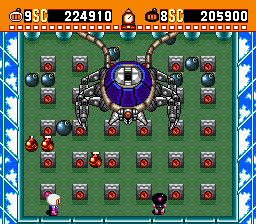
sbm2  While I was a fan of Bomberman, I had never played any of the Super Bomberman games, of which I understand there are four.  I spent a ton of time with Wario Blast (featuring Bomberman) on Gameboy, which instilled a love of the little robot in me.  I also spent some time with various N64 games and a few download titles since.  But I never really even knew about the SNES games at the time.  Super Bomberman is a good, if not spectacular, rendition of Bomberman.  You blow up enemies and pick up power-ups.  There is a story mode, where you play against the computer, pretty simple with some fun but unspectacular bosses to fight.

sbm3I am given to understand that the other Super Bomberman games are better than the first one.  That seems likely.  This game is a pretty no frills experience.  It has just story mode and battle mode.  Each works just fine, but there are few bells and whistles.  Still, the game is still a lot of fun.  Bomberman stuck around so long because the core game is so very good.  Though this game provides little beyond that experience it is still a worthwhile experience just for that.

This game really makes me pine for the days when games like this came out.  That is maybe (absolutely) being unfair to the robust indie and download game market, but I can’t help but look back on the days when something like this could get a boxed release and be a well-remembered game.  Games like Bomberman aren’t exactly gone, but they have become rare and have been shoved off to the sidelines of the gaming world.  The closest recent example of game like this that I can think of is Nintendo’s Boxboy; a game that is relatively simple on the surface, but has satisfying depths to plumb.  Really, this is just an old game enthusiast yelling at kids to get off my lawn.  I am growing increasingly disconnected with modern gaming, and going back and playing games like this makes it clear to me how much more I liked games back then.

sbm4

So, Super Bomberman; it is a good game.  One that is a perfectly fine game, but maybe isn’t as worth playing now thanks to other Bomberman games that just offer more.  I have heard the Saturn Bomberman is the cream of the crop, but there is too much of the series I haven’t played. Still, I’d call the first SNES game I played this year an unqualified success.

A Super Friend Turns 20

August 23 marks the 20th anniversary of the release of the Super Nintendo. This is a source of much celebration and rejoicing for right-minded people as the SNES is probably the best video games system ever released. It is also going to be the source of a week’s worth of celebratory posts on this blog.


AS much as I love the NES, I have to say that my favorite video game console is the SNES. As its name suggests, the Super Nintendo is simply a more powerful Nintendo Entertainment System. While there were a few different kinds of games for the system — like the 3D Star Fox and arguably Mode 7 racers like F-Zero, though they had NES precedents — most of the games for the SNES were fundamentally similar to those on the NES. Developers, however, had learned much in the six or so years since the NES first appeared. With the added power, they were ready to perfect the kinds of games popularized on the NES. SNES games looked better, sounded better, and played better. They were just more polished and expansive and just plain better in nearly every way than NES games. Compare Metroid to Super Metroid or The Legend of Zelda to A Link to the Past. (You could also compare Super Mario World to any of the NES Mario games, but that point is debatable.)

Better than Super Mario Bros. 3

Since the SNES was the last popular primarily 2D console (I said popular Saturn fans who only theoretically exist) it was the last time 2D games were the recipients of attention and dollars from publishers. After the SNES, 2D games were primarily throwbacks or fan-games, or the SNES’s second coming as the GBA/DS. This is why the SNES is 2D perfected; there was never anyone to make these games better than they were on the SNES. And while the SNES’s library isn’t particularly large, it is very top heavy. There are a disproportionate number of great games for the system.

Other than the games, the SNES also had maybe the greatest controller ever created. Nintendo has a way with controllers. Even their ugliest monstrosity (N64) works well in practice. The SNES controller is perfect in its simplicity. Instead of 2 face buttons, the SNES has 4, cleverly spaced and half convex, half concave for easy sightless button recognition. It also introduced the now essential shoulder buttons, which now are used as triggers for shooters but then were there to keep from gimping Street Fighter 2. For 2D games, there is nothing better than the SNES pad.

God's controller

The system itself was not as sleek as the controller was. It did fix the NES’s greatest flaw, the easily broken VCR-like sliding deck, but it looked very boxy, like a toy. The look of the system did not do it any favors in its competition with the Sega Genesis. In the battle between these two 16-bit titans, Sega tried to brand itself as the cool video game console. With claims of “Blast Processing,” a noticeably sleeker console and coups like blood in Mortal Kombat this perception was widely cemented. Sega’s success seems to have worked against it in the long run, though. Nowadays the Genesis is mostly remembered for fake “Blast Processing” and Sonic the Hedgehog. It is tempting to say that Nintendo let their games do their talking, Sonic may be facing some harsh critical reevaluations but Mario World is still widely regarded as a classic. But it is easy to remember that Mario did not beat Sonic back then, Donkey Kong Country did, with its “cool” digitized graphics. And Nintendo was hardly sitting quietly, it is just that their attempts to encourage players to Play it Loud were not so successful.

What could be cooler?

In the end, the SNES was not quite the cultural touchstone that the NES was. It faced stiffer competition from the Sega Genesis and mostly just built off the success of its predecessor. But the SNES was released at the perfect time to catch my attention and there are just so many great games that I could never love another console as much. So this week is going to be dedicated to my boxy friend sitting in the cabinet under the TV, growing ever yellower in its old age. This week I think I will Play it Loud, and I hope you will too. Or you could wait until the week that is actually the anniversary, but that doesn’t work with my blogging schedule.