Video Game Archaeology: Burai Fighter

It’s back, hopefully as something regular. Video Game Archaeology is my monthly exploration of an artifact video game found during my excavations of various bargain bins and yard sales; an examination of a game cast off and long forgotten.

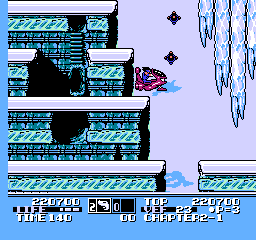
This entry in VGA is Burai Fighter, yet another NES game. I discovered it while looking up information on Low G Man. Both games were made by KID, a smaller NES developer whose output I am coming to really appreciate. Once I turned the game on, I realized I had played it a little at some point in the past. Probably at a friend’s house for a birthday party. Burai Fighter is a solid NES game, not quite spectacular, but definitely better than the average. Burai Fighter was published in America by Taxan in 1990. It is a shooter with less of a focus on the shooting and a greater emphasis on navigation. KID, the developer, also made the GI Joe games, as well as Low G Man and more recently some visual novels. They never really had that big breakout hit, but all of their games that I have played are good. KID also developed the well-regarded shooter Recca, which I have never played. One thing worth noting outside the game is its amazing boxart. The cover to this game looks awesome. According to the game’s manual, the Burai are the are Super-Brains bent on conquering the universe.

Burai Fighter is quite a bit different than the average scrolling shooter. Instead of the usual ship, you play as a man in a flying space suit. Instead of just scrolling to the right or up, Burai fighter scrolls in all directions. Usually it does go in just one direction, but there are places where if you push against the screen at the right time the direction will change. Unfortunately, looking for these can get you squeezed into trap corners. Still, the way it does it is pretty neat. Stage 5, I believe, is kind of a trick stage, where the game scrolls a little way before changing direction and trying to trap the player. Like most shooters, it requires some memorization to beat, but for the most part you can just play. Stages 3 and 6 are completely free scrolling. At the start of the stage it shows the player where the boss is on a grid and it is up to the player to go find it. Those stages are interesting in theory, but the best that can be said of them is that they are better than the bulk of NES special stages.
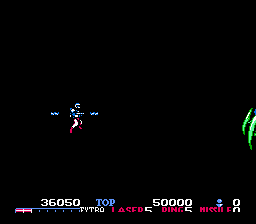
The controls take some getting used to. You shoot the direction you were pushing, eight possible directions, when you started shooting. As long as you hold the shoot button you will shoot that way. To change you aim you must stop shooting. The other button unleashes a screen clearing attack as long as you have collected enough red whatevers. There are three different weapon upgrades, with a well thought out system behind it. There is the ring, which isn’t very strong but does shoot through walls. Then there is the missile, which shoots right all the time but us very strong. Finally there is the laser, which can shoot through multiple enemies. You collect upgrades and the game saves all the upgrades you get, with three different levels of power for each weapon. When you die, you only lose the one you currently have. The only way to change weapon is to pick up an upgrade for that weapon.

There are a lot of friendly features in Burai Fighter, at least for an NES game. Infinite continues, fairly regular checkpoints, multiple difficulties, keeping weapons after death. Those are all good things. The problem with the game is that the levels are rather simple. Outside of some scrolling tricks, there is just not a lot going on. There aren’t many different enemies and few different patterns. The game is largely simple. It looks good, it plays good and it sounds good. The music for level 2 is especially good. Fans of 8-Bit games should at least give it a try.
Video Game Archaeology: Low G Man

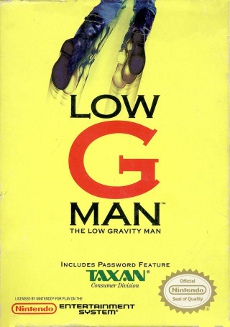
It is time for more Video Game Archaeology! Video Game Archaeology is my monthly exploration of an artifact video game found during my excavations of various bargain bins and yard sales; an examination of a game cast off and long forgotten. This month’s game is Low G Man: The Low Gravity Man, an action game from Kid and Taxan for the NES.


Low G Man was released in 1990 by Taxan. Before playing it for VGA, I was not familiar at all with it. I had heard some people refer to it as a joke, as though Low G Man was a comically awful game, only worth remembering for how badly it failed. Knowing nothing else, I was content to leave my knowledge at that. Then I learned that KID had developed it and it jumped to the top of my list of old games to play. Though they stayed alive into the 2000’s making Japanese visual novels, KID was best known to me as a solid developer of NES action games, specifically the GI Joe games. Since I enjoyed those games so much, I was eager to see more of their oeuvre. While I wasn’t overwhelmed by it, Low G Man wasn’t disappointing either. It was just a kind of good NES game.

Low G Man is a middle of the road NES action game, generally well made but Lacking the polish or spark of a truly great game. There is nothing brokenly wrong with the game, but neither does it do anything to distinguish itself from the multitude of similar games for the system. Low G Man tries, though. The first part of the attempt to give Low G Man an identity is right there in the title. The title character has a “low gravity suit” that allows him to jump incredibly high. As in about 2/3 of the screen to start with, and power ups that increase it significantly. It takes a bit to get used to the height of the jumps, but it works. Except that most of the levels are not designed to incorporate the high jumps. Yes, the player can jump higher than the screen, but there is little reason or incentive to do so. The second distinguishing characteristic of Low G Man is the two part fighting system. The player has two main weapons, a freeze ray and a spear. The ray, which I assume is supposed to be some sort of EMP gun since the enemies are mostly robots, doesn’t actually damage enemies; it merely stops them. The spear is needed to damage enemies. So first the enemy must be frozen, the stabbed to death with the spear. The problem is that the spear and gun share a button, making it easy to accidentally use the wrong one. While it is satisfying to freeze an enemy, then jump on its head to stab it repeatedly, it mostly just grinds the action to a halt. It works for boss battles, but for most of the rest of the game it is tedious and awkward. What keeps Low G Man from being great is that its signature gameplay features are either badly implemented or simply bad ideas. It feels much like the first Mega Man game: all the parts are there for a classic, but it doesn’t quite come together. Unfortunately, there was no Low G Man 2 to sand off all the warts.

Though there was no sequel, this game does share a lot with the GI Joe games, especially the first one, on the NES. Both games have 3 part stages, with occasionally controllable vehicles. The music is similar, and the graphics are almost identical. Really, the graphics are very good. Though too often the background is black, when out in the open you can see the player characters long hair wave as he jumps. Both the GI Joe games and Low G Man feel the same. I am willing to consider GI Joe the polished classic to Low G Man’s rough draft. The only thing that was really dropped was the cumbersome spear fighting. Though the emphasis on jumping high is gone, Snake Eyes still jumps absurdly high.

Low G Man is not a must play. It is just another competent action game in the veritable sea of action games on the NES. For fans of KID’s other NES games, though, it is worth checking out Low G Man. Just remember that it is an NES game, and therefore quite, frustratingly difficult.