Still a Super Mario World

Super Mario 3D World was the best game to come out last year. There was some fierce competition, most of it from Nintendo themselves. A Link Between Worlds was great and The Wonderful 101 was something special. Still, 3D World was better. At this point, excellence is so routine to the Mario series it is expected. Somehow, Super Mario 3D World still surprises with it quality.

3dworld2

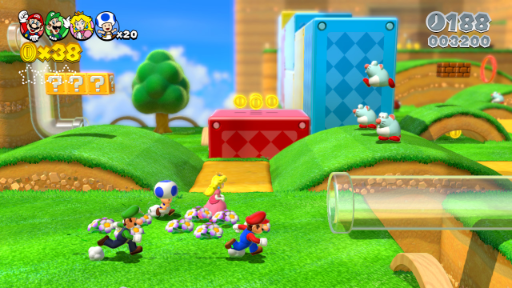
While the game largely plays the same as the seminal 3DS’s Super Mario 3D Land, 3D World does feature ton of new stuff. There are new power-ups, most notably the catsuit and the double cherry. Both of those work well with the main focus of the game: the multiplayer. Like the New Super Mario series, 3D World is designed for up to four players. While making a 2D game, like NSMBU, accessible for multiple players is relatively easy. The game usually only has to track the players across one plane. Creating a 3D game with single screen multiplayer is much more difficult. 3D World accomplished this, primarily by fixing the camera high in the sky.

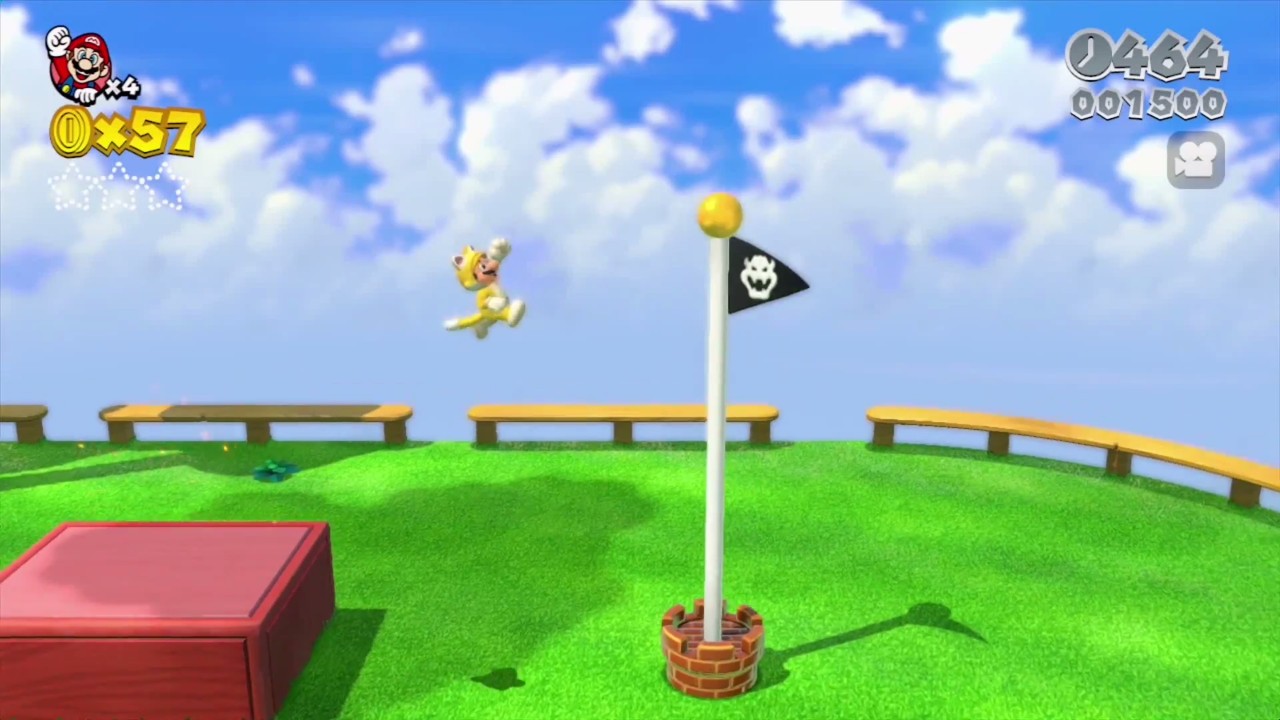
The problem with that method is that it makes some jumps hard to judge. Not impossible, but it is occasionally unclear where exactly where Mario is. This problem is becomes bigger with a full four characters on the screen. The camera doesn’t track any one player’s movements, so sometimes you end up in the background, trying to complete difficult jumps blind. This would be a huge problem if it weren’t for the game’s most prominent power-up. The catsuit gives the player a ton of leeway on those jumps, since it lets the player climb on things. It is extra mobility in a game all about mobility.

Even with that, multiplayer can get hectic. That is where the double cherry comes into play. No, it doesn’t alleviate the confusion of multiplayer, it multiplies it. In single player the cherry duplicates can be hard to track, it is nigh impossible with extra players. This is far from a bad thing. They craziness happening on the screen turns a delicate ballet of speed and momentum into an overcrowded party.

3dworld

Both of 3D World’s signature power ups play with the constraints of multiplayer. The biggest “new” feature of the game is also focuses on that. The Super Mario Bros 2 gang is present in 3D World, along with their unique gameplay styles. Mario is the all-around character, Luigi jumps the highest, Peach floats and I guess Toad runs the fastest. I mean, who uses Toad?

All the focus on multiplayer did not cause the single player to suffer. All the things that help the multiplayer also work well in single player. The double cherry is fun every time it shows up, and the catsuit is fits naturally in with Mario’s usual power ups like the fire flower. The greatest boon are the multiple characters. Switching from character to character drastically changes how you approach levels. Peach acts as an easy mode, with her ability to float to out of reach collectables . 3D World is genuinely smartly designed, with elements that work with each of its different styles of play.

3dworld3

All this and I didn’t really mention that the difficulty curve is pitch perfect and that the level design ranges from great to inspired. Or how the music is delightfully jazzy. Really, the game is just about perfect. Mario is still the king. Since Nintendo tends to limit their Mario releases to one per subseries per console, it will likely be a while before we see another Mario game. I am more than happy to savor this one for a while.

Now Playing in December

Beaten:

Kirby’s Adventure:
I just had a hankering for some Kirby and this was sitting right on my WiiU. It is such a great game, which I have written before. Good times.

Rocket Knight:
This is the PSN game from a few years ago. It is pretty great; just a solid update of a long dormant franchise. It has that old school edge to it. It just doesn’t rise above good. It is missing that spark to make it really memorable. Still, it’s well worth the time.

NES Remix: Oh man, this game. Sure, it’s just a Nintendo sanctioned rom-hack, but it is a fun rom-hack. I hope it is a sign of things to come. Because as much fun as this game is, it has some stinkers it uses for its challenges. Ice Climbers and Clu Clu Land in particular are terrible, no fun pieces of crap. But Super Mario Bros, Donkey Kong and Donkey Kong Jr. work great in this bite sized format. It is just a wonderful dose of full Nintendo nostalgia. At some point I am going to get all the stars, but I’m fun calling it done with some stars left unearned.

Crimson Shroud: I picked this up a long time ago on my 3DS and just sort of lost track of it. It is excellent. For as small a game as it is, there is a ton of world building going on. There is enough going on in this game to sustain a full-fledged RPG, something 30 or 40 hours in length, but it is all crammed into a game that lasts about 10. I am actually shocked that no has made a game so blatantly based off a tabletop game until now. I hope Matsuno is working on something else after this, since he is about the best maker of RPGs.

Bioshock: I just wrote about this. A game as great as its reputation.

Yakuza 3: This is a game that I could see a lot of people just not liking. It is ostensibly a game about Japanese mobsters, but the play spends at least half the game running errands for orphans. I loved it, though I don’t know I have enough to say about it to sustain its own post. The Yakuza series just feels like a modern version of the beat-em-ups I like so much back in the 8 and 16-bit days. I’d call it the modern day River City Ransom. It is pretty much everything I love about video games, including running errands for orphans. I really need to get Yakuza 4 and finally play Yakuza 2.

Orion’s Odyssey: This is the first Kickstarter game that I’ve backed that I’ve actually received. It is a puzzle game with an absolutely charming story mode. You use small shapes to form bigger shapes. It starts off pretty simple, but once you get into the challenge mode it can become downright infuriating, in a fun way. I’d recommend anyone with a DSi or 3DS to go ahead of buy this. It is a pretty great little game.

Final Fantasy XIII-2: Somehow they managed to make a game with a plot that made less sense than FFXIII. That is quite the accomplishment. Still, they did fix some of the problems with the first game. The big one is that they gave the player a lot more freedom. After few hours, large chunks of time are open to the player to explore as one sees fit. The battle system is still a lot of fun and it is surprisingly fun to put hats on monsters. Honestly, though, I think I liked the first game better. Lightning is better than either character in this game, so is Fang and hell even Snow. Still, this is more of a game rather than an experience.

Ongoing:

Popolocrois: This is a fun and charming little PSP game. I’m not sure I am going to stick with it, though. It is something of an amalgam of 2 games and is set into distinct chapters. I finished the first chapter and I’m having a hard time finding the desire to go back and start the next one. It is just clunky enough to be off putting, no matter how charming it is.

Trauma Center: New Blood: Good God this game is difficult. I played through the first three chapters and I’m not sure I am going to be able to beat it. It will be the only Trauma Center game I haven’t beaten.

Earthbound: I finally got going on this. I’ve finished Twoson and got Paula on my team. This game is so damn great. I am intentionally taking it slow because I want to savor it.

Upcoming:

Xenoblade: A half-finished game that I plan to finish off this year. I am slowly recalling just how to play so far this month.

Paper Mario Sticker Star: Another half-finished game that I plan to finish off this year.

Ratchet and Clank Future: The whole Future trilogy is up. I am going to beat all of them in the next few weeks.

The Legend of Zelda: A Link Between Worlds: I got it for Christmas and can’t wait to dive in.

Final Fantasy Crisis Core: I’ve got a well thought of FF game for my PSP and I am going to give a go.

Assassin’s Creed 3 Thoughts

I have been out of the blockbuster video game loop for a while now. For this whole generation, actually. This wasn’t entirely by choice, but I haven’t felt like I’ve been missing out. I’ve been more than happy with the games I’ve been playing. I choose the Wii 5 years ago and have had little cause to regret that choice. While I have had access to a PS3 for a couple years now, but I still haven’t really scratched the games available on it. Plus, the preponderance of shooters has left me with less to catch up on than I expected. (My position of shooters is that I don’t like them very much, so I don’t play them.) However, a couple of months ago, flush with dropping 400 bones on a WiiU and eager to have things to play on it, I decided to tip my toe back in the blockbuster pool with Assassin’s Creed 3. If this is the sort of experience I have been missing while playing my Wii and DS, I think I’ll stick with what I’ve been playing.

assassins-creed-3

Assassin’s Creed 3 is not that bad of a game, but it is severely flawed. The frustrating thing about it is that parts of the game a nearly excellent, but the broken and stupid parts really drag the whole experience down. To start with, and this is a problem I’ve found to be prevalent on HD consoles, this game is buggy as shit. I really don’t understand how a game that crashes this often made it on to the shelves. The gameplay framework that ACIII is built on is very good. Running across rooftops in Boston and New York and through the trees on the frontier is a blast. And through the combat can get tedious, it works well. The problem is that the majority of the story sequences focus on bullshit minigames and stealth crap like eavesdropping . Assassin’s Creed III falters because its story sequences are just no damn fun to play.

The story itself is not much better. The setting is great and underused. There are tons of points in history with plenty of gameplay to mine, and the Revolutionary War/Colonial America is near the top of the list. In their desire to get most bang for the historical buck, the completely fumbled the story that holds it all together. Sure, you get to hang out with George Washington and Sam Adams, but don’t expect anything coherent in the development of Conner, Haytham and Achilles. Since I haven’t played any of the other Assassin’s Creed games, I won’t comment on the Desmond sections except to say that what is there is nowhere close to a complete story. Connor’s story jumps from scene to scene with only the slightest bit of continuity. Characters change opinions and motivations with no warning or reason and the game forces actions on the player that make no sense. Really, the story is a complete mess.

Assassins-Creed-3-Perch

If I disliked so much about AC3, why did I play it for more than 20 hours? Because removed from the story sequences, the game is a lot of fun. The assassin recruitment missions are fun, as is picking up a group of fellow assassins. Too bad they are almost completely optional and have little to do outside of recruitment. Exploring is great fun; I found nearly all of the trinkets. There is also significant side-quest about building a community on the frontier. While I wish it was more fleshed out, the stories of those townsfolk make more sense than the main story.

At its best, Assassin’s Creed III is a nearly great game. Unfortunately, anything good is equaled by broken, stupid and frustrating bad parts. It is a flawed experience that is just barely worth the player’s time.

Goodbye Nintendo Power

The news earlier this week that Nintendo Power would cease publication hit me pretty hard. For many gamers who grew up in the days of the NES and the SNES, Nintendo Power holds a special place in their hearts. While it was blatant Nintendo propaganda and the strategies found within were frequently not ideal, the amount of love lavished on the games found inside was made the magazine eminently enjoyable. NP made each and every game seem like a classic. Yes, it existed to sell more games, but in those pre-internet days information was not that easy to come by. The loss of Nintendo Power feels like a big step away from gaming as I grew up with.

I wasn’t always subscribed to NP. I was for about two years around 89-91. I bought the magazine occasionally for the next decade before resubscribing a little before publishing switched over to Future. The magazines fortunes mostly followed its namesakes. In the 8 and 16-bit days Nintendo Power was amazing. There was always tons of excitement and plenty of games to cover. In the N64 and Gamecube days the excitement didn’t flag, though there was a lot less to be excited for. It sometimes made the magazine a depressing read. When it switched over to Future, it immediately got better. I’m not trying to bad mouth it from just before, but Nintendo Power over the last 5 years has been the best video game magazine on the shelf. I am disappointed that I let my subscription lapse in the last year. I have saved most of the issues I ever received and have spent plenty of time over the last week looking over them. It is truly sad to see it go.

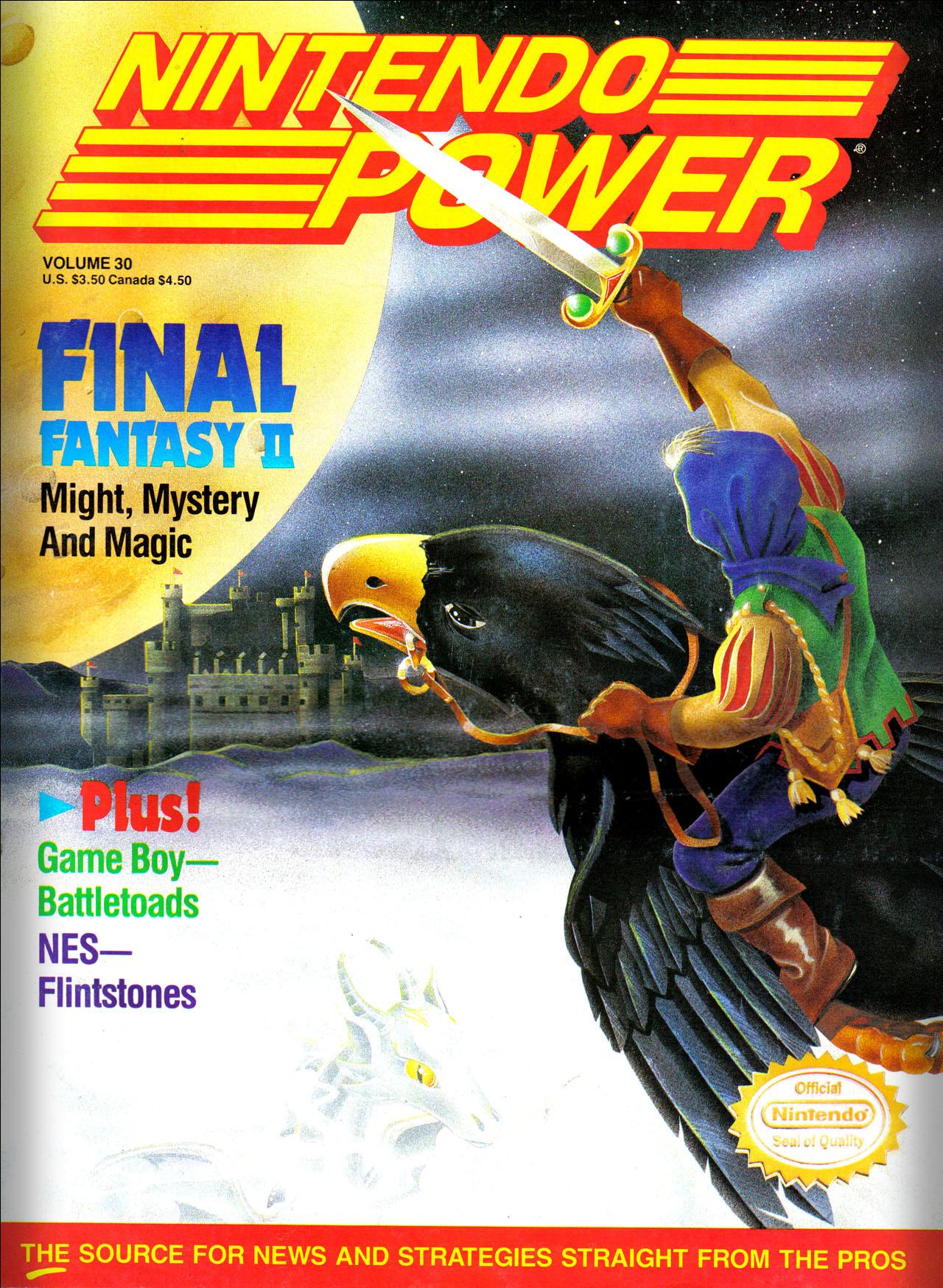
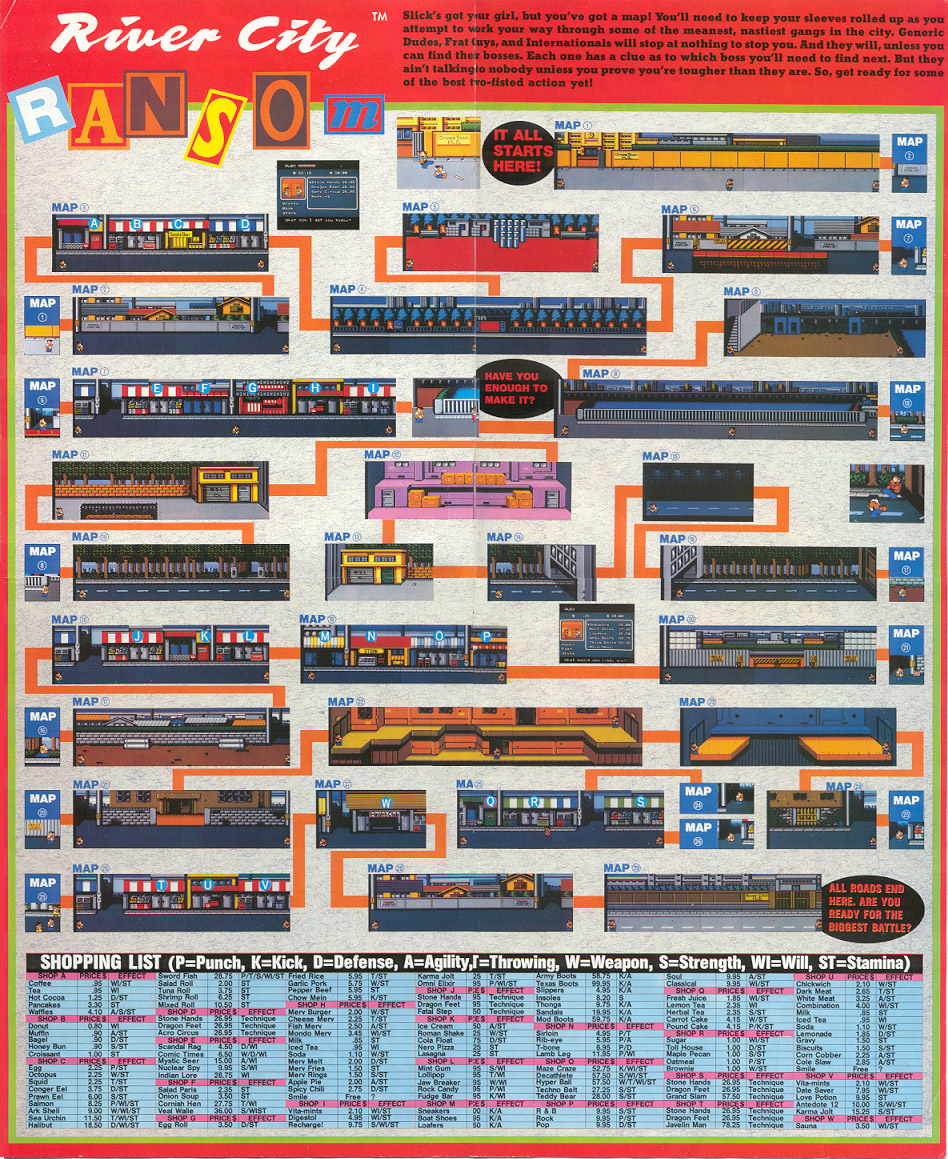
In many ways Nintendo Power helped shape my gaming tastes, even when I wasn’t able to find or play the games it covered. I had no idea what an RPG was before I read the NP that covered Final Fantasy II. I didn’t play that game, at least not for more than an hour, until it was ported to the GBA but still I know that game front to back just from pouring over Nintendo Power. It made the game seem like such an amazing adventure that I had to play, but I was never able to find it. Then there was River City Ransom. Another game that just captured my imagination but this time I was able track it down. For once, at least, a game was everything Nintendo Power promised it would be. It was the usual beat-em-up with some RPG mechanics. Seeing those two games helped me realize just how many different kinds of games were out there, and seeing all the maps and screenshots in NP helped me visualize exactly how those games worked.

The loss of Nintendo Power is kind of forcing me to realize just how far from the mainstream I’ve become when it comes to gaming. I don’t think my tastes have really changed, but gaming has. I still like the same kinds of games I always have, but they are apparently not popular anymore. In the last year or so I’ve got so many new games that cater almost perfectly to me, games like Xenoblade, the Last Story, Solatorobo and Rayman Origins, but still this seems like an aberration rather than a trend. Most of the games I’ve really enjoyed have not enjoyed much in the way of sales success. The few interesting games that Japan is able to produce often have a hard time making it to America. I’m never going to be a fan of shooters and I’m never going to want more than one sports game for any system. It’s not that I think they aren’t good games, they just aren’t games that interest me. I’m not saying I am going to quit playing video games, but things like the shuttering of Nintendo Power show me that the current gaming industry doesn’t support the kind of things I like. Still, I have nearly 25 years of great gaming memories to look over and there are still plenty of great games I haven’t played.

Memories of Chrono Cross

There are few more divisive games than Chrono Cross. While it garnered almost universally terrific review at release, the public at large seems to be split. The reason for this is quite simple: Chrono Cross is an absolute terrible sequel to Chrono Trigger. That is not to say that it is a bad game. Far from it. Chrono Cross gets almost everything right, it only falters when it tries to connect to Chrono Trigger. Nearly every time a part of Cross echoes Trigger is stumbles.

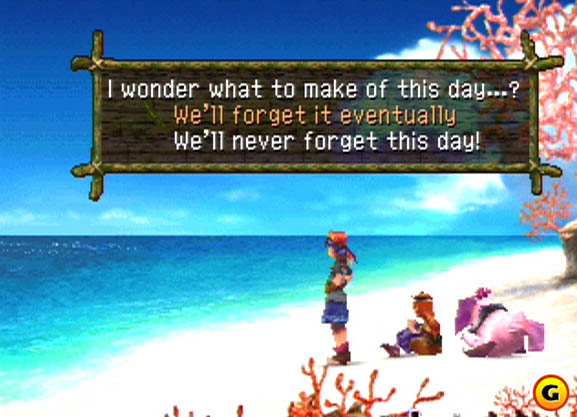
Honestly, I absolutely love Chrono Cross. Both because it is a great game and because of my memories of the time when I played it for the first time. I came to the PS1/N64 generation of consoles pretty late, not getting a 64 until Christmas ‘99 and then a Playstation near my birthday (October) the next year. Chrono Cross was one of the numerous RPGs is bought the next year, flush with money from mowing lawns and too old to ride my bike but still too young drive. Plus, that summer I has home alone. Part of my family went on an RV trip to the west, to see the Grand Canyon and Yellowstone, but anyone who has spent a week in an RV with 8 or so people know why I declined to join them. My two brothers closest in age spent a month or so with an uncle 500 miles away, but I didn’t go with them either. So at home, with my Dad who was working all day, after I finished whatever mowing I had to do that day I had the house, and TV, to myself. The games I played that summer! Final Fantasy IX, Final Fantasy Tactics, Legend of the Dragoon, Lunar 2 and Chrono Cross. Amazing games (save for LoD) and while I still would rate most of them among my favorites in the system, but Chrono Cross is the game I most associate with that summer, if only for the summery tropical aesthetic.

If there is one place where no one can argue that Chrono Cross doesn’t shine, it is the presentation. The music is one of humanity’s greatest achievements (warning, the last statement may contain a small amount of hyperbole.) The graphics, while primitive by today’s standards, hold up better than nearly any other 3D PS1 game. The character designs are great, and the colorful, tropical world is still all too unique. Chrono Cross undeniably looks and sounds incredibly good.

Chrono Cross did carry a few things over from Trigger in a good way. Like the lack of random battles, though it didn’t do as well as Trigger. In Trigger many encounters were built into the map, in Cross there are enemy sprites that when engaged zaps the players to usual battle screen. In another way, though, Cross takes the no random battles further by eliminating experience points. In stead of gaining levels by fighting battles, in Cross players get star levels by beating bosses. Other than for some supplementary stat increases after the five or so battles following a level, there is no reason to ever fight a non-boss battle. The forced level let developers hone the difficulty much more tightly. All players are going to have roughly the same stats, so they know exactly how tough the boss can be. Chrono Cross is one of the tougher RPGs I’ve played, a fact easy to forget after a decade of New Game +. The somewhat higher difficulty is tempered by Cross letting players run from any battle. Even boss battles. This means that there is no good reason to see the game over screen. If your element layout or strategy isn’t working, just run away and reset everything. The system all work together, designed to work in concert rather than just things thrown against the wall. It emphasizes strategy over simply making numbers bigger.
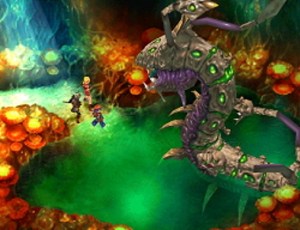
None of that would matter if the actual battle system didn’t work just as, which it fortunately does. Each character has 7 stamina per turn, which can be used to attack or to use an element. Weak, medium and strong attacks take 1, 2 and 3 stamina points respectively, but they each open up the characters grid the corresponding amount if they connect. Casting a spell, or an element as they are called in this game, takes a full 7 stamina, but it can be done as long as the character has at least one stamina point, allowing them to accumulate a deficit of up to 6. Effective strategizing means using using enough attacks to open up the grid, but not letting the whole team fall into a deficit, which allows the enemies a free turn. Despite being a rather novel set up, the battle system is surprisingly intuitive. It never feels overly complicated or different for the sake of being different, despite changing plenty of things from Chrono Trigger . There is no MP and it is completely turn based. Instead of learning abilities, with the exception of 3 unique techs for each character, there are only elements and the grid. Each character has a grid on which the player can but spell elements, each of which can be cast once per battle. Since the player can’t just spam their best attack over and over, they must rely on smart allocation of elements. The battle system is good enough to make you want to fight battles even though there is absolutely nothing gained from doing so.

The story, while not as good as the gameplay or graphics, has its moments. Early on it is terrific. It aims for poetic and actually hits it. There are constant references and allusions to dreams and memories and conflating the two, setting up the nostalgic “what is things were different” yearning that is the tone for the game. The dreamlike state, starting with the actually dream sequence at the beginning, never really goes away. The two realities work because one in not wholly better than the other. Serge is only alive in one world, but in his home world nearly all of the Viper Manor characters have been killed. It actually makes it hard to decide which one is the preferable “real” world. When the dragons show up things kind of go to crap, but there are still plenty of great moments. The dreamy-ness of the plot helps excuse some of its shortcomings, but not all of them. The first six or seven hours or so really work well, but after that it kind of sketchy.
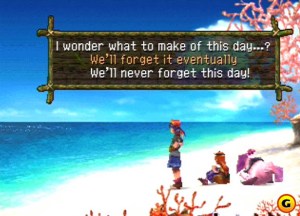
One part routinely pointed out as a weakness is the numerous, thinly developed party. I will not argue that the majority of the party is well-developed, but I will argue that the large party is an asset rather than a fault. The characters that matter, Kid, Lynx and Harle, are all well rounded. Most of the rest have only small windows of importance, and some have absolutely none. However, many have their own stories going on outside of Serge’s. The whole world seems connected, with many of the characters having pre-existing relationships, but it also as though Serge’s search into the mystery surrounding him is not the only thing going on for many of the characters. There is the whole Viper Manor group, which numbers about a dozen character and while most of their story can be uncovered over the course of the game, plenty of the dots are not necessarily connected for the player. The individual characters aren’t particularly well-developed, but they all feel like pieces of a well-developed world.

As I mentioned earlier, the game usually falters when it refers back to Chrono Trigger. While they both take place in the same world, the only mentions of places familiar from Trigger are uniformly insulting and terrible. All the happy endings have been quickly erased, and the sleepy town of Porre is now a warlike empire. Squaresoft did seem to know which dangling plot thread from Trigger players wanted so deal with, that of the missing Schala, but they dealt with it in an entirely unsatisfying manner. The questions of what happened to her aren’t really answered, and Magus doesn’t even make an appearance. Also, Schala is Kid kind of and it doesn’t make sense. The story really goes off the rails the more it tries to be a sequel to Chrono Trigger. The worst part of the battle system, the sparse and useless double techs, is a tacked on hold over from Trigger. It almost seems like Chrono Cross goes out of its way to not be a satisfying follow up to Chrono Trigger.

Removed from the idea that it is supposed to be a sequel, Chrono Cross is one of the absolute best RPGs on the Playstation. It can be hard to separate the two games though, and Cross can only suffer from the comparison. The two games in the Chrono series are both excellent, but they really don’t seem to get along with each other.
Second Quest Part 2, Kind of

If you remember, a few months ago I said I was going to beat every Zelda game, spend the year taking in the series. But after putting up my thoughts on the original Legend of Zelda, I haven’t had anymore ready to go. That is because I was playing Zelda II: The Adventure of Link. It had been nearly 20 years since I had last played Zelda II; I had only vaguely pleasant but confused recollections of it. Playing it again lately has been a largely frustrating experience. Not so much because Zelda II is a bad game, it has its problems but it is mostly well made, but because its flaws are almost perfectly suited to pissing me off.

Since I didn’t even come close to beating Zelda II, I only reached the second dungeon, I am only going to go over a few things that made me put it away. The first is the how slow getting information out of townsfolk is. This is something that only makes me mad because I am already kind of fed up with other things, but this doesn’t help. It’s like torture. Another is how the game gives out experience. Like the fact that not all enemies give experience or that some actually take it away. And last of all, is that Zelda II did not fix the unknowably arcane crap from Zelda I. That seems like all they actually kept, things like knowing exactly where to go in the woods to find Bagu or whatever his name is to get across the river. I only found out by using a guide, which I was trying to avoid.

It simply comes down to the fact that I just do not like Legend of Zelda II: Link’s Adventure. More power to the people who love it, I won’t say they are wrong but I’ll be damned if I’ll waste anymore time playing it myself. So there is at least 1 Zelda game I will not beat this year. On to A Link to the Past!

SMT Devil Survivor, with no “witty” title

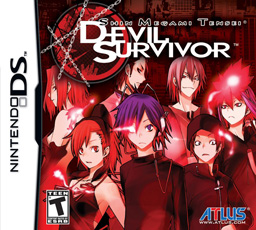
Shin Megami Tensei Devil Survivor is a game that, on paper at least, I should really enjoy.  I like strategy RPGs, I like Shin Megami Tensei and its rock/paper/scissors-esque battle system, and I like games with branching paths and different endings.  However, despite being made up almost entirely of things I like, Devil Survivor ended up being much more frustrating than fun.

It took me a while to figure out just why that is. It wasn’t because it is difficult.  I’ve played harder games than Devil Survivor, and though it was far from easy, Devil Survivor was far from too hard.  Actually, the difficulty is just about right.  It wasn’t the at times off putting character designs and characters.  Yeah, Yuzu’s boobs are weird and she’s kind of annoying, but for the most part the story stuff is pretty good.  After beating the game (taking Amane’s route out of necessity rather than choice) and thinking on it for a while I’ve realized what the problem it.  Devil Survivor needs a map.

I don’t mean an explorable map, like DQ VIII and nearly every other classic RPG.  That is not part of the game for a reason; it simply does not fit with what the game is doing.  I don’t necessarily mean a true map.  I just want some way of navigating the various game systems. I want a map of map of each character’s progress, some way of charting my progress towards the various endings.  Chrono Trigger had multiple endings, but its endings are dependent on big obvious things.  It is never hard to tell what ending you are going to get.  I don’t mind making tough decisions with real impact in games like this, I just want to know that I’m making such a decision.  With Devil Survivor, I really never knew where I stood.  I decided early on which ending I wanted to get: Atsuro’s.  I kissed his ass for four or so days in the game, only to get to Day 7 and realize that somehow I failed to unlock his ending.  I only had Amane’s and Yuzu’s endings to choose from. It was frustrating, and that frustration could have easily been avoided with a touch of transparency on the game’s part letting me know how about my progress.

It is not just in the story mechanics that need a map.  Even though Devil Survivor has the SMT series’ usual collection of demons, it lack the usual compendium.  The player can’t catalog and buy back old demons.  That makes the fusing process a constant move forward.  It doesn’t make it impossible to repeat specific builds, it doesn’t really even make it harder to do so, it merely makes it a longer more tedious process to do so.  Also, you can’t just look through a list for the demons with the right attributes for a tough battle, you have to get lucky with the auction house or fusing.  Just as with the story, Devil Survivor’s party building mechanics drops the player into the wilderness with no way to find their way around.  And for me at least, that is a big problem.

I love maps.  I doubt I would have enjoyed Super Metroid or Ocarina of Time without them.  I loved drawing maps in the Etrian Odyssey series.  Those are literal maps, sure, but the concept is the same.  I like to see where I have been and plan out where I am going.  Radiant Historia uses a timeline so the player knows where and when they are in the game’s time traveling, reality switching story.  Throughout almost all of Devil Survivor, I felt lost and I hated it. Which is sad, because otherwise it is a really good game.

Sky Crawlers

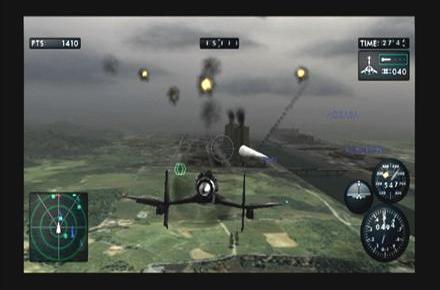
I’ve only got a few missions left before finish the story section of Sky Crawlers: Innocent Aces (since writing this I’ve finished) and I’m somewhat at a loss for what to say about it. This is partially due to my not really having a reference point to judge it against. I haven’t played too many flight sims. I did enjoy Sky Crawlers, for the most part, but I could believe that other games do the flight thing better than this one. I also don’t have much to say about the story. I haven’t seen the movie this is based on, though I understand that the stories aren’t really connected. (Is the movie still on Netflix? I should watch it.) Its anime nonsense. Enjoyable anime nonsense, but nonsense nonetheless. I just can’t take a story seriously when it features pubescent super-pilots called ‘Kildren.” Its just not possible.

I can at least make a note of the controls. I think it would be fair to call me a fan of the Wii’s motion controls. For most games they add to the experience despite the inherent slight loss of precision. So listen to me when I say that the default controls in Sky Crawlers are an unforgivable crime. Their problems are numerous and glaring. First, the game wants the player to put the Wiimote into their left hand and the nunchuck in the right. Yes, it wants you to hold it opposite of every other Wii game ever. Its akin to an NES game telling the player to play with the controller upside down. In Sky Crawlers, the wiimote operates as the throttle. The actual steering is left to the nun chuck. But the nunchuck flat doesn’t work as its supposed to. No part of this control scheme is useable, let alone intuitive. It is simply awful. After the tutorial, I realized the complete failure of the motion control and switched to a wavebird and never looked back.

The only other thing of note are the tactical maneuvers. If you can stay close enough to an enemy long enough you can execute a special maneuver the puts the player right behind them. There are three levels, but I have never found a reason to wait past the first one. Sure, higher levels actually get you behind some of the tougher enemies, but for 90% of the game you could have shot down the enemy 4 or 5 times while you wait for the meter to fill up. I don’t like the system because instead of letting the player pull off amazing moves, like flips and barrel rolls in Star Fox, the player pushes one button and the game does it for them. Still, even with it the dog fights are fun.

Sky Crawlers is a decently enjoyable game. Not worth full price, but its worth digging out of a bargain bin. Its not like there are a lot of flight sim options out there for the Wii. And who knows, you might like this games nonsensical anime stylings.

Ratchet & Clank

After beating Skyward Sword, I dug out my PS2 and plugged it up (as we say around my house) to my TV. I still have a list of PS2 games I want to play, the top game on it being Ratchet & Clank. I beat it rather quickly. Ratchet & Clank is doubly unfortunate for my timing in playing it, coming right after playing my game of the year by a wide margin and also after I’ve already played two of its superior sequels. Ratchet & Clank is still a good game, but it lacks some of the conveniences, like strafing, and flair of the later games in the series. It is hard to judge it too harshly for not including its sequels improvements, especially since Going Commando and Up Your Arsenal are two of the very best games on the PS2. Despite its shortcomings, Ratchet & Clank is still a very good game.

The series didn’t change greatly in either of its next two sequels. You still play as furry alien Ratchet and his robotic backpack/sidekick Clank. You still fly around the galaxy doing good. And you still collect a variety of inventive and destructive weapons with which to blow up everything. While the focus shifts from platforming in the early games to shooting later on, the fundamentals have remained largely the same. The biggest change is the addition of strafing, which any part of this game that requires shooting sorely lacks.

The weapon selection is sadly rudimentary. There are some interesting toys, like the attack drones, for the most part the weapon selection is bland. Had I played R&C before its sequels, I doubt I would have been disappointed in the selection but it pales in comparison to the later games.

That is the big problem with R&C. Playing it now, nearly ten years after its release, it suffers from being improved upon by its subsequent games in the series. Much like Mega Man 1, the first Ratchet & Clank provided a solid foundation for future great games. The R&C series is probably the closest thing in 3D to the original series Mega Man games (I love Legends, but its something else entirely) so it is an apt comparison. Though I would say R&C is much closer in quality to its sequels than MM1 was. If you’ve already played the later games, then there isn’t any real reason to go back, but if you are new to the series you might as well start here.

Like We Ever Left Dreamland

Some thoughts on Kirby: Return to Dreamland

As prevalent as Kirby games have been on Nintendo systems since the pink ball first appeared, it is amazing to think that Kirby: Return to Dreamland is his first main series console outing since 2000’s (I think) Kirby 64. Most of his games have been relegated to handhelds and even then were mostly remakes and offshoots. The few home games have been aberrations (Air Ride) or not really Kirby games at all (Epic Yarn, though it is delightful). For his first primetime outing in a decade, Kirby proves that he still has it.

Return to Dreamland is also a return to Kirby’s best game, Super Star on the SNES. Kirby’s trademark power-ups in both games have more than just one or two uses; most of them give Kirby an expansive new move set. It may take some time to learn how to use some of the powers, but for most of them, it is worth it. And the best always has been and always will be fighter, tied with parasol. While sometimes a specific power-up is needed, the game most fun when you simply chose a power you like and wreck the game with that. Another thing Return to Dreamland takes from Super Star, though admittedly it likely also takes it from New Super Mario Bros Wii, is the co-op mode. Four players can play simultaneously. While it is one of the games biggest draws on paper, it is mostly the games greatest failure.

Okay, maybe it’s not quite a failure, but 4 player is not as good as it could and should be. Disappointing is what I’d call it, especially compared to the madcap perfection of NSMBW. There a several problems in playing with more than 2 players. First, the screen is zoomed in too far, crowding the players into a tiny area. There is just not enough room for 4 characters. The second problem is the ability for players to ride on each other’s backs. Not that it is a bad idea, but it is way to easy to accidentally hitch on to one of your buddies, messing up some tricky platforming section. This is compounded by the zoomed in problem. The two together make 4 player a mess.

Kirby: Return to Dreamland falls just short of classics like Kirby Super Star and New Super Mario Bros Wii. It is still very good, and mostly enjoyable, but the aforementioned flaws–and a few others like the shared life pool–make merely a very good game instead of a great one. It does capture that wonderful joy that is inherent to the Kirby series, easy to beat but hard to master and fun for everybody. It just further cements the Wii as the best system for Nintendo games since the SNES.