Laaayyytooonnn!!!

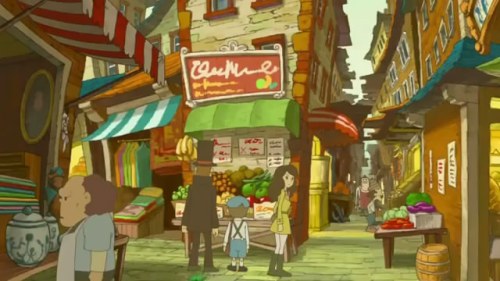
Professor Layton has ruined me for adventure games. I know that Layton’s games aren’t quite classic adventure games, but the differences are why I love Layton and why I am indifferent to most of the genre.

In most adventure games, the developers have to go to extreme lengths to incorporate the puzzles into the game world. The games are intricately designed to give the player the tools needed to solve their problems and to make sure that each of those tools has a believable reason to be there. In the end, I find that it generally hamstrings both the puzzles and the stories the puzzles are propping up. The story is forced into situations that allow the player to solve puzzles and the puzzles are forced to fit into the general milieu. No puzzles involving ray guns, because ray guns don’t make sense. The story needs you to go in this storage closet because you have to have a screwdriver later. It may only be a problem to me, but the delicate blending of story and puzzle usually leaves both unsatisfying.

The Professor Layton series gets around this problem by flatly ignoring it. You solve puzzles because that is what the game is about. Brainteasers and the like. The story of is there because it is the most entertaining method of delivering those puzzles. The good Professor’s cases are always charming, at least somewhat due to his world’s fascination with puzzles. Instead of building the puzzles into the story, though the fourth game has done this a couple of times by the halfway point, Layton merely has characters offer them to the player as challenges. Sure, this crazy old bat has the information you need, but she’ll only give it to you if you solve her puzzle. What the puzzle is doesn’t matter at all to the story. The stories in Layton games are always charming pieces of fluff. They occasionally hit a strong, moving character moment, but rarely is there anything exceptional.

But the puzzles are invariably better than those I’ve encountered in actual adventure games. Solving a Layton puzzle is so satisfying. The game presented you with a challenge and you overcame it. In regular adventure games, when I finally stumble upon the solution, my reaction is usually vague anger. It is either so ridiculously circuitous a solution that I hate the game for thinking it up or stupidly easy, but frustratingly obtuse. Either way it is no fun.
I’ve played enough Layton games now that I know I can never go back to the old games. I’m sure I’ll try them out occasionally, because I can never leave well enough alone. I’m sure adventure game purists will scoff at my missing the point for hating adventure games for what makes them great. The only thing I’m not sure of is my continued access to future Layton games. I can only hope that unlike every other game I like, Professor Layton has been financially successful here in the states and they keep being made. But that is just me being grouchy and pessimistic. At least the Layton movie is being released here next month. I’ll have to buy that.

Its Secret is Sincerity

The game I’ve been playing for the last 2 weeks, Solatorobo, is a late gem for the slowly fading DS. I’m just having some trouble articulating why I like it so much. In many ways, it is exactly the kind of game I don’t tend to like. It is very shallow. All fights play out basically the same, with in the way of difficulty or design. At the same time, it goes out of its way to hold the players hand. Everything gets a tutorial or an explanation from the characters. The game doesn’t allow, let alone expect, the players to figure out anything on their own. This ties into the last big problem, that the game is terribly talky. Characters won’t shut up. The players every action prompt more dialogue from somebody. Despite these problems, and more, I still really like the game, though. Somehow, a piece of quality shines through the crap that might have drowned this game.


One area is shines is in the graphics. This is a fine looking DS game, especially for one with 3D graphics. It honestly gives Final Fantasy: 4 Heroes of Light a run for best on the system. The sound is likewise excellent. There are still some problems, though. For all that there is a beautiful world to explore, the game denies the player that exploration. The areas available to venture into are usually cramped walkways, sewers and caves and the like. It tantalizes with beauty, but hides it.

As I said before, Solatorobo is quite shallow. All fighting generally boils down to dodging the opponent’s one attack, running behind it, picking it up and throwing it. Ad naseum. There are some flying areas, both sort of explore-y spots and races, but neither of those adds much. Playing the game becomes somewhat rote after a very short period.

If I have all these complaint about the game, how can I saw I like it so much? I think it comes down to the games attitude. This is a bright, optimistic game. Its outlook is more like Skies of Arcadia than Final Fantasy 7. Sure, many of the elements that make up the game world are perfectly designed to appeal to me. I love airships and floating continents. And the fighting robots look like they came straight out of Miyazaki. Much work has clearly gone into the world on which this game takes place. It feels less like the usual checkpoints of places to go in a game, here is a snow town and there a tropical island, and more a cohesive world. There is a history and sense of place that most games miss.

However, that alone would not be enough to buoy a lackluster game. Somehow, Solatorobo is more than the sum of its parts. It is talky, but the story is much better than the usual fare. It is not great by any means, but its tone is so different, so optimistic and bright, that it distinguishes itself. Many times, I sit grinding my teeth every time a game interrupts my play to let some douche-y characters jabber on. (I’m looking at you every Tales game ever!) In Solatorobo, the dialogue, while rarely essential, is usually worth hearing. The picking up mechanic has some life to it, though it is too simple to really power a whole game, but combat is infrequent enough that it is rarely a problem. The game is relaxing. It is a stress free, frustration free romp through a colorful world. Solatorobo is not a great game. It is not a game that will go down as one of its systems best or something essential. What it is is an easy, cheerful diversion. It has its problems, but it is hard to hold those problems against a game that so firmly has its heart in the right place.

Tap, Tap, Tapping away!

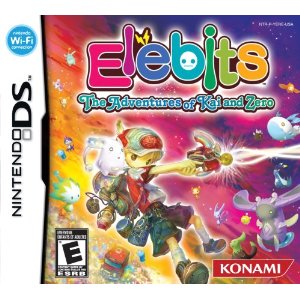
Still playing my DS all the time? Damn straight. After I positively devoured Kirby Mass Attack, I expected to get to jump right into the second of the three DS games I am anticipating this fall, Solatorobo. Unfortunately, for some reason Amazon did not ship the game until Thursday, though it was released on Tuesday. No big deal, but I don’t pay for Amazon Prime to get my pre-ordered games a week after they come out. (Actually, I don’t pay for Amazon Prime at all, but that is beside the point) During the interminable wait, I had to play something, so I broke out Elebits: The Adventures of Kai and Zero, a game I picked up out of a bargain bin, probably during one of GameStop’s “Buy 2, Get 1 Free” sales.

I am enjoying it much more than I expected. There is no escaping the fact that this is primarily a kid’s game, what with the childish graphics — by which I do not mean 2D, but that the sprites are large, simple and big headed — and complete lack of difficulty, but there is enough substance under the candy coated exterior to keep me playing. Elebits is a rather clever mix of Pokemon and The Legend of Zelda tied around an annoying central mechanic. I cannot fathom why the game is built around tapping the DS’s bottom screen constantly, over and over and over. In order to power special skills and various contraptions around the game world, the player must collect charge. This is done by tapping on little creatures, the titular Elebits, which pop out from under rocks and out of trees. It isn’t hard, but it is tedious. It is like a Zelda game that is half collecting Rupees that try to run away from you. This stupidity drags the first hour or two of the game to an anti-fun halt.

The rest of the game has been fun. Easy but enjoyable nonetheless. Despite not having actual dungeons, Elebits plays like a Zelda game. That is a huge compliment. The biggest difference is that instead of finding new tools and magical items, the player finds Omega Elebits. These Omegas function identically to Zelda’s tools, with each one having a unique puzzle-solving ability. The Fire Omega, for instance, can spew fire clearing away path-blocking brush and the Ice Omega can create ice platform to let the player cross rivers. To further add to the Pokemon-ness is the fact that the player can evolve most of the Omegas, provided you feed them enough charge, that is.

You will be constantly interrupted from your pleasantly easy Zelda-clone to poke at the little Elebits on the bottom screen. The emphasis on charging does lessen as the game goes on. Your collection tank gets bigger, evolved Omegas cost less to use and the game start providing you with more high charge creatures to capture. Still, front-loading tedium is never a way to hook players. I put Elebits down when Solatorobo arrived in the mail, but one I finish that, and probably Professor Layton 4, I will be back to take on the last third of Elebits.

The Adventure is Over (for now)

Playing a pair of games last week, 9 Hours 9 Persons 9 Doors and Touch Detective, made me finally realize that I don’t like adventure games at all. It took me a long time to come to this realization because point-and-click adventure games seem like something I would really like. They are a combination of reading, which I greatly enjoy, and puzzles, which I also greatly enjoy. Combined like they are in most adventure games, though, somehow makes them both less appealing.
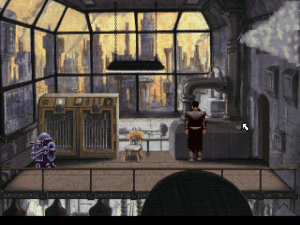
At first I thought I just needed to learn the methods, the syntax, of the genre to enjoy it. Listening to the terrific episode of Retronauts about adventure games led me to believe this was likely the case. So I fought through games like Syberia, Beneath a Steel Sky and Lure of the Temptress. While I found the stories enjoyable for the most part, I thought the solving arcane and baffling.

I did play some adventure games that I likes, but they were all somewhat different than the traditional genre entry. The Phoenix Wright games, while they have enjoyable characters and plots, have much simpler and straightforward puzzles. Never are you presented with a problem that you can’t solve at the time you encounter it. The series goes out of its way to make sure you have the tools to solve all of its problems. Then there are the Professor Layton games, which divides the puzzles entirely from the adventure game parts. The puzzles are also more brain teasers more than environmental hurdles. Zack and Wiki have more traditional styled gameplay, but broken up into easier to digest discrete stages.

My first problem with “real” adventure games is that the puzzles are so sprawling that I have trouble identifying the puzzle. I know that is part of the solving of an adventure game, but I often find it needlessly obtuse. Such is the case for much of Touch Detective. I feels less like I am solving problems and more like stabbing wildly at crazed leaps of non-logic.

My other big problem is that they don’t let you skip steps. (I know this one is all on me.) Once I figure out the solution, the games don’t just let me put in my answer and go. I still have to go through the motions of solving it. This is what is supposed to be fun about these games and it annoys me. When I know the answer I don’t want to do the problem anymore. Noting this has helped me realize that adventure games are just not for me. And that’s okay. The genre shouldn’t change so that I (and people who feel the same as me.) can enjoy it. That would ruin what the fans of the genre like. There are certainly things that could be improved, but I’m more than content to just accept that this is a genre I don’t enjoy.

My SNES Experience

As I wrote the other day, though my love of the NES is unaffected, the SNES is my favorite video game system. The NES is certainly a console with some special personal relevance; its release date was within days of my own release date. I have lived my entire like in the Nintendo age of video games. (which of course began with the release of the NES, reviving the video game industry in the USA after the crash of ‘84.) Unfortunately, this means that the heyday of the NES was pretty well over before I was aware. The SNES’s release in August of 1991 occurred at a time when I was 6 years old and beginning to really get into video games.

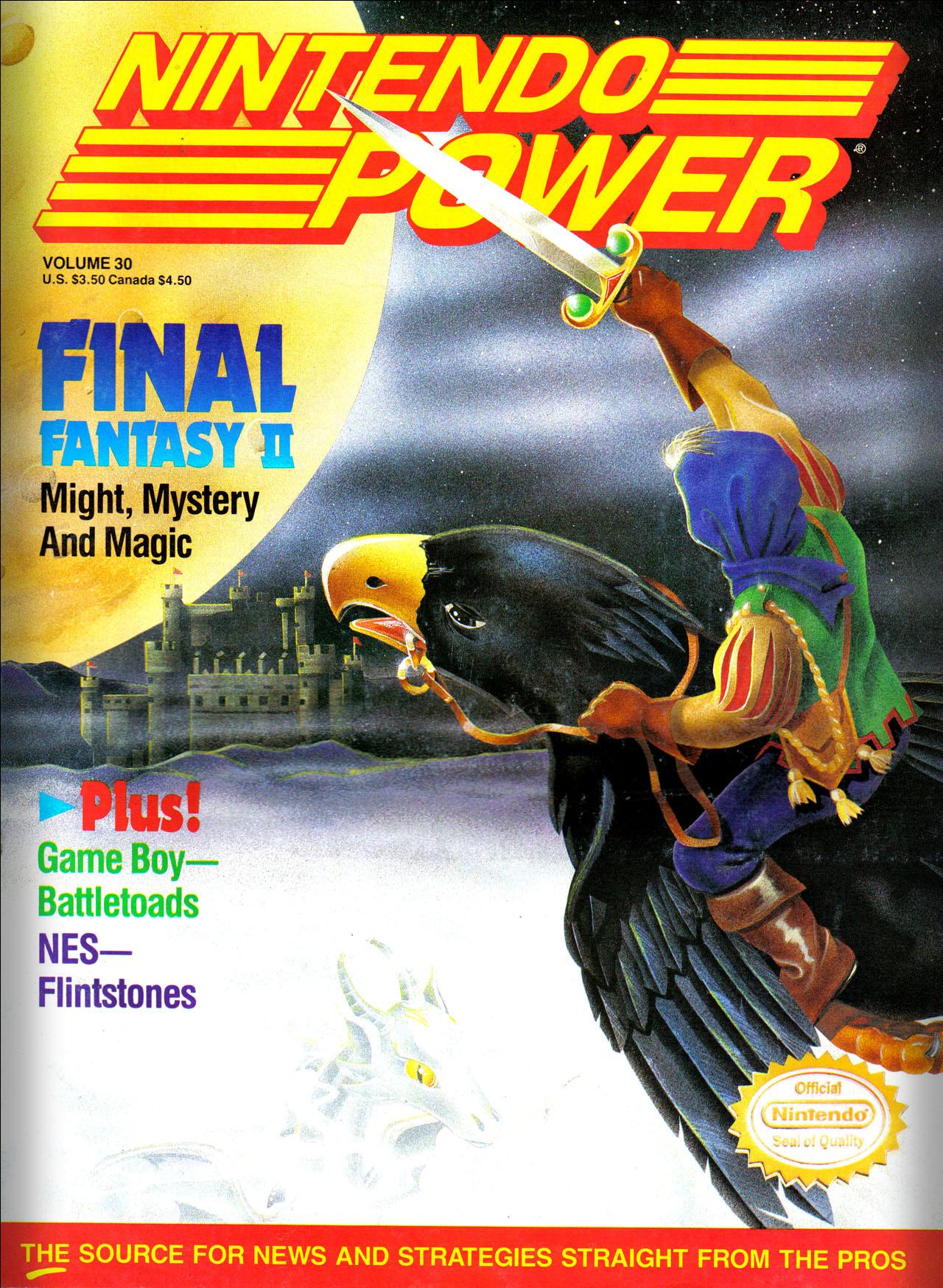
My experience with the SNES did not actually start in 1991. I don’t think I scrounged up the cash to buy one (my parents refused to buy us another video game system) until sometime in 1996. But I was certainly aware of it before then. I had long had a subscription to Nintendo Power, (I think my Dad got it around the time of the Dragon Warrior give-away) so I had seen what the new system had to offer. I absolutely poured over the issue that covered Final Fantasy 2. My only experience with RPGs at the point had been the limited Dragon Warrior and Final Fantasy 2 was a quantum leap above that. When I saw the original Final Fantasy on a clearance list at Wal-Mart, I jumped all over it. I loved Final Fantasy, but it clearly was not on the same level that I dreamed Final Fantasy 2 was on.

All because of this

I remember the first time I actually saw an SNES. It was my cousin’s; he showed it off by ruining his Dad’s A Link to the Past game. Okay, he didn’t really ruin it; he just smacked a chicken around until the flock of them attacked then paused the game, leaving it like a trap for his father to find.

The first time I played one for any amount of time was at my friend’s house in the summer of probably 1995. The reason I didn’t own one was due t a lost battle over a Christmas present with my brother. I wanted the SNES; (did he see those screenshots of FF2?!) he wanted a Sega Genesis. To play Mortal Kombat or sports games or some such nonsense. My friend had an SNES, but he didn’t have the coveted Final Fantasy 2. No, he had Final Fantasy 3! My 10-year-old mind was blown. Paying back years of his coming to my house to play Nintendo, I returned the favor all summer. (My friend also had an older brother somewhat meaner than mine, so it wasn’t all peaches and gravy.) Using Final Fantasy 3’s underrated two-player option, we played through that game together. Then we played Earthbound, then Chrono Trigger and other classics. That summer I became determined to own my own Super Nintendo.

That quest turned out to not be very difficult. Another friend had gotten a second SNES at Christmas and instead of returning it, agreed to sell it to me for a cool $50. From then on most of my money earned mowing lawns and from meager payments for doing household chores, went to buying new SNES games. I have always been nearly a generation behind on gaming, and with the usually cheaply acquired games, I found the latter days of the SNES were a Golden Age. Of course, not all games were cheap. I dropped more than a hundred dollars in one go on Final Fantasy 3 and Chrono Trigger, but they were easily worth it. There was also Super Mario World, Secret of Mana, Sunset Riders, Legend of the Mystical Ninja and many, many others.

The SNES was something of a Holy Grail console for me. For the longest time I searched for one, but could not get it. When I finally did own one, it turned out to be even better than I had imagined. You can make great arguments for so many consoles being the best ever: the sheer number of games for the PS2, the fact that most of the great SNES games are also available for the Wii or the combination of innovative brilliance and classics styles on the DS, but for me the best is and always will be the Super Nintendo.

Gaming Doldrums

I had a post ready to go last week, but I scrapped it because I didn’t like the tone. It was whiny and petulant examination of my increasing disillusionment with video games. I still believe much of what I wrote that video games and the community around them no longer seem to be for me. Maybe I’m growing up (God forbid) or maybe the games really are changing. Either way, I didn’t like the way I complained about my malaise, especially now that I’ve determined the actual cause for it: the games I’ve been playing lately.

Those games are Donkey Kong Country 2 and Viewtiful Joe Double Trouble. They are not necessarily terrible games, but they seemed perfectly suited for ticking me off and disappointing me. Just piles of tedium and bullshit; enough to make me want to quit playing video games entirely.

DKC2, which I’ve already wrote about somewhat, has two big problems. The first is its reliance on Diddy’s animal friends. Rambi the rhinoceros and his cohorts should be analogous to Mario’s various power-ups; useful and needed to reach some secrets, but not necessary to complete the stage. Instead of being supplemental tools, they become the very purpose of more than half the stages. And that’s not counting the three or so mine cart levels. The sheer amount of gimmick levels is disappointing because the “normal” levels are so good.

The animal problem is largely a personal preference, but the other problem is just pure bullshit. That other problem is DKC2’s save system. DKC2 tries to move beyond the earlier game continuation model derived from arcades. There are no continues or passwords, but a more modern hard save. Unfortunately, Rare seemed to think that simply being able to save was too easy, so they clogged the system up with tons of bullshit.

First, saving requires banana coins, which are scattered about the stages. Resident Evil uses a similar system, but that game is based on the idea of scarcity. The fear of not having enough drives the game. Even Resident Evil, though, was kind enough to let keep your typewriter ribbon through after you save. Not in DKC2, all your banana coins disappear when you load your save.

The bullshit doesn’t end there. You can only save at the “Kong Kollege” in each area. But the “Kollege” is not immediately available. No, you have to beat 2 or 3 stages before it usually opens up. So you had better hope you have enough lives to do that left after you beat a boss, because you’ll probably have to fight it again. Alternatively, you could go to a previous area to save, but then you also have to pay Funky Kong a couple of you banana coins to fly to the proper area. If you don’t have enough coins, or if you die, then you have to replay a few early levels to earn the coins needed to leave the area. It is an unending cycle of tedium and bullshit.

Viewtiful Joe: Double Trouble, on the other hand, is simply a disappointment. Clover Studios/ Platinum Games has a pretty much flawless track record, with games ranging from merely very good, like MadWorld and Viewtiful Joe 2, to true classics such as Okami. But Viewtiful Joe DS is not very good at all. Instead of being a handheld game, it desperately tries to recreate the home experience. It also tries to make use of all of the DS’s functions. These toe goals work against each other to make a mess of a game. The two changes from the console games are the screen size and the controls. The controls had me trying to use the touch screen, hit the shoulder buttons and use the d-pad all at the same time. Which had my hands cramping within 20 minutes. The screen size severely limits the series’ trademark stylish action. Together it makes the game a slow, dull, physically painful experience.

Amazingly, once I beat DKC2 — yeah, I beat it, it was not going to beat me — and quit playing Viewtiful Joe, I starting liking video games a whole lot more again. Sure I’m still not too thrilled about where they seem to be headed, as there is less and less of the stuff I like, but now I’m rediscovering the joy of The Legend of Zelda: Majora’s Mask, possibly the most underrated Zelda game. Also, I’m finally starting to come around to Dragon Quest VI. The job system is dumped on me halfway through is starting to be interesting, even if the story is still lackluster.

But video games, yeah I love those. I’m going to go replay Suikoden now, because nothing can restore your faith in video games like the first 2 Suikoden games, except of the holy trinities of the SNES: either the trio of Super Metroid, Super Mario World and Link to the Past, or the trio of Earthbound, Final Fantasy III (VI) and Chrono Trigger.

The Quest: Part the Third

Another week, another game crossed off my list. Gungrave is beaten. Tsugunai: Atonement still is not, but I did make some progress. I also started playing Growlanser III again. All in all a productive week.

Gungrave is astoundingly short. Given what it is that is not surprising, but it does not change the fact that this game is not long at all. I am not overstating this; I beat the game in less than 3 hours. Gungrave is a shmup by way of the 3D action game. The graphics are rough, the story is barely intelligible (I assume it relies on knowledge of the anime/manga/whatever) but the game is actually fun. It occasionally puts the player in that perfect, zen-like shooter trance, where the controller is forgotten and the player simply reacts. Honestly, though, I would have been upset with the length if I had paid more than 6 bucks on this game.

Tsugunai’s blandness has kept me from making much more progress. If my opinion does not change by next week, the game is getting kicked to the bottom of the list, or even off it.

I also broke out Growlanser Generations back out. GG is Working Designs last release, a compilation of Growlanser II and Growlanser III. I’ve already beaten II and I liked it a lot. I played about halfway through III before I got bored or distracted by something else. Since starting it again, I’ve noticed 2 things. The first is how great the battle system is. It is like a real time Final Fantasy Tactics. More could have been done to improve it from II, all that appears to be changed is a significant bump up in the difficulty, but it is still very good. The second thing is how very anime this game is. That is something that may have appealed to me 5 or 6 years ago, but now it is somewhat off putting.

Next week: more Tsugunai and Growlanser, plus I plan to start Castlevania: Lament of Innocence. In addition, Eve of Extinction, which was found not purchased, is again lost. It has been replaced on the list with the newly purchased Yakuza 2. Which does not play in my PS2, but I am determined to play it.

Continue reading

The Quest 2

In the first week of my concentrated effort to clear out my PS2 backlog I have made some good progress. I started the week playing two games: Activision and Neversoft’s Gun and Tsugunai: Atonement developed by Cattle Call and published by Atlus. So far, I would say I enjoyed both of them to at least some degree.

I beat Gun. It is a competently made GTA-clone with an–at the time at least–unique setting, but it definitely has its flaws. For one, its game world is very small. There is a decent variety of missions, but there just aren’t very many of them. There is a variety of locales, but they are all really small. Even with how small they are, they are still sparsely populated. Gun manages to feel both cramped and empty. That doesn’t ruin the game, though. It just leaves the player wishing there were more, and that is not the worst thing to say about a game.

I just really wish they had done a better job with the story. Gun’s story is just a slap-dash collection of western clichés that does a decent job developing the protagonist but leaves everyone else simple caricatures (the gold-hearted hooker, the corrupt mayor, etc.). I would like to see how it stacks up against the recent Red Dead Redemption. Gun is a good, but nowhere near great game.

Tsugunai: Atonement I did not beat. I haven’t quite played quite enough of it to form a full opinion on it; the game is structured into 34 missions and I’ve cleared 9 of them. So far, the game is long on ideas and short on execution. I really like the premise: the main characters spirit has been separated from his body and he must possess people to help them solve their problems. Someone could make a great game around this idea, but Tsugunai does not appear to be that game. The most obvious flaw is in how the game looks. Not only are the graphics bland, which they very much are, but also the screen is very dark. This is not a problem with my TV; I can see every other game just fine. However, Tsugunai is often so dark you cannot even see how bland the graphics are. On the plus side, the soundtrack is by Yasunori Mitsuda at his Chrono Crossiest.

So next week I’m going to continue hacking away at Tsugunai and start up Gungrave. I’ve been told Gungrave is quite short, so if I finish that I may start on Castlevania: Lament of Innocence or start again on Growlanser III. 27 left.

Continue reading