Comfort Games

Everyone knows about comfort foods; the foods you love for the nostalgia or convenience, for their just downright comforting nature. While there are definitely cultural indicators about exactly what food an individual considers comfort food; what your mother (or whoever did the cooking in you childhood home) cooked most often or best is likely to be one of them. My mom makes some great chili, but that is beside the point of this post. My thoughts are about comfort games.

I have found that, like food, there are games that have certain emotional effects. It is not all nostalgia, but that is a certainly a major influence. This is the case for the NES Mega Man games and River City Ransom. However, there are quite a few games that I never played as a child that I would call a comfort game. Games like Harvest Moon or the Dragon Quest series.

Comfort games don’t necessarily overlap with ones favorite games, at least not entirely. Liking the game is definitely essential. I do like all the games I’ve previously mentioned, but they are not necessarily my favorites. But I find comfort games to be relaxing, or … comforting, and that is not necessarily true for some of my favorite games. I love the Persona games and Etrian Odyssey, but I don’t consider them comfort games. They are too challenging, too hostile. They are actively trying to defeat the player, while most of the games I put in this entirely-made-up-by-me-just-now category tend to fall more in the sandbox style, giving the player a world to explore but letting them choose their own pace.

The games that I most often use as comfort games are Mega Man 2 and 3. While they definitely fall into the category of challenging, though I would say not quite hostile, I have played them so many times at this point that I know the games back to front. The stage choosing options always give the option for some kind of challenge, but these are games that I know. This is definitely a nostalgia pick, Mega Man was my childhood. When I think of how a 2D action game should play, I think of Mega Man. No game quite makes me feel at home like Mega Man 3.

One that I did not play until later that fits is Harvest Moon. Specifically Harvest Moon 64, which I played long after I had a Gamecube. It is a nostalgic throwback to a way of life I have never known, but the rote completion of daily tasks I find to be perfectly relaxing. Harvest Moon gets away with subverting something nearly every other game does. Most games let you do something you couldn’t in real life, like fight aliens or play professional football, but that given the option you most likely would. Harvest Moon has player do task that they would most likely balk at in real life. Harvest Moon is just perfectly “homey.”

Last but not least is Mr. Driller. Though it plays like an old-school arcade game, Mr. Driller is not actually that old. But I find it to be very relaxing. There is a certain element of repetition in comfort games. They don’t require perfect concentration, just a vague, relaxed awareness. If I was expecting to get high scores in Mr. Driller I would need to focus, but just playing the game is good enough. I can zone out and just relax.

Those are 3 (okay, really 4) games that I would call comfort games. Does anyone else have any? Any games that are purely relaxing or remind you of home? Has anyone else thought about this in a more considered or articulate fashion? Tell me what games are comfort games for you.

A Question of Character 2: Guy Gardner

I don’t think I went over exactly what I intend for A Question of Character to be in the first entry. That is partially because I converted what going to be an unrelated post into the inaugural AQoC post.

With A Question of Character, I plan to examine the history of a comic book character with the somewhat flimsy pretense of answering a question about who they are. This question can range from this month’s Why is Guy Gardner such a jerk? to something as simple as Who the hell is Wildcat? While I would certainly welcome questions from readers–assuming I have any–this is largely an excuse for me to write about some of my favorite lesser-known superheroes. Like Video Game Archaeology, this is going to be a monthly feature on my blog. Hopefully. I mean, this entry, for instance, was for June, though it wasn’t actually posted until August.

Green Lantern Corps #19

As was probably clear from that month long series of panels featuring him, I am a big fan of Guy Gardner, the one true Green Lantern. Also, even just from those panels, it should be obvious that good ol’Guy is a pretty big asshole. Like the majority of the human race, I’d say Guy has a pretty good reason for being kind of a dick to everybody. Not that is really excuses it, but you can see where he is coming from.

So why is Guy such a jerk? Continue reading

Cowboys & Aliens

The title Cowboys and Aliens suggests a Western/Sci-Fi mash-up romp. With a cast including Harrison Ford, Daniel Craig, Olivia Wilde and Sam Rockwell and directed by Jon Favreau (the man behind the Iron Man movies) this should have been a slam-dunk. It is not. Cowboys and Aliens is an amazingly dull and absolutely humorless mess of a movie. Continue reading

What I Read in July 2011

Another month, another comfortable four books read. This month there is an unintentional theme, though. Superheroes. I like superheroes, but I had no intention of reading three, four if you squint, prose books about them in one month. But it worked out that way, giving my thoughts a convenient thread to tie them together.


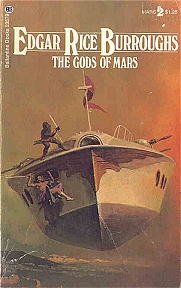
Gods of Mars, Edgar Rice Burroughs.
This is the 2nd of the John Carter books and it manages to top the first one. Gods of Mars is pure pulp action. Each chapter has John Carter and friends facing a new threat and greater odds than the one before it, with no time for reflection or thought or meaningful character development. John Carter is the manliest of men, his prowess being almost ridiculous. Not one but three beautiful women are in love with him; not just 3 women but the three most beautiful women on Mars. He can outfight any 10 men, 20 if he is angry. He is as much of a superhero as any in the books I read this month. In fact, with his otherworldly origin and leaping prowess he bears no little resemblance to certain alien rocketed from a dying planet to Earth, where the yellow sun gave him extraordinary powers.
The expanded societies of Mars are nuts. The white Martians exploit the red Martians, but are in turn exploited by the black Martians. And everybody is exploited by the mad false Goddess Issus. It is a terrible, labyrinthine system that only a man as great as John Carter could free them from.

Gods of Mars is a blistering, exciting read, but the prose and plot can be quite simple. It does offer a somewhat pointed critique of blind faith, but there is little her to stimulate intellectually. Still, it is loads of fun.

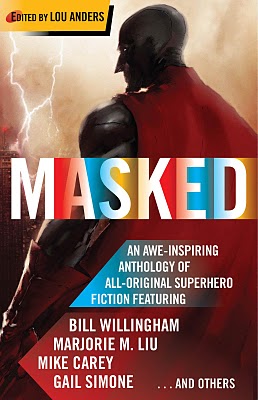
Masked, ed. Lou Anders.

Masked is an anthology of short stories about superheroes, written mostly by comic book writers. Like any anthology, the stories vary in quality. I picked this up because I like many of the contributors, such as Gail Simone, Bill Willingham and Matt Sturges. On the whole the collection is satisfying, even if there are some stinkers.

Among the stories I liked were Matt Sturges’ somewhat gruesome “Cleansed and Set in Gold” about a hero who gets his powers through terrible means and Paul Cornell’s campy “Secret Identity.” The capper is Willingham’s A to Z in the Ultimate Big Company Superhero Universe (Villains Too)” the last and longest of the stories that compress an event comic into 40 or so pages. There were also many other really good stories.

But there were definitely some disappointing ones. Simone’s “Thug” has her trademark deranged yet heartfelt tone, but the stylistic choice of having it seem to be written by the mentally challenged protagonist made it painful to read. Also, too many of the stories focus too much on the gruesome side of superheroics, reveling in the blood and destruction and death. It is tiring and occasionally disgusting.

Still this is a really nice collection. I recommend a checking it out from a library. It is a decent enough way to pass a weekend.

Supergods, Grant Morrison

Supergods is acclaimed comic book scribe Grant Morrison’s part biography, part history of superheroes jumble. Both parts are worthwhile, but not necessarily aimed at the same audience. I am not sure who exactly this book was intended for, other than Grant Morrison fans (of which I am one). Supergods is quite properly aimless.

The first half, though both parts blend together, is a brief, idiosyncratic history of superheroes. Morrison shows just how well he gets the characters, but most of the information is rather basic. The second half is mostly biographical, with some in-depth dissection of the important superhero works of the last quarter century, both Morrison’s own and others. The problem is that anyone who has read enough to understand Morrison’s critiques probably already knows the information in the first half. Meaning the either one half of the book is needless or one half is incomprehensible. Still, taken individually both are good. It is worth to me to hear Morrison go on at length about this topic. He is the undisputed master of superhero storytelling.

There are, however, some downright bad chapters. Such as any time he writes about movies. Morrison wants to note who thoroughly superheroes have taken over summer movies, but he doesn’t seem to have much to say about any of the films.

I still recommend people read this book. People I know can borrow my copy if they wish. Morrison gets superheroes like no one else, and writes with a manic joy that is hard to match. Though this is non-fiction, it is never even close to dry. This is a unmissable opportunity to learn at the feet of a master.

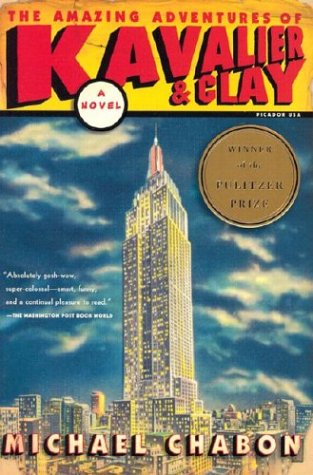
The Amazing Adventures of Kavalier and Clay, Michael Chabon.

The Amazing Adventures of Kavalier and Clay is an astounding, wonderful, unforgettable novel. It did not quite know me off my feet like Yiddish Policeman’s Union did, but that is solely because I had already experienced Chabon. I was ready this time. Amazingly, Kavalier and Clay was even better than Yiddish Policeman’s Union.

The novel follows the exploits of Sammy Clay and Joe Kavalier, two cartoonist cousins in the early days of comic book superheroes. The two create their own popular superheroes, Sammy providing the stories and Joe the art. Their story closely parallels the experiences of some real comic book creators, but is definitely their own. Their experiences in life grow to mirror their comics, with Joe and Sammy becoming something like comic book characters themselves. Their friends and enemies are like the supporting characters of a superhero. There is the beautiful love interest, the dastardly villain, the nutty side characters. Life reflects art reflects life.

The novel is an effective history of the Golden Age of comics that never gets in the way of the characters personal stories. Chabon’s prose is lush and extravagant, displaying a love of words and of the subject matter. Though the tome is nearly 700 pages long, it moves with astounding celerity. It is never slow, never plodding, but it is a detailed account of the lives of a group of people over more than a decade. There are many events to cover and while Chabon rarely lingers too long, he also doesn’t rush. The novel breathes, it lives. And it is terrific.

I can’t heap enough praise on what I’ve read from Chabon. Though somewhat longer, Kavalier and Clay is slightly more engaging than Yiddish Policeman’s Union. Both novels are wonderful works of fiction. If you read at all, read Chabon. I am definitely going to track down the rest of his books. Do yourself a favor and do the same.

Biweekly Quick Comic Review 2

  • Action Comics 903. Written by Paul Cornell, art by Axel Gimenez.   I missed Paul Cornell’s work with Lex on this title, having started with 900, but unlike most people, I am thoroughly enjoying this Doomsday story. It is goofy, but in a fun way. Sure, there are plot holes you could drive a truck through, but Superman fires himself out of a cannon at the Doomsday fortress. This is merely an excuse for Superman and his allies to fight the biggest, most ridiculous threat imaginable and triumph. ***1/2
  • Daredevil 1. Written by Mark Waid, art by Paulo Rivera and Marcos Martin. Mark Waid does something not seen with Daredevil for the last quarter century: something new. He seems to be significantly brightening up the blind hero’s world. Waid is one of the best at pure superhero stories and the art in this book is fantastic. It is a new take on Daredevil that is simultaneously fresh and true to the character. This is a great comic. *****
  • Flashpoint: Project Superman 2. Written by Scott Snyder and Lowell Francis, art by Gene Ha. This is easily one of the best Flashpoint tie-ins, up there with Frankenstein. It is often gruesome, but with reason. The world of Flashpoint is a terrible place for everybody. Project Superman actually has an interesting “What if?” scenario for its main character. What if his rocket had been found but the government and not a kindly couple? I do like the reversal of his relationship with Gen. Lane, who here treats him as much like a son as possible. It also fixes a quibble I had with Flashpoint 3, that Superman would always be good. I don’t know if he will show back up in the main series, but his interactions with Gen, Lane give him reason to be a hero. ****
  • Green Lantern Emerald Warriors 12. Written by Peter Tomasi, art by Chris Batista. This title is plainly and obviously treading water until the big September reboot, but the last 2 issues have been the best of the series. A giant, green energy eating space spider is causing trouble for the corps, so Guy must form a team, without regulars like Arisia and Kilowog, to take care of it. So he gathers some red shirts and gets the job done. The only other survivor, the walrus-like Theodoric, is a character I hope to see more of. It is a good, not great, one off story. ***
  • Power Girl 26. Written by Matthew Sturges, art by Hendry Prasetya. Matt Sturges comes on to finish out this book with a pair of one shot issues. This one is pretty damn good. Power Girl is signing autographs at a Power Girl convention, which I have no problem believing exist in the DC Universe. One fan turns out to be an alien who wants to steal PG’s powers. With the help of some young fans, PG stops the alien. It isn’t complex, but it is fun and well executed. ***1/2

Even Quicker Reviews:

  • Batman: Gates of Gotham 3. Strong character work. ***½
  • Detective Comics 880. Not surprising, but still really good. ****
  • Flashpoint Wonder Woman and the Furies 2. A disjointed, sloppy mess. **
  • Flashpoint Kid Flash Lost 2. Lost is an accurate description, but it is still fun. ***
  • Flashpoint Lois Lane and the Resistance 2. Surprisingly strong, both in art and concept. ***
  • Green Lantern Corps 62. Kind of dumb. **
  • Supergirl 66. Fun, snappy superheroics. ***½
  • War of the Green Lanterns Aftermath 1. Turgid and dull. **

Always Sunny S. 1, Ep. 4

It’s Always Sunny in Philadelphia Season 1, Episode 4:

Charlie Has Cancer

For too long I was of the opinion that the addition of Danny Devito as Frank marked a bad turn on Always Sunny. That was all through the second season, as I recalled how great season 1 was. I don’t hold that opinion any longer, especially after this rewatch and realizing just how limited season 1 was. It was more restrained, but that is more held back from the heights it would achieve and less grounded in reality. Season1, even being only seven episodes long, still manages to retread a lot of ground. Continue reading