A Question of Character 2: Guy Gardner

I don’t think I went over exactly what I intend for A Question of Character to be in the first entry. That is partially because I converted what going to be an unrelated post into the inaugural AQoC post.

With A Question of Character, I plan to examine the history of a comic book character with the somewhat flimsy pretense of answering a question about who they are. This question can range from this month’s Why is Guy Gardner such a jerk? to something as simple as Who the hell is Wildcat? While I would certainly welcome questions from readers–assuming I have any–this is largely an excuse for me to write about some of my favorite lesser-known superheroes. Like Video Game Archaeology, this is going to be a monthly feature on my blog. Hopefully. I mean, this entry, for instance, was for June, though it wasn’t actually posted until August.

Green Lantern Corps #19

As was probably clear from that month long series of panels featuring him, I am a big fan of Guy Gardner, the one true Green Lantern. Also, even just from those panels, it should be obvious that good ol’Guy is a pretty big asshole. Like the majority of the human race, I’d say Guy has a pretty good reason for being kind of a dick to everybody. Not that is really excuses it, but you can see where he is coming from.

So why is Guy such a jerk? Continue reading

Quick Comic Reviews

Now that I’ve started getting my comic books from an online service and get a shipment every other week, I’ve decided to do biweekly short comic reviews. I’ll be writing some brief thoughts on a handful of comics every other week or so. I won’t be reviewing all that I read, just the ones I feel like I have something to say about.

  • Flashpoint 3, Geoff Johns and Andy Kubert

With this issue, Flashpoint goes from being merely slow to being pointless. Last issues (hilarious) cliffhanger is quickly ignored and the plot moves on, but Flash and friends haven’t really done anything yet. This sort of slow build could be effective, but this is only a 5 issue series and we’ve already burned through three of them. I also take offense to the idea that Superman would be a hero no matter what. I would be fine if he didn’t return after this issues cliffhanger. ** (2 stars)

  • Green Lantern 67, Geoff Johns and Doug Mahnke

The War of the Green Lanterns finally concludes. This crossover has been plagued with shipping problems and I’ll need to go back and reread the whole thing to really rate it. This issue was big on noise but short on sense. As is the way with Johns’ Green Lantern stories, it all comes down to Hal and Sinestro. It is suitably explosive, but the logic behind most of it is either not explained or nonexistent. *** (3 stars)

  • Green Lantern Corps 61, Tony Bedard and Daniel Hor

A fallout issue that follows up on the crossover that just ended. Most of the Lanterns who got their rings from the corrupted Mogo give them up, but one feels that she belongs in the Corps. So she and John Stewart go to her sector and try to stop a war. In general, this is the kind of story I want to see from Green Lantern Corps, highlighting a new/unknown member while still being about the main characters. Unfortunately, this is not a particularly good example of how to do that, unlike last months Emerald Warriors, which was perfect. *** (3 stars)

  • Birds of Prey 14, Marc Andreyko and Billy Tucci and Adriana Melo

Marc Andreyko comes on for two issues between Simone leaving and DC blowing the whole thing up. I like the concept of this story, exploring the WWII origins of some of the Birds characters that is really unexamined. Unfortunately, the art, as it has done for most of this series, hampers the writing. Not the Billy Tucci pages, those are good. But Adriana Melo is not great (weird faces) and her style clashes horribly with Tucci’s. **½ (2 ½ stars)

  • Detective Comics 879, Scott Snyder and Francesco Francavilla

Snyder’s excellent run on this title continues. Francavilla’s art is stupendous. Excellent use of color, with red and green tinting everything. There is a lot of good in this issue, but some stuff is unwanted. Like the opposite surprising appearance of the Joker and James Jr.’s goofy plan. Of course complaining about the Joker being in a Batman story is also really dumb. **** (4 stars)

  • Batgirl 23, Brian Q Miller and Pere Perez

Brian Q Miller’s excellent 2 years of Batgirl comes to end, part 1. As usual, this issue is great. It does feel like this is a larger story crammed into less space than would be desirable, but the snappy dialogue and excellent characterization are still in full effect. I am really going to miss this book. Month in month out this is one of DC’s best. **** (4 stars)

  • Superboy 9, Jeff Lemire and Pier Gallo

Superboy under Jeff Lemire has also been one of DC’s best books. Much like Batgirl, this issue seem to be trying to compress a longer story into the issue left before the relaunch, with longer building subplots abruptly coming to a head. Very good, if rushed. ***½ (3 ½ stars)

  • Frankenstein and the Creatures of the Unknown 2, Jeff Lemire and Ibraim Roberson and Alex Massacci

While most of the Flashpoint tie-ins haven’t been very good, Frankenstein has been a welcome exception. This issue is not quite as good as the last one, but when you open with Frankenstein killing Hitler there is nowhere to go but down. Still, this is good stuff, though the art suffers in spots. **** (4 stars)

  • FF 6, Jonathan Hickman and Greg Tocchini

On the first page of this comic is a cast list. None of those characters appear. This issue exists to explain who Black Bolt is and bring him back to life. Presumably, this is a necessary step for later parts of this story, but it still makes for a disappointing issue. ** (2 stars)

  • American Vampire: Survival of the Fittest 2, Scott Snyder and Sean Murphy

I was going to criticize this issue for being too slow, then I realized that was dumb, just because this issue doesn’t get to any actual vampire fighting. However, the heroes survive a plane crash and infiltrate a castle full of Nazi vampires. And it is drawn by Sean Murphy, who is really good at drawing. Best of all, I don’t see this mini-series getting anything but better. **** (4 stars)

Even Quicker Reviews

  • Secret Seven 2 *1/2  This is not good.
  • Deathstroke and the Curse of the Ravager 2 ***½  This is good.
  • Citizen Cold 2 **  I like Kolins’ art, but his writing is stodgy.
  • Booster Gold 46 **½ Jurgens has left Booster a little fun.
  • Batman: Knight of Vengeance 2 ***½  Crazy, and good.
  • Emperor Aquaman 2 **½  Yawn.
  • World of Flashpoint 2 **½  Guy Gardner is an Australian Buddhist
  • Fear Itself: Youth in Revolt 3 **½ I like the characters because no one else does.

All Roads lead to Helldorado

I have a treat for readers today! Since the late 80’s DC Comics have labeled many of their intentionally out of continuity stories as “Elseworlds.” While great deals of these stories, like all comics, are crap, there have been some standouts. Mark Waid and Alex Ross’s Kingdom Come is a true classic, and Batman Year 100, Gotham by Gaslight and The Golden Age are all good. (Some are probably clamoring for Superman: Red Son, but I’m not a huge fan of that one.) However, the best Elseworlds that DC ever published has to be Justice Riders.

Written by Chuck Dixon with art by J.H. Williams III, Justice Riders re-imagines the Justice League as cowboys. While the high-concept is good, it would have been easy to just crank out a passable but forgettable story with little effort. Nevertheless, Dixon wrote a western that if stripped of its Superhero trappings would still be compelling, if overly supernatural, tale.

It may come as a disappointment to some that the Justice League in Justice Riders does not feature Superman or Batman. There is a simple reason for this: in the 90’s they were most often not part of the Justice League. The exception being Grant Morrison’s spectacular run on the title that started the same year that this comic was released. No, the League used for Riders is most of the rest of DC’s big 7¾besides Superman and Batman, the big 7 includes Wonder Woman, The Flash, Green Lantern, Aquaman and the Martian Manhunter¾plus some favorites from the very popular, and also spectacular, Justice League International. The star of this book is Wonder Woman, re-imagined here as Sheriff Diana Prince.

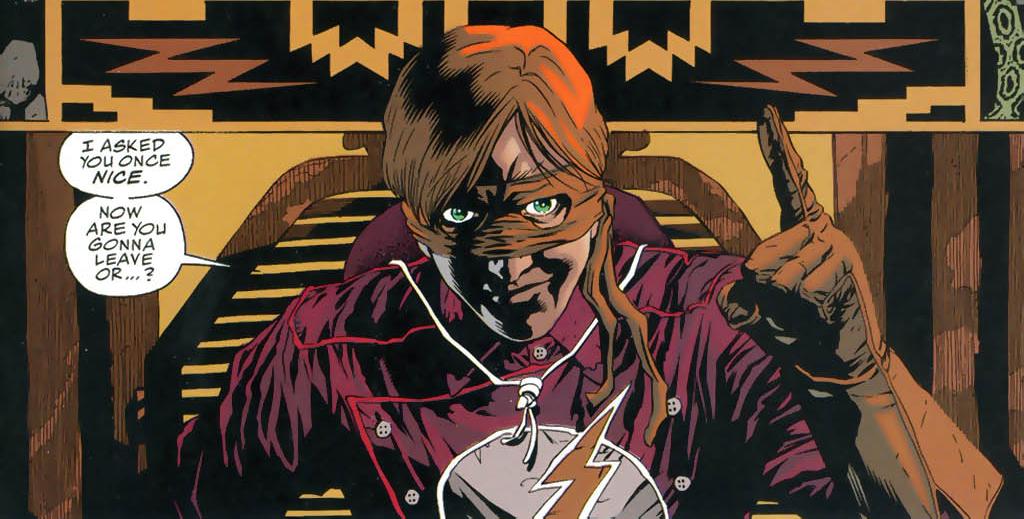
After leaving her town, Paradise, to catch some horse thieves, she returns to find it destroyed. With the dying words of her faithful deputy, Oberon Sheriff Prince vows revenge on the people who destroyed her town. So she goes recruiting. The first gunslinger to joiner is Kid Flash, the fastest gun in the west.

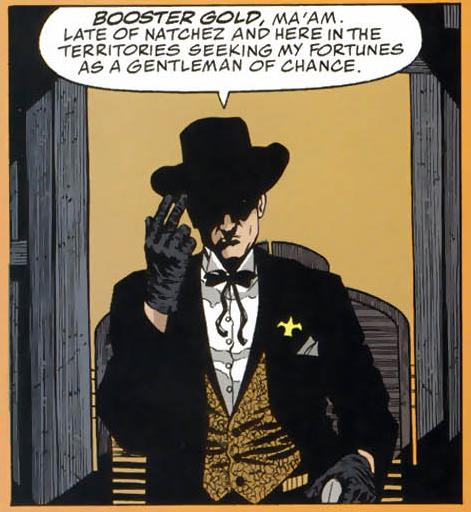
Young Wally West, who still has his super speed, quickly agrees to join Diana, though he does question her recruiting a man with his reputation. She also turns down Booster Gold, a gambler who looks exactly like Bret Maverick, preferring to decide for herself who joins her posse.

Her next target is Katar Johnson, a Native American who joins no questions asked. All he needs is his gear, which includes hawk wings, a loincloth and a shotgun. Honestly, Native American Hawkman may be the best Hawkman.

Meanwhile, still wanting to help, Booster enlists the eccentric Beetle to give him an edge over the speedy Flash. The possibly insane Beetle has just what he’s looking for.

We also get our first look at the villains, of this tale, the murderous railroad kingpin Maxwell Lord, the otherworldly Faust and their army of killer robots.

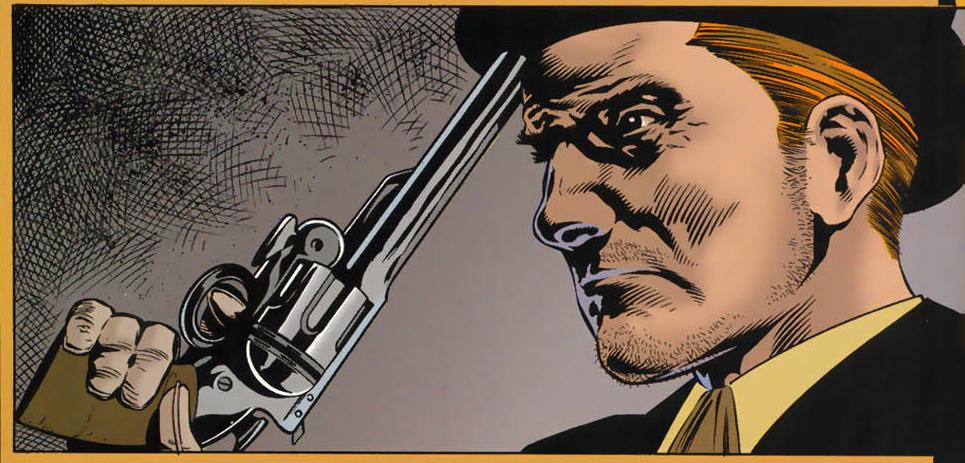
So perhaps I oversold how true of a western this is. That doesn’t matter. What does matter is that Justice Riders is a comic where the Cowboy Justice League fights an army of killer robots. All beautifully drawn by the great J.H. Williams III. It is terrific. I simply can’t emphasize enough how great the art is, as the included pictures should attest.

There aren’t many true surprises in this book, and there doesn’t need to be. Aside from the plethora of supernatural and science fiction elements, Justice Riders is a straightforward revenge western. Sheriff Prince and her group, who eventually number 7, chase Max Lord across the Southwest before the final showdown in Helldorado. There are several sumptuously drawn gunfights, and some inspired appropriations of Superhero concepts into the western framework.

There is one more wrench thrown in, one that is what puts it over the top. Kid Flash is wanted for murder in Texas and there in only one man who can track him down. The incomparable Kid Baltimore, the bowler wearing Pinkerton Detective Guy Gardner. As is always true, Guy Gardner is awesome. And his appearance in this book is just a glorious cherry on this delicious, western sundae.

It shouldn’t be hard to track a copy of Justice Riders down; I highly recommend you do so. You can get it for about $10 on Amazon. I found it for less than 5 at a local comic shop. It is bound like a paperback, so it will sit perfectly on a bookshelf. Really, go get it.

The Brave and the Bold

So DC Comics has been making some pretty big news last week, huh?

Personally, I really like the idea. While it may turn out to be just a bigger version of the usual post-event shake up, I think this is a genuine attempt by DC to sell comics to more people than the usual comic book readers. There is overwhelming evidence that the general public not only likes superheroes; they love them. From blockbuster movies to video games to toys to clothes, comic book properties sell just about everything but comic books. DC, a perpetual number 2 in market, appears to have finally decided to bite the bullet and change the way they do things. So whether fans like it or not, DC is re-launching their comic line and pushing hard into the digital sales market. DC might save the dying comic industry with this endeavor, it is just as likely they flame out spectacularly. It is a brave and bold risk.

Fan reaction has been hilarious. It is the sort of petulant, entitled complaints one would expect from “comic book geeks.” (Which are not any worse than other sorts of geeks. For instance, check all the LeBron talk during the recent NBA finals. We are all geeks, the only difference is the subjects of our geekdom.) Not that there haven’t been thoughtful, insightful responses, but many fans are just angry about what DC is doing to their characters. Reading lots of reactions this week tells me that the fan base is septic, reacting to every proposed change with pessimism and bile. Kudos to DC for trying to break free from the anchor currently sinking comics.

Not that I’m convinced it will necessarily be successful. Is the audience actually there of for digital comics? Will DC ruin any chances of success by trying to have their cake and eat it too? This things make this a big risk.

DC’s pricing strategy is the only one that makes sense. People say they will only buy digital if it‘s $.99 , but most of those would probably not buy any no matter the price. But keeping them the same as print to start, 2.99, and dropping to 1.99 after a month is a good compromise. 1.99 is not too much, that is about the same as a bottle of soda.

DC has also claimed that they are actually going to try to market Comics to a wider audience. The Green Lantern App is a good start, but if they are really serious they should put an add in the trailers for the coming Green Lantern movie. With comics being available in more bookstores, like Barnes and Nobel and Hastings, it should be easier than it has in a long time to get comics. I have nothing against comic shops, but if they are the only way to get comics then the comics market will continue to shrink.

When every thing is said and done, though, what really matters is how good the books DC puts out. Below are my thoughts on each and every one of the 52 number ones as well as a quick rating of my interest in each title (Excited, Intrigued, Dubious, or Pass): Continue reading

Why Superman is the best.

It’s been a while since I’ve done so, but I’m getting a hankering to write about superheroes.  At first I was going to write a defense of that most unlovable of heroes, Marvel’s Ant-Man, but if I’m going to write about superheroes, I should write about the best superhero.  Since I can do that and write about the best comic at the same time, I decided to write about Grant Morrison and Frank Quitely’s All-Star Superman.  Specifically All-Star Superman #5, my personal favorite comic book ever.

As everyone should know, the only superheroes that actually matter are Superman, Batman and Spider-Man.  Sure, lots of the others are great–I like Guy Gardner and Thor– but the three I mentioned are the ones that set the standards for the rest.  Spider-Man is the perfect teenage superhero, with a simple reading being the spider powers stand in for puberty.  Batman is the man who makes himself a myth, with one of the greatest fictional locales to run around.  But Superman is the original and best superhero.  He represents the best that humanity–and in some ways America– can hope to be, an ideal to strive to.  No story better illustrates this than All-Star Superman.

All-Star Superman #5 is a story titled “The Gospel According to Lex Luthor.”  On the surface, it is a simple comic; Lex Luthor, condemned to death, allows Clark Kent to interview him in prison, to give the world his side of the story of his war on Superman.  The irony immediately obvious to every reader is that Clark Kent is Superman, which despite being the smartest man on Earth Luthor has not figured out.  However, there is much more going on here than that.  While this comic is about Luthor’s side of the story, is as perfectly contrasts the values and principles of Superman and his greatest enemy.

First, a brief explanation of Lex Luthor.  Whether in his original identity of a standard mad scientist or his revised (Post Crisis on Infinite Earths) power-mad CEO, Luthor has generally been Superman’s foremost adversary.  He has appeared in every modern Superman movie.  Luthor is, simply, Superman’s opposite in most ways.  Luthor is smart, rich and powerful as well as completely self-centered.  While his is undeniably intelligent, Luthor’s real defining trait is his narcissism.   If not for Superman, Luthor would be the most powerful person on Earth.  Superman’s superiority, instead of being an example to follow, makes Luthor insanely jealous.  While he is smart enough to gain any accolade he desires, he cannot accept Superman’s supreme physical advantage over him.   Luthor is easily one of, if not the, best comic book villains.

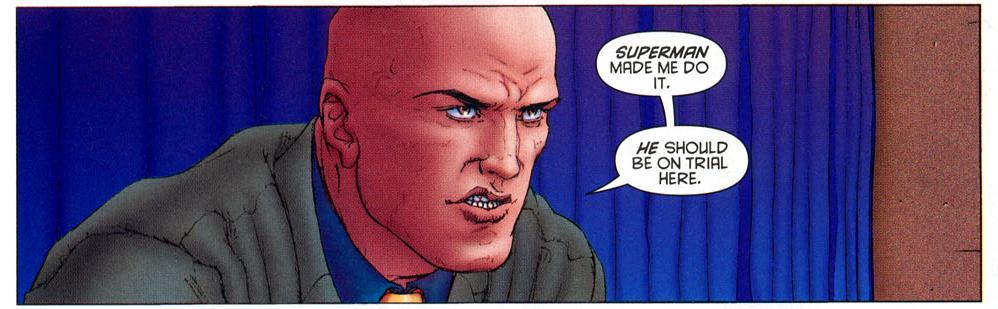
The Gospel According to Lex Luthor starts with Lex being sentenced to death for his recent (Issue 1) attack on the first manned mission to the Sun.  His defense?
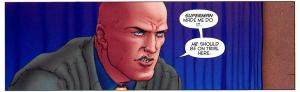
He is so blinded by his personal war with Superman that he believes he needs no defense for his actions.  Before his execution, he allows one reporter to interview him: Clark Kent.

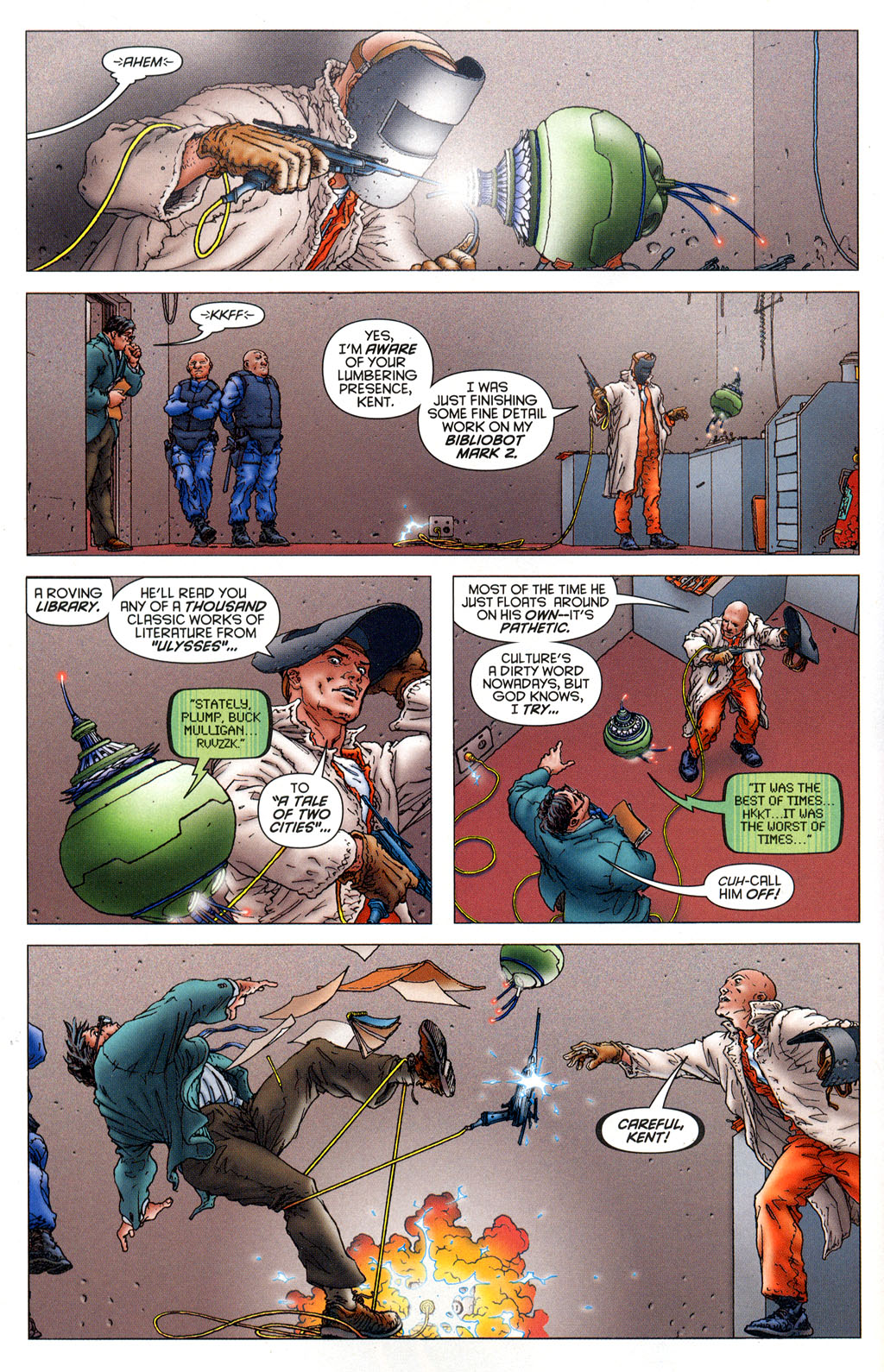
The Clark Kent of All-Star Superman is not the competent figure that he has been since John Byrne’s reboot in the 80’s. Morrison’s Kent takes the mild mannered reporter shtick much further than just mild-mannered he is a complete pantywaist.  While I prefer the version of Superman where Clark Kent is who he is and Superman is the disguise, in order to really believe no one suspects he is Superman the other way actually works a little better.  I can see why no one suspects, or even believes when confronted with it point blank, that Clark Kent is Superman.  But one of the most amazing things about All-Star Superman is how Kent’s clumsiness is just another tool in his crime-fighting arsenal.  Case and point page 4:
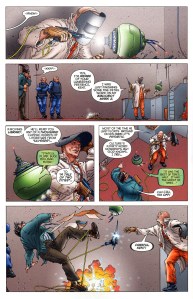
This also illustrates one of the fundamental differences between Superman and Lex Luthor:  Luthor spends all of his time trying to destroy his enemy; Superman goes out of his way to save him.

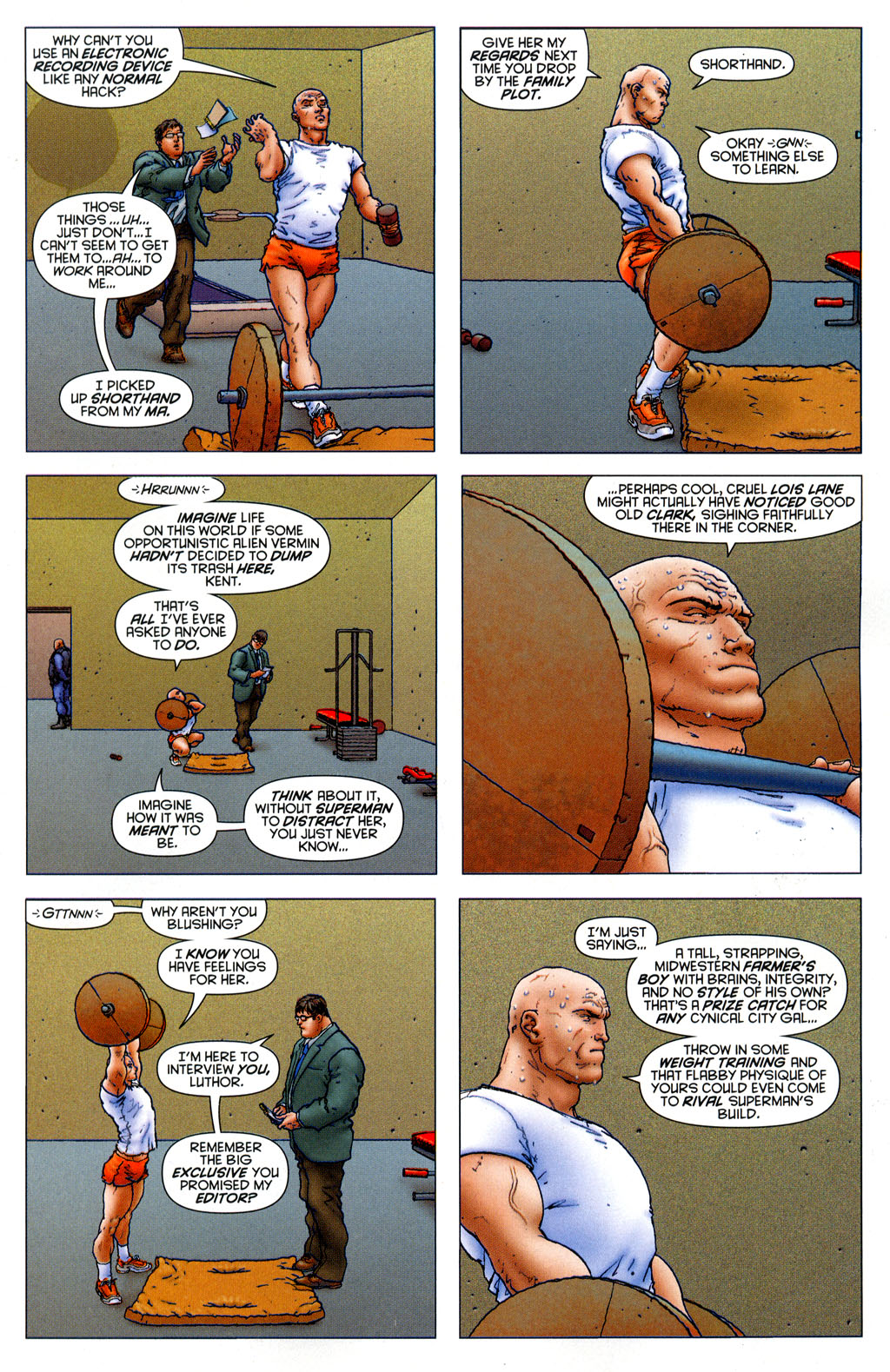
The next few pages really show how Luthor thinks, both about himself and about Superman.  He calls his guards “fat girls” and asks Clark if he feels “diminished by [Superman’s] very presence.”  While in the midst of a strenuous work our routine, Luthor focuses on questioning Clark’s masculinity.  He displays his own insecurities about Superman’s physical prowess, with the focus on Clark’s masculinity and his own hard exercise regimen.  There is some validity to Luthor’s anger here; there is no way that any person could match Superman’s strength.  But he is so focused on it that he can’t even begin to fathom that Superman could be posing as a man that appears as feeble as Clark Kent does.

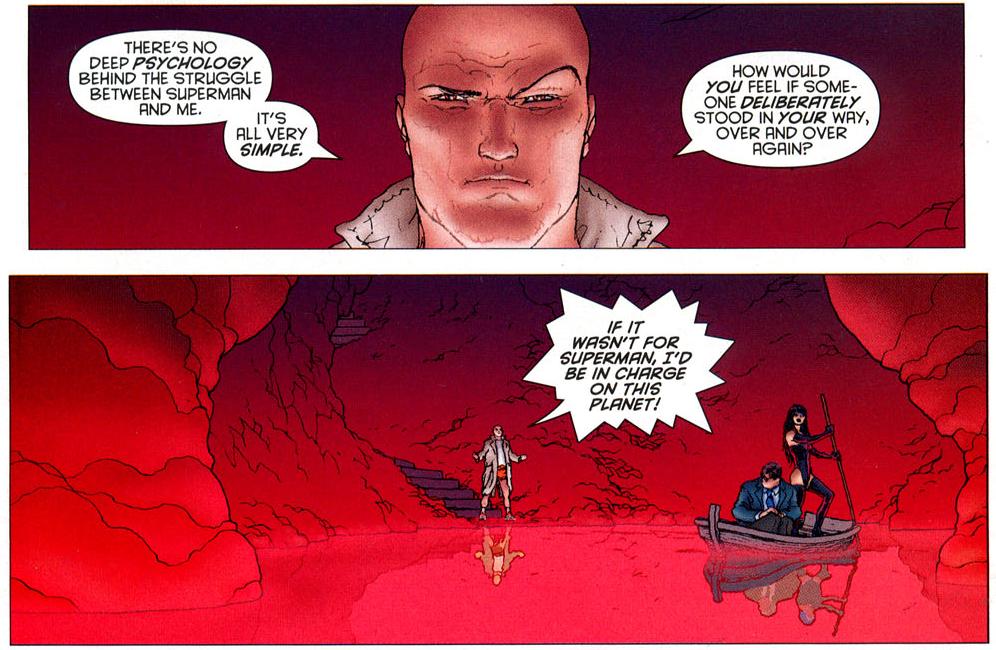
We then move on to the communal area of the prison, where Lex outlines his utopian vision of society, which he calls “survival of the smartest”, while being completely oblivious to the angry stares he is getting from every other inmate. He has no fear; even of the occasionally super powered Parasite (he sucks the power out of other people, including Superman).  “Brain beats Brawn every time,” Luthor says, which he believes makes his victory inevitable, though it proves to be the opposite.

Parasite starts to absorb Superman’s powers and breaks free from his restraints, which starts a riot.  While pretending to blunder into the fray, Clark manages not only to save Lex’s life again; he also saves all the guards caught up in the riot.  All while not breaking his cover as Clark Kent.  While Lex and Clark make their escape to Luthor’s cell, they are pursued by the increasingly immense Parasite.  Superman causes a convenient earthquake, and Lex:

Note how quickly Luthor abandons brains for brawn.  He doesn’t even question the earthquake, he doesn’t try to think of an escape from the Parasite, he hopes for a miracle.  Then as soon as his enemy is down, he starts kicking him. Once they get to Lex’s cell, he simple continues on his tirade against Superman.  His petty grudge has completely consumed him.  He gloats about how he’s turned the newspaper and the prison against Superman, and then shows Clark his escape route.  Lex has no intention of escaping; he merely wants to show how little power the law has over him.  Here Clark almost loses it.  He does not understand how Luthor can focus only on his personal war with Superman, when together they could do so much to help the world.  But Luthor is determined to throw his life away in his maniacal quest to destroy Superman.
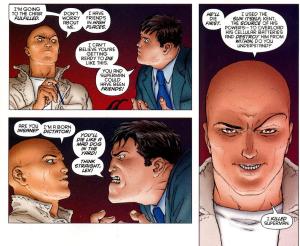
He also drops his final bomb:  Superman is dying.  The readers already know this, but they did not know that it was an intended part of Luthor’s plan.
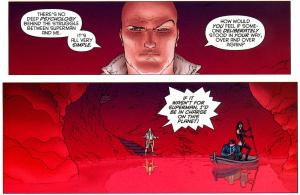
While this comic defines Lex Luthor, it also defines Superman.  While incredibly intelligent, Luthor thinks only of his own quest for power.  Superman on the other hand, despite having no reason to feel anything but hate for a man who has spent his life trying to kill him, does everything he can to save Luthor from himself.  Superman’s faith in humanity is such that he thinks even the worst of us are worth saving.