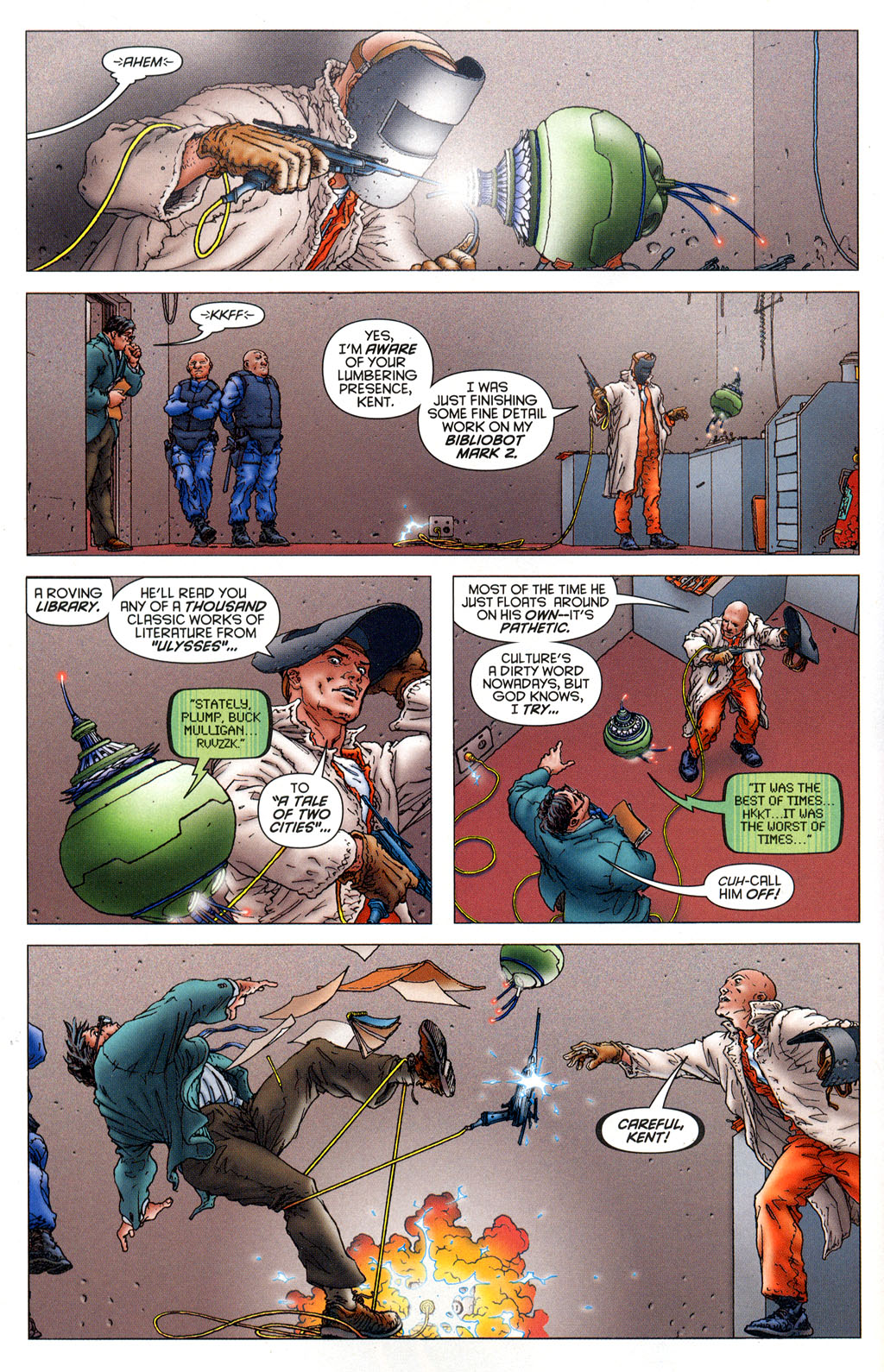
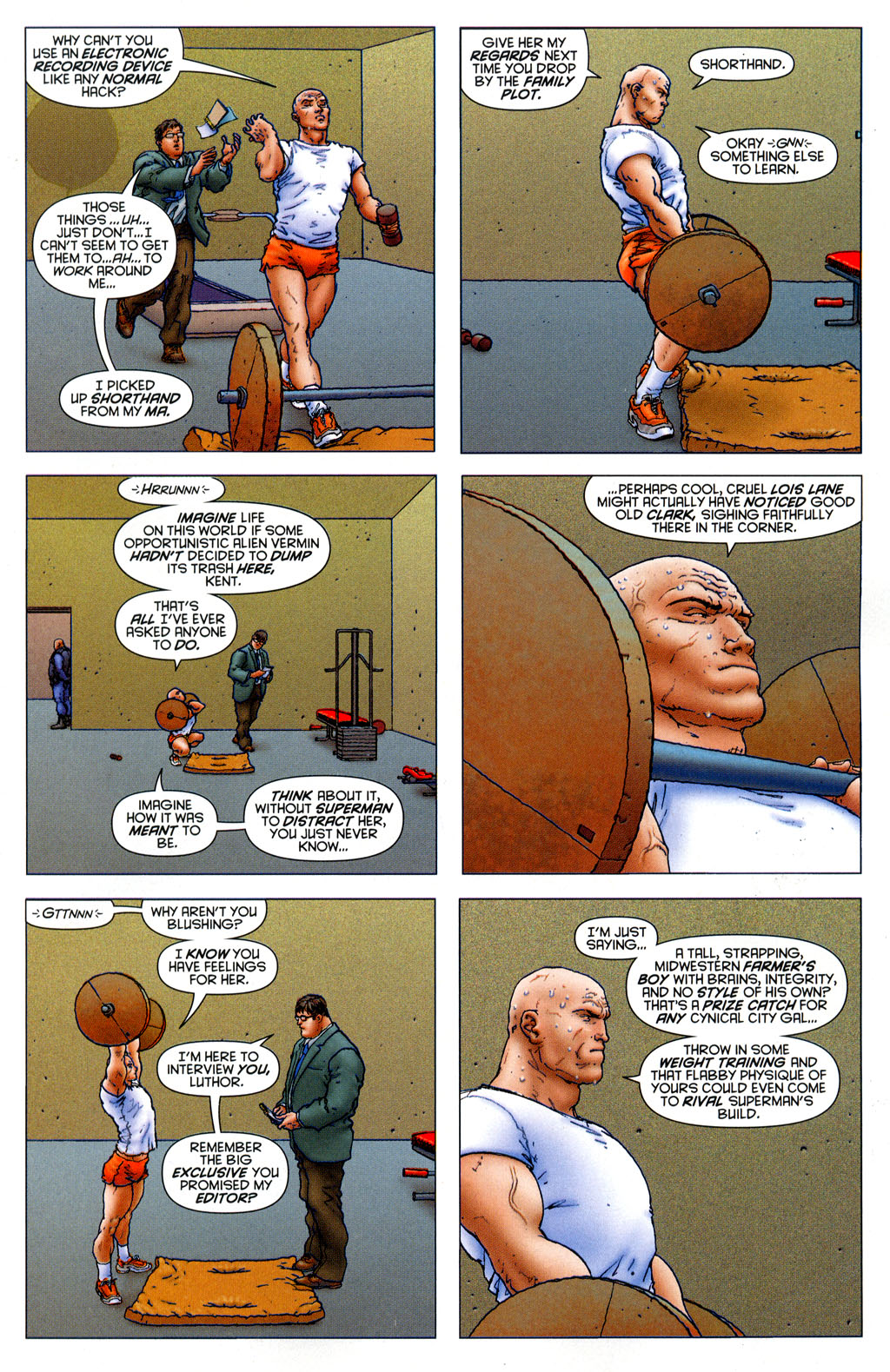
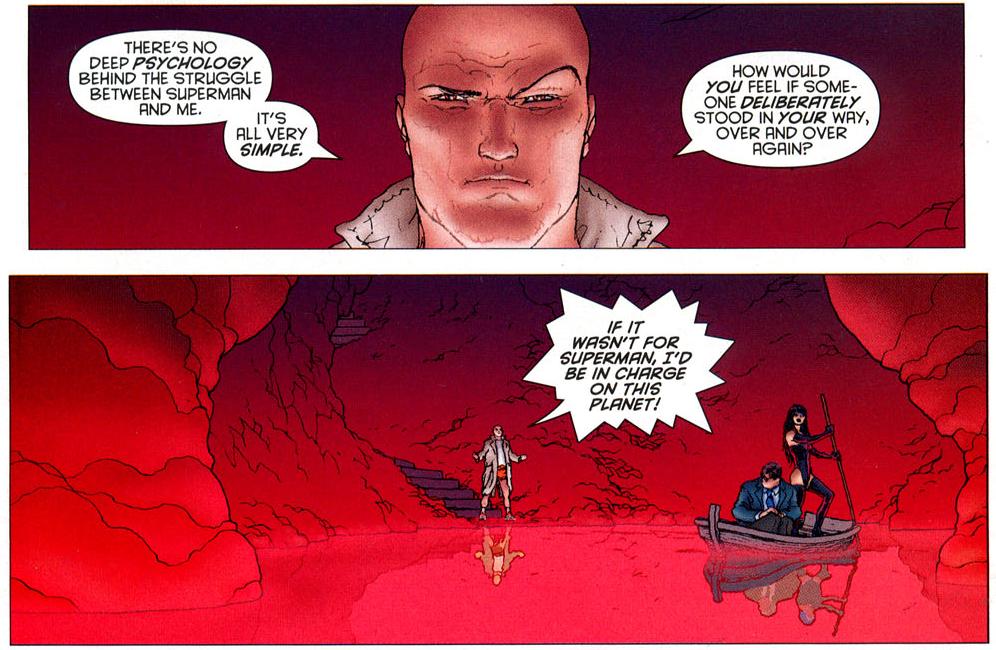
The Quest: Part the Third

Another week, another game crossed off my list. Gungrave is beaten. Tsugunai: Atonement still is not, but I did make some progress. I also started playing Growlanser III again. All in all a productive week.

Gungrave is astoundingly short. Given what it is that is not surprising, but it does not change the fact that this game is not long at all. I am not overstating this; I beat the game in less than 3 hours. Gungrave is a shmup by way of the 3D action game. The graphics are rough, the story is barely intelligible (I assume it relies on knowledge of the anime/manga/whatever) but the game is actually fun. It occasionally puts the player in that perfect, zen-like shooter trance, where the controller is forgotten and the player simply reacts. Honestly, though, I would have been upset with the length if I had paid more than 6 bucks on this game.

Tsugunai’s blandness has kept me from making much more progress. If my opinion does not change by next week, the game is getting kicked to the bottom of the list, or even off it.

I also broke out Growlanser Generations back out. GG is Working Designs last release, a compilation of Growlanser II and Growlanser III. I’ve already beaten II and I liked it a lot. I played about halfway through III before I got bored or distracted by something else. Since starting it again, I’ve noticed 2 things. The first is how great the battle system is. It is like a real time Final Fantasy Tactics. More could have been done to improve it from II, all that appears to be changed is a significant bump up in the difficulty, but it is still very good. The second thing is how very anime this game is. That is something that may have appealed to me 5 or 6 years ago, but now it is somewhat off putting.

Next week: more Tsugunai and Growlanser, plus I plan to start Castlevania: Lament of Innocence. In addition, Eve of Extinction, which was found not purchased, is again lost. It has been replaced on the list with the newly purchased Yakuza 2. Which does not play in my PS2, but I am determined to play it.

Continue reading

Gaming in the Clinton Years?

These videos have been making their rounds on the internet for a few years, but having rediscovered them recently I’ve realized that they never get old. A quick google search of “gaming in the Clinton Years” or “George Wood,” the deranged reviewer, will find you someone going after them with much more fervor and glee than I can muster, but I’d still like to highlight some of the more ridiculous reviews.

These are some prime entertainment. This reviewer combines a perfect blend of ignorance, belligerence and enthusiasm with some nonsensical mad-libs like observations. Whether he is exhorting the player to just give up on hard levels, spoiling every bit of story he can get his hands on or just wishing Lara Croft would get breast cancer, you’ll never be exactly sure where he is coming from or where he is going.

His Goldeneye review as a lot of time makes fools of us all in it, as Goldeneye was really one of first games to sell mostly due to its multiplayer. But it is nowhere near as hard as he seems to believe. And suggesting any game ape Turok is as incorrect as possible.

On Mega Man Legends, he praises the game for being more story focused, like he wished more games were, then faults it for being too story focused. Making a story heavy Mega Man is as bad as a Mario sports game indeed.

I could keep posting these all day, but the complete failure of his Symphony of the Night Review is a good stopping place.  Search for Gaming in the Clinton Years on youtube and have fun.

The Quest 2

In the first week of my concentrated effort to clear out my PS2 backlog I have made some good progress. I started the week playing two games: Activision and Neversoft’s Gun and Tsugunai: Atonement developed by Cattle Call and published by Atlus. So far, I would say I enjoyed both of them to at least some degree.

I beat Gun. It is a competently made GTA-clone with an–at the time at least–unique setting, but it definitely has its flaws. For one, its game world is very small. There is a decent variety of missions, but there just aren’t very many of them. There is a variety of locales, but they are all really small. Even with how small they are, they are still sparsely populated. Gun manages to feel both cramped and empty. That doesn’t ruin the game, though. It just leaves the player wishing there were more, and that is not the worst thing to say about a game.

I just really wish they had done a better job with the story. Gun’s story is just a slap-dash collection of western clichés that does a decent job developing the protagonist but leaves everyone else simple caricatures (the gold-hearted hooker, the corrupt mayor, etc.). I would like to see how it stacks up against the recent Red Dead Redemption. Gun is a good, but nowhere near great game.

Tsugunai: Atonement I did not beat. I haven’t quite played quite enough of it to form a full opinion on it; the game is structured into 34 missions and I’ve cleared 9 of them. So far, the game is long on ideas and short on execution. I really like the premise: the main characters spirit has been separated from his body and he must possess people to help them solve their problems. Someone could make a great game around this idea, but Tsugunai does not appear to be that game. The most obvious flaw is in how the game looks. Not only are the graphics bland, which they very much are, but also the screen is very dark. This is not a problem with my TV; I can see every other game just fine. However, Tsugunai is often so dark you cannot even see how bland the graphics are. On the plus side, the soundtrack is by Yasunori Mitsuda at his Chrono Crossiest.

So next week I’m going to continue hacking away at Tsugunai and start up Gungrave. I’ve been told Gungrave is quite short, so if I finish that I may start on Castlevania: Lament of Innocence or start again on Growlanser III. 27 left.

Continue reading

Ineffective!

25 Years of NES Part 22:  Final Fantasy

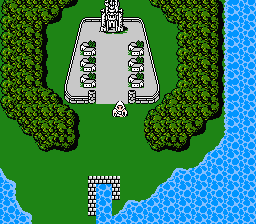
Final Fantasy has a title which is of course ironic now considering the more than dozen sequels and spin-offs in the Final Fantasy series today, but at the time of its release, according to video game legend, Final Fantasy was SquareSoft’s last gasp as an early game studio, so the title was apt. It is a little hard to look at this primitive game now and see the progressive title it was at the time. However, compared to its NES competitors Final Fantasy had some innovative features.

Taking a page or more from D&D, Final Fantasy lets the player choose his party from a small stable of available jobs. These jobs are FF most brilliant feature. By tying different combinations of jobs, the player can replay this game numerous times and get a vastly different experience. Those jobs are:

  • Fighter: the meat shield. One of the most important classes. He can use all the good armor and weapons, but he gets no magic, at least not to start. Because the way game has the enemies attack (50% of the hits go to the party leader, 25% to the number 2 guy and 12% each for the last two spots) having a Fighter or two at the top of your party can let you go for a long time with the pair of meat shields eating the majority of the hits.
  • BlBelt: like the fighter, the BlBelt is an effective damage dealer. Unlike the Fighter, the BlBelt does not get all that great armor or all those great weapons. Fortunately, he does not need them. He is more than a match for the Fighters damage output, and after the first few levels he will not need and sort of weapon. A very low maintenance character. To offset his great damage output, he looses the ability to take that many hits. He’s not exactly fragile, but he is no match for the fighter.
  • BlMage: Pure magical damage. This little guy is death on a larger scale than the Fighter or the BlBelt, hampered only by the number of charges he has for his spells. Most of the battles are beaten by blasts of Lit2, the BLMage is the best choice for clearing mobs until you acquire some items that cast Lit2 when used.
  • WhMage: the healer and undead killer, the WhMage has its uses, but it is not necessary. Yes, the WhMage is unnecessary. S/He is not useless, but the goal for most battles should be to get out as fast as possible, and the WhMage has few good damaging options, as well as being fragile. Some money can be saved with the WhMage’s healing magic, but likely not enough to offset the loss of damage. Still, adding one, but not more, is not a terrible choice.
  • RdMage: Jack of all trades, master of none. In the first half of the game, the RdMage is great. He deals and absorbs all most as much damage as a Fighter as well as almost matching the casting ability of the BlMage and WhMage. As the game goes on his abilities become less and less impressive; the RdMage does not get access to higher level spells, armor or weapons. He is much better early than late, but is still a good addition.
  • Thief: He combines the damage and armor limitations of the RdMage with the spell casting ability of the Fighter. The Thief is just not very good. He does get the most significant change in class to Ninja. The Ninja gets some good spell casting and better equipment. The Thief has many disadvantages but no advantages.

There is a class change about halfway through the game, but most of the classes just become slightly stronger versions of the original class. More spells, more equipment, few substantive changes. Except, of course, the Ninja who makes the Thief useful.

The game’s quest is simple, but significantly more involved than Dragon Warrior’s. After you pick your four Warriors of Light, then you must defeat the four elemental fiends who are killing the world to relight the Crystals. By the end, the story morphs into one about a time loop and an infinitely repeating quest. Luckily, the translation is quite good by NES standards, though it is sometimes still hard to figure out exactly what is going on.


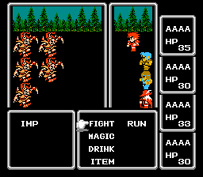
Unless you already know the game inside and out, Final Fantasy is also very hard. The most annoying thing is wasted attacks. If you have a character attack an enemy that is already dead, then instead of moving to the next target, like nearly every game sense, it tells you that your attack was “ineffective.” I cannot help but imagine the warriors blindly wailing on imp corpses. Then there are the long dungeons, with tons of both random encounters and triggers that cause battles with every step, plus chests that are designed to be empty. Half the game seems designed to frustrate the player.


Outside of its primitiveness, there are real flaws to Final Fantasy. It was evidently a hastily programmed game, because there are numerous bugs and glitches. Some are interesting and have become a part of the game’s lore, like the Peninsula of Power, a spot on the map that allows a player early in the game to fight some of the strongest enemies. If the player is unaware then this could be a disastrous encounter, though the peninsula is far enough out of the way that most players would not encounter it naturally. A prepared player can use this mythical Peninsula for some dangerous but effective leveling. The truth about this peninsula is that the area box for those enemies was made just a little too large and accidentally caught the piece of land sticking up there. Others are more detrimental. For one the Intelligence stat is broken. It does nothing, so the mages big stat means nothing, so a Black Mage casting Lit2 gets the same result as a Fighter using an item to cast it. Also, many of the spells are useless, or are bugged so they do not work correctly. Many of them are slightly different instant death spells that are ineffective against most late game enemies.


None of these flaws really makes the game unplayable, and many of them are fixed in later versions, but it does make Final Fantasy a significantly flawed game. For people with no nostalgia for FF on the NES or for NES RPGs I would recommend the GBA or PSP versions of the game. If you did play this game back in its day, then I recommend giving it a replay in its original form; its well worth the repeat experience.

I can’t finish this book

For the better part of the last 2 years, I have been reading The Once and Future King. I blew through the first “book” The Sword in the Stone. As all good people are, I was very familiar with Disney’s animated version and it is mostly the same in the book. Only there is more of it. And Robin Hood. It is exactly what I thought I was getting into. The second part, The Queen of Air and Darkness, sets up Arthur’s goals as king and is largely terrific. But I have not been able to make much progress since I finished the second part, and I have only recently realized why.

I know how King Arthur’s story ends. I’m fairly sure everybody does. Everybody knows about Lancelot, Guinevere, and Mordred. If I read the rest of the book, that stuff happens. As long as the book remains unread, Arthur is still a young, idealistic king. I can still look back fondly on his adventures with Merlin. Once I read it, I’ve condemned him to the failure of his dream. It is like the reverse of “The Monster at the End of this Book,” in which Grover is deathly afraid of the promised monster and appears afraid of letting the reader turn the page.

This sort of thing does not normally bother me; I’m sure I’ll get over before long. I want to read the rest of the book. I feel compelled to see it to the end. However, knowing what is coming has made me put it off as long a possible. I can count the number of books I’ve started but never finished on one hand; aside from The Once and Future King and what I’m currently reading (The Devil’s Eye by Jack McDevitt) the only thing that comes to mind is that monstrous turd Battlefield Earth. There is little fear I will not finish.

Honestly, I wanted to see if I could relate serious literature to The Monster at the End of the Book, and I feel I succeeded. Really, I love that book for introducing young me to the concept of meta-fiction.

Why Superman is the best.

It’s been a while since I’ve done so, but I’m getting a hankering to write about superheroes.  At first I was going to write a defense of that most unlovable of heroes, Marvel’s Ant-Man, but if I’m going to write about superheroes, I should write about the best superhero.  Since I can do that and write about the best comic at the same time, I decided to write about Grant Morrison and Frank Quitely’s All-Star Superman.  Specifically All-Star Superman #5, my personal favorite comic book ever.

As everyone should know, the only superheroes that actually matter are Superman, Batman and Spider-Man.  Sure, lots of the others are great–I like Guy Gardner and Thor– but the three I mentioned are the ones that set the standards for the rest.  Spider-Man is the perfect teenage superhero, with a simple reading being the spider powers stand in for puberty.  Batman is the man who makes himself a myth, with one of the greatest fictional locales to run around.  But Superman is the original and best superhero.  He represents the best that humanity–and in some ways America– can hope to be, an ideal to strive to.  No story better illustrates this than All-Star Superman.

All-Star Superman #5 is a story titled “The Gospel According to Lex Luthor.”  On the surface, it is a simple comic; Lex Luthor, condemned to death, allows Clark Kent to interview him in prison, to give the world his side of the story of his war on Superman.  The irony immediately obvious to every reader is that Clark Kent is Superman, which despite being the smartest man on Earth Luthor has not figured out.  However, there is much more going on here than that.  While this comic is about Luthor’s side of the story, is as perfectly contrasts the values and principles of Superman and his greatest enemy.

First, a brief explanation of Lex Luthor.  Whether in his original identity of a standard mad scientist or his revised (Post Crisis on Infinite Earths) power-mad CEO, Luthor has generally been Superman’s foremost adversary.  He has appeared in every modern Superman movie.  Luthor is, simply, Superman’s opposite in most ways.  Luthor is smart, rich and powerful as well as completely self-centered.  While his is undeniably intelligent, Luthor’s real defining trait is his narcissism.   If not for Superman, Luthor would be the most powerful person on Earth.  Superman’s superiority, instead of being an example to follow, makes Luthor insanely jealous.  While he is smart enough to gain any accolade he desires, he cannot accept Superman’s supreme physical advantage over him.   Luthor is easily one of, if not the, best comic book villains.

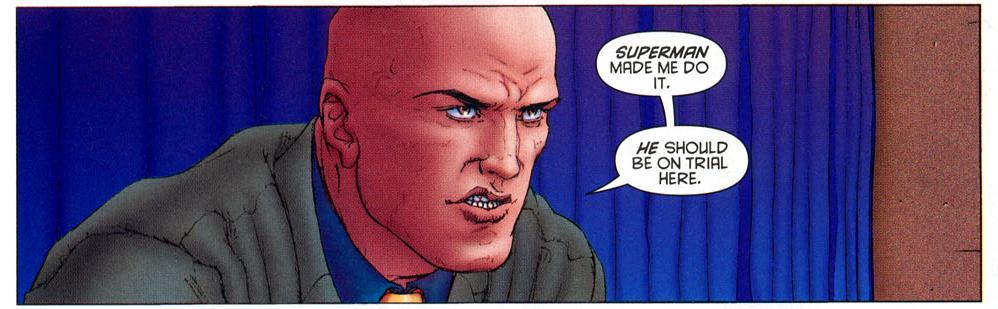
The Gospel According to Lex Luthor starts with Lex being sentenced to death for his recent (Issue 1) attack on the first manned mission to the Sun.  His defense?

He is so blinded by his personal war with Superman that he believes he needs no defense for his actions.  Before his execution, he allows one reporter to interview him: Clark Kent.

The Clark Kent of All-Star Superman is not the competent figure that he has been since John Byrne’s reboot in the 80’s. Morrison’s Kent takes the mild mannered reporter shtick much further than just mild-mannered he is a complete pantywaist.  While I prefer the version of Superman where Clark Kent is who he is and Superman is the disguise, in order to really believe no one suspects he is Superman the other way actually works a little better.  I can see why no one suspects, or even believes when confronted with it point blank, that Clark Kent is Superman.  But one of the most amazing things about All-Star Superman is how Kent’s clumsiness is just another tool in his crime-fighting arsenal.  Case and point page 4:
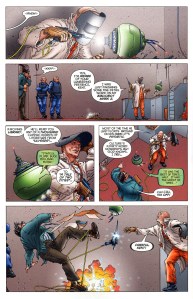
This also illustrates one of the fundamental differences between Superman and Lex Luthor:  Luthor spends all of his time trying to destroy his enemy; Superman goes out of his way to save him.

The next few pages really show how Luthor thinks, both about himself and about Superman.  He calls his guards “fat girls” and asks Clark if he feels “diminished by [Superman’s] very presence.”  While in the midst of a strenuous work our routine, Luthor focuses on questioning Clark’s masculinity.  He displays his own insecurities about Superman’s physical prowess, with the focus on Clark’s masculinity and his own hard exercise regimen.  There is some validity to Luthor’s anger here; there is no way that any person could match Superman’s strength.  But he is so focused on it that he can’t even begin to fathom that Superman could be posing as a man that appears as feeble as Clark Kent does.
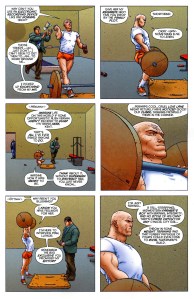
We then move on to the communal area of the prison, where Lex outlines his utopian vision of society, which he calls “survival of the smartest”, while being completely oblivious to the angry stares he is getting from every other inmate. He has no fear; even of the occasionally super powered Parasite (he sucks the power out of other people, including Superman).  “Brain beats Brawn every time,” Luthor says, which he believes makes his victory inevitable, though it proves to be the opposite.

Parasite starts to absorb Superman’s powers and breaks free from his restraints, which starts a riot.  While pretending to blunder into the fray, Clark manages not only to save Lex’s life again; he also saves all the guards caught up in the riot.  All while not breaking his cover as Clark Kent.  While Lex and Clark make their escape to Luthor’s cell, they are pursued by the increasingly immense Parasite.  Superman causes a convenient earthquake, and Lex:
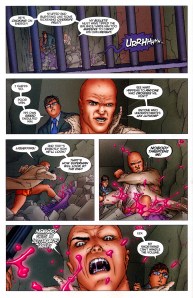
Note how quickly Luthor abandons brains for brawn.  He doesn’t even question the earthquake, he doesn’t try to think of an escape from the Parasite, he hopes for a miracle.  Then as soon as his enemy is down, he starts kicking him. Once they get to Lex’s cell, he simple continues on his tirade against Superman.  His petty grudge has completely consumed him.  He gloats about how he’s turned the newspaper and the prison against Superman, and then shows Clark his escape route.  Lex has no intention of escaping; he merely wants to show how little power the law has over him.  Here Clark almost loses it.  He does not understand how Luthor can focus only on his personal war with Superman, when together they could do so much to help the world.  But Luthor is determined to throw his life away in his maniacal quest to destroy Superman.
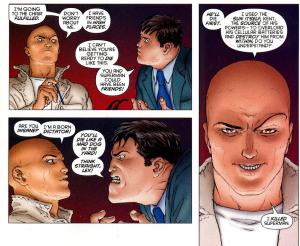
He also drops his final bomb:  Superman is dying.  The readers already know this, but they did not know that it was an intended part of Luthor’s plan.
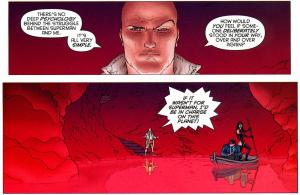
While this comic defines Lex Luthor, it also defines Superman.  While incredibly intelligent, Luthor thinks only of his own quest for power.  Superman on the other hand, despite having no reason to feel anything but hate for a man who has spent his life trying to kill him, does everything he can to save Luthor from himself.  Superman’s faith in humanity is such that he thinks even the worst of us are worth saving.

The Quest

I am tired of playing my PS2.  My PS2 has certainly seen better days.  It no longer plays DVDs, it has trouble with some games despite their pristine conditions.  It won’t recognize the lid is closed unless there are several games sitting on top of the system.  The system in definitely on its last legs.  As much as I love the old guy, I am ready to move on.  Honestly, for much of the last 2 years I have been done with it.  I have played my Wii and DS and recently my brother’s PS3.  But that PS2 stayed hooked up right next to others, waiting for me to finally come and finish off my PS2 library.  Well, that time is now.

Here is the list of PS2 games that I own but haven‘t beaten:

  1. Unlimited Saga
  2. Mark of the Kri
  3. Okage: The Shadow King
  4. ChoroQ
  5. Phantom Brave
  6. Chaos Legion
  7. Forever Kingdom
  8. Silent Hill 2
  9. Darkwatch
  10. Gungrave
  11. Shining Force Neo
  12. Genji
  13. Maximo
  14. Marvel Ultimate Alliance
  15. Front Mission 4
  16. Grim Grimoire
  17. Killer 7
  18. Star Ocean 3
  19. SMT Devil Summoner 2
  20. Shining Tears
  21. Growlanser 3
  22. Drakengard 2
  23. Castlevania:  Lament of Innocence
  24. Gun
  25. Tsugunai: Atonement
  26. Wild Arms 3
  27. SMT: Nocturne
  28. Rogue Galaxy
  29. Steambot Chronicles
  30. Bully
  31. The Thing
  32. Eve of  Extinction

32 games.  My goal is to beat or just remove every game on the list.  I intend to beat most of them, but I am sure there are some on the list I will never be able to.  I’m not just going to exclude games so that I can say I cleared the list, but neither am I going to spend a lot of time playing a game that I hate.

It is quite a list, but I can already thin it.  I beat Bully and Steambot Chronicles in the last week or so, so that removes them from the list.  And there are a couple to simply remove.  I have tried on at least 4 separate occasions to play Unlimited Saga, and every time quit frustrated.  It may be a worthwhile game once you get the hang of it, but I have wasted enough time on it already.  It is off.  And Phantom Brave, while a perfectly fine game is off as well.  I am removing Phantom Brave because I already played almost 2 thirds the way through it only to lose my save.  The day may come that I decide to replay Phantom Brave, but I did not like it well enough to play it through again.  So that is 4 games off the list, with 28 left to go.

I hope to have this list finished before the end of summer.  While there are quite a few RPGs on that list, I have played most of them extensively, so that is not an outrageous goal.   Right now I am playing Gun, a decent western GTA clone and Tsugunai: Atonement, an RPG from early in the PS2’s life from Atlus that is, through the first hour, completely mediocre.  Here I go.