25 SNES #5: The Death and Return of Superman

The plan was for the next entry in this series to be an RPG, either the fairly lengthy one I am no halfway through (Lufia) or the relatively brief one I’ve queued up next (Super Mario RPG), but by the two thirds point of the month it was clear that wasn’t going to work out, so instead I switched to another brief game; The Death and Return of Superman

daros1

When I went searching for some SNES deep cuts to help get me to twenty-five games for the year, the one really surprising game I occasionally saw on best of lists was The Death and Return of Superman.  Most of the others I was familiar with even if I hadn’t had the chance to play them. This was a licensed title that had completely slipped past me. Usually that sort of thing does bode well, but Death and Return of Superman is a perfectly fine game.  It is very much of a product of the 90’s and hasn’t aged particularly well, but there is plenty of interest here and the game plays just fine.

daros2

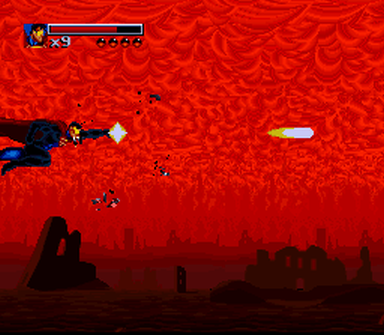
Like the majority of licensed games in this era, Death and Return of Superman is a beat-em-up. Superman goes left to right and punches dudes until he gets to a boss; repeat as necessary. It has some of the usual flaws with this sort of game.  The levels aren’t particularly interesting and there simply aren’t enough enemy types.  It eventually gets old traveling through similar looking enemies punching the same 5 guys in the face.  Still, there is something satisfying about it as well. The best sorts of beat-em-ups don’t overstay their welcome, being both fairly brief and fast paced.  The Death and Return of Superman’s levels tend to go on a little too long, but the game itself is about the right length.
daros4

In some ways it feels designed with home consoles in mind, in some ways it feels like the worst sort of quarter munching arcade game. One point against it is that it is single player only.   Likely a concession to making it play well on the SNES.  There isn’t much slowdown and the sprites look good. As I said earlier, the game could do with more enemy types, but the ones here look pretty nice.  The game also has five different playable characters, giving some variety to the game.  Unfortunately, the different characters all play just about the same.  They have the same basic set of moves and there doesn’t appear to be any difference in their strength or speed.  It mostly just ends up being different sprites.  Another problem is just how repetitive the bosses can be.  They can level the player in a few hits and don’t really do anything interesting.

daros3

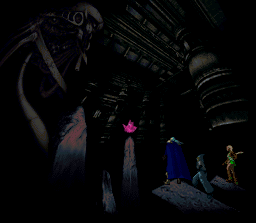
Still, it is an enjoyable experience if a flawed on.  I really liked how the game actually tried to tell a story.  In fact, I prefer this telling to the comics.  While the comic story this is based on is a famous one, it is not a very good one.  It is a better idea for a story than an actual story.  That is why the player changes character so frequently.  You start as Superman, who runs through a couple of levels before fighting Doomsday and dying.  Then four replacement Supermen show up to try to take his place: Cyborg Superman, Superboy, The Eradicator and Steel.  The comic played it as a mystery of just who was the real Superman, only for none of them to turn out to be.  The game runs through the plot in a handful of levels, with the player taking the role over whatever Superman is necessary at the time.  It works, and makes for an interesting set up.  It also helps that Superman feels like Superman. He may go down like a chump to the bosses, but he flies and punches with power and has his heat vision.

It is a good game.  A run through of takes no more than an hour and a half to two hours and it is decently entertaining the whole time.  It could really do with a two player mode, but I don’t have a second player to play with anyway.  It might be the best Superman game, but that says more about the other games to bear his name than anything about this one.  The Death and Return of Superman is a serviceable beat-em-up that at least appears to be trying to do something interesting even if it doesn’t completely succeed.
Codename STEAM

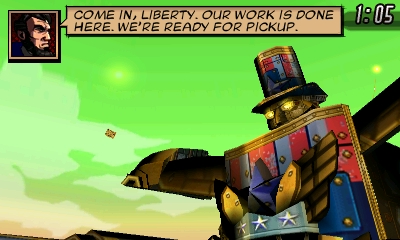
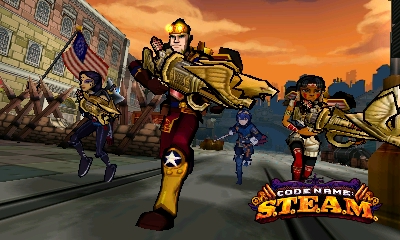
I don’t think I could love the setting and look of a game more than I love that of Codename STEAM. Set in an alternate 19th century, it stars a variety of characters from tall tales and literature, who team up using steampunk weapons to fight cthulhu monsters. All led by Abraham Lincoln and his Lincoln mech. The characters designs are reminiscent of Jack Kirby (actually, it might be more like Mike Mignola) comics and the graphics are some fine cell shaded goodness. It is such a shame that the game is chore to play.

cs1

Really, it comes absurdly close to being excellent. There are just a few problems that derail the whole experience. In theory the game plays much like Sega’s PS3 masterpiece Valkyria Chronicles. It is a strategy game where each character’s turn plays out a little more like a shooter. It doesn’t translate perfectly to the 3DS’s one stick set up (I don’t have a New 3DS, which might alleviate this small problem) but using the touch screen for aiming is functional. The first big problem is that the game features no map. In Valkyria Chronicles the game gives the player a map of which to formulate strategies. Even Intelligent Systems’s, the developer of Codename STEAM, other strategy game Fire Emblem let’s players see the whole map before making their moves. Codename STEAM only lets the player see from each unit’s perspective in a tight over the shoulder view. It makes it all but impossible to determine the best course of action.

cs3

That is a small problem and one that can be overcome with just a little bit of annoyance. The real problem is with the game’s turn system. It is set off of each party member carrying a steam tank on their back. They can store and use only so much Steam. This means that the player has to balance moving and attacking and storing up steam for counterattacks or the next turn. The only problem is that holding enough steam for counterattacks means barely moving on your turn. Enemies seem to be able to move much farther and attack more often than the player. To have any chance, the player has to plan around counter attacks, which slows the game to an intolerable crawl. This is made worse on maps with the little drone enemies that call in mortar attacks on squad members close enough to attract their attention. That means moving as far as possible, which means no counterattacks.

When the system works, it works really well. There are maps where it just clicks and provides a tense, strategic experience. Each character is unique enough that knowing them and their individual strengths helps to inform the player’s strategies. For example Lion, the Cowardly Lion from Oz, can perform a jumping attack that gets him around certain obstacles. That allows for pincer attacks and the like. Tom Sawyer can fire his weapon many times, though it only does a little damage. That makes him great for scouting and stunning enemies. Too bad things do not work smoothly all that often. Often situations spiral out of control with little the player can do to stop them. It ceases being about making good tactical decision and becomes about already knowing what is coming next.

cs2

Despite all of its flaws, I still think I kind of like this game. I am putting it away for now, a little over halfway through, but I expect to come back to it after the spring rush of 3DS RPGs is over. It is a noble experiment for Nintendo to invest in a new property, too bad it didn’t work out as well as Splatoon did. It seems unlikely, but I would meet a sequel to this game with open arms. The problems with this game could easily be fixed with just a few tweaks and then Nintendo would have another strategy series to set next to Fire Emblem and Advance Wars.

Mario & Luigi: Paper Jam

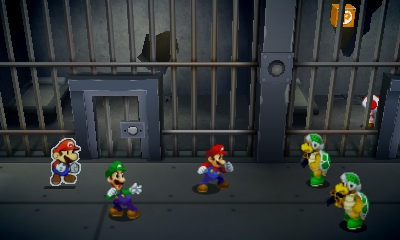
The Mario RPGs, both of Paper Mario and Mario & Luigi sub-brands, tend toward being tedious at times. I love them, but there is no denying it. The Mario & Luigi games tend toward condescending tutorializing and Paper Marios tend to feature funny bits that are just a chore to play. Those are blemishes on otherwise very good games, though the degree to which those flaws derail the experience varies. Nintendo combining the two series was on it’s a terrific idea; it had the potential to be one of the best games of the year, but it also runs the risk of flaws compounding to make one of the most frustrating game experiences imaginable. While Mario & Luigi Paper Jam is not quite the best case scenario, it luckily strays far from the worst case scenario.

mlpj1

Mario & Luigi: Paper Jam is not really a combination of the different stands of Mario RPGs, it is just a Mario & Luigi game with the Paper Mario characters tossed in. That in itself is one of the better gimmicks in the series, less tiresome that Partners in Time’s babies or Dream Team’s dreams. The Paper Mario stuff is just a flavoring added on to the usual M&L goofiness. They didn’t go quite far enough with the paper stuff, but they got some good use out of the paper doppelgangers. It clearly made it easier to come up with enemies, since they could double up on the Mario staples and have to lean less on new, and generally less interesting, original baddies. I would say that the lack of original characters is a flaw, but the only truly interesting character this series has ever come up with is Fawful. Instead, the game just lets the slightly different Bowsers and Peaches play off each other for some really fun scenes.

mlpj4

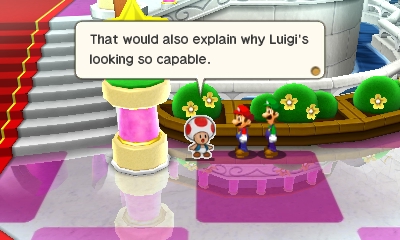
Comedy has always been a big part of these games’ appeal. That is true of both Paper Mario and M&L. True comedies are rare in games, and even rarer among RPGs. That fact that these games have been consistently funny over almost ten games. While not all of them have been great games to play, they’ve all brought the same sense of wacky irreverence. The two series combined are maybe funniest yet. This is quite an accomplishment for a games with three protagonists, none of which talk. The best bits are the Bowser parts and the seeing the two Peaches outwit the two Bowser Jrs. It never really strays from the conventional Mario cast, but it does really good work with them. Really, the Paper Mario stuff helps sand down the flaws of the previous M&L game. Dream Team, while not a bad game, was interminable with the tutorials and not especially funny chatter. That is cut down quite a bit in this one. There are still some annoying minigames, but they are less frequent and less onerous.

mlpj5

Despite all that this game does well, I still can’t quite say that I love it. I’m not really sure why; it addresses almost all of the problems I had with the previous game. It also brings some much needed challenge to the bosses. They might actually go a little too far into difficult. The story doesn’t do anything special, but it is funny and fast moving. It might just be that the addition of Paper Mario to the team is just too much for me to handle. I can’t manage three separate characters as once. Really, it is just as fun as the game is from moment to moment, it all feels belabored and pointless in the end. What Mario is actually doing is never particularly interesting; he is just going through the motions that make up a Mario game; except this time the gameplay is not as outrageously good as it is in the platform games. When it stops being funny it starts being a drag. Still, those moments are relatively few. Mostly the game is a joy.

25 SNES #4: Joe and Mac

The Joe and Mac series is one of those small blips that litter video game history. They were moderately popular for a few years before disappearing without a trace and without much thought to where they went. They are not unlike Gex or Onimusha. Not bad games necessarily (I have a lot of good things to say about Onimusha someday), but not the most memorable one either. I only know Data East’s Joe and Mac because I had a friend in grade school that swore by and I heard about it on Retronauts. Having never played it, I added it to my list for this SNES explorative endeavor. I almost wish I hadn’t.

jam2

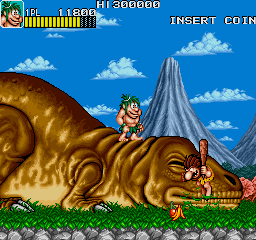
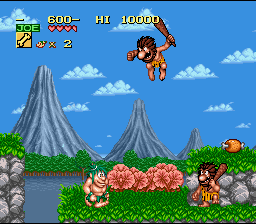
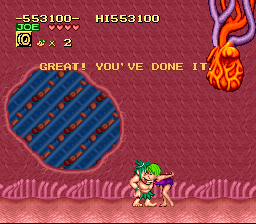
Joe and Mac shows its arcade roots. I was expecting something more like Mario, but the game shares more with Contra. There is some light platforming, but most of the game is a prehistoric run and gun. Only a run and gun without good shooting ahem, throwing options. There is a bone, a boomerang and a fireball. All of take more than one hit to kill an enemy. In the time I spent with the game, no more than the hour or so it took to finish it, I was not able to tell if there was a power difference between them. It seemed like it only changed the speed and trajectory of the player’s shots. While the overall it was much like Contra, it lacked that series’ tight levels. Joe and Mac feel sloppy and half formed. More accurately, it feels like an arcade game designed to eat quarters hastily remixed to play decently on a home console. There are a lot of cheap hits and deaths, but the game gives players a life bar and plenty of health pick-ups. That just serves to make a lot of it feel inconsequential. There is little penalty for getting hit.

jam1

What I missed, and what I am sure was the true draw of this game back in the day was the coop. I didn’t have someone to play with and this feels like a game that gets a lot more fun with a little cooperation and/or competition. It isn’t bad single player, but there are so many better games to play on just the SNES that I can’t recommend it. But coop can change things. If there is some fighting you to get to the health refills or to rack up the most points, a lot of the inconsequential stuff can feel more important. But even then, it is not like the SNES is lacking other coop games. I know the system was flooded with beat-em-ups.

jam3

Joe and Mac is a relic of a bygone time. Being forgotten to history is probably a kindness to it. It was never good enough to be called great and time hasn’t done it any favors, but it certainly isn’t bad enough to be worthy of any great scorn. It is just a mediocre arcade port from 1991 and it plays like it.

Xenoblade Chronicles X

I was shocked about how much I enjoyed Xenoblade Chronicles X. I am not, in general, a big fan of sandbox RPGs. Bethesda’s output has never done anything for me. In fact, it has actively repulsed me. People often describe all the great things they do in Fallout or Elder Scrolls games and while those descriptions are great, actually doing those things tend to be dull. They are simply not fun the play. I am also not remotely interested in exploring their giant worlds. I do like the idea of exploration, but most Western RPGs I’ve played have not strayed far from the well-worn territory of Lord of the Rings influenced fantasy or generic post-apocalyptic (I am undoubtedly doing a disservice to Fallout, but that sort of setting does absolutely nothing for me) wastelands. Xenoblade Chronicles X, despite coming from a completely different gaming legacy, scratched the itch for me that those sorts of sandbox games did for seemingly everyone else. It did this by actually being fun to play and providing a world I actually wanted to explore.

xcx3

One thing that had been missing from a lot of JRPGs lately is any sense of exploration. I don’t mean anything crazy, just something on the level of SNES Final Fantasies. Even that level of exploration is hard to find. Look at FFXIII. That game was intentionally aping popular corridor shooters, but it ended up creating a world with a very novel setting that didn’t allow the player to have any sense of how this amazing world fit together. Then there is the largely delightful Bravely Default, which crammed a 40 hour game into 15 hours’ worth of game world. There have been exceptions, like Dragon Quest VIII and the first Xenoblade Chronicles. Xenoblade Chronicles X took the original game and did the world just a little bit better.

xcx4

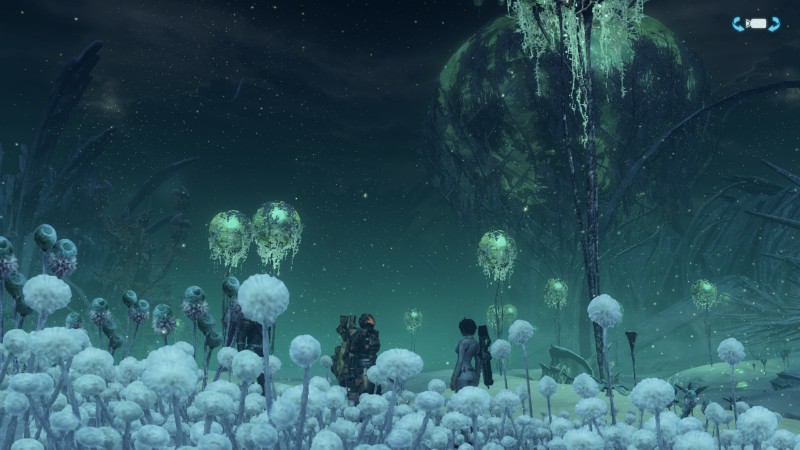
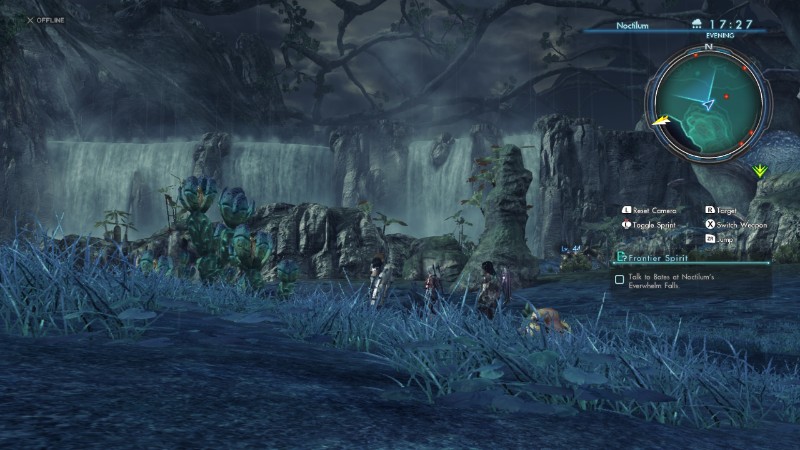
XCX starts the player as one of the few remaining humans, who have escaped the soon to be destroyed Earth and crashed on the alien planet Mira. The player character then joins an organization tasked with exploring and taming this alien world. Mira is hands down the best video game setting I’ve encountered. The player starts in the relatively normal area of Primordia. It is a rocky plain with a variety of plains creatures running around. Even in this first area there are several different landscapes. There are beaches with dangerous crab-like enemies and flying mantas. There are wide open plains with boar-like enemies and prides of giant cat-esque creatures. There are also rocky hills and tranquil lakes. In the sky about all of this are floating plateaus that taunt the player with their inaccessibility. Enemies range in size from dog-sized beetles to brontosaurus looking monsters that are a hundred feet tall. Just running around exploring this one continent can take dozens of hours. Even late in the game, after I had played for nearly 100 hours, I was still finding new nooks and crannies in Primordia. After that, the player goes to Noctilum, a densely packed rain forest and swampy area. Again, this one continent has enough to explore to keep a player busy for a longer time than some games last. After that there are still three full continents to explore, each as varied and interesting as the first.

xcx1

The best part is that, after the prologue and tutorial, nearly the entirety of the world is open to explore. If the player so desires, he can run to the fifth continent as see how far he can get. It won’t be too far, the enemies are tough, but it is possible. This lets the game keep players exploring. In all the 120+ hours I played of this game, I never felt like I was repeating myself. There was always some place new to go and some new sight to behold. And the best part is that any place you can see you can go. There are some restrictions, places that require a skell, the game’s names for its mechs that player’s party can pilot, to reach, but many more just require creative use of the landscape.

Those Skells are worth a mention. The player can see other character using them from early on, but the player doesn’t get a license until a good bit into the game and it isn’t until late that it gains the ability to fly. When that flight ability opens up it leads to one of the most exhilarating moments in video game history, as the player seamlessly flies out of the city into Primordia, up into the sky, landing on one of those floating plateaus, and able to look down at the human city and most of the continent below. It is amazing.

xcx2

None of that would matter if exploring itself were a chore, but the game wisely facilitates exploration and experimentation. The player’s primary task is to place probes on the landscape. Those allow for more information about the surrounding area. They also serve as checkpoints. The player can warp to many of those probes once they are laid and dying simple kicks the player back to the most recent one, with no loss of experience of money. The lack of penalty for stumbling onto a super strong monster lets the player be bold about the paths they take.

Then there is the battle system, which is complex and active, but not particularly difficult. Most battles can be won with persistence, but there is depth to it if the player wants to find it. That holds true for most of the rest of the game. The income players can derive from placed probes can be manipulated to obscene heights, but the game only requires the minimum effort to be overcome. The story is there. It is told sloppily and without much care as far as pacing and tension, but it is built on some solid ideas and concepts. It doesn’t do anything egregiously bad, but kind of over explains itself since it assumes players have forgotten what’s up with hours between story missions. In contrast to the failings of the central plot, the characters, in aggregate if not each individual, have interesting stories. Each party member has a handful of mission specific to them that helps explain who they are and what they want. All of them are skippable. In fact, other than the handful of party members forced on the player at the start of the game most of the party is skippable. But those stories are reasonably well written and occasionally quite touching.

Xenoblade Chronicles X is not a perfect game. It is big and messy and often obtuse. But the things it does well it does so well to completely overshadow its missteps. It can be annoying to have to track wayward party members down each time you want to change the line-up, for example. That is an odd oversight for a game that does the busy work on collection missions for the player, not requiring them to run back to town to get their rewards. Overall, though, the game does more right than it does wrong by a long shot and so much of what it does well is not done well by any other game. Xenoblade Chronicles X is a singular experience, the kind of game that only comes around once in a great while and is not a game to be missed.

Now Playing in Jan ‘16

I only beat a few, short SNES games in January, but I should be able to finish a few games that I’ve been playing all month on other systems. There are a ton of games for the 3DS hitting in the next few months that should keep me busy for most of the year. I hope to speed through Mario & Luigi: Paper Jam and Final Fantasy Explorers in time to get to Fire Emblem Fates before the end of the month.

Beaten

Super Punch-Out!! – see here.

Radical Dreamers – see here.

Super Bomberman – see here.

Ongoing

Prince of Persia – There is a lot I like about this game, but at about the halfway point there is one fundamental problem that will stop me from calling this game a favorite. The controls are simply loose. There are large windows for button presses needed while parkouring all over this game’s world. It does make the game easy, which I don’t necessarily consider a bad thing, but it causes at least as many problems as it solves. That window is so big that I’m not sure the game responds or that I pushed the right button, so I push another button and screw it all up. It is really frustrating.

Yakuza V – More Yakuza, and this time it’s better than ever. This one starts better than Yakuza 4 if only because it starts the player with Kazuma instead of making you wait until neat the end to get to play as the character you really want to. I haven’t made it more than a few hours in, but I am loving it so far.

Pokemon Alpha Sapphire – Something about the main game (ie the single player storyline) in this edition of Pokemon stymies me. I struggled to get through it when it first came out, struggled again when I played Emerald around the time that Diamond and Pearl came out and now I am struggling with it here.  I simply don’t care much for the Pokemon available and the map kind of curls around on itself in unintuitive ways.  In many ways this is the most mechanically pleasing Pokemon game, but this region is easily my least favorite to explore. It is tedious in a way that the other games rarely are.  I am nearly through with it, though.  I will finish sometime, but the deluge of 3DS RPGs coming in the next few months might mean that it happens later rather than sooner.

Lara Croft Go – I had this recommended to me after gushing about how much I love Monument Valley. After playing about half of this I see the similarities.  Lara Croft Go is slower and more complex, but like Monument Valley it is a game made with the strengths and limitations of mobile in mind.  I am really enjoying it. Maybe not as much as I enjoyed MV, but still it is really good.  I’m not even going to add for a mobile game to the end of that, because this game is simply really good.  It looks like a sort of turn based platform game, but it is really just a puzzle game.  And it has some doozies for puzzles.

Codename STEAM – There is so much good about this game that the problems make it all but impossible to really enjoy it are just heartbreaking. The big one is the camera. It is hard to play a strategy game when you can’t form a strong picture of how the battlefield is shaped. This one is going on the backburner for now.

Ace Attorney: Trials and Tribulations –

npj2

I played through the previous two games in the original trilogy last year and now I’ve started this one.  The first case is set in the past and has rookie Mia Fey defending young Phoenix from murder charges. It works as a decent case, an effective tutorial and an essential set up of all the cases that come after it.  It is pretty much exactly what the first case of an Ace Attorney game should be.  If I remember correctly, the rest of the game is nearly as good.  I’ll be busy with Paper Jam and Final Fantasy Explorers, but I hope to have this finished by the end of next month.

Mario & Luigi: Paper Jam –

npj1

I wasn’t the biggest fan of the most recent games in either the Mario & Luigi or Paper Mario series, but through the first ten or so hours this combination of the two has been really good. The heavy handed tutorial and chatter overload from Dream Team had and the mix of the regular and Paper Mario crew makes up for Sticker Star being drained of all personality. Really, it has been pretty delightful so far. My only complaint would be with how the Toad Hunts are handled, and that is really more of a nitpick.

Upcoming

Final Fantasy Explorers – It looks like a FF themed Monster Hunter or maybe just an update of the Crystal Chronicles styled games. Either way, I am very intrigued by it. I expected it to arrive in time to start it this month, but it came late. I guess I’ll see next month how good it actually is.

Fire Emblem Fates – I am still undecided on which version I’ll play (I’m buying both, one for me one for my brother) but I am more than eager to play this. Awakening was a big reason I got a 3DS when I did and it has been too long since I’ve had new Fire Emblem to play. Plus, it looks like Nintendo has wisely excised most of the excruciating otaku bait from it, so it won’t be so embarrassing to own.

Enslaved: Odyssey to the West – This game was recommended to me as something similar to Prince of Persia and Ico, but I was unable to find it for a long time. Luckily for me, I noticed it was on sale on PSN for a little over $5 so I jumped on it. I have to get through the rest of Prince of Persia and Yakuza V first, but this game is next on my list.

Lufia & Super Mario RPG – I guess both of these could have gone in ongoing, but I’ve barely started both of them. I need to finish at least one to keep on my 25 SNES pace and I feel confident that I will do that.

25 Years 25 Games #3: Super Punch-Out!!

For as big a fan as I am of Mike Tyson’s Punch-Out!!, it was kind of shocking to me to find out that there was a sequel on SNES.  This was in 2008, about the same time as Nintendo announced the Wii game.  Somehow, the existence of the SNES game eluded me for nearly 15 years.  I really don’t know how I didn’t know about it. I did buy it on the Virtual Console, but I never got around to playing it.

After beating it, I have to say that I don’t like it as much as the other two Punch-Out!! games I’ve played. A big part of that is how familiar I am with the NES game and how closely the Wii game sticks to it.  Super Punch-Out!! is quite a bit different. It is more complex, with a wider variety of punches and dodges available to the player, and it has a roster of opponents that is mostly unique to this game. (and the arcade games that no one has ever played) I think what really hurt my enjoyment of it, though, is that I don’t really remember how long it took me to get good at Punch-Out!!

spo1

I found playing Super Punch-Out!! very frustrating.  After the first few easy opponents, I started ran into the wall that is learning new fighters.  I got by Piston Hurricane and Bald Bull pretty easily, but Dragon Chan and Masked Muscle was where I started having a lot of trouble.  These fighters have a lot of different moves and tics, and learning those takes time.  Especially when the game doesn’t quite work like I expect it to.  The real problem is how fast I was trying to beat this game.  Now I think of NES Punch-Out!! as a pleasant romp, at least until the last three or four fights.  But it took me a long time playing that game to get that good.  Like playing it off and on for more than 20 years. Compared to that, or to a game that is deliberately as close to that game as possible.  Super Punch-Out!! is trying to push the series forward, and it mostly works, but it frustrates an old pro at the NES game.

None of those problems really have anything to do with what this game actually is.  Although I don’t much like this game, I can’t really claim that it isn’t a good, or maybe even great, game.  The complexity it adds should be counted as a good thing.  I really liked the different super punches that Little Mac has at his disposal.  I never really figured out how the different punches worked, but the options are good.  It will take time to learn when to use which one might take some time, but I like having a more options than just uppercut.

spo2

I’m of two minds about the new boxers in this game.  I really like some them; they work.  What I don’t like is how far they start to get away from being, you know, boxers.  Masked Muscle is fine; his luchador shtick doesn’t interfere with him being a boxer.  His one extra move is to spit in the player’s eyes, an illegal move but not a crazy one.  Likewise with Heike Kagero and his hair whip.  But Dragon Chan and his kicks or How Quarlow and his stick are just a step too far for me.

spo3

Super Punch-Out!! is a great looking game.  No one can argue with that. Just like the original was one of the best looking games on the NES, this one has some of the best looking sprites on the SNES. The music is also a highlight.  Really, there is no part of this game that isn’t well made; I just don’t like it as much as the previous game. Nintendo rarely misses and they were really on the top of their game in the SNES days.  While Super Punch-Out!! doesn’t quite have the reputation of some their best games, like Super Metroid or Yoshi’s Island, but it really shows how the mastered this hardware.

25 SNES #2: Radical Dreamers

The second game in my quest to explore more fully the SNES video game library is a strange one. A good one, but it is truly one of the oddest games that I have ever encountered. Radical Dreamers is a visual novel with some light RPG elements. Honestly, it is pretty light on the visual part of visual novel as well. It is also a sequel of sorts to Chrono Trigger, which is quite possibly the best game on the system as well as my personal favorite. So in making a sequel to a popular game, Squaresoft chose not only to change the genre, or to release it only on a little used platform, but it also buries the lead so deep many players are likely to not get ever realize what they are playing. Still, it turned out to be a fairly entertaining game, especially with the fan-translation by Demiforce.

Radical Dreamers - Nusume Nai Houseki (Japan) (BS) [En by Demiforce v1.4] (~Radical Dreamers - Le Tresor Interdit) 0000

That Squaresoft would make a sequel to Chrono Trigger is not odd. Especially one that follows up one of the biggest dangling plot threads from the game. That the perfect storm of factors that lead to Chrono Trigger’s creation weren’t able to be recreated wasn’t a surprise; that they got the minds behind the two biggest RPG franchises together to make it in the first place was something of a minor miracle. Still, that it was not really an RPG is a strange choice. It was also only released on Satellaview, an early attempt by Nintendo for some sort of online gaming, is also a curious choice. I am sure Nintendo was eager to get other companies to support his endeavor. A fairly short visual novel was probably a good choice for that platform. These two choices are compounded by not being upfront that this is a follow up to Chrono Trigger. Players were likely an hour or more into the game before the oblique references to Chrono Trigger added up to enough make it clear that it takes place in the same world and it is most of the way through the game until Magus reveals himself.

Radical Dreamers - Le Tresor Interdit 0014

Still the game itself is a lot of fun. It follows a trio of adventurers, Kid, Serge and Magil, as they break into Viper Manor in an attempt to steal the Frozen Flame from the villain Lynx. Most of the main scenario of the game consists of running through the mostly abandoned mansion trying to find where the Flame is hidden. It really builds the characters well in its rather short running time. Serge, the player character, is somewhat inexperienced, which means that Kid and Magil spend a lot of time helping him out. The center of the game is the relationship that develops, aided by the player, between Kid and Serge. Magil holds himself somewhat separate. In all, it is a compact, fun adventure, though some of the battles can get annoying. The music is quite good, and the few instances where it really uses graphics they look pretty nice.

Radical Dreamers - Le Tresor Interdit 0007

After the main scenario is completed players can activate a handful of others. Those are mostly comedy or just plain weirdness. In one Magil falls in love, in another he is a space cop and even a mecha pilot. I didn’t complete all of them, but they fit in with the title. They are all something like dream sequences, fitting for a game called Radical Dreamers.

If the main scenario sounds familiar, that is because it was expanded to be the opening part of the eventual “real” sequel Chrono Cross. The broad strokes are the same, though many of the details are changed and it serves merely as the opening of a much larger adventure. Really, the only thing that was lost in conversion was that Magil was secretly Magus. The Viper Manor portion of Chrono Cross was probably the best part of that game; the rest seems a little lost.

Radical Dreamers - Le Tresor Interdit 0017

Still, the existence of Chrono Cross and this game’s scarcity condemn it to be little more than a footnote in the grand scheme of things. It is a small little project that served as the basis for something much better. The game is still worth playing, even if just for an excuse to see the weirdness.

Radical Dreamers - Le Tresor Interdit 0021

Good night, Konami

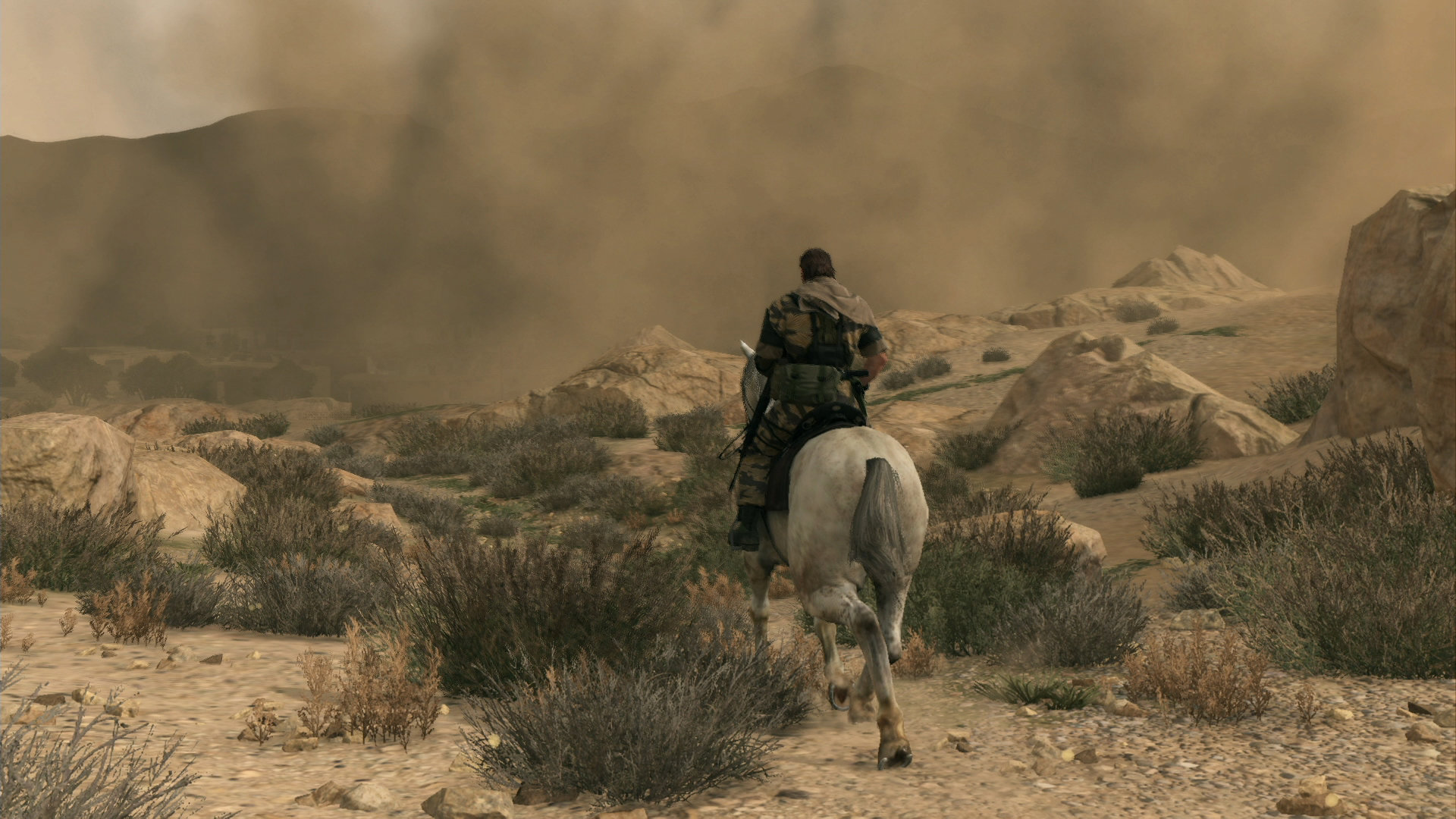
It has been a long time since I played Metal Gear Solid V: The Phantom Pain, but I haven’t really stopped thinking about it or trying to write this blog post; I am merely having trouble finding the words to express my thoughts about the game. MGSV is a game that has inspired many thoughts, most, but not all, of them complimentary to the game. Not only is it a massive game, but it is also likely the last game in the series. Or maybe just the last legitimate game in the series. On top of that, it seems to be Konami’s last video game, as they make an inelegant exit from the industry to focus on the actually profitable parts of their business. In many ways, MGSV feels like the last game of an era. Maybe that is because I played on the PS3, but it feels something like a farewell to that generation and a farewell to the last vestige of Japanese influence on the current gaming industry.

Part of me wants to use a post about The Phantom Pain to eulogize Konami; the hardest part of playing this game is having to reconcile its mastery with the loss of that titan. The video game industry without them simply feels wrong. Each console generation has winnowed out companies that were able to adapt to the new technology. They may have been masters at one point, but their times passed and they went away, with new developers rising to take their place. Mid-tier companies like Jaleco and Sunsoft sputtered and failed in the transitions to 16-bit and 3D. Throughout all of that, though, there were some stalwarts, companies like Nintendo, Capcom and Konami. No matter the system, you could expect to see their games among their most well regarded. (With the obvious exception of Nintendo on non-Nintendo systems) For more than two decades Konami developed a great mix of big time titles, like Castlevania, Gradius or Contra, and slightly lesser known fare like Legend of the Mystical Ninja and Suikoden. They pumped out tons of quality titles in all sorts of genres. Since the days of the Playstation, their biggest hit has been inarguably Metal Gear Solid. While Castlevania and Contra withered on the home console side, both series managing to make marks only with frequent and frequently excellent handheld titles, Metal Gear Solid kept the attention of gaming community. It is only fitting that with Konami making a lamented and ungainly exit from the video game business, Metal Gear Solid V is their last hurrah.

mgsv1

Eulogizing would make more sense if The Phantom Pain was a backward looking game, but it is not. It is still out there on the forefront of the gaming scene, where the series has always been. While it does play in many ways like previous MGS games, it does so much more. The first three MGS games were each one or two missions. Snake starts with a goal and each boss and area is another step in achieving that goal. MGSIV, for better and worse, expanded that, being comprised of several missions. MGSV takes that a step further; it is a full campaign. Snake deploys into two giant sandboxes with a giant list of missions to accomplish. This added scope leads to more gameplay systems added to an already complex game. Now, Snake runs an entire military force. The more he builds his base, the greater the resources available to Snake in the field. The base building plays into the online component. It also plays into the new buddy system, where Snake brings along a companion with a certain set of skills. It turns the whole thing into a very complex web that is surprisingly painless to navigate. The depth is there for players that want to dig into it, but it is also possible to just understand that bigger numbers are better and just play the game.

Where the game falters, at least somewhat, is in the story. The broad strokes are great, but that is all there is; the game is only the broad strokes. It plays as though the story portions weren’t finished, especially knowing how long winded the previous MGS games could be. Since I don’t want to spoil the big reveal that has certainly already been spoiled for everybody, I will say that the somewhat simple tale of revenge and a man slowly becoming the things he hates are done well.

mgsv2

That is really my problem in examining this game: I am not invested in it is enough. I can’t provide a strong break down of the gameplay because I was that player that barely took the time to understand it and just figured bigger numbers are better. Mind you, I played the game for near on 100 hours, but I never really dug too deep into all of my options. I used the same load out for most missions. I hand a tranq pistol and a tranq sniper rifle. I knocked dudes out and tied balloons to them to take them to my base. I snuck whenever that was an option and tried to avoid killing. And I am not enough expect enough in the story of Metal Gear to get really analyze its themes. I have missed too many chapters, including the opening one to this game. I am rarely an expert on games; I am more of a tourist. I come through and see the sights, but I don’t stop long enough to really dig deep into the details. I am fine with that, I would rather play a lot of different games than learn one completely. But The Phantom Pain is a game that needs to be examined by an expert.

What Metal Gear Solid V: The Phantom Pain is to me is a last trip through a series and a company that is going away. I don’t know that it is a good farewell to either. It feels like an evolutionary step for Metal Gear, a game the takes the series to a new place just waiting for another game to perfect it, like MGS3 did for the original. And it doesn’t inspire much reflection on Konami, other than that at one point they used to make excellent games like this as a matter of course. I was glad to play this game, but it ends on a bittersweet note because I know that there will not be any more like it.

Every year, video gaming changes further from what it was when I started playing and I am less and less interested in putting forth the effort to track down the stuff I like. The pool of new games I want to play dwindles every year and every year I care a little less. The Phantom Pain is the first game in long while to remind me that there are things that I have never done in a game. If only other games offered similar new experiences.

25 Years, 25 Games #1: Super Bomberman

I decided to ease myself into this 25 Years, 25 SNES Games project with Super Bomberman. More so than any other game on my list, this one I knew what I getting going in.  It’s Bomberman.  Everyone’s played some version Bomberman before. Right?

sbm1

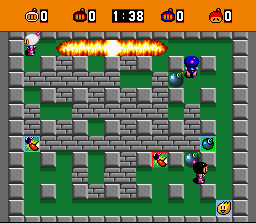
Maybe not everyone has played Bomberman, but since his last game came out more than a half decade ago, maybe people don’t know Bomberman.  Well, they should; his games were great. They spanned most consoles from the NES all the way to Wii, Xbox 360 and PS3. While Hudson Soft other supposed mascots, the one that stuck around throughout the history of the company was Bomberman.  The games, at the heart of their most important mode, can trace their style of play back to Pac-Man and other single screen character action games.  Players control a little robot in a maze, trying to clear paths or trap monsters/other players with their bombs.  On the surface it is simple, but the complexity is hidden just beneath the surface, especially against living, breathing opponents.

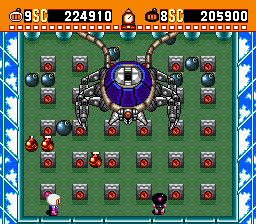
sbm2  While I was a fan of Bomberman, I had never played any of the Super Bomberman games, of which I understand there are four.  I spent a ton of time with Wario Blast (featuring Bomberman) on Gameboy, which instilled a love of the little robot in me.  I also spent some time with various N64 games and a few download titles since.  But I never really even knew about the SNES games at the time.  Super Bomberman is a good, if not spectacular, rendition of Bomberman.  You blow up enemies and pick up power-ups.  There is a story mode, where you play against the computer, pretty simple with some fun but unspectacular bosses to fight.

sbm3I am given to understand that the other Super Bomberman games are better than the first one.  That seems likely.  This game is a pretty no frills experience.  It has just story mode and battle mode.  Each works just fine, but there are few bells and whistles.  Still, the game is still a lot of fun.  Bomberman stuck around so long because the core game is so very good.  Though this game provides little beyond that experience it is still a worthwhile experience just for that.

This game really makes me pine for the days when games like this came out.  That is maybe (absolutely) being unfair to the robust indie and download game market, but I can’t help but look back on the days when something like this could get a boxed release and be a well-remembered game.  Games like Bomberman aren’t exactly gone, but they have become rare and have been shoved off to the sidelines of the gaming world.  The closest recent example of game like this that I can think of is Nintendo’s Boxboy; a game that is relatively simple on the surface, but has satisfying depths to plumb.  Really, this is just an old game enthusiast yelling at kids to get off my lawn.  I am growing increasingly disconnected with modern gaming, and going back and playing games like this makes it clear to me how much more I liked games back then.

sbm4

So, Super Bomberman; it is a good game.  One that is a perfectly fine game, but maybe isn’t as worth playing now thanks to other Bomberman games that just offer more.  I have heard the Saturn Bomberman is the cream of the crop, but there is too much of the series I haven’t played. Still, I’d call the first SNES game I played this year an unqualified success.