2nd Quest 4 Swords

This series hasn’t really turned out liked I had hoped. Not the Zelda series, but my series of blog posts as I attempt to replay them all this year. I am about halfway through Link to the Past and have put some time in on Majora’s Mask, but I haven’t really had the time to sit down and play them that I had wished. It doesn’t help that I have been playing them on my Wii and it is currently unavailable to me. I have managed to play the free download version of 4 Swords on my 3DS, though. I know it really doesn’t come until much later, but I’ve played it and I might as well go over it while it is still fresh.

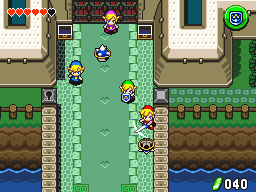
4 Swords began as a link up extra in the GBA port of Link to the Past. Nintendo was trying to sell connectivity, and 4 Sword was their way of shoehorning it into LttP. The version I played was rereleased as a free download as part of the Legend of Zelda’s 25th Anniversary. Essentially, it is Legend of Zelda: The Arcade Game. It is a mix of traditional Zelda dungeons with some Gauntlet like sensibilities.

Gone from 4 Swords are all of the series overworld and story parts. It is just dungeons. There is also no gradual accumulation of tools; you have a maximum of two at any given time. The emphasis is on getting the best use out of limited tools and on cooperation. 4 Swords is ideally a multiplayer game. I, unfortunately, was unable to play it that way. It is playable in single player, with one person alternating control over two Links. It is actually a lot of fun. The dungeons aren’t particularly complex, they are randomly generated, but there are some novel cooperation puzzles. The arcade game comparison comes in with 4 Swords goal of collecting Rupees. The player is scored on how many Rupees they collect. In multiplayer this adds a touch of competition, with each player trying to get the most Rupees, but in single player it just makes collecting the Rupees more important than usual.

It is certainly not the full Zelda experience, but there is certainly a lot to love. While the initial dungeons fall into the usual Fire/Forest/Ice variety, the bonus dungeons are neat. They are done in the style of previous Zelda games. One looks like LttP, another Link’s Awakening and the last looks like the original Legend of Zelda. It is really cool. This is a fun distraction rather than a full game. Definitely not an essential experience, but a worthy addition to the Zelda series.

It is a Somewhat Disappointing Story

Mario and Luigi: Bowser’s Inside Story is a game that, on paper, I should love. I really enjoyed the first M&L game (though I missed out on the second one) and this one brings back the best part, Fawful, and has some of the best looking sprites I’ve seen in a long time. It also has Nintendo’s trademark quality localization, being mostly witty and funny. So I am having difficulty pinpointing exactly why I found playing it to be such a chore.

Part of it I think is the premise. Mario and Luigi manipulating Bowser from the inside while he fights against Fawful’s minions sounds great, but it doesn’t quite work out as it should. All of Bowser’s insides basically look the same, meaning that nearly the entire time game Mario and Luigi are stuck in one area. Also, the globins, the anti-body inhabitants of Bowser’s body are a big miss on the writer’s part. Talking to them is simply tedious. The Mario Brothers portions of the game are simply not as good as they could be. The Bowser portions are much more entertaining. They are certainly better written. Bowser’s charmingly self-centered nature is tons of fun. He sees everything only as reflections of his importance. His goals haven’t changed, he plans to conquer the Mushroom Kingdom and force Peach to be his bride. However, with Fawful currently in power, his goals are temporarily aligned with Mario’s. Still, Bowser finds it hard to focus on the larger goal rather than instant gratification. The problem with Bowser’s portion is the other problem I’ve had with the game.

Mario & Luigi: Bowser’s Inside Story tries its best to utilize as much of the DS’s functionality as possible. In this case this is a bad thing. There are many features on the DS that when uses appropriately can greatly enhance a game. The great games on the system use only the ones necessary. M&L3 uses as just about everything on the system, no matter how awkward the implementation is. The game has the player turn the system sideways to fight big battles with Bowser, you blow in the mic to blow fire, tap the screen for various attacks. It makes battles, whose timing mechanics already make them more involved than most, a chore. I found most of the tapping, sliding and other touch mechanics to be tiresome. The worst part is that the increased complexity in battle mechanics is offset by a simplification of the platforming parts, which were the best parts of the first game.

These problems aren’t really that big. They are kind of nitpicky. Still, they added up to enough to keep me from truly enjoying the game. Mario and Luigi: Bowser’s Inside Story is a well-made game with small flaws that simply rubbed me the wrong way. I wanted to like it, I really did, but I didn’t really enjoy the game all that much. I know some people were disappointed when Nintendo announced Paper Mario for the 3DS rather than a new Mario and Luigi game, but I’m perfectly happy with that series continuing over this one.

Goodbye Nintendo Power

The news earlier this week that Nintendo Power would cease publication hit me pretty hard. For many gamers who grew up in the days of the NES and the SNES, Nintendo Power holds a special place in their hearts. While it was blatant Nintendo propaganda and the strategies found within were frequently not ideal, the amount of love lavished on the games found inside was made the magazine eminently enjoyable. NP made each and every game seem like a classic. Yes, it existed to sell more games, but in those pre-internet days information was not that easy to come by. The loss of Nintendo Power feels like a big step away from gaming as I grew up with.

I wasn’t always subscribed to NP. I was for about two years around 89-91. I bought the magazine occasionally for the next decade before resubscribing a little before publishing switched over to Future. The magazines fortunes mostly followed its namesakes. In the 8 and 16-bit days Nintendo Power was amazing. There was always tons of excitement and plenty of games to cover. In the N64 and Gamecube days the excitement didn’t flag, though there was a lot less to be excited for. It sometimes made the magazine a depressing read. When it switched over to Future, it immediately got better. I’m not trying to bad mouth it from just before, but Nintendo Power over the last 5 years has been the best video game magazine on the shelf. I am disappointed that I let my subscription lapse in the last year. I have saved most of the issues I ever received and have spent plenty of time over the last week looking over them. It is truly sad to see it go.

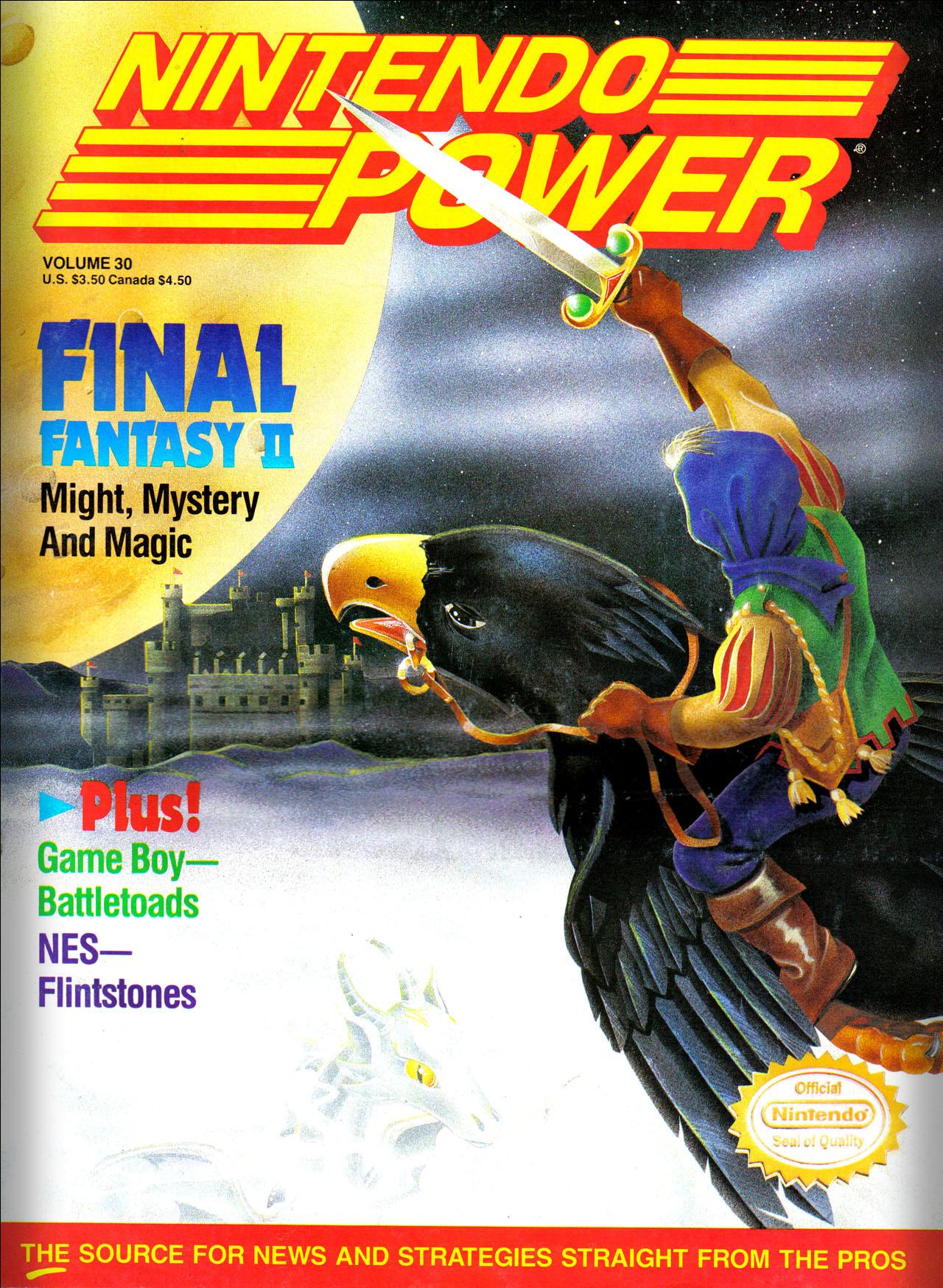
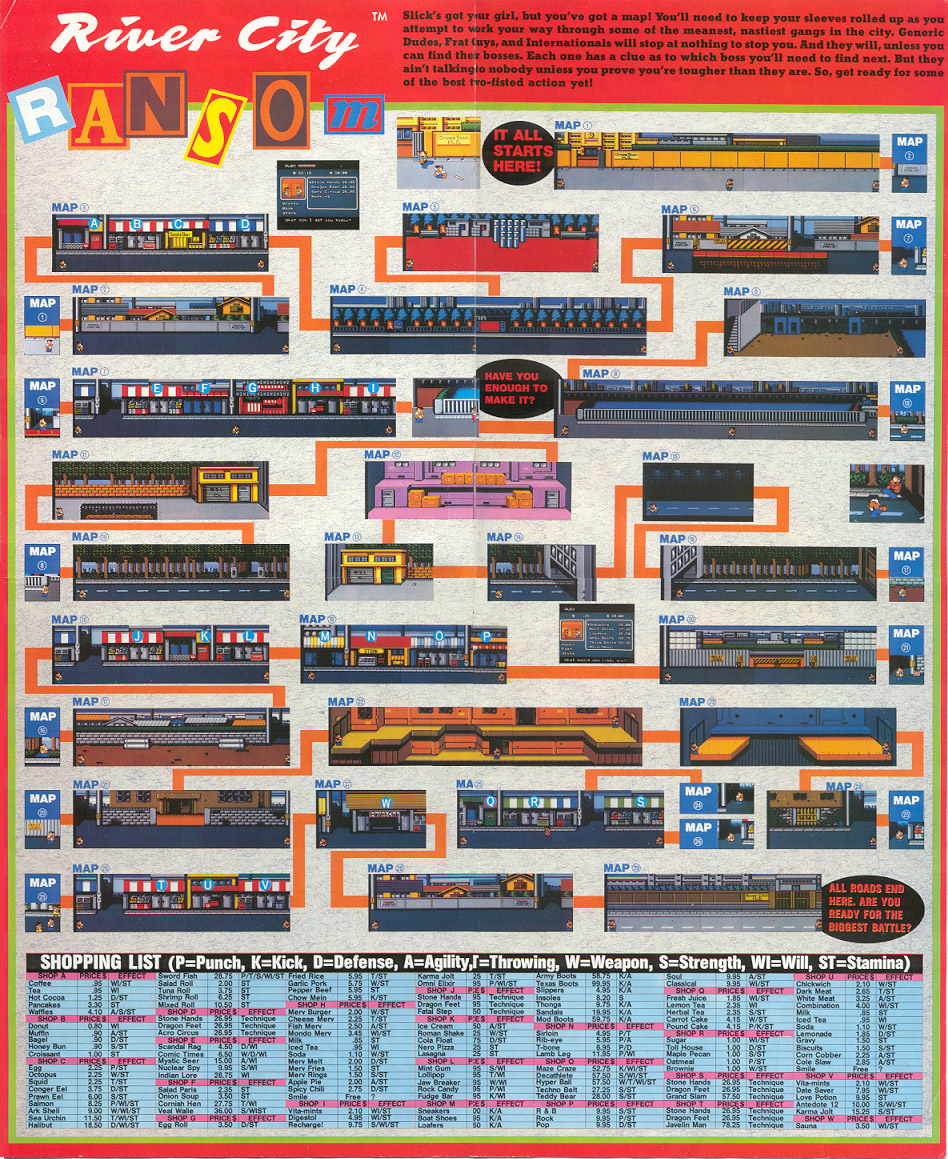
In many ways Nintendo Power helped shape my gaming tastes, even when I wasn’t able to find or play the games it covered. I had no idea what an RPG was before I read the NP that covered Final Fantasy II. I didn’t play that game, at least not for more than an hour, until it was ported to the GBA but still I know that game front to back just from pouring over Nintendo Power. It made the game seem like such an amazing adventure that I had to play, but I was never able to find it. Then there was River City Ransom. Another game that just captured my imagination but this time I was able track it down. For once, at least, a game was everything Nintendo Power promised it would be. It was the usual beat-em-up with some RPG mechanics. Seeing those two games helped me realize just how many different kinds of games were out there, and seeing all the maps and screenshots in NP helped me visualize exactly how those games worked.

The loss of Nintendo Power is kind of forcing me to realize just how far from the mainstream I’ve become when it comes to gaming. I don’t think my tastes have really changed, but gaming has. I still like the same kinds of games I always have, but they are apparently not popular anymore. In the last year or so I’ve got so many new games that cater almost perfectly to me, games like Xenoblade, the Last Story, Solatorobo and Rayman Origins, but still this seems like an aberration rather than a trend. Most of the games I’ve really enjoyed have not enjoyed much in the way of sales success. The few interesting games that Japan is able to produce often have a hard time making it to America. I’m never going to be a fan of shooters and I’m never going to want more than one sports game for any system. It’s not that I think they aren’t good games, they just aren’t games that interest me. I’m not saying I am going to quit playing video games, but things like the shuttering of Nintendo Power show me that the current gaming industry doesn’t support the kind of things I like. Still, I have nearly 25 years of great gaming memories to look over and there are still plenty of great games I haven’t played.

After 13 Games You Know It’s Never Really Final

Final Fantasy XIII is a smoking hot mess of a game. For everything it well or exceptionally well, it does another thing either poorly or fails to do it at all. The game has one of the most well-realized main casts in the genre paired with a plot that never even tries to make sense, as well as a complete lack of a supporting cast. It streamlined plenty of the tedium that plagues JRPGs but also loses many useful or necessary conventions in the deal. Playing FFXIII is like watching a play through a telescope; you see some things in magnificent detail, but it is nearly impossible to form a context for what you’ve seen due to the tiny field of view.

Final Fantasy XIII odd dual identity is easily seen in its story. FFXIII main characters are a well-rounded, engaging group. Sure, some of their characterizations fall back on the usual anime tropes, but there is more depth to them than the majority of video game casts. Lightning tries to be the stoic badass, and is for the most part, but in becoming that badass she has forfeited her connection to her sister. She is out for redemption, to atone for not being there for her sister when Serah needed her. Sazh, apparently a favorite of many though not me, is a father out of his depth trying to save his son. Fang and Vanille have a relationship that echoes Lightning and Serah’s, an older sister trying to protect the younger. Hope starts as a whiny brat and matures into a somewhat less whiny brat. He faces the trauma of seeing his mother die in the opening minutes of the game, and must process that grief and grow beyond it. Snowe, while not one of my favorite characters, is certainly an entertaining one. He is the peppy JRPG hero, like Vyse from Skies of Arcadia or Lloyd from Tales of Symphonia, in a game that has absolutely no use for him. He wants to protect his love Serah, but fails. He tries to find meaning in their becoming L’Cie, but there is none to be had. He is forced to confront the wreckage inadvertently left in the wake of his can do attitude. Unfortunately, there are virtually no supporting characters. The game starts to build up some villains, but they promptly disappear after a few scenes, with the exception of Barthandelus. Any other supporting character is lucky to get so much as a name and two scenes. The plot, to put it nicely, is an indecipherable mess. The party is made L’Cie at the start. What exactly being a L’Cie means is never clearly explained. The player must infer it from the small amount of context available. The important thing is that people do not like them. The must obey the fal’Cie, which again are entities with no clear explanation, just that they are powerful beings. There are mentions of Cocoon and Pulse, but for the longest time no explanation of just what those two are. Countries? Cities? Planets? Once more, though never all, becomes clear the party finds a new goal. (Big Spoilers) The villain wants them to kill the fal’Cie powering Cocoon, but they refuse. Then, they kill it anyway and everything works out. Because it does.(End of Big Spoilers) The story game plays out in blunt, yet effective character bits intertwined with often visually amazing but nonsensical plot scenes. It is baffling how they got one part so very right, yet flubbed the others so very badly.

The rest of the game is the same way. The battle system seems to be another take on many of the same ideas that power FFXII’s battle system. Individual attacks are automated, but the player gets to choose what actions the characters can take. The control is another step back, with players making sets of classes for their party and switching class make up on the flay to handle dynamic battle situations. While the lack of direct control can seem off putting at first, once the game lets the training wheels come off it is rather entertaining and there is more strategy involved than most games in the genre. All other parts of usual JRPG gameplay are gone. There are no real towns to visit, no shops, nothing but tunnels to run through. Some of the losses are good. The genre, led by FFVII, had become bloated with mini-games and tedious sidequests. Those are all gone. Their loss helps streamline the game. But the loss of towns and shops hurt, making it harder to get a sense of this world and the people in it. Everything is done by a computer that pops out of save points. Despite the very real characters, the world of Final Fantasy XIII feels the most artificial. This world exists just to tell this game’s story. The crazy tunnel land suddenly ends when the player reaches Gran Pulse, a wide open plain full of strong enemies and optional missions. Instead of being a welcome change, at first is feels crippling. The game has held the player’s hand for so long that the sudden lack of direction is almost overwhelming. After a little bit of hesitance, though, Gran Pulse shows itself to be the best part of the game. The battle system has a near perfect combination of fluidity and strategy that running around fighting monsters is actually fun.

It is initially hard to get past FFXIII’s obvious terrible flaws. But the core of the game is very very good. That with the fine level of polish helps keep Final Fantasy XIII entertaining. I’d put it near the middle of the series in terms of quality, there with the other middle of the road Final Fantasies like 7 or 8. It is a flawed gem whose flaws are all the more obvious due to how large of a gem it is. It is not my favorite, and with what is essentially a 20 hour tutorial to start I can’t see myself replaying it soon, but I really did like this game.

Stealing all the Rhythm

After finishing, for now, Theatrhythm, I moved on to another game rhythm game, despite my complete lack of, you know, rhythm. Sega’s, with some sort of publishing help from Nintendo if the Club Nintendo insert is anything to go by, Rhythm Thief and the Emperor’s Treasure is a wonderfully charming game. It isn’t particularly original, but it has a delightful exuberance that helps keep it entertaining throughout its ten or so hour run time. It does have its flaws though, the most prominent being a lack of feedback when you fail a mission. Despite some frustration, Rhythm Thief is greatly entertaining.

At its heart, Rhythm Thief is a curious and appealing mix of other popular series. The game is formatted largely like Level 5’s outstanding Professor Layton games, but instead of puzzles there are a series of Elite Beat Agents-esque rhythm games and the story is heavily and obviously influenced by the work of Hayao Miyazaki. The mix works wonderfully. There isn’t quite the same fluidity to the tap to find gameplay as there is in Layton, the biggest reason being that there are only about 50 games rather than near on 200 puzzles. I had some real problems with a few of the games, though I understand others did not so maybe it was just me. The biggest problem I had was that the game does not do a good job of showing the player where they went wrong. I failed repeatedly at several of the games, like the dog romance ones for instance, with no clue as to what I was doing wrong. Was I tapping too early? Too late? I never figured it out. At times I was certain the timing was flat out off. It is a problem, but not quite a dealing breaking one. The frustration would have been eased is I had realized I could buy items to help ease the difficulty.

The story is flat out amazing. (Beware of the coming spoilers!) It starts out being Castle of Cagliostro, with the titular Rhythm Thief playing the part of Lupin the 3rd but with additions to the plot that are, if anything, even more crazy than the stuff Lupin gets up too. You race against the apparently resurrected Napoleon Bonaparte to gather a series of ancient artifacts from various Paris landmarks. There is a carbon copy of the rooftop scene from Cagliostro that takes place on the Eiffel Tower. Then it changes to aping Castle in the Sky instead, with a flying fortress hovering over Paris ready to destroy the city until the scrappy young protagonists can stop its power made operator.

While Rhythm Thief has its problems, it is so thoroughly charming that they are easy to forget. There are certainly bouts of rage inducing frustration, enough that some people will certainly put the game away unfinished, but I found the game to be a delight. It mines a different vein of nostalgia than Theatrhythm, instead of cashing in on a quarter century of hard earned memories, Rhythm Thief offers a grab bag of other games and movies touchstones to reminisce about. It does feel a little cheap, but still fun.

Dancing Mad

When I first heard about Final Fantasy Theatrhythm, I dismissed it out of hand. It sounded like a cheap, stupid attempt to cash in on 25 years of Final Fantasy nostalgia. Around its release I heard quite a bit of buzz about it and finally deigned to check out a preview video. Then I immediately preordered. Theatrhythm is not, in fact a cheap stupid cash-in; it is a brilliant, enthralling attempt to cash-in on 25 years of Final Fantasy nostalgia.

I’ve put about fifteen hours into it so far, and have barely scratched the surface of this rhythm game. I haven’t unlocked any of the hidden characters and only a few of the songs, but I have played through the series mode several times. The mechanics are pretty simple, much like the underrated Elite Beat Agents. You tap, hold and slash to the rhythm of a song. The brilliant part is all in the flavor. It fuses some RPG mechanics to the simple rhythm gameplay to make it truly a Final Fantasy game. Players choose from the protagonists of the 13 mainline FF games, get experience from completing songs and learn abilities. That dressing is nice, but the real fun, at least for me is what is going on in the background during the songs. Though they are less involved than the stories that play out in EBA, they are so steeped in Final Fantasy Lore that it is almost disgusting.

There are traveling songs, where the characters walk, or ride chocobos, through the landscapes of the various games. Authentic landscapes from the games. All of the important landmarks are visible in the background. There is some inherent joy in seeing familiar places from a new perspective. Then there are the battle songs. These are less specific to the individual games, but the simulated battles against classic Final Fantasy enemies are cool. The real killers are the movie ones. Behind the main theme of the various games they play the big scenes of the game in the background. It is just an unstoppable wave of nostalgia backed by solid gameplay. Plus there is the charm of the cutesy character designs and the often hilarious pre-song party quotes.

Final Fantasy is one of the few series that could do a game like this and get me the way Theatrhythm does. Zelda and Mario could, so could Mega Man and Suikoden. I think that’s about it. There are other series with games that I love or games that have terrific music, but I don’t have the nostalgia for them that I do for Final Fantasy. As much as I love even Mario and Zelda, I’m sure I’ve spent more time playing Final Fantasy, if only because the games are longer. Also, the greater focus on story in Final Fantasy gives makes it easier to mine nostalgia than Nintendo’s gameplay rich but story poor franchises. As far as anniversary games go, Theatrhythm blows Nintendo’s offerings out of the water. Popping a Super Mario All-Stars ROM on a Wii disc just doesn’t cut it. Theatrhythm is a novel experience that hits me perfectly in the nostalgia center of my brain. Now I’m off to play both Theatrhythm and half of the Final Fantasy series.

2nd Quest Part 4: Ocarina of Time


There are two games in the Legend of Zelda series that usually get mentioned in “greatest game of all time” discussions: Link to the Past and Ocarina of Time. They are the 2D and 3D epitome of the series, respectively. While LttP’s reputation seems to be unassailable, probably as much as because it is a great game as because it was the last big 2D game in the series, Ocarina of Time lately has faced some harsh critical evaluations. While most people think that at least one or two the later 3D are significantly flawed, plenty find at least one to be better than Ocarina. Flaws pointed out usually involve the mostly empty Hyrule Field, as well as the game being too easy and too ugly. For the most part I disagreed. Hyrule Field is empty, but it only needs to be traversed a couple of times, and for most of them you can ride Epona. Even with its emptiness it helps provide a sense of scale, to make Hyrule seem like a real place. The game does seem easy now, but that is mostly in the difficulty of translating puzzles from 2D to 3D. Plus, I still say it provides enough challenge. There is no defense for its ugliness, there are no good looking N64 games. After playing the new 3DS version of the game, I have reconsidered. I don’t disagree for the most part, I disagree entirely. Ocarina of Time is one of the greatest games of all time. It has flaws, slight, forgettable ones, but on the whole it is a triumph.

One thing I had forgotten about Ocarina was how well it told it story. Story is something that the Zelda series puts so little emphasis on that I find it easy to forget. Ocarina’s story has a fairy tale quality to it. Link is the only Kokiri without a fairy companion, and while he gets along just fine, some of the other Kokiri treat him like a second class citizen. One morning a fairy comes to him and requests that he see the Great Deku tree, beginning his epic journey. The first third of the game, playing as young Link as he tries to help Zelda fight off the evil Gannondorf, is perfectly plotted. It tells a fun, childlike story while planting the seeds for the time jump to the second half. Link leaves his home and meets a Princess, becomes an honorable member of the Goron tribe and inadvertently wins the heart of another Princess, this time of the Zora’s. He also manages to visit almost all of the land of Hyrule and meet just about everybody. This opening part last about 4 or 5 hours, and it is a near perfect introduction to the world, while still providing meaty gameplay. The first dungeon, the Great Deku Tree, is pretty rudimentary, but the next two, Dodongo’s Cave and Jabu Jabu’s Belly, while small are perfectly good Zelda dungeons. The early part of Ocarina is just a wonderful fairy tale.


Which makes the second part particularly jarring, even when you know it is coming. As the player returns with the third magical doodad to open the door to the master sword, he is met by Zelda and her protector Impa being pursued by Gannondorf. He retrieves the magic Ocarina she flings at him and goes to get the power to defeat Gannondorf once and for all. Unfortunately, Gannondorf is thee waiting for him. So instead of stopping him, Link gives him the power he has so desperately sought. When he wakes up 7 (?) years later, finally old enough to wield the sword Gannondorf has turned the Hyrule into a nightmare version of itself. Instead of dancing people and carnival music in Hyrule square, it is full of zombies. Every idyllic place that young Link visited is not a twisted form of itself, ready to fall apart after years of misrule. And Link, being the hero that he is, sets out immediately to right these wrongs by finding the last five of the six sages, as explained to him by Rauru, the Sage of Light. One connection I did not pick up on before I played Zelda 2 was that the names of the Sages are the names of the towns from that game: Rauru, Saria, Ruto etc. He is also helped by the mysterious Sheik, a member of the sheikah, of whom Impa was the last member.

The second part of the game is amazing. The five main dungeons are all impressive, with distinct looks and feels. I know some hate the Water Temple, but it is one of my favorites. I’m not a big fan of the Spirit Temple’s reliance on doing it at different ages, but it is a neat gimmick. Another thing I had forgotten were the mini-dungeons. I had no recollection of the Ice Cave and I had little memory of the bottom of the well. Those small dungeons helped keep the formula of solve a dungeon, mess around in the surrounding area/town, go to the next area fresh. Sometimes there is a little something extra to do. Really, the second part of Ocarina of Time is as good as video games get. There is minimal interferences from the game, it is left up to the players to find their way. Of course, there is only some sequence breaking possible it is more than most of the later games would allow.


I played the 3DS version, but it has been long enough since I had played the N64 one that I can’t really note detailed differences. The graphics have been noticeably cleaned up, fixing the game looking ugly problem. There have been some fixes for the Water Dungeon, with color coded doors for water height and a quicker way to put on and take off the iron boots, but I didn’t remember that being such a problem. On problem it did add was that the 3DS joypad is too close to the shoulder button used to lock on to enemies, making some fights actually physically painful. As far as I could tell, the 3DS version is mostly the same truly excellent game that Ocarina of Time has always been.

The Legend of Zelda: Ocarina of Time is a game that completely deserves it reputation. It is a terrifically designed game from start to finish. Each area builds on the ones that came before it. The young Link set and older Link payoff is much more impressive than the dark world shenanigans of LttP. The story is simple, but it is perfectly executed and given just enough attention, by which I mean very little. Ocarina of Time is the reason that the Zelda series is still relevant today, unlike nearly every other 2D holdover, Mario excluded. Nintendo and Miyamoto found out how to translate the 2D experience into a different, but still completely satisfying new 3D experience. It has been 15 years since Ocarina was released and it is still just as vibrant today as it has ever been. It is a true classic.

Some thoughts on Downloadable Games and Samurais

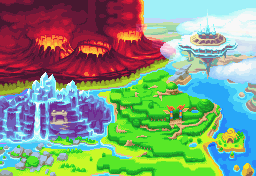
One of the best things to come out of this console generation has been downloadable games. Not DCL so much, though I don’t begrudge companies trying to soften the hit of skyrocketing development cost with some cheap extra revenue. But full downloadable titles are great. Not every game needs to be a blockbuster, that kind of thinking leads to skyrocketing development costs. Some games can just be short diversions, worth an afternoon or three of enjoyment and priced accordingly. That is exactly the sort of game Sakura Samurai is, and I like it.

Sakura Samurai: Art of the Sword is basically Punch-Out! with a sword. It is not so much an action game as it is a rhythm game. Much like Punch Out, the player must watch the enemies movements and dodge or counter accordingly. With the exception of the bosses, though, the enemies have much less complex move sets, as does the player character. You can dash in any direction and swing your sword, but that’s about it. The advantage it has over Punch Out is that you face more enemies at once. Instead f just one opponent, there are as many a five squaring off with you.

It is simple, but it is fun. This is a game with personality. It is addicting, as you get into a rhythm dodging and slicing you won’t want to put it down. And I lasts, if what I assume is the last boss is the last boss, just about as long as its simple gameplay warrants. No padding to excuse its price, it last just long enough to fully explore its mechanics. This is the kind of title download services were made for. Short, sweet and fun.

And the best part, the best part of the 3DS’s downloads specifically, is that it is always on the system. The biggest drawback of portability of portable games has been the desire to have more than one game. It is often not convenient to carry extra game carts around. But downloaded games are always right there. I might just have Ocarina of Time in my cart slot, but I have a dozen games sitting on my system if I’m traveling and want a change. It is a perfect combination. Now that its here I can’t imagine ever giving it up.

First Impressions of Xenoblade Chronicles

Xenoblade, to my knowledge, is the first game to actually follow up on  Final Fantasy XII’s attempts to breath life into the stagnating RPG genre. It may be too little, too late but nevertheless Xenoblade makes an admirable attempt at moving forward.  I am not necessarily referring to the traits from MMOs that both games adopted, though I think the streamlined battle system is used to great effect; I am talking about a shift in focus from the story to the gameplay.  Not by just adding increasing opaque and complex systems, but changing the way the games are actually played. This is not just what I think, this sentiment is echoed by Xenoblade’s director in an Nintendo Power interview.  The story is the usual anime-inspired pap, but the entirety of the gameplay pushes the genre somewhat closer to its western brethren while not losing any of its eastern charm.


Even if it were a by the numbers, vanilla exercise, Xenoblade Chronicles would be somewhat remarkable.  Sprawling JRPG epics are not so common as they once were.  In the previous two console generations big games like this abounded, but like Bison they are now quite rare. The craving for an epic made it hard to accept the hubbub around Xenoblade’s disappearing reappearing release date.  Was the actually good enough to warrant such attention?  For once, the answer is yes.  Most games get that great reverse sour grapes reputation, that the game we didn’t get was actually really great, but only a few times has this been true.  It was true of Final Fantasy V and of Mother 3.  Fortunately it was also true of Xenoblade Chronicles.


I haven’t actually played it enough to make any lasting judgments.  The first twenty hours are fantastic.  The story isn’t great, but it is more than tolerable.  I’m still not sure how some of the more complex battle mechanics will work, but so far battles are engaging.  Where the game shines, though, is in the scope.  I have played games like Skyrim or Fallout 3, but I still say that Xenoblade has the most impressive landscapes I’ve encountered in a video game.  They are not quite as expansive, though they are far from small, but they a significantly more interesting.  Xenoblade is a serious attempt to create a world, and it succeeds in spades.  The first three open areas: around Colony 9, the Guar Plains and the Satorl Marsh, are all interesting, well populated landscapes.  The grassy hills and cliffs of the plain, occasionally beset by torrential downpours and the moody, foggy marsh are especially entrancing.  I was impressed by the big, empty Sandsea in FFXII years ago, but that has nothing on this.  Even if all other part of the game fall apart before the end, just exploring the world makes Xenoblade worth the price of admission.  Fortunately, so far the rest is pretty good too.

Video Game Archaeology: Low G Man

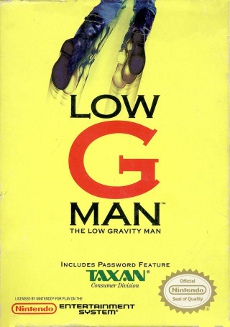
It is time for more Video Game Archaeology! Video Game Archaeology is my monthly exploration of an artifact video game found during my excavations of various bargain bins and yard sales; an examination of a game cast off and long forgotten. This month’s game is Low G Man: The Low Gravity Man, an action game from Kid and Taxan for the NES.


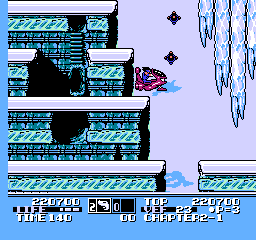
Low G Man was released in 1990 by Taxan. Before playing it for VGA, I was not familiar at all with it. I had heard some people refer to it as a joke, as though Low G Man was a comically awful game, only worth remembering for how badly it failed. Knowing nothing else, I was content to leave my knowledge at that. Then I learned that KID had developed it and it jumped to the top of my list of old games to play. Though they stayed alive into the 2000’s making Japanese visual novels, KID was best known to me as a solid developer of NES action games, specifically the GI Joe games. Since I enjoyed those games so much, I was eager to see more of their oeuvre. While I wasn’t overwhelmed by it, Low G Man wasn’t disappointing either. It was just a kind of good NES game.

Low G Man is a middle of the road NES action game, generally well made but Lacking the polish or spark of a truly great game. There is nothing brokenly wrong with the game, but neither does it do anything to distinguish itself from the multitude of similar games for the system. Low G Man tries, though. The first part of the attempt to give Low G Man an identity is right there in the title. The title character has a “low gravity suit” that allows him to jump incredibly high. As in about 2/3 of the screen to start with, and power ups that increase it significantly. It takes a bit to get used to the height of the jumps, but it works. Except that most of the levels are not designed to incorporate the high jumps. Yes, the player can jump higher than the screen, but there is little reason or incentive to do so. The second distinguishing characteristic of Low G Man is the two part fighting system. The player has two main weapons, a freeze ray and a spear. The ray, which I assume is supposed to be some sort of EMP gun since the enemies are mostly robots, doesn’t actually damage enemies; it merely stops them. The spear is needed to damage enemies. So first the enemy must be frozen, the stabbed to death with the spear. The problem is that the spear and gun share a button, making it easy to accidentally use the wrong one. While it is satisfying to freeze an enemy, then jump on its head to stab it repeatedly, it mostly just grinds the action to a halt. It works for boss battles, but for most of the rest of the game it is tedious and awkward. What keeps Low G Man from being great is that its signature gameplay features are either badly implemented or simply bad ideas. It feels much like the first Mega Man game: all the parts are there for a classic, but it doesn’t quite come together. Unfortunately, there was no Low G Man 2 to sand off all the warts.

Though there was no sequel, this game does share a lot with the GI Joe games, especially the first one, on the NES. Both games have 3 part stages, with occasionally controllable vehicles. The music is similar, and the graphics are almost identical. Really, the graphics are very good. Though too often the background is black, when out in the open you can see the player characters long hair wave as he jumps. Both the GI Joe games and Low G Man feel the same. I am willing to consider GI Joe the polished classic to Low G Man’s rough draft. The only thing that was really dropped was the cumbersome spear fighting. Though the emphasis on jumping high is gone, Snake Eyes still jumps absurdly high.

Low G Man is not a must play. It is just another competent action game in the veritable sea of action games on the NES. For fans of KID’s other NES games, though, it is worth checking out Low G Man. Just remember that it is an NES game, and therefore quite, frustratingly difficult.