Video Game Archaeology: Low G Man

It is time for more Video Game Archaeology! Video Game Archaeology is my monthly exploration of an artifact video game found during my excavations of various bargain bins and yard sales; an examination of a game cast off and long forgotten. This month’s game is Low G Man: The Low Gravity Man, an action game from Kid and Taxan for the NES.
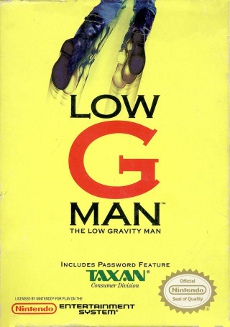
 

Low G Man was released in 1990 by Taxan. Before playing it for VGA, I was not familiar at all with it. I had heard some people refer to it as a joke, as though Low G Man was a comically awful game, only worth remembering for how badly it failed. Knowing nothing else, I was content to leave my knowledge at that. Then I learned that KID had developed it and it jumped to the top of my list of old games to play. Though they stayed alive into the 2000’s making Japanese visual novels, KID was best known to me as a solid developer of NES action games, specifically the GI Joe games. Since I enjoyed those games so much, I was eager to see more of their oeuvre. While I wasn’t overwhelmed by it, Low G Man wasn’t disappointing either. It was just a kind of good NES game.

Low G Man is a middle of the road NES action game, generally well made but Lacking the polish or spark of a truly great game. There is nothing brokenly wrong with the game, but neither does it do anything to distinguish itself from the multitude of similar games for the system. Low G Man tries, though. The first part of the attempt to give Low G Man an identity is right there in the title. The title character has a “low gravity suit” that allows him to jump incredibly high. As in about 2/3 of the screen to start with, and power ups that increase it significantly. It takes a bit to get used to the height of the jumps, but it works. Except that most of the levels are not designed to incorporate the high jumps. Yes, the player can jump higher than the screen, but there is little reason or incentive to do so. The second distinguishing characteristic of Low G Man is the two part fighting system. The player has two main weapons, a freeze ray and a spear. The ray, which I assume is supposed to be some sort of EMP gun since the enemies are mostly robots, doesn’t actually damage enemies; it merely stops them. The spear is needed to damage enemies. So first the enemy must be frozen, the stabbed to death with the spear. The problem is that the spear and gun share a button, making it easy to accidentally use the wrong one. While it is satisfying to freeze an enemy, then jump on its head to stab it repeatedly, it mostly just grinds the action to a halt. It works for boss battles, but for most of the rest of the game it is tedious and awkward. What keeps Low G Man from being great is that its signature gameplay features are either badly implemented or simply bad ideas. It feels much like the first Mega Man game: all the parts are there for a classic, but it doesn’t quite come together. Unfortunately, there was no Low G Man 2 to sand off all the warts.
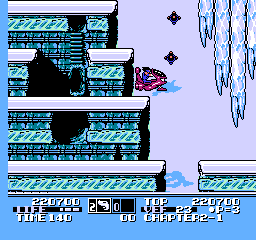
Though there was no sequel, this game does share a lot with the GI Joe games, especially the first one, on the NES. Both games have 3 part stages, with occasionally controllable vehicles. The music is similar, and the graphics are almost identical. Really, the graphics are very good. Though too often the background is black, when out in the open you can see the player characters long hair wave as he jumps. Both the GI Joe games and Low G Man feel the same. I am willing to consider GI Joe the polished classic to Low G Man’s rough draft. The only thing that was really dropped was the cumbersome spear fighting. Though the emphasis on jumping high is gone, Snake Eyes still jumps absurdly high.

Low G Man is not a must play. It is just another competent action game in the veritable sea of action games on the NES. For fans of KID’s other NES games, though, it is worth checking out Low G Man. Just remember that it is an NES game, and therefore quite, frustratingly difficult.

Video Game Archaeology: Dino City

It is time for more Video Game Archaeology! Video Game Archaeology is my monthly exploration of an artifact video game found during my excavations of various bargain bins and yard sales; an examination of a game cast off and long forgotten. This month’s game is Dino City from Irem for the SNES.

This game was given to me as part of a Holiday gift exchange with the intention of me covering it here.  One look at what is quite possibly the best boxart ever and I knew that I had to play this game. Dino City is possibly the least known game that I’ve covered for VGA.  The internet at large seems to have little to no recollection of it.  There are a few videos on youtube, but that is about all.  The few people that do remember this game seem to like it quite a bit and wikipedia tells me that it got fairly good reviews back in the day.  However, I have no idea why.  This is a pokey, awkward and too hard platformer with little in the way of personality.  I’m being kind of harsh, it wasn’t terrible, but neither was Dino City actually any good.

Dino City is loosely based on the straight to VHS movie Adventures in Dinosaur City.  I actually saw this movie, and if my 20 year old memories are to be believed it was not too bad.  I suspect that my memories are suspect, though.  The plot is that young Timmy and his friend Jamie try to watch TV on one of Timmy’s Dad’s experiments, who I guess is some sort of scientist possibly the mad sort, and get sucked into some sort of dinosaur land.  There they team up with some Dinosaurs to fight evil Neanderthals.  And to get back home, I guess.  This is a platformer, there really isn’t a lot of story.  The game was developed by Irem, famous mostly for R-Type and other shooters.  They also developed one of my favorite games, Steambot Chronicles for the PS2.  Honestly though, much of their output, especially on consoles, is rather mediocre.  For every R-Type, there is a Deadly Towers or Spelunker.  Still, they are at least competent creators of video games with some classics to their name.

The player can choose from either Timmy riding Rex the T-Rex or Jamie riding Tops the Protoceratops.  There is actually significant differences between the two, as Rex can only punch while Tops throws some sort of darts or something.  There is no advantage to Rex, Tops is better, as he seems to do as much damage as well as have enough range that the won’t constantly be being hit.  Which brings me to my first big problem with this game. Many enemies take two or three hits to kill, which is just unfeasible with Rex’s tiny punching range.  You can jump on enemies a la Mario, but that still takes several hits to kill them.  This leads to the player character taking plenty of extra hits.  At least the developers compensated for this, in the early levels I played at least, by leaving plenty of life refilling hearts around.  This is certainly less of a problem with Tops, since most enemies can be dealt with from a distance.  It is a completely different game depending on which dino you choose, and Tops is the right choice.  I couldn’t even hurt the fist boss with Rex, but I didn’t have much of a problem with Tops.

Another place where the game falters are the controls.  They often feel sloppy.  Your character doesn’t quite move like you would expect him to move.  Everything seems to happen in slow motion.  Maybe I am just lamenting a lack of Mario-esque momentum, but Mario is the gold standard for the genre.  But while I played, it just felt right.  It wasn’t helped by the way too high (read: cheap) difficulty.  It might be a mindset thing.  I expected it play like a Mario game, which are usually designed to allow players to build momentum and sprint through levels, but Dino City has a slowed, more precise pace.  I didn’t like it.

Dino City is actually pretty solid on the presentation side.  The graphics, while not mind blowing, are pretty good.  Especially some of the changing backgrounds, like the sunset in the third stage.  The sprites are big and colorful, just as you would expect from an SNES game.  And the music is not too bad either.  There are some decent tunes, but again, nothing much better than good.

I guess I can see some nostalgic love for this game from people who played it new, but it hasn’t stood the test of time too well.  It is hard in the least fun ways, having enemies that take forever to dispatch and tiny platforms with imprecise controls.  Really, it is the cheap difficulty that really sinks it.  Still, I would say it is worthy of remembrance for the majestic box art alone.  It is likely a game that is better than the movie it is based on, but we needn’t set the bar that low for our entertainment.

images taken from the vgmuseum.

Video Game Archaeology 7: Shadow of the Ninja

After an unfortunate hiatus, Video Game Archaeology returns!  Video Game Archaeology is my monthly exploration of an artifact video game found during my excavations of various bargain bins and yard sales; an examination of a game cast off and long forgotten.

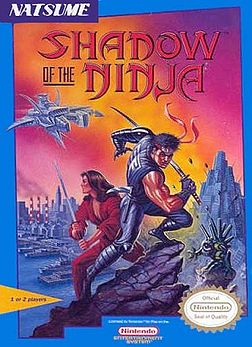
Natsume today is known mostly for the Harvest Moon series, but that wasn’t always the case. While they were never quite on the level of Capcom or Konami, Natsume published quite a few quality games over a variety of genres for various systems until basically the PS1/N64 era. Like any Japanese game company worth its salt, Natsume published some fine NES games. None of them seem to have been very popular, but the ones I’ve played are solid games. I’ve played a bit of Shatterhand and poured over an issue of Nintendo Power about the unfortunately named S.C.A.T, though I never actually played it. After reading this Hardcore Gaming 101 article, I decided to rectify that and downloaded Shadow of the Ninja off Virtual Console. Continue reading

Video Game Archaeology: Rocket: Robot on Wheels

It is time for more Video Game Archaeology! Video Game Archaeology is my monthly exploration of an artifact video game found during my excavations of various bargain bins and yard sales; an examination of a game cast off and long forgotten. Featured this month is the Nintendo 64 game Rocket: Robot on Wheels.

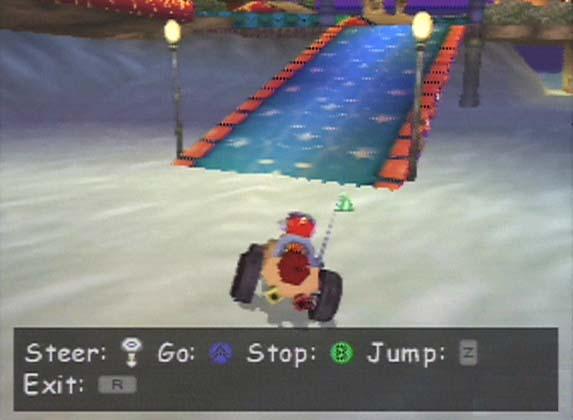
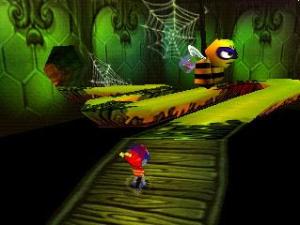
Rocket: Robot on Wheels is the story of a robot that must save his owners theme park by defeating the devious raccoon mascot (actually mascot’s sidekick) and retrieving all of the tickets he had stolen. Yes, Rocket is that specialty of the N64: the collect-a-thon platformer. Here is have to be completely honest, while I recognize that that they are wholly out of favor I never really soured on collect-a-thons. I don’t necessarily love all the games in the genre, but I still like many of them. I played Banjo-Kazooie in the last year and still loved it. And I really liked Rocket as well.

A collect-a-thon, for those to whom God was merciful and were spared the eye-searing N64/PS1 days, is a game that focuses primarily on collecting various doodads and baubles. In older games, the goal was usually to reach the end of a stage or to defeat a boss, but in a collect-a-thon the levels are generally large playgrounds and the goal is to find all the crap hidden in a level. While you can trace the roots of this nonsense back to the 16-bit era (see: all the crap to collect in DC2), collect-a-thons really got their start with Mario 64.

Mario 64 set the tone for N64 platformers. Instead of linear levels like the 2D games, Mario 64 gives the player large, relatively open levels with 5 or so stars to find in each of them. Other than coins, that is all there really is to collect. Other developers saw Mario 64 and thought, “if kids like collecting stars so much we’ll give them 500 things to collect.” Then they did so.

Pocket is a perfect example of the collect-a-thon. In each of the 8 stages, which are somewhat cleverly attractions at an actual theme park, the player must collect 15 tickets. While most of the tickets are cleverly hidden or earned from completing actual tasks, there are at least 2 in each stage that you receive as rewards for collecting other things. In each stage, there are 200 gears, which are used to upgrade some of Rocket’s skills but mostly just there, so one of the tickets can be a reward for finding all 200. Also in each stage is a machine that must be repaired. To repair it you need to find the 6 pieces of it scattered about the stage. Doing so opens up some previously unavailable sections of the stage and nets you the immediate reward of a ticket. The extra collectables are mostly unnecessary. They pad a game that is already plenty long and is otherwise really fun.

Collect-a-thons do not hinge on the collecting but on the obstacles between the player and the doodad. In this area, Rocket is quite good. While not all the challenges are particularly fun, one that is not is an annoying dolphin ride, most of them are well done. At least through the first 3 or 4 stages, which is all the further I got. Rocket’s most effective tool is his electric tether. It is used, thanks to his stylish lack of arms, to grab and throw objects. It is also used as a grappling hook, a la Bionic Commando or Metroid. Unfortunately, it is severely underutilized in that capacity.


There are some flaws. One is the camera, the bane of nearly every N64 game. The camera is quite simply terrible. It seems to purposefully plant itself at the worst possible angle and fights strenuously to keep you from positioning it somewhere useful. Half of the challenge in this game is getting the camera to a place where you can see what you are doing.

Another problem, I wouldn’t quite call it a flaw because it is clearly supposed to be integral to the game’s identity, is the curios momentum and physics in the game. The world of Rocket feels somewhat like the ice stage from every game ever. Rocket is called the “Robot on Wheels,” so having him roll around seems right even if it takes quite a bit of getting used to at the beginning. It works with the physics of his tether. When your primary weapon is tossing things, how they move is an important part of the game. In Rocket things just seem to not stop when they should. If you throw something, it will bounce around for an improbable amount of time. It is different from other games and in this case, I say that is a bad thing. The physics in Rocket make me want to play a different game.

Rocket is impressive as the maiden effort of developer Sucker Punch, the company that would go on to make the Sly Cooper series and the Infamous series. There is a lot that feels like rough draft Sly Cooper in this game. It has a similar style and a very familiar raccoon character. I would say that the first Sly Cooper game is notably less ambitious than Rocket, though it is the better game. Sucker Punch displays a tendency to cram a wide variety of gameplay styles in their games, like various vehicles and the like, but keeping most of them true to the general feel of the game.

One more interesting tidbit is the fact that right up until just before its release this game was titled Sprocket, but they had to change the name due to legal threats from Hanna Barbara, the owners of The Jetsons and apparently the word sprocket.

For those with fond memories of the N64, Rocket: Robot on Wheels is definitely worth a look. While I’m not about to put it up there with the best of N64’s titles, it definitely belongs in that second rung. Would say it is just a small notch below Banjo-Kazooie, the second best platformer on the system. This is exactly the sort of hidden gem I hope to uncover in these excursions.