Pikmin 3

Both of the people who read my blog regularly will likely recall that I’ve had Pikmin 3 on my “to play” list for about a year. I don’t know why I’ve put it off for so long. At first it was due to a deluge of other games; games like Wind Waker HD and The Wonderful 101. Pikmin 3 was continually pushed down the list. One thing that did keep pushing it down the list is that it is best played with the wiimote and nunchuk, which means that I couldn’t play it on just the Gamepad. That made it just that much easier to skip it and go to something that I didn’t need the main TV for. Now, though, I have finally taken the time to play this game. Pikmin 3 is an amazing game; beautiful, original and with a startling attention to detail. I feel like a fool for putting it off so long.
pikmin4

I never played the first two Pikmin games. They came out during the time I was largely not playing video games. I did have a Gamecube, but other than Resident Evil 4 and Smash Bros Melee I didn’t have a whole lot for the machine. The Pikmin games looked good, but I just never happened to stumble upon them. Plus, my experiences with console based RTSes, even ones that were supposedly well made, have never been good. I did pick up the New Play Control Pikmin 2 for the Wii, but my nephew borrowed it and I haven’t seen it since. So Pikmin 3 was my entry into this series.

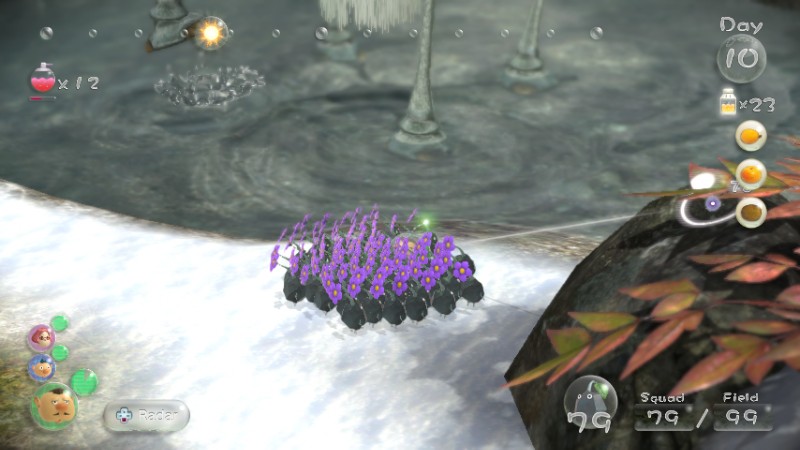
Pikmin 3 takes a complex genre, real time strategy, and gives a patently Nintendo take on it. It is simplified in some ways, like resource management and unit types. Games like Warcraft and Command and Conquer had various resources that the player had to harvest and then allocate to expand their army. Pikmin 3 does have some resources, but there is little about them to manage. Instead of an extensive tree of unit types to build an army with, there are only a handful of Pikmin types to use. In typical Nintendo fashion, the elements of Pikmin 3 all work together. The main goal of the game, other than to reunite the three little aliens that are the game’s protagonists, is to find fruit. The protagonists convert it to juice and drink, with their mission to the planet they crash on being to find new sources of juice. While there are frequently other goals, that is the primary one. The only other resources besides fruit are flowers and enemy carcasses, both of which are used to create more Pikmin. The color of Pikmin you get from them are determined by the type of Pikmin you used to send them back to the home base.
pikmin1

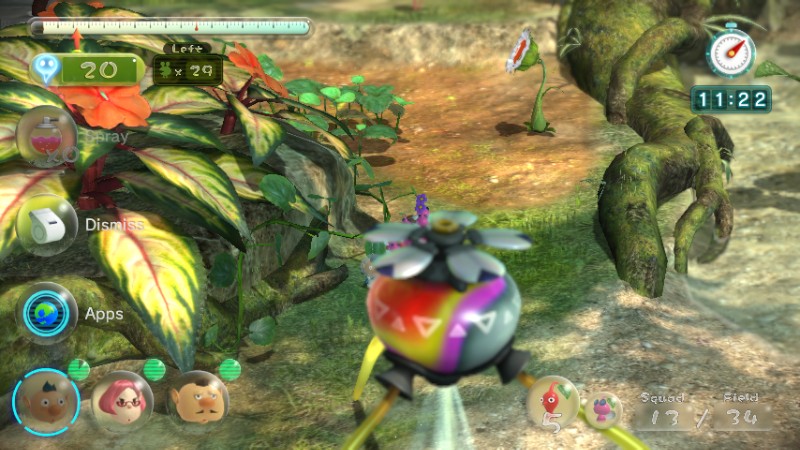
Solving puzzles and fighting enemies in the game is all based on the color of Pikmin. There are red, yellow and black Pikmin and they have a sort of rock/paper/scissors relationship. The red ones are immune to fire and good at fighting while the yellow are immune to electricity and, while not as good of fighters as the red are lighter and can be thrown farther. Choosing the correct Pikmin for the job is two thirds of the game. It simple in theory but difficult in practice. Especially once you get all three characters together and can split them into three distinct groups. Do you want to split your colors between each commander, or give each commander one color to lead. It hits that perfect balance of easy to play, hard to master.

Pikmin 3 is also one of the best looking games I’ve ever seen. The tiny aliens you control explore an Earth-like world, finding familiar fruits and your discoveries new names. It is cute. The same goes for all of the “alien artifacts” you find over the course of the game. Seeing these little aliens interpret various trinkets in amusing ways it highly entertaining. It all looks good, simultaneously detailed and clean. It is fun to just run around the areas of the game and just look at what there is to find.

pikmin2

It is really just another great game on the WiiU, a system with a robust and varied library despite its reputation for not having any games. Nintendo may be failing to sell the system, but they are not failing to support it with excellent software. It seems likely that Pikmin 3 is the last entry we’ll see in this series, which is a shame based on how great this game it.
Castlemania

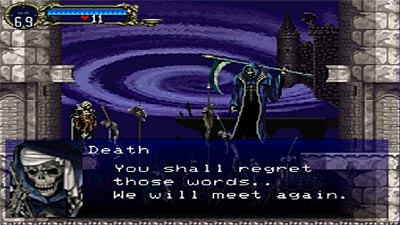
After beating Rondo of Blood, I did two things. I downloaded Super Castlevania IV on my WiiU and played through that and I started playing the Symphony of the Night port in the PSP. That was the game I was originally trying to play in the first place. I had wanted to play the Castlevania game that most often gets called the best, and almost unanimously agreed that it is the best of the “Metroidvania” style games, the style it brought to the series. I have played all the games the sprung from this one, but by the time I was aware of it on the PS1, it was hard to find and expensive. While it has been on the PSP and Playstation Store for quite a while, I hadn’t made time to play it until now. I’m glad I’ve played it now; Symphony of the Night is excellent.

sotn3

Symphony of the Night turned the level based set up of the previous games into the series into a giant, connected, Metroid-like map. Instead of a steadily more challenging tour through Dracula’s Castle, here it is one giant map that is kind of free to explore from the start. The game doesn’t force you to go anywhere, but you are limited by what abilities Alucard has found. This means that the difficult can be uneven. It is also changed from being a straight action game to being an RPG. Alucard gains levels and has quantified stats. It is not necessarily a good change, but it is certainly not a bad one.

Symphony of the Night doesn’t feel as perfect and complete as Super Metroid, the other game that led to the made up word Metroidvania. Super Metroid is pure, distilled perfection. There is nothing extraneous in the game. All of the tools and abilities that Samus ends up decked out with are to some extent necessary. (I am of course referring only to a normal playthough, not using any of the special tricks that can almost break the game.) Symphony of the Night, on the other hand, is filled to the brim with extraneous tools and abilities. Yes, Alucard gains necessary abilities like the double jump and the bat form. But there are also elements like the weapons, which are varied and special but none of them are strictly necessary. There are the familiars, which I didn’t even realize existed until I was more than halfway through the game.

sotn2

That is what makes Symphony of the Night great. Super Metroid may be neat and polished; Symphony of the Night is messy. It is filled to the brim with stuff to find and toys to play with. The fact that most of these elements add to the game rather than detract from it is amazing. The player doesn’t really lose anything by not using familiars, but they add something to the game. If the player doesn’t want to deal with messing with their equipment, they can use the short sword that the player is almost required to get. While it uses a similar set up to Metroid, it ends up being quite different. Every time you play Super Metroid it is largely the same. Symphony of the night changes with each attempt, depending on what items enemies happen to drop and which tools you choose to emphasize. Those tools are fun to use. There are tons of weapons to choose from, many with unique special properties. The experience of the game can change drastically with some equipment choices. While not exactly the strongest weapon in the game, the Shield Rod has special abilities when paired with certain shields. Some weapons have greater range or swing faster. The leveling system can also be manipulated into making the game harder or easier depending on how you approach the game.

sotn1

One of the most interesting things about Symphony of the Night is that while it seemed an offshoot, a strange experiment for the series, it ended up being the true continuation of the series. It is the game that kept the Castlevania series limping along for a decade when most 16-bit franchises not owned by Nintendo fell by the wayside. The series went 3D like everyone else, with about an average amount of success; which means that the games were bad, but not completely terrible. It wasn’t the smashing success of Ocarina of Time or Mario 64, but neither was it Bubsy 3D. The 3D side of the series muddled on, but those aren’t the game people remember. The ones that people love are Symphony’s progeny, the Metroidvanias that Konami produced for the GBA and DS. People remember Aria of Sorrow and Dawn of Sorrow, they don’t tend to recall Lament of Innocence.

None of the later games ever surpassed Symphony of the Night, though. They often came close, but never quite reached the peak. The rough edges that made Symphony special were never really sanded off, they were usually just moved to a new area. Whether from a lack of care, money or time (or a combination of all three) none of the handheld games showed the same attention to detail that this game did. This one was a masterpiece, a one of a kind game that deserves its reputation for being one of the greatest games of all time.

Unfinished Business with Suikoden 2

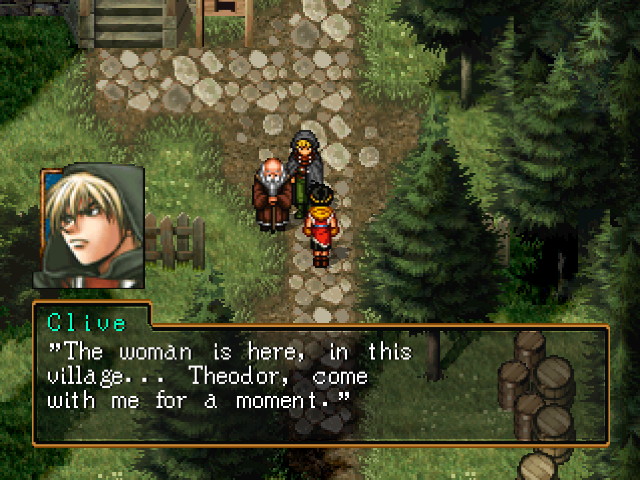
As I’ve said before, I love Suikoden 2. Playing Final Fantasy Tactics reminded me of some similarities between the games’ stories, so after completing FFT I started a new file on Suikoden 2. Not only did I want to refresh my memory, but I also have unfinished business with that game. I may have beaten more than a half dozen times, but there is one part of the game I’ve never experienced. I have never been able to complete Clive’s Quest.

clq

Clive’s Quest is a sidequest in Suikoden 2 centering on a character named … wait for it … Clive. In order to complete that sidequest you have to essentially beat the game in less than 20 hours. A tall task in a game that generally usually takes me more than 40. It is certainly possible, even without using some of the more involved tactics players have come up. All you have to do is skip almost all of the optional stuff in the game. This time, I was determined to see Clive’s Quest through. That determination, however, petered out around the time I hit South Window, a town you visit at about the one quarter mark of the game. At that point I realized how much I missed all the optional stuff you have to skip to complete that quest.

The Suikoden games are filled to the brim with optional things. You don’t have to work very hard to find most of them, simply walk around your castle and they happen. The spontaneity of these scenes is what makes the world of Suikoden seem so alive. It feels like this stuff is happening whether you are there to see it or not. Sure, there is fun stuff like having your army detective investigate each of the 108 Stars of Destiny that make up your party, but there is also more subtle stuff like stepping into the dining hall and seeing the two dog-like Kobolds performing a dance number. The more you poke around the game world, the more stuff happens that fleshes out the characters and the world.

cq2

One the few of these bonus scenes that excludes the rest is Clive’s Quest. To see Clive and Elsa’s story play out, you have to reach certain towns before too much time passes on the game clock, the last being what is essentially the last dungeon with right around 21 hours on the clock. I can’t ever force myself to miss all the good stuff just to get those few elusive scenes. It is just about the only thing I haven’t done in this game. I’ve recruited both Valeria and Kasumi, since you have to choose one or the other. I’ve gotten all of the endings, even the one when Riou (the “canon” name for the protagonist) and Nanami run away instead of finishing the game. I’ve even intentionally let Ridley die so I could recruit his son Boris. Unfortunately I have never been able to force myself to ignore all the other stuff I could see just for Clive. After failing recently, I’m not sure I ever will.

Still, each failure to complete Clive’s Quest is another time I play through Suikoden 2, so none of them are truly failures. Each time I play through the game it is a joy. I really wish Konami would make this game available for purchase on some download service. If I am really wishing for things I can’t have, I might as well wish that Konami would take the time to retranslate the game. Again much like Final Fantasy Tactics, the translation is got in the late 90’s was serviceable at best and unforgivably sloppy at worst. Unfortunately, the game tends toward the latter. It is the biggest flaw in what is otherwise a great game.

My 5 Most Hated Games

I made a handful of these lists a few years ago, hoping to start a blog feature called Top 5 Friday. That never really came to fruition. Is this me making another go of it? Not really. I’m just going to post Top 5 lists whenever I don’t have anything else to put up.

Today’s list is my 5 most hated games. This is not a list of the 5 worst games I’ve ever played, though there would be some crossover with the games on that list, but the 5 games that got the most visceral hateful reaction from me. With simply a terrible game it is easy to just shut it off and never play it again. To get me to truly hate something, I have to care about it to begin with’ as well as spend enough time with it to get me to really dislike it. So this list has a lot of sequels and RPGs. Bad sequels to games that I really liked and bad RPGs that I spent way too long playing.

rs3

5: Star Wars Rogue Squadron 3: Rebel Strike – The first two Rogue Squadron games were excellent. The third looked to continue this, but included bafflingly awful on foot missions. I was at the height of my Star Wars fandom, and had spent so much time with Rogue Squadron 2 that I could barely wait for Rebel Strike. It couldn’t have disappointed me more. I hated it so much that I sold it back to Gamestop after only a few weeks, something I never do. Maybe I judged it harshly, but even after 10 years it was one of the first games that came to mind for this list.

tota

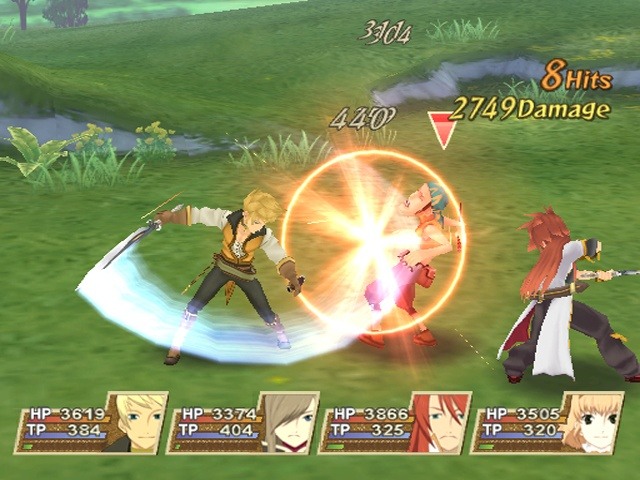
4: Tales of the Abyss – This is likely the best game on this list, as well as a game I really wanted to like. Tales of Symphonia hit me at just the right time in High School, especially for an RPG fan playing on the RPG starved Gamecube. I went to considerable length to track down its sequel. Aside from my natural inclination to like it, Tales of the Abyss came highly recommended, both for its improved battle system and its story. The improved battle system held up its end of the bargain; the story not so much. Tales of the Abyss is a long game, nearly 60 hours. A duration that is hard to stomach with a cast of unlikeable, irredeemable assholes that make up the player’s party in this game. I couldn’t stand this group of characters. At a certain point all of the characters ruin whatever likeability they ever had, and the game expects the player to side with them. I hated every minute I had to spend with that despicable group of anime clichés.

lds

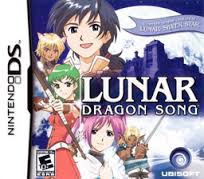
3: Lunar Dragon Song – I love the first two Lunar games. When a sequel hit early in the DS’s life I was overjoyed. Then I played it. It makes every mistake an RPG could make. This game has no redeeming qualities. Worst of all, it got my hopes up for the continuation of a great series that this game really doesn’t deserve to be a part of.

hydlide

2: Hydlide – A kid with an NES probably had a limited amount of funds to get games with. One of my first choices was Hydlide. At the time every game was a new experience, I just had to figure out how each game worked. I spent hours trying to crack Hydlide, assuming that once I learned how it worked it would be fun. I never learned how it worked and it was never fun. Even later, when I learned how it worked it was still awful. This one has a special place pf hate in my heart for being my first bad game.

hoshi

1: Hoshigami: Ruining Blue Earth – All the previews of this game highlighted how like Final Fantasy Tactics this game it. At this point I had never seen anything like FFT, so another game like that sounded like a dream come true. So I begged my Mom to take to Funcoland to spend $40 on this game. Then I played it. It was like FFT; like FFT’s mentally challenged cousin. The game expected the player to grind incessantly. There was nothing even close to the Job system. In fact, the game seemed to go out of the way to hide how it worked mostly because I don’t think most of its systems did work. It looks like FFT, but it plays like a nightmare. After a week of unremitting agony, I finally convinced my Mom to drive me back and exchange it, getting I think Final Fantasy IX. That should be the end of this tale, but that would not get this game to the top of my most hated list. Years later, Hoshigami was released on the DS. I was both still a fan of strategy RPGs and still remembered how much I disliked this game. But all the preview talked about how it fixed the problems with original version. So I plunked down $30 on this game again. And it was still awful. This time I was not able to get my money back. I hate this game not just because it was bad, but because it fooled me twice. Fool me twice shame on me, I know, but that doesn’t make me hate this game less.

2nd Quest: The Phantom Hourglass

ph0

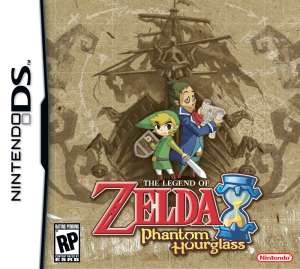
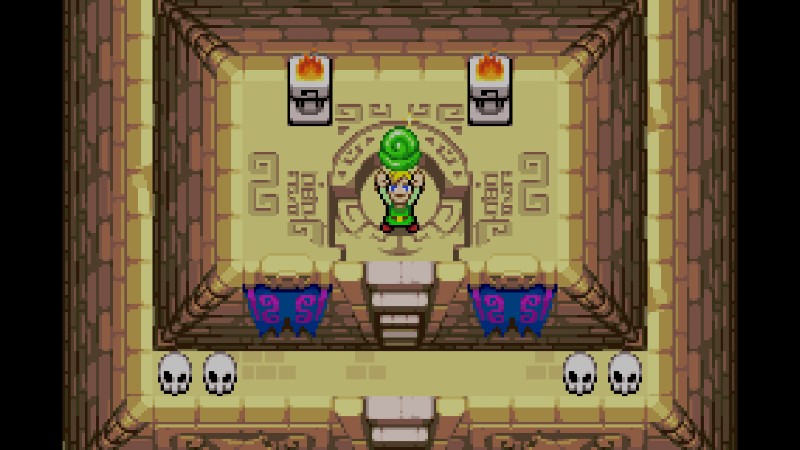
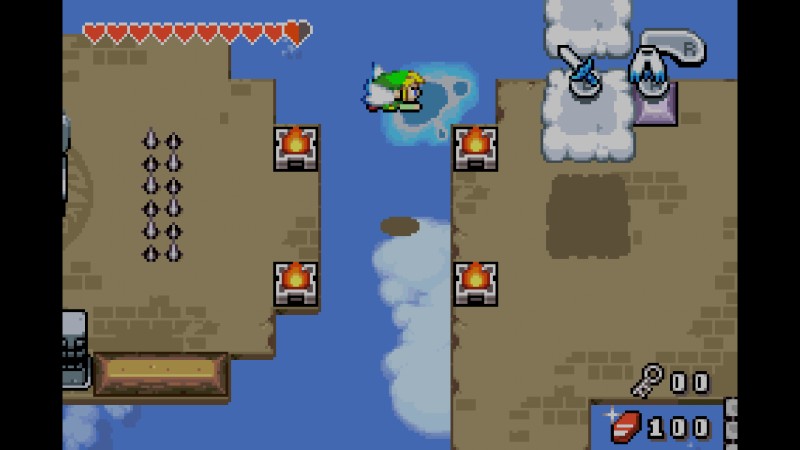
The Legend of Zelda games on the DS are probably the most divisive in the series. Both The Phantom Hourglass and Spirit Tracks share the same conflicting control scheme. They also tried to recreate the look of the console Zeldas on a handheld that wasn’t quite powerful enough to do it right. The cel-shaded look from Wind Waker returns here, and it mostly works despite the DS being a terrible system for 3D graphics. It looks slightly worse than Ocarina of Time did. With the DS Zelda games, Nintendo could have taken the easy route and just made what was essentially A Link to the Past on a handheld and everyone would have loved it. They did that with A Link Between Worlds. They went for something else entirely. I can’t say it completely worked out, but it was a noble experiment.

ph4

The most divisive part of The Phantom Hourglass is the stylus controls. In what seems a desperate, and completely unnecessary, attempt by Nintendo to prove the usefulness of their touchscreen enabled DS very few actions in Phantom Hourglass use button presses, nearly everything is done with the stylus. Despite the fact that the controls are very different from the rest of the series or really any other game, playing Phantom Hourglass soon feels natural. There are times when the controls are awkward, mostly when the game is pulling mechanics straight in from previous Zelda games, but for the most part they are excellent. Many actions are streamlined, like picking up and throwing pots and rocks. It takes just two taps of the stylus to execute. Drawing paths for the boomerang or bombchus and aiming the bow are likewise very natural. The combat, however, suffers greatly. Swinging the sword boils down to imprecise flailing. Luckily, most enemies are designed to be taken down with such flailing, making it only a slight problem. The requisite bout of batting an energy ball back and forth with a boss is awful, though. It is all but impossible to be precise. I can understand how the controls are a love them or hate them prospect; they are far different from what players are used to, but I have to say they impressed me with how well they work.

ph3

The other common complaint with Phantom Hourglass is about the Temple of the Ocean King. This is a dungeon that the player must go through multiple times throughout the game, each time going a few floors deeper than the time before. It is a decent idea of the surface, but the execution completely ruins the idea. Other than the chests you open, the dungeon resets each time, so you have to solve each puzzle again. Also, the dungeon is timed. So not only do you have to redo the dungeon, you have to redo it quickly. That’s not all; it is also a stealth dungeon, full of enemies called Phantoms, giant ghostly knights that the player can’t hurt. So you have to repeatedly, quickly sneak through this same dungeon more than a half dozen times. It was a poor design decision. And since it forms the backbone of the game, it really hampers the proceedings.

The biggest flaw, though, is the overworld. Returning to the look and world of Wind Waker was great, but the barely interactive sailing on the world map is the worst. I understand that space on the DS cart is limited and maybe they couldn’t do a big overworld, but knowing that the map was a necessary compromise needed to get that ugly low-poly 3D look, doesn’t help sell it. This is a Zelda game where exploring is a chore that I spent most of my time trying to avoid. That is as far away from the normal Zelda experience possible.

ph2Luckily the dungeons are all really good. When the game gets out if its own way and just lets the player play, it is a damn fine game. The available tools are limited, but the game comes up with multiple ways to use most of them. The grappling hook is really great in this regard. You can use it like the hookshot, but you can also use it to make tightropes across pits and like a slingshot to shoot the Link across some holes. It is the standout tool of the game. Most of the dungeons have some really great puzzles. They are not confined to one room, some of the better puzzles continue across several floors. They are truly satisfying.

The Phantom Hourglass is a flawed game. Most of the problems with the game could be fairly easily fixed. Taking out the repeating part of the Temple of the Ocean King mostly solves that problem and just giving the player direct control of the world map would make it less annoying. Still, despite those problems, The Phantom Hourglass is a largely enjoyable game. I find how experimental it is laudable, but that doesn’t really make it necessarily a good game. It is a divisive entry in the series with good reason. I liked The Phantom Hourglass, but I don’t see myself coming back to it any time soon.

2nd Quest The Minish Cap

The Legend of Zelda: The Minish Cap is Capcom’s third (technically 4th if we count the 4 Swords mode from the GBA Link to the Past port as its own game) and final game in the Zelda universe. Their first two games, Oracle of Seasons and Oracle of Ages, were solid Gameboy games that were built on the bones of Link’s Awakening. While neither is perfect, both are solid games. With The Minish Cap, Capcom finally got it right. For the most part.

Minish1

The Minish Cap starts with young Link and Zelda attending a fair in Hyrule town before going to the castle. There, the evil sorcerer Vaati takes control of the elemental powers and turns Zelda to stone. The only clue Link has to go on to save her is a legend about the Picori, a race of tiny people. Soon, through the use of the titular Minish Cap, a magic hat (not really, but that is close a close enough explanation) that gives Link the ability to shrink himself down to tiny size to meet with the tiny Picori as well as with the reach previously unreachable areas. It gives the game a fairly original hook.

First and foremost, The Minish Cap is a fine looking game. The backgrounds are detailed and colorful; the character sprites, though they look a little over rendered, are still magnificent. Minish Cap is easily the best looking 2D Zelda game. The detail in the surroundings is especially impressive when you shrink down. The bosses look nice, but most of them are just big versions of regular enemies, which is a little disappointing.

Minish2

It is also just a lot of fun to play. The selection of tools, while small, gives Link an interesting move set. Almost all of them appear in other games, but here they all used rather well. Plus, there are several sword abilities that are only useable with specific items. The game actually gives the player Link’s down stab from Zelda 2. The dungeons, while few in number, are inventively laid out and just generally a joy to play through.

The biggest problem with The Minish Cap is that it is just too darn short. There are only five dungeons and the word map is tiny. For a series that is generally as expansive and epic as Zelda, The Minish Cap is disappointingly brief. The game ends just as it gets going. There are a couple spots it looks like more dungeons could have been added, like the Graveyard and the mountain, but they were already pushing the game’s scenario to include 5 dungeons.

Minish4

A slightly lesser problem is how gated the game feels. There are a lot of spots where you are blocked off by a hole with a rock to push into it from the other side. Those spots work for me. There you just need to get the right item to advance, a perfectly valid reason to block the player off. The spots where your hat won’t let you go somewhere until you so somewhere else or talk to someone else first. That sort of nonsense is prevalent in this game. Then there are the Kinstones. Many of the other characters have half a kinstone and Link must find the other half and match them up. When he does, it unlocks something on the map, like a piece of a heart or a cave full of rupees. It essentially takes all the reward out of exploring, since you have to find the kinstones before you can actually find most of the stuff.

Minish3

Taken for what it is, The Minish Cap is an excellent game. But it is something far different from the regular Zelda game. Instead of a relatively open game about exploring. The Minish Cap is a very structured experience. The game is telling its story and the player is not really allowed to deviate from it. Fortunately, while the game is very guided toury, it is a singularly fun tour. Until A Link Between Worlds, I would say this was the best handheld Zelda game. The Minish Cap is a brief little delight.

Kirby Triple Deluxe

Kirby games tend to come in two flavors: weird experimental things like Mass Attack or Epic Yarn and rock solid platformers like Super Star or Return to Dreamland.  Both are indispensable to the pink puff ball.  I love the Kirby series because it has games like Kirby’s Adventure as well as games like Kirby’s Canvas Curse.  Triple Deluxe definitely falls into the regular platformer category.  In fact, it stands as one of the most impressive outings for the “normal” Kirby, with both outstanding level design and a deep roster of power-ups.

kd3

Let’s get one thing out of the way up front, Kirby Triple Deluxe is easy.  It is a Kirby game, they are all easy.  I wouldn’t want a Kirby game that wasn’t easy.  Outside of setting limitations on yourself, like playing without power-ups, this game is not going to challenge any sort of experienced player.  If you are coming into this game looking for challenge, I recommend you both look elsewhere and reevaluate the life decisions that led you to this moment.

On to more important topics, Triple Deluxe has some excellent level design.  A lot of the game, making some of the best use of the 3Ds’s 3D capabilities in along time, takes place on two planes.  There is the foreground, generally where Kirby starts, with the usual linear 2D action.  Then there is anther background plane.  By using special stars Kirby can jump back and forth.  Enemies can do the same.  Cannons shoot from the back screen to the front.  Most of the puzzles are about how to get a certain power from the front to the back or vise versa.  There are also a handful of levels that cover much of the path and force the player to use a mirror in the background to navigate.

kd1

It is never hard to reach the end of a level, but it can be take some careful examination of your surroundings to get each of the three or four sun stones hidden in each stage.  This is where the game can get truly devious.  You’ll need to find hidden keys and manage to transport them to locks, as well as various destructive items that you’ll need to clear the way.  I especially like the laser bar, that Kirby holds on one plane that stretched to the other.  He must avoid obstacles on his side while using the laser to clear the way on the other.  It is the kind of inventiveness one would expect from a Mario game, though it never gets to the point where it truly requires mastery.

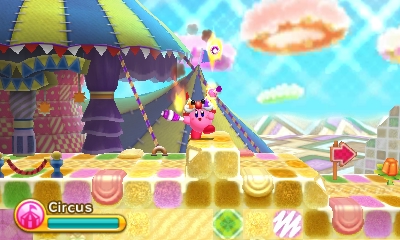
The second thing that makes this game, and this series, so great are the power ups.  Triple Deluxe uses the same, mostly, set of powers as Return to Dreamland.  That means each power-up has multiple uses and skills, making each one a varied tool that does require some mastery to use effectively.  Old favorites like Fighter, Beam and Wing are present, each with a handful of uses.  There are also some new ones, most of which are good enough that I hope they stick around.  Circus is cute, but I found it to be largely useless.  However, Bell is both adorable and useful.  Beetle and Arrow verge on being overpowered, though no more so than Hammer.  Since each power has so many moves an uses, it is largely up to the player which one to use.

kd2

The last new power is Hypernova, which gives Kirby the power to suck up anything. While this is technically a power-up, it has more to do with the level design than with the other powers.  It is required for the levels it appears in, and when its present the game becomes about using Kirby’s sucking power to solve all of his problems.  It is less a powerful tool and more a necessity.  That doesn’t make it not fun.  The Hypernova levels are some of the best in the game.

This is all wrapped in a cuddly package with some of the best graphics on the 3DS.  It is just a short, delightful game.  It oozes charm and personality, and backs that up with some truly excellent gameplay.  There are modes I’ve barely touched, from the 2 Dedede centric modes to the multiplayer arena battle mode.  Like its predecessors Super Star and Return to Dreamland, Kirby Triple Deluxe does so much right that it is hard to hold any of its little faults, length and lack of Hammer power-ups, against it.

2nd Quest: Oracle of Seasons

I know I said I was going to play Majora’s Mask, and I am currently doing so, but after finishing up Bravely Default I needed something to play on my 3DS. So I picked up my game of Oracle of Seasons game that I gave up when I got A Link Between Worlds for Christmas. I am glad I finally got the chance to finish it up. I wasn’t much a fan of the other Oracle game. It was good, but Oracle of Ages has way too much tedious chatting and fetch questing in between the parts where the player actually gets to play. Oracle of Seasons doesn’t have much of that nonsense, and it’s all the better for it. While not as quite as good as Link’s Awakening, Oracle of Seasons is an excellent game. It is, however, maybe the most difficult Zelda game that is not on the NES.

oos4

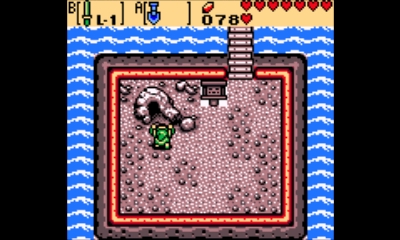
The internet tells me that Oracle of Seasons started as remake of the original Legend of Zelda. I believe it. The two games are quite alike. The first three or four dungeons of Seasons are much like the early dungeons of LoZ. Later the season changing mechanics become more involved, which obscures the similatiries, but there are still some. Many of the bosses are straight out of the first game. It is also, at times, brutally difficult. I don’t think I would have beaten it if I hadn’t been playing a linked game and therefore able to get the Master Sword. Oracle of Ages is a test of the player’s mind, Oracle of Seasons is a test of the player’s skill. There are some tricky puzzles, but there are more hazards and enemies. Like the LoZ’s rooms full of Darknuts and Wizrobes, OoS is all about the mastery of Zelda’s stiff combat. The individual rooms in the dungeons aren’t as difficult as the originals, the later dungeons are more of a prolonged nightmare. Normally, once you clear a room it is cleared until you leave the dungeon or die. However, in Oracle of Seasons, when you go into one of the side scrolling underground areas all the enemies respawn. Which means that as the player moves through the dungeon, there are no cleared rooms. They are always full of enemies.

oos3

Also, the game doesn’t have the same potion as the original. In that game there were blue and red potions, good for one or two uses depending on which color. In Oracle of Seasons, there is a potion, which you have to do most of the trading sequence to unlock, which is one use and is automatically used when you run out of hearts. So if you wanted to save it for the boss but you fell to a half dozen wizrobes just before, you’d have to leave the dungeon and run all the way across the map to get a new one. It is a frustrating decision. All together it means that that while the individual challenges are never as hard as Legend of Zelda’s, there is a constant source of tension and challenge in that there are always more enemies.

The first half of this game is just perfectly smooth. Compared to the other handheld Zelda’s, this game is really straightforward. There is none of the nonsense between the player and the dungeons, that player must only find them. It is refreshing. I love the Zelda series, but sometimes the games bog down forcing the player to do things that simply aren’t that fun. Seasons, the first half in particular, is remarkably short on that kind of stuff. The game is Zelda on the simplest terms in a lot of ways. Where it deviates from that is with the Rod of Seasons. It adds some puzzle solving to the overworld. Fun puzzles solving, not the nonsense from Ages. Each season changes the layout of the map a little, with different map features. Winter has snow drifts for the player to walk on, Spring had flowers that shoot the player up, etc. These are cued in by persistent map features. If there is a spring flower, it will still be there in the summer and fall, merely a withered husk of its springy healthy self. While it does require some thought, environmental never gets too difficult. There is only one spot where it gets truly complex, the Lost Woods, but it gives the player just enough to think about.

oos1

There are some downsides. Some of the later dungeons get downright brutal. Not necessarily a bad thing, but it can be frustrating. Much like the previous two Gameboy Zeldas, the thing still feels limited. I know that is absolutely an unfair complaint to lodge against the games; I don’t care. Their system of origin really keep me from liking them as much as I do nearly any other Zelda game. A lot of it has to do with the item switching. I think I complained about that in both my Link’s Awakening article and my Oracle of Ages one; the complaint still stands. Have to go to the menu over and over to change weapons and tools to solve puzzles is not fun. It is annoying. Still, Oracle of Seasons is a fun game. It doesn’t reach the heights of console games, but it was a fun experience. It was definitely better than Oracle of Ages, but not quite as good as Link’s Awakening.

oos2

One last thing, I guess I need to mention the linked parts of the two Oracle games. If you input a code from one of the beaten games, it opens up some changed cutscenes and puzzles in the new game. There are also a lot of extra rings and items to acquire. Mostly this is done by getting a code from a character in one game and then giving to a character in the other. It is tedious and not very fun, but it does provide some neat linked activity for the two games. Most importantly, it also unlocks the true ending of this little subseries. In the second game, the witches Twinrova start to complete their dastardly plot of sacrificing Zelda to resurrect Ganon. It adds an extra dungeon and a couple of boss battles for Link to thwart them. It is a pretty neat addition.

I’ve Done it, Professor!

The end has finally come.  Professor Layton and the Azran Legacy is the last Professor Layton game, according to developer Level 5. (Professor Layton vs Phoenix Wright is coming to America later this year.)   They are continuing the Layton series with Layton 7, but it is going to be something significantly different. I am a little sad to see this change happen, but I recognize the need for change.  We have gotten six Layton games, plus a movie, in little more than seven years.   I love the characters and I love the puzzles, but I don’t feel like they have anywhere new to go with them that doesn’t change their fundamental relationship.  Honestly, that breakdown has already started with Azran Legacy.

layton3

The puzzles have always been the first draw of this series.  Their appeal is still there.  As usual, there are 150 puzzles scattered throughout the game, very few of which must be completed to beat the game as long as the player beats enough to pass a couple of checkpoints.  I don’t see these sorts of brainteasers ever losing their appeal.  The interface problems I had with the previous game still exist.  These is an uncomfortable disconnect between nice looking diorama-like environments that Layton and company visit on their adventures and the tapping the player does to interact.  Most of that comes from having the touch screen on the bottom and the 3D area on the top, so the player is not actually tapping where they want to tap, they are using the bottom screen more like a mouse.  It just doesn’t work as well as it could.  I understand why they stuck with that, the 3D environments look too good to give up on, but at times it makes playing the game a bit of a chore. At least it looks good.  Outside of the environments, the characters look a whole lot better in this game than in the last one.  Last time, I found the newly 3D Layton and Luke to be somewhat off putting, but either I’ve just gotten used to how they look, or Level 5 cleaned things up considerably.

layton4

The story, on the other hand, is a mixed bag.  It starts strong, and has all the elements to provide the same sort of entertainment that the rest of the series did.  The mysteries of Descole, Bronev and the Azran civilization that have been building for the last couple games are finally brought to a head.  This should be the grand culmination of all of that.  It starts well, with Layton meeting a colleague and finding a frozen magical girl.  After a brief detour in London, the game then jumps to a globe trotting search for hidden artifacts.  Unfortunately, during this part of the the adventure the mystery of Bronev and his organization Targent is largely sidelined.  They have a presence, but it is mostly in the form of a pair of bumbling lackeys. Still, the individual episodes at all of the stops are classic Layton, even if they don’t feel like they are contributing to the overall storyline very much.

layton2

It is the final quarter of the game where the disappointment sets in. There are two causes for this disappointment.  The far lesser one is, spoilers, that the story hews very close to Studio Ghibli’s Castle in the Sky.  It is not uncommon for video games to take cues from Castle in the Sky, but Professor Layton and the Azran Legacy’s homage is just a little too close to the real thing.  It brings little new to the familiar premise.  While this is somewhat disappointing, there are far worse things to do than steal from Miyazaki for your ending.  What I liked the least was a series of rapid fire revelations that were each ridiculous on their own way.  Any one of them would not have been so bad, but the entire mess of one on top of the other was unbearable.  The Layton series has been no stranger to stupid plots twists and asinine revelations, but usually they are at least interesting.  The ones here reek of fanfic.  The whole plot of Bronev and Descole ends in about the least satisfying way possible.

layton

So Professor Layton’s story ends with it least enjoyable adventure.  It is disappointing.  Of course, never say never with video game characters.  Level 5 seems eager to go a separate way with this series, but if Layton 7 bombs, I wouldn’t be surprised to see more games starring the top hat sporting archaeologist.  Even though I found The Azran Legacy to be disappointing, I can’t say I disliked it.  It has everything that made the series so enjoyable.  I just wanted, even expected the series to go out with a bang and instead got a whimper.

Top 10 Games of 2013

This was supposed to go up more than a month ago, but I somehow lost it in the shuffle.  I thought about just letting it go, the end of February is an odd time for a best of the last year list, but I wrote this and want to post. So here are my Top 10 Games for 2013.

2013 was the year that the 3DS really came into its own.  It was a good system before that, but this year it really ruled.  The hits started early, with Fire Emblem Awakening in February and never really stopped.  Plus, there were a ton of great downloadable games as well.   The WiiU, while a failure from a sales standpoint, also had a decent amount of good games.  Plus a couple truly great games. I wish I’d have been able to afford a few more PS3 games, but I’m so far behind with that system it is hard to justify new game purchases.

Before I get to the list, I really should mention a few games that missed the list.  Mostly because I didn’t play them, or didn’t play them enough.  Pandora’s Tower was the last hurrah for the Wii.  I bought it and gave it a try.  It seemed okay, but was kind of janky.  I need to give it another chance, but it got lost in my Monster Hunter mania. Pikmin 3 is by all reports excellent.  Somehow, I just never made time for it.  It slipped through the cracks.  Likewise, I never really found the time for SMT Devil Summoner: Soul Hackers.  I just added it to the ever growing pile of unplayed SMT games.

The two Zelda games released this year, A Link Between Worlds and Wind Waker HD, were also excluded.  A Link Between Worlds because it is my Christmas present so I haven’t gotten to play it.  Wind Waker HD, though, I Ieft out because it is a remake.  That is also why I left out DuckTales Remastered, as excellent as it may be.   Continue reading