Queen & Slim Review

Queen & Slim is a gorgeously shot and well acted romantic drama that ultimately feels more strongly weighted toward style rather than substance. It is a movie that deliberately provokes with how it portrays the police and how they interact with African Americans, but I am not sure it actually has much coherent to say about the issue. I do welcome alternate views on that, though.

The two protagonists, who are not named until near the end of the film. Daniel Kaluuya’s “Slim” and Jodie Turner-Smith’s “Queen” meet for a Tinder date. Queen, a lawyer, had a bad day at work and wants some company. Their date is uncomfortable; the two have little chemistry. They get pulled over on the drive home by a cop who, despite Slim’s completely cooperation, keeps escalating the stop. He just keeps pushing Slim and Slim keeps taking it. Queen, however, pushes back a little. Maybe he doesn’t need to conduct a completely unnecessary search of Slim’s drunk in the freezing cold. When he pulls his gun for absolutely no reason, she gets out of the car. After he fires on her, Slim fights back and the cop ends up dead. With little time to think, the two take off on the run.

The rest of the movie follows them as they run from the police. They don’t really have a plan or a destination, just no other choice with trigger happy cops on their trail. They become unwitting cultural symbols as they continue to evade the cops. As they go, they draw closer together. Forced together by chance, they end up forming something that feels like a real relationship, even as every element of their story is coated in tragedy.

The movie looks amazing. It is a road movie, with the two of them driving all over the eastern United States. Sunrises and sunsets look great, as do the two stars as they watch the countryside pass or each other. There is a lot internal going on, as you can see the characters journeys in their faces as the movie goes. The terror, the elation, the exhaustion. Kaluuya is amazing at this; Turner-Smith is fine. Bokeem Woodbine shows up for a while and is as entertaining as ever.

The movie doesn’t quite come together as more than a disconnected series of stops, other than in the building relationship between Queen and Slim. All of the provocative imagery about police and protests feels like window dressing. This is a movie created with that as the backdrop, that acknowledges those problems, but it is not a movie that helps sort through those tough issues.

Queen & Slim might have hit harder if there hadn’t been movies in the last year or so that explored similar topics with greater focus and skill. For example, last year’s Blindspotting covered some of the same ground, but that movie was more thoughtful and considered while it was no less confrontational. Queen & Slim’s point seems to be that no point can be taken from tragedies like this. Which, fair, but I walked away with a greater memory of some truly wonderful shots rather than anything from the story.

***
Knives Out

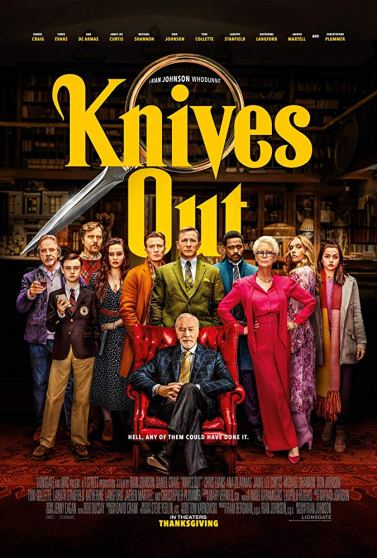
This is likely the best movie I’ve seen this year. A mystery like this is almost perfectly calibrated to for me to like, even if the execution is merely competent. (See 2017’s Murder on the Orient Express.) Luckily, Rian Johnson’s Knives Out is more than just competent: it is outstanding. Knives Out isn’t quite the classic “whodunit,” as the killer is revealed pretty early, but it is a wonderful, twisting mystery that fully satisfies.

Harlan Thrombley, a wealthy mystery novelist, dies after his 85th birthday party. His entire family was there, as was his nurse. The evidence suggests a suicide, but when a pair of cops show up after the funeral to ask a few questions, they have famous private investigator Benoit Blanc with them, and he suspects foul play. Blanc and the officers proceed to question all the family members present.

That family is a classic array of mystery suspects. The first is Jamie Lee Curtis as Harlan’s daughter Linda. She is a proud and haughty real estate mogul, who seems to get along with her dad. Then they question her husband, Richard, played by Don Johnson, who had argued with Harlan before the party. There is Michael Shannon’s Walt Thrombley, Harlan’s youngest son who runs Harlan’s publishing company. He also argued with Harlan that night. There is Joni, played by Toni Collette, the widow of Harlan’s other son who is reliant on Harlan for financial support. Then there is the next generation of Thrombleys, alt-right dweeby teenager Jacob, performatively liberal college student Meg and family black sheep Ransom, played by Chris Evans. Ransom is not present, but the others have bits to contribute to the case. Finally, there is Harlan’s young nurse, Marta, played by Ana de Armas. She was the last person to see Harlan alive, as they played Go in his attic office before leaving for the night. She also has the unfortunate personal tic of vomiting when she lies. Taking everyone’s self-serving testimony, Blanc has to put together what happened that night and find out who is responsible for Harlan’s death.

It is a star studded cast. I haven’t even mentioned that Daniel Craig play Blanc, employing a delightfully overdone southern accent as he drops tortured bits of wisdom. Or Lakeith Stanfield as the lead cop on the case. Ana de Armas is the star of the movie though. She impressed in Blade Runner 2049, but she is even better here. Her Marta is pressed into service as something of a Watson to Blanc’s Sherlock Holmes. Her unavoidable honesty, and the fact that she has nothing to gain by Harlan’s death, makes her the person he can rely on while investigating.

To the shock of nobody, not everything is as it seems. Everybody is hiding something, even Blanc himself. The movie is light on its feet and wonderful to look at. It keeps flipping the viewer’s understanding and expectations. The one thing that is constant is that the Thrombleys are terrible. They are not equally terrible, or terrible in the same way, but they are all terrible. From Joni’s apparently good hearted but still thoughtless – she gets one of the early big laughs by noting that she knows Blanc from reading a tweet about a New Yorker article about him – actions to Richard’s overt, presumptive and unearned sense of superiority they all suck. When Ransom shows up, you really want to believe he is not as bad as you’ve been led to believe. Sure, he’s the black sheep, but the family sucks and Chris Evans is charming. But in the end he is another Thrombley.

The movie is just purely entertaining from start to finish. I loved every second of it. Rian Johnson has quickly become one of my favorite directors. From this to The Brothers Bloom to The Last Jedi, every movie I’ve seen of his has been both thoughtful and entertaining. With him being signed on for a trilogy of Star Wars movies, I hope he has time for diversions like this in the years to come.

*****

21 Bridges Review

I’m of two minds about 21 Bridges. On the one hand, it is a well executed crime thriller; on the other it embodies some downright gross policies. Just as a pure exercise in genre, it is a lot of fun. However, the movie’s take on killer cops is troubling, at best.

Chadwick Boseman plays Andre Davis, whose father was a cop who was killed while working and is now a cop himself. A cop with a reputation for shooting suspects. He claims they were all in self-defense and the movie does nothing to question that. At the start of the movie, two small time crooks attempt to steal a small amount of cocaine they have been told was being held at a restaurant. Once there they find ten times the amount of cocaine they expected. In the midst of the heist, they also find nearly a dozen cops descending on the restaurant. The crooks, Michael (Stephan James) and Ray (Taylor Kitsch) shoot their way out, killing more than a half dozen cops. In the aftermath, Andre is called in. Realizing how close they are on the trail of the crooks, he requests to have all 21 bridges connecting Manhattan to the mainland to be shut down so they can find them before they escape. Andre is joined by narcotics officer Burns (Sienna Miller) as they attempt to track down the unknown killers. Andre is pressured to shoot first and ask questions later, but he seems uncomfortable with that.

The movie is surprisingly sympathetic to the crooks. Maybe it was just me, but I found myself rooting for them as the movie went on. For all they are murders, it paints them fairly sympathetically. They are both ex-soldiers; just poor guys who are putting the skills they have to good use. Ray is more than willing to shoot his way out of any situation, but Michael is more thoughtful. He is the first to twig that something isn’t quite right with what is going on. When he is finally cornered by Andre about halfway through the movie, he tries to convince him something more is going on. Andre is already on the same page at that point, noticing how his fellow officers are shooting first, asking questions never and acting without his approval even though he is supposedly in charge of the investigation.

The movie really works in some tense shoot out scenes. The opening slaughter shows the cold efficiency of Ray, who quickly realizes they will not make it out without shooting. That continues to a shootout in a fortified penthouse, and another in a mostly abandoned butcher shop. There is also a solid on foot chase scene. I feel like I say this a lot, but it’s not John Wick but it is still pretty well done.

My biggest problem with this movie is how it just tacitly accepts that the police need to kill people. It sets up a dichotomy between good killer cops and bad killer cops, with the cops in this movie killing suspects as a matter of course. The movie posits these extra-judicial killings as an unfortunate necessity, even as nearly every cop in the movie is revealed to be at least somewhat dirty. The fact that the circumstances here do not represent anything like real-life are kind of moot. When J.K. Simmons’s Captain McKenna tells Andre to kill the shooters because he doesn’t want to put the families through the “trauma” of a trial, the movie treats this as an at least somewhat reasonable request. It is a disgusting request.

My problems with politics it espouses aside, 21 Bridges is a solid action thriller. If it felt more mindless it would be better, instead it manages to feign thoughtfulness, as though it means what is says, which is pretty gross. Boseman, however, remains an excellent presence to center a movie on.

***

A Beautiful Day in the Neighborhood

A Beautiful Day in the Neighborhood attempts a delicate balancing act and mostly manages to follow through on it. While the trailer focused on Mr. Rogers, this really isn’t a Mr. Rogers movie; it is a movie about a cynical journalist whose interviews with Fred Rogers helps him to reevaluate his life. The movie is about the fictional Lloyd Vogel and his relationships with his father, his wife and his newborn child. Mr. Rogers is the catalyst for his change, but he is not the central character of the movie.

That point is an important one, because the most wholly successful part of the movie is Tom Hank’s portrayal of Fred Rogers. He nails the slow, deliberate cadence of how he talked, his complete empathy. The movie puts him to good use when he is on screen. Vogel is tasked with interviewing Rogers for a magazine feature on heroes. The cynical Vogel goes in trying to find the cracks in the apparently saintly Mr. Rogers. However, Mr. Rogers honest, if not entirely open, replies to his questions cause the reported to stumble. This eventually leads to a Vogel

The central emotional thread is how Vogel, played by Matthew Rhys, relates to his father and how he is going to relate to his newborn son. Vogel’s father, played by Chris Cooper, left the family while his mother was sick with cancer. He shows up to Vogel’s sister’s wedding in an attempt to mend things, but Vogel is not interesting in hearing from his dad. As he meets with Mr. Rogers begins to realize that his anger at his father will continue to affect his life, and his family’s lives, as long as he holds on to it. So with Mr. Rogers as the catalyst, Vogel begins to reconnect with his father.

There is something strange about this movie. The objectively very corny Mr. Rogers stuff worked for me completely. From movie’s framing device as an episode of Mr. Rogers Neighborhood, to spontaneous Mr. Rogers reactions like the crowd on the subway breaking out into his theme song or him asking for a moment of silence during a meal and having the whole restaurant, and the movie, go silent for a minute. That stuff is corny, but it absolutely worked on me. A lot of that has to do with the completely irony free Mr. Rogers, in real life and as portrayed by Hanks. What was more spotty was the somewhat boilerplate familiar reconciliation plotline that takes up most of the movie. It isn’t because Cooper or Rhys aren’t good actors or doing good work; the story is just has so little interesting going on that it never really does anything.

A Beautiful Day in the Neighborhood is well worth watching. It does given a look into what made Mr. Rogers so amazing, so powerful and so unique. But the movie doesn’t really focus on him. If you want a movie about Mr. Rogers, watch last year’s Won’t You Be My Neighbor. This is a middling to solid drama with a strong Tom Hanks performance as Mr. Rogers that makes the whole thing work.

***1/2

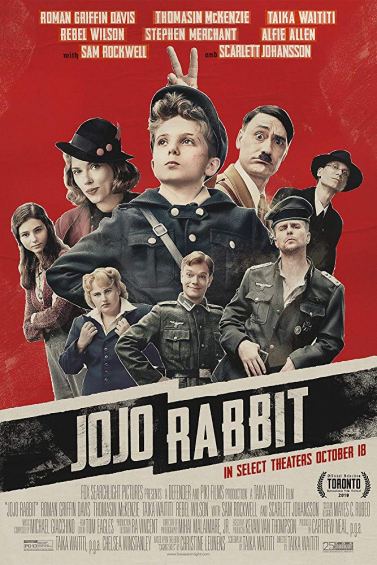
Jojo Rabbit

Taika Waititi’s reputation as a director is already strongly established. He has made one of the absolute best comedies of the last decade in What We Do in the Shadows. He made one of the best MCU movies in Thor: Ragnarok. He also made the underrated, or maybe just underseen, Hunter for the Wilderpeople. His latest movie, Jojo Rabbit, is referred to as an anti-hate satire. It is set in Nazi Germany, with Waititi playing the role of Hitler. Or at least a little boy’s imagined version of Hitler. It is quite a swing, but is any one has earned the right to take a swing, it is Waititi. Luckily, it mostly works out.

Jojo Rabbit star Roman Griffin Davis as Jojo, a ten year old boy living in Nazi Germany. He is an avowed and enthusiastic Nazi. He also doesn’t seem to have too many friends; his best friend is his imaginary friend, Adolf Hitler. At the start of the movie, he attends a Nazi Youth Camp, where he is taunted about his absent, possibly deserter father. In an attempt to prove his courage, Jojo is involved in an accident that leaves him partially crippled. Stuck at home and with doing menial tasks for the local Nazi party, Jojo is lonely.

Soon, he learns that his mother has hidden a young Jewish girl in the walls of their home. This revelation starts Jojo on a path of examining the lies and hatred that he has bought into so thoroughly in an attempt to find a place to belong.

While billed as a satire, Jojo Rabbit is more of a farce. It portrays the Nazis cartoonishly, both in their evil and in their stupidity. There are a lot of strong comic performances portraying these Nazis, from Waititi’s petulant, forgetful, imaginary Hitler, to Rebel Wilson as the comical extreme of “for the fatherland and femininity.” Stephen Merchant shows up as an unctuously smiling SS officer who is both comical and scary. The biggest presence is Sam Rockwell as the one-eye, frustrated and flamboyant officer in charge of town. He looks after Jojo while Jojo’s mother works and seems increasingly disillusioned with the Nazi regime.

Jojo’s interactions with the Nazis is played as humorous, his home life is more of a drama. He lives alone with his mother, played by Scarlet Johansson. She is clearly hurting at her son’s full throated adoption of Nazi thought. Something she doesn’t share, as she hides a young Jewish girl in their house. Still, she tries to gently lead Jojo away from the destructive ideology he has bought into. Jojo soon meets the girl, Elsa, played by Thomasin McKenzie. At first he is indignant, then scared. Soon, he starts to build a relationship with her. As he interrogates her, attempting to get information about Jews for the Nazis, he comes to really care for her. He starts to drift away from the Nazis. Waititi’s Hitler starts to recede from the movie.

Jojo Rabbit attempts a delicate balancing act, dealing with some serious thoughtful issues while also telling jokes. It isn’t the first movie to do that with this same issue, To Be or Not To Be starring Mel Brooks comes to mind. Jojo Rabbit mostly manages successfully. It doesn’t quite pack the dramatic punch it could and depending on how funny you find kids shouting heil Hitler, it doesn’t quite knock the humor out of the park either. Still, it is charming and heartwarming movie that entertains for its entire runtime.

****1/2

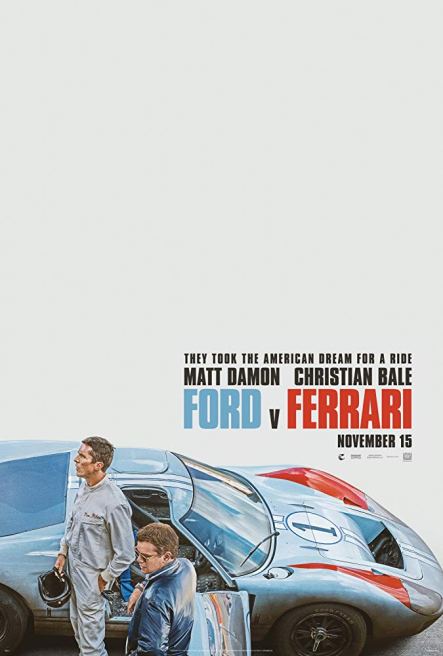
Ford v. Ferrari

For a movie titled Ford v. Ferrari, Ferrari has very little presence in the film. Enzo Ferrari appears, as do some Ferrari racers, but this is a movie about Ford, and a movie about Carroll Shelby and Ken Miles.

Wisely, the movie doesn’t really try to portray Ford as the good guys. Henry Ford II is a blustering blowhard. He wants to be on top of the car game, but doesn’t seem to have any idea how to get there, other than to throw money at everything. At the start of the movie, Ford is in a bad place. Executive Lee Iacocca comes up with a plan to drive interest in the company’s vehicles; buy Ferrari. They make sexy racing cars, with their designs and reputation Ford could get back on top. Unfortunately, their trip to Italy to make their sales pitch ends with Ferrari insulting the Ford Company and Henry Ford II personally. In a fit of pique, Henry Ford II, who was not all in on the Ferrari plan, decides that Ford is going to build a race car to beat Ferrari at the 24 hours of Le Mans. To do so, he hires Carroll Shelby, the only American racer to win the race.

Taking an already existing prototype, Shelby tries to create a race car that can beat Ferrari. To this, he brings on the best driver he knows, Ken Miles. Together, they make the car and try to work the kinks out of it, all while dealing with recalcitrance and pushback from the suits at Ford. Eventually, they get the car to Le Mans, and Miles gets his chance to race.

This is a very meat and potatoes movie. It rests on the sturdy shoulders of Matt Damon and Christian Bale. Bale has the showier role. He is the bigger personality; the one actually behind the wheel of the car. Damon gets to do a lot of yelling at jerks in suits. They are both excellent. The movie is full of moments of just them being great. Whether it is Damon plotting a way to get a douchey executive out of the way so he can talk Ford II into leaving him in charge, or if it Bale and Damon fighting with groceries on the front lawn, or Bale explaining the intricacies of racing to his son, the two of them are excellent. Those two performances are more than enough to carry the movie.

Then there are the racing scenes. Specifically, the climax of the movie at Le Mans. The movie does an excellent job of conveying the speed and danger of driving in one of these races. It does a great job of showing the feel of the race. Le Mans is a grueling endurance test and the movie does a great job of showing just how hard it is to keep going for the whole 24 hours. And in showing how good Shelby and Miles are at racing.

I am not sure what the movie is saying with its primary players. One can look at the process of designing the car as the process of movie making. Shelby, the director, and his team are the ones with the ideas and vision, but Ford, the studio, is the one with the money to make that vision happy. Shelby has to walk a narrow line of achieving his vision while keeping the suits happy. Ferrari has little to do with it. It is impossible to see him as a villain, and the movie doesn’t portray him as such. He is an artisan; his cars are crafted works of art. Other than this race, which Ford won by throwing more money at it, Ferrari and Ford are not really playing the same game. It is a battle of quality and quantity. Still, at the end, it is not Henry Ford II, ostensibly his boss, that Ken Miles looks to after the race; it is Enzo Ferrari.

This is a good movie. Just a solid, entertaining film. That is more than enough.

****

Charlie’s Angels (2019)

This is a delightful spy action movie. It is just a lot of breezy fun to watch.

This Charlie’s Angels sets itself up as a continuation of all of those that have come before it. This is the soft reboot formula that worked so well for the Fast and Furious movies. It doesn’t erase or replace the show or movies, it just builds on them. The Townsend Agency is now international, and Bosley is a rank not a person. Still, all of those that have come before are still a part of the agency’s history. This movie focuses on two agents. Jane, a no nonsense former MI-6 agent and Sabina, a wild card. The movie opens with them taking out a smuggler. The two of them, played by Ella Balinski and Kristen Stewart respectively, don’t exactly get along. A year later, they are working in Europe. The Agency is contacted by Elena, a programmer on an experimental energy device that is potentially dangerous. She wants to turn over evidence that the company, or someone in it, is hiding the danger. They are attacked by an assassin, and the teams Bosley ends up dead. With Elena in tow, the team meets up with a new Bosley, played by Elizabeth Banks, and tries to secure these dangerous prototypes. The whole thing turns into a twisty spy mystery, with echoes of Mission Impossible.

Most of the movie works real well. The characters are better defined than you would expect. There is some specificity to them. The plot is lightweight, but it works. These types of movies tend to get convoluted, but Charlie’s Angels manages some complexity without getting too knotty. It sets up some uncertainty over a traitor in the teams midst, and keeps it just uncertain enough to be enticing. You can guess who is the good guy and who is the bad guy pretty easily, but there is just enough to make you doubt yourself for it to work. The action scenes are well constructed; you can follow the action and the flow of each fight. It maintains a clarity that some more ambitious action movies fail at. They are not that excitingly choreographed, though. The execution feels a little sloppy at times, with tame stunts and oddly framed shots. This movie will never be confused with John Wick.

Kristen Stewart steals this movie. She just takes over every scene she is in. There is something infectiously joyous and fun about her performance. It is not as if she is up against easily overmatched performers. The cast is filled with “that guys”, actors like Djimon Honsou and Nat Faxon. Patrick Stewart plays a Bosley, and is clearly having a great time. Balinski proves herself adept in the actions scenes. Naomi Scott, from Aladdin, plays the client and she is just as watchable her as she was in that early summer hit. Elizabeth Banks, who also wrote, directed and produced this movie, delivers in her role. Still, none of that matters when Kristen Stewart is on the screen. She walks a line of not taking the movie seriously at all, and delivering a perfectly serious performance. She plays the teams wild card, and seems to be treating the whole movie as if she is a wild card. It works; it is magnetic.

This movie seems like it is getting ignored at the box office. That is predictable. It is the kind of movie that I think people will happen upon in a few years. Maybe it will show up on cable, or on a streaming service and people will notice that it is much better than expected. It isn’t a perfect movie, but it is certainly better than it has been received.

***1/2

Parasite Review

Believe the hype, I guess. Bong Joon-Ho’s Parasite is the masterpiece it has been called.

Kim Ki-taek lives with his family, wife Chung-Sook and children Ki-woo and Ki-jung, in a part basement apartment. Largely unemployed, they work part-time folding cardboard boxes for a local pizza restaurant. Thanks to the recommendation of a family friend, Ki-woo gets a job as a tutor for the daughter of a rich family, the Parks. After overhearing the rich mother talking about needing an art teacher for her son, he suggests a friend of his, Jessica. There is no Jessica, instead his sister Ki-jung poses as an art tutor, and art therapist, to get a job with the family. Soon, all four family members are working for the Park family. That is when things really get weird.

Parasite sets up a poor versus rich parable. It puts you on the side of the poor family, as they work whatever menial jobs they can get, as they huddle around their elevated toilet to snag the wifi signal from a nearby cafe, and as they leave their windows open as exterminators spray the streets to get rid of the bugs infesting their hovel. The literally live below ground, in a semi-basement. You see how little they have.

That is contrasted with the Park family, with their elegant, elevated townhouse. That family is so well off that they are essentially inventing problems to solve. While the movie puts the viewer in the corner of the Kims, it does not demonize their victims. The Parks are oblivious and careless, not vicious. The father’s seem to get along when Ki-taek is driving, but at home it is clear that Mr. Park does care at all for his driver. Ki-woo and his pupil Da-hye have a romance, but when the Parks throw a party and he looks out over the rich, well dressed guests and wonders aloud if he fits in, she clearly has never even considered the question. The Parks are not evil, they are simply unable to see outside of their own sphere. They never look below them.

Parasite does an amazing job of juggling tones. In my admittedly limited experience, Korean movies tend to be elastic with tones and it can be disorienting. Bong Joon-Ho’s previous movie, Okja, did this as well. Parasite managed to vary tones while keeping a feeling of consistency. It is often very funny. It is also frequently tragic, or poignant. It is sometimes scary. The movie jumps from one to the other with amazing deftness, flipping from hilarious to sad and back again in a few seconds.

I am trying not to spoil much of what actually happens in the movie, but Parasite is easily one of the best movies of the year. It starts as one thing, a simple sort of heist movie, then morphs into something else about midway and never looks back. It is stunning.

*****

Motherless Brooklyn

There is something delightfully old-fashioned, for good or ill, about Motherless Brooklyn. I know the movie made significant changes from the source material. I am not quite sure about its portrayal of tourette’s syndrome. But I loved that Motherless Brooklyn is just an old-fashioned noir. It isn’t simple or without bigger themes, but it seems more than happy to just execute a solid formula that hasn’t gotten much use lately.

Lionel Essrog is a private detective working for his father figure Frank Minna. When a mysterious job goes south and Minna ends up shot, Lionel takes it upon himself to solve the mystery of why Frank was killed. As these things tend to go, what at first seems like a fairly simple mystery soon spirals into something much, much bigger. Lionel is a skilled detective, smart and observant. He also suffers from tourette’s and possibly some other neurodevelopmental issues. He works with Minna at his combination private investigation and car service, along with a trio of other orphans that Frank took under his wing. At first, they seem just as eager as Lionel to find Frank’s killers, but things get complicated.

The movie just jumps eagerly into noir tropes. After Lionel literally takes Frank’s place, wearing his hat and coat as he starts backtracking through the investigation that led to Frank being shot. He ends up at a jazz club and finds out that Frank was looking into something that leads to city hall. He meets a crazed seeming man at a community event, who gives him some insight on Moses Randolf, the unelected powerful man who secretly runs the city. Eventually, he discovers the secret that Frank had uncovered that he was going to use to blackmail some powerful people.

That is where the other thread of this movie comes in, bringing in the real history of New York’s policy of discrimination under the guise of urban planning. Lionel’s investigation brings him in contact with African American communities that are labeled as slums and cleared more for the profit of Randolf’s cronies than for helping to reform the city.

Motherless Brooklyn isn’t really showing the audience anything that hasn’t been done before. Chinatown comes to mind. It is a noir detective story, eventually the hero finds out that the system is designed more to enable the bad behavior of the people in charge than to rein them in. Still, the movie shines by being well acted and genuinely thrilling. Edward Norton is great as always and the movie is absolutely populated with recognizable faces. Bruce Willis seems more engaged than he has in years for his brief appearance as Minna. Gugu Mbatha-Raw is excellent as a young lawyer fighting against this gentrification who is more entwined in this that it first appears. The performance that will be most polarizing is Alec Baldwin as Moses Randolf. He channels more than a little of SNL impression of loathsome garbage, but it works for a character that is truly gross and somehow untouchable despite everyone seeing how gross he is.

Motherless Brooklyn doesn’t reinvent the wheel. But it doesn’t really need to. Sometimes all that is needed is something well executed. They don’t make movies like Motherless Brooklyn that often anymore, but I am glad this one got through.

****

Harriet Review

I don’t mean this to sound as dismissive as I know it will, but Harriet feels like the movie you would watch in history class when there is a half day or a substitute. It competently goes through the motions of telling the story of Harriet Tubman, with more than a little skill, but somewhat lacking in style.

I can’t really point to any area where Harriet fails. It starts with Tubman, then called Minty Ross, as a slave in Maryland. Her free husband and father contacted a lawyer to straighten out the fact that Minty and her mother were supposed to be freed under the terms of their old owners will, but his son has refused to do that. That appeal goes about as well as you’d expect. After Minty prayers for her master’s death are granted, his son tries to sell her off to repay some debts. Minty has had enough and decides to run away. With some help from the local preacher and a kindly Quaker, Minty escapes over a hundred miles to Philadelphia and takes the name Harriet Tubman.

Harriet does an excellent job both keeping the focus on Harriet and in giving a glimpse into a wide variety of black experiences under slavery. Harriet is one, though a unique one is some ways, still an experience that many shared. She was born into slavery, but escaped to freedom. She knows what it is like to live under that evil, and wants to do everything she can to end it or help others escape. Her husband and father are free men, but live in the slave-owning South and were at one time slaves themselves. They are still subject to Southern Racism, but have a different experience than Harriet and different reactions. There is also Harriet’s sister, who refuses to leave with her. It is easy to look at it as a lack of courage, but the movie shows how the system affects people, how Harriet’s sister fears for her young children, who it would be very hard to take with them and let’s that fear keep her enslaved. In Philadelphia, there are free African Americans who were born in freedom. They recognize the evils of slavery, but only kind of understand its corroding evil. I don’t mean to say they don’t treat it as real, but their reactions are more analytical. The movie gives a peek at all these different experiences, mostly through the lens of how they see Harriet and how Harriet sees them.

The biggest white role in the movie goes to Harriet’s would be owner, Gideon Brodess. The movie never falls into the all too common in Civil War movie trap of letting him, and his fellow slave owners, off the hook for the evil the perpetrate. At first it seems like it might, playing him as slightly sympathetic to Harriet before she runs away, but soon the facade is removed and the movie shows him for what he is. It is a deep ingrained callow selfishness, where he just doesn’t view these people as people. Even near the end, when Brodess does something that could maybe be called good, the movie shows the self interest behind it.

It is somewhat less successful in wrestling with Tubman’s faith. The movie acknowledges it, but doesn’t quite seem to understand it.  Harriet has nothing to say about its protagonists faith.  She may interpret her blackouts as visions from God, and the movie actually gives her visions during her faints, but it just sort of happens without comment,

Harriet is a perfectly fine, by the numbers biopic. But it is telling a story that shockingly, or maybe not that shockingly considering who the main character is and Hollywood’s determination to filter every story through a white lens, has not previously been put to film. It is well done and gives a glimpse into the life of a national hero. It does not, in any way reinvent the wheel, but sometimes all you need is a well-made wheel.

***1/2