2nd Quest: Majora’s Mask

The Legend of Zelda: Majora’s Mask was easily the most difficult game in the series to play so far. Not that it is a hard game, in fact most of it is quite easy. Rather than the moment to moment being hard, the difficulty is found in the overarching meta-game. In many ways, Majora’s Mask is a fascinating and unique game. Its Groundhog’s Day-esque 3 day cycle and darkly bleak tone is unlike anything else in the series, if not video games in general. Unfortunately, while those things make the game unforgettable and one of a kind, it also sometimes makes it no damn fun to play. Majora’s Mask is an excellent game, maybe the best in the series, but I’m not sure I’d ever want to play it again.

from vgmuseum

from vgmuseum

It is strange that unique is one of the first words that come to mind when thinking about Majora’s Mask, considering that the bulk of the assets used to create the game are recycled from Ocarina of Time. Characters, weapons and enemies are just lifted from that previous game and repurposed in this one. There are some new things, but for the most part it is made out of Ocarina’s leftovers. This isn’t a complaint; it is no different from the similarities among the Gameboy games or the two DS games. It does, however, add to the weird, dark tone of the game. Everything is familiar, yet slightly different. It is unsettling, disturbing even. Far from being a problem, the recycled content just adds the nightmare feeling the game has going on.

Depending on how you count it, Majora’s Mask either has the smallest set of items or the biggest. Link doesn’t get all that much to work with in this game, outside of series mainstays like the bow, bombs and hookshot. It is simple, vanilla. But the game also has the masks. There was a mask or two in Ocarina of time, mostly as window dressing for a sidequest. As the title would suggest, the Masks are a bigger deal in Majora’s Mask. Most are again sidequest material. They grant small powers or abilities and have only a few uses over the course of the game. Then there are the transforming masks. There few masks let Link change from into one of the other races that populate Hyrule. (I know this game isn’t technically in Hyrule, but the point is the same) Being a Deku Scrub or Zora significantly changes everything about how Link moves and fights and just how the game plays. The only thing close to in the rest of the series is the Wolf form in Twilight Princess. The masks have to be included when thinking about the game’s layout of tools. And despite only having a handful of dungeons, it makes good use of the limited toolset. The dungeons, though, are almost an afterthought in Majora’s Mask. They all really well designed, but the player spends such a small amount of time in them that they are probably the least memorable part of the game.
zeldamm04

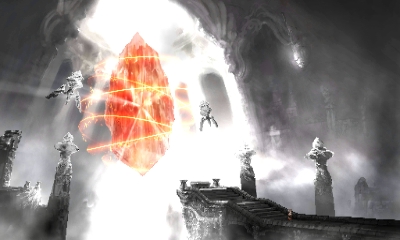
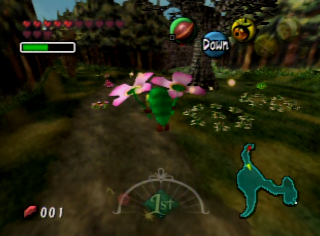
I guess that brings me to the game’s most prominent feature, the three day cycle. In Majora’s Mask, the Mask-addled Skull Kid is crashing the moon into the city of Termina in three days. Once you get to the end of the three days, or anytime you feel like it, you have to play the Song of Time to rewind things back to the start. Unfortunately, all the characters reset to where they were at the start. Link loses all ammo and rupees, though he keeps key items like weapons and masks. This is the aspect of the game that is most often singled out for praise, and it is pretty great. It really makes the game stand out and play different than any other Zelda. It really let Nintendo make a living world for this game. In other games, NPCs wait around for the player to activate them. Sure, modern games may give them a routine to go through, but Majora’s Mask gives them three days’ worth of life. They have goals and stories. They’re stories even change, usually slightly, based on what the player does even if it doesn’t directly affect them. The three day cycle gives the world life. Clock Town, even though it is getting ready for a big celebration, slowly empties as that grimacing moon bears down on the town. There is a palpable feeling of desperation and terror as the days go by.

zeldamm06

The tone of the game is unlike anything else. I’ve already mentioned that several times, but it is so very true. There is a darkness to Majora’s Mask. You don’t just get a mask that lets you turn into a Zora, you watch a Zora die in your arms on the beach having failed in his attempt to save his people’s eggs. You don’t just help them out, you take his face, become him, and try to right things. Even if you are successful, he’s still dead. If you don’t make it to the Ranch by the end of the first night, then all of its inhabitants are so traumatized by its … ghost attack that they are unable to speak or interact. Everywhere you look there is a dark and tragic story happening that unless the player intervenes to stop it. This where the extra level of darkness comes in, because every time you reset the clock, all the work you did is undone. Like Sisyphus, everything repeats, but there is not enough time to save everybody. When you save one person or group of people, you condemn another to some hellish tragedy. There is no winning, there is no real progress. You mist simply use the people you need to use to achieve your goals, which incidentally end up saving everybody.

While the repetitive nature of the game set up works for world building and story and tone, I find it intensely annoying to actually play. Sure, a player that truly knows the game can beat it with only the smallest amount of redoing things, but a player less familiar might have to do some things over and over again. Like beating the boss of a temple. Once a temple is beaten, the area of the map where it’s located is changed dramatically. The swamp is freed from its poison; spring finally comes to the mountain, etc. There are treasures that can only be found or sidequests that can only be done once the boss is beaten. Which means that unless you clear the area completely after beating it, you’ll have to beat the boss again to right things, then go looking. It cries out for the use of a guide. That is how I find a lot of Majora’s Mask; great from a conceptually stance but somewhat tedious to actually play.
zeldamm09

I can say that The Legend of Zelda: Majora’s Mask is an unreservedly a great game. Everyone should play it at least once. But now having beaten it for the second time, I would be fine with never playing it again. There is a barrier between the player and enjoying Majora’s Mask, a barrier of effort. It is a game that takes real effort to make any progress in, not really a game made for relaxing play. It is definitely not my favorite Zelda, but it is so unique and creative that it is impossible to dismiss the people who call it theirs.

I’m Quitting Video Games. Kinda

I’ve had some experiences with video games over the last week or so that have got me thinking.  The first was while typing up my Shin Megami Tensei post from the other day.  (Update to that post: I forgot that I never beat The Answer from Persona 3 and I bought Persona 1 off of PSN the other day, so it is now 10.5 unbeaten SMT games) While writing that, I realized that I have spent a lot of money on games I’ve never played.  I’m not talking about my stack of bargain bin PS2 games.  Sure, I might have fifty bucks invested in twenty or so games, but that is not a big deal.  If there is a time to take a flier on some unheralded game it is when they are deeply discounted because stores are trying to clear shelf space for new things.  No, it is that like the stack of unplayed SMT games from yesterday, I have at least twice as many more that aren’t from any specific series.  And that is not including my brother’s collection of PS3 games that I am trying to work through.  Now just because I spent money on something doesn’t mean I should feel compelled to play it, especially if I am not enjoying it.  That is not the case with these games. I bought them all with a reasonable expectation of enjoying them and simply haven’t had the time to try them out. These mountains of unplayed games got me thinking about why I feel the need to constantly add to that stack.

The other experience is that I finally played Monster World IV.  Monster World IV is a Sega Genesis game, a part of the oft overlooked Wonder Boy series, that never came to America in the 16-bit era.  I picked it up on PSN a few months ago, but never had the time to play it.  But a couple of days ago I turned on my PS3 to play Batman Arkham Asylum, but saw Monster World IV on my system and started that up instead.  I instantly fell in love with it.  It’s a rather simple to play 2D action game with an enjoyable mix of combat, puzzles, and platforming.  The lovingly animated sprites are just a joy to watch in motion.  Really, it is a perfect example of all the things I loved about that generation of games.  In the hour and a half I played that game, clearing the first of its four elemental dungeons, I had more fun than I’ve had with all the eight or ten hours I’ve played Batman.  And I like the Batman games.  They are about as good of games as this generation has produced.  It got my wondering just how many more gems like this I’ve yet to play.

Those two things led me to this realization: I have no interest in the next generation of video games.  None whatsoever.  This isn’t just my usual avoidance of launch consoles (with the exception of the WiiU I’ve never bought a console without a year or two’s worth of games and a price drop) but a complete lack of interest in modern gaming.  I look at the upcoming games and realize that outside of a swiftly expanding indie game scene and some of Nintendo’s offerings, I have no interest in anything new.  Less than no interest.  If someone tried to give me $400 to buy a PS4 or XBONE, I’m not sure I would take them up on the offer.  And not just because I’d have to pay taxes and $100 more for the XBONE.  I just don’t know what I would do with the machine.  What is different about this generation is that I don’t see a day when there are enough games on one of these systems to warrant a purchase.  There aren’t any games that I am interested in.  I guess that is not strictly true, I do want to play Final Fantasy XV.  It is no burning need, especially since that game has no release date.  Not enough to sway me into actually wanting the console.

If I am being honest with myself, this isn’t really a change with this generation of games.  I have been drifting out of the mainstream since at least the PS2 era.  I can remember being flummoxed by my friends’ love of Halo.  I would join them for multiplayer games, and with Halo 2 eventually became a competent player, but outside of the multiplayer setting I had little interest the series or first-person shooters in general.  Shooters, both first and third person, have increasingly come to dominate the market.  For most of this last generation, I’ve played Wii and DS and ignored the supposed big consoles.  That, however, was not due primarily to a lack of interest.  I didn’t buy a PS3 or 360 because I couldn’t afford one.  Why doesn’t Nintendo suffer from my disinterest?  For the same reason that many people complain about them.  They are, by and large, putting out the same kind of games they always have.  They are bigger and prettier and arguably better, but at their core they are the same games.  I like those games; that is the kind of game I want.  It is the same for indie games.  They mostly take their cues from 8 and 16-bit games.  I want more of that.

I don’t mean to say there aren’t good games being made, there are.  They just aren’t games for me.  Occasionally Sony or Capcom drops me a bone, but mostly they make games for that shooter/Assassin’s Creed audience.  I don’t blame them; they are just following the money.  But I am going to bow out now.  I’ve looked around and I can see this just isn’t for me anymore.  Fortunately, there are enough good old games around that I don’t need new consoles.

A Strange Journey

I had what I thought was a great idea to play through Persona 3 or 4 over the course of a year, beginning on the date when the game begins and playing a week at a time.  I was going to have a weekly update on the blog here of what I accomplished that week and my general impressions of the game.  Not the most original idea, I know, but I thought it sounded like a fun way to replay one of favorite PS2 games.

That plan fell through.  One reason why was because I didn’t get started in time; I missed the date that either game starts on.  That was not an insurmountable problem; I still could have played a couple of weeks to get caught up and went on from there.  But I also couldn’t decide which of the two games to replay.  I like Persona 4 more, but I’d kind of like a second go at Persona 3 now that I am more familiar with how the Shin Megami Tensei series works.  Again, a problem I could have easily solved.  Another reason I held off was that I wanted to have a way to get some screencaps of the game while I played.  I wasn’t planning to do a full on let’s play or anything, but a couple of shots a week to demonstrate things would have been nice.  I do want to get some kind of capture device on the near future, but I have no definite plans.  Or money for that matter.  That was the big one.  If I am going to devote a year to a project like that, I’d like to do it well.

There is another reason that greatly trumps those three reason for me giving up, or at least delaying, this Persona project.  That reason can be summed up with one picture:

That is my pile of unbeaten Shin Megami Tensei games; there are 9 of them if you add in my PSN copy of Persona 2 Eternal Punishment.  Some of them I’ve not played, like Digital Devil Saga 2 and Soul Hackers.  Others I’ve played quite a bit but haven’t quite beaten, Persona 4 Arena and Devil Survivor 2.  Going off of Howlongtobeat.com, I’ve got about 300 hours of video games in that stack.  I find it hard to justify playing through either of the Persona games again when I haven’t yet played Nocturne.

So now my plan is to try to beat all of those games over the next year, in time to start a Persona replay at the correct date.  I’ve made plans to beat a series of games over the course of a year before (see my still ongoing replay of the Zelda series), but this time it is less of a concrete project and more just making these games a priority.  I’ve enjoyed every SMT game I’ve played so far, but they take so long that I kind of have to set aside time to play them.  First up, I am going to finish the single player of P4A.  I’ve already cleared it as several characters, but I want to try to do with all of them.  It shouldn’t take all that long, but it isn’t exactly fast.  Also, I am going to put a little more time into Devil Survivor 2.  I’ve been playing it some recently, but not putting any serious effort into it.  And these games generally require some effort.  That is part of what makes them great.

While I’ve become a big fan of this series, and all its various sub-series, I haven’t been aware of it for all that long.  The first Shin Megami Tensei game I played was Persona 3.  I bought the FES re-release after hearing the internet gush about the game forever.  I loved it, despite some niggling complaints, mostly about having to rely on AI party members for healing.  There was a notable flaw in the AI that if you were poisoned, they wouldn’t heal it unless you were at full HP.  So every turn they heal your HP, but leave you poisoned so they would have to do the same thing in the next round.  Still, once you learned the idiosyncrasies of the system it was particularly fulfilling.  Persona 3 was not exactly punishingly difficult, but it did keep players on their toes.  The player had to be wary or it would be game over.  After years of Square’s fun but generally toothless RPGS, Persona 3 was a big change and a refreshing one.  I was hooked.

So I looked into the series and tracked down a couple of other SMT games, Digital Devil Saga and Devil Summoner for the PS2, figuring they would keep me busy while I waited for Persona 4.  Neither of them really grabbed me like Persona.  I loved their settings, especially Devil Summoner, but they each had their faults.  I wasn’t a big fan of DDS’s character building system or how it really felt like only half of a game.  It was half of a game that took me fifty hours, but it definitely feels incomplete.  Still, the battle system, which was largely similar to Persona 3’s, with an emphasis on hitting enemy weaknesses for more turns, was largely great.  Devil Summoner’s battle system, though, was limited.  It was an action RPG, but none of the fights were significantly different than any other.  It was all dodge and slash and having the right element.  Fun initially, but repetitive.  Despite not really loving either of those games, I was hooked on the series at this point.

From Persona 4 on a new SMT game was something I greatly looked forward to.  Which is strange, since I’ve only finished two games in the series since then.  I’ve pre-ordered most of them, aside from the PSP games since I didn’t have the system until recently, and spent a lot of time tracking down Nocturne and Digital Devil Saga 2.  But I’ve only managed to finish the first Devil Survivor and Shin Megami Tensei 4.  Though I enjoyed it, Devil Survivor frequently paralyzed me by giving me many choices and no clear idea of their consequences.  It also ended up taking me a long time to beat, which meant that I didn’t end up getting to Strange Journey or even Devil Survivor 2 when they came out.  I have played those two games, getting probably halfway through each of them. SMT 4 was one of my favorite and most anticipated games of last year.  I wasn’t letting anything put me off of playing it.

Shin Megami Tensei games are a constant struggle; that is part of their charm.  They are generally fair in their challenge, but also unrelenting.  Much like Etrian Odyssey, they require players to learn their systems and to exploit those systems.  The enemies will do the same. You have to learn and take advantage of enemies’ weaknesses while covering your own.  The general idea of hitting a weak point for a turn advantage is carried across the series.

The other big draw is how the series makes use of a wide variety of myths and legends to fill out its roster of enemies and allies. They are called Demons general, but they run the gamut from Japanese demons to Celtic heroes to Christian Angels.  But it also uses them as characters in the stories. They aren’t embarrassingly re-imagined like Final Fantasy’s summons (I’m looking at you Shiva) but they are sometimes re-contextualized in a modern setting.  Still, having knowledge of the myth that each creature springs from helps to understand where characters are coming from.  In Persona, a characters persona tells you about their character.  For instance, Persona 3’s protagonist starts with the persona Orpheus, who in the myth went to Hades to save his dead lover, and eventually becomes Thanatos, who is death incarnate.  The game doesn’t just assume you know this stuff, though it doesn’t go out of to inform you either.  Most games have a compendium, a list of all the demons you’ve encountered, that will give you information about them.  That will tell you most of what you need to know.  Having a basis in real myth gives the stories of these games another level that most RPGs lack.  Sure, many of them end up being little more than the typical anime nonsense, but at least there is something going on rather than just blindly hitting all the otaku pleasing tropes.

So I am going to try to get back to Persona 4 Arena soon.  I’m not doing much else with my PS3 right now, though I don’t get a lot of time for games on the TV.  I am also going to try to power through the rest of Devil Survivor 2 soon as well.  That would be a good start, but I doubt I’ll ever be actually caught up on this series.  I expect to see Persona Q here a few months after its Japanese release in June, and Persona 5 is looking to be the big send off for the PS3 some time next year.  Staying on top of this series is a never ending battle, but a worthy one.

Kirby Triple Deluxe

Kirby games tend to come in two flavors: weird experimental things like Mass Attack or Epic Yarn and rock solid platformers like Super Star or Return to Dreamland.  Both are indispensable to the pink puff ball.  I love the Kirby series because it has games like Kirby’s Adventure as well as games like Kirby’s Canvas Curse.  Triple Deluxe definitely falls into the regular platformer category.  In fact, it stands as one of the most impressive outings for the “normal” Kirby, with both outstanding level design and a deep roster of power-ups.

kd3

Let’s get one thing out of the way up front, Kirby Triple Deluxe is easy.  It is a Kirby game, they are all easy.  I wouldn’t want a Kirby game that wasn’t easy.  Outside of setting limitations on yourself, like playing without power-ups, this game is not going to challenge any sort of experienced player.  If you are coming into this game looking for challenge, I recommend you both look elsewhere and reevaluate the life decisions that led you to this moment.

On to more important topics, Triple Deluxe has some excellent level design.  A lot of the game, making some of the best use of the 3Ds’s 3D capabilities in along time, takes place on two planes.  There is the foreground, generally where Kirby starts, with the usual linear 2D action.  Then there is anther background plane.  By using special stars Kirby can jump back and forth.  Enemies can do the same.  Cannons shoot from the back screen to the front.  Most of the puzzles are about how to get a certain power from the front to the back or vise versa.  There are also a handful of levels that cover much of the path and force the player to use a mirror in the background to navigate.

kd1

It is never hard to reach the end of a level, but it can be take some careful examination of your surroundings to get each of the three or four sun stones hidden in each stage.  This is where the game can get truly devious.  You’ll need to find hidden keys and manage to transport them to locks, as well as various destructive items that you’ll need to clear the way.  I especially like the laser bar, that Kirby holds on one plane that stretched to the other.  He must avoid obstacles on his side while using the laser to clear the way on the other.  It is the kind of inventiveness one would expect from a Mario game, though it never gets to the point where it truly requires mastery.

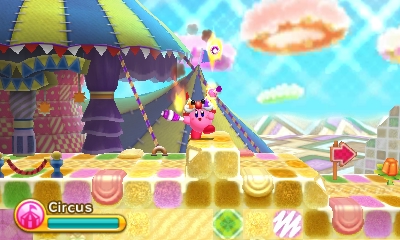
The second thing that makes this game, and this series, so great are the power ups.  Triple Deluxe uses the same, mostly, set of powers as Return to Dreamland.  That means each power-up has multiple uses and skills, making each one a varied tool that does require some mastery to use effectively.  Old favorites like Fighter, Beam and Wing are present, each with a handful of uses.  There are also some new ones, most of which are good enough that I hope they stick around.  Circus is cute, but I found it to be largely useless.  However, Bell is both adorable and useful.  Beetle and Arrow verge on being overpowered, though no more so than Hammer.  Since each power has so many moves an uses, it is largely up to the player which one to use.

kd2

The last new power is Hypernova, which gives Kirby the power to suck up anything. While this is technically a power-up, it has more to do with the level design than with the other powers.  It is required for the levels it appears in, and when its present the game becomes about using Kirby’s sucking power to solve all of his problems.  It is less a powerful tool and more a necessity.  That doesn’t make it not fun.  The Hypernova levels are some of the best in the game.

This is all wrapped in a cuddly package with some of the best graphics on the 3DS.  It is just a short, delightful game.  It oozes charm and personality, and backs that up with some truly excellent gameplay.  There are modes I’ve barely touched, from the 2 Dedede centric modes to the multiplayer arena battle mode.  Like its predecessors Super Star and Return to Dreamland, Kirby Triple Deluxe does so much right that it is hard to hold any of its little faults, length and lack of Hammer power-ups, against it.

An Untold Story of the Labyrinth

I’m an old hand at the Etrian Odyssey series, having been on board since the first entry. So the purist in me rebelled at the idea of Etrian Odyssey Untold: The Millennium Girl, with it’s preset party and a more detailed story. A large part of my enjoyment of the series came from choosing my own party and building their skills. It was the same kind of enjoyment that people get out of games like Diablo, but with a party of five instead of just one character. It is easy to build one powerful character, it takes a more measured approach to build an effective party. Despite these misgivings, and the confirmation of Classic mode, I was on board for the game. Unfortunately, I had just finished EOIV when Untold came out, so I let it sit on my shelf for a few months while I wound down from the previous game.

eou2

The set party was a new challenge for the series. I didn’t like it. There is no flexibility to the party. While you can only take out five in a group, I usually fill my guild with more like eight. Some are there strictly for gathering. The rest are there to give my team some adaptability. If the enemies are weak to elemental attacks, then I can be sure to include an Alchemist. If they are not, his back row spot can go to a Survivalist. I normally favor an offensive set up, with three fast but lightly armored attackers in the front row. The Story team does not give the player that option. You have a Protector and a Medic, there are no options about this. Instead of being able to adjust your team to fit the challenges, in Story Mode you must figure out how to use your team to surpass them. It can be frustrating, but it is not a bad challenge. It is just different from how I usually approach the series.

eou3

They do have a system for adjusting your team set up, Grimoire stones. They give the character who equips them a few points in skills that their class normally couldn’t learn or even enemy skills. It replaces the sublclassing system, where each character could pick a secondary class and gain access to several of another class’s skills. In theory, the Grimoires are fine, but the system just doesn’t work. Gaining the stones is random. Fusing them is confusing and even when understood not that useful. You combine three stones, transferring skills from the second one on to the first, while gaining the weapon proficiency of the third. While I am sure with enough time and effort a player could craft some ridiculously good stones, the process is tedious. Plus, since gaining the stones is random, there is not guarantee that you’ll actually get any worth fusing.

FOE! FOE! FOE!

FOE! FOE! FOE!

As for the story, I liked it. It does spoil the big reveal in the first few minutes, but once you accept that it is not going to be a big reveal in this game it is okay. While they don’t quite escape the generic quality that often hampers JRPGs, that feeling that they are less characters than conglomerations of traits, they never cross that line into annoying. I don’t get the decision to make the Highlander a silent protagonist, but Frederica is good character. Her earnestness is appealing, as is her struggle with adapting to a world 1000 years different from the one she knew. The big winners are the townsfolk, who instead of just faces to provide services get characters of their own. Having a party around to react to events in the game and the like really helps to flesh out the world. Honestly, what is here is not much further along than the story stuff that was already present in EOIV. The strengthened central narrative does break the no nonsense mode that the original game had, but never egregiously. Plus, there is still classic mode, which plays just like the rest of the series. It is there for players, like me, who prefer that experience.

eou4

This game almost feels like a dry run for the upcoming Persona Q: Shadows of the Labyrinth. If that game is anything like Persona 3 or 4, then the story will be significant. Here is a test game with a greater focus on story than the previous games in this series. I have come around from my initial misgivings, though. While I wasn’t a huge fan of some the system changes or the set party, I did end up enjoying the story. As long as it is merely an option alongside a Classic Mode, I don’t mind if this mode is included in a possible Etrian Odyssey V or even an Etrian Odyssey 2 Untold.

Now Playing in April 2014

I’ve really been knocking it out with the handheld games recently. Mostly that is because my new job has me sitting in a room all by myself for hours on end with little to do. No one cares if I bring in my 3DS and play games. This has also freed me up to play more console games, since playing my 3DS at work makes me less eager to do so at home.

Beaten

Batman Arkham City: I got this for cheap for the WiiU, having only barely played the first game in the series. I really only had one problem with this game: the look. Not the graphics, which are largely excellent, but the design. This is possibly the ugliest take on the Batman characters I’ve ever seen. They range from grotesque to simply off putting. Otherwise, the game is aces. I’m not generally a big fan of open world games, they tend to turn fun things into chores, but Arkham City largely bypasses this. Mostly because it is just so much fun to be Batman. I am a big fan of skipping side stuff. I barely touched it when I played Bully or GTA, but here I loved it. This game might even be better if you removed the storyline and just let the player run around as Batman rounding up villains. Even crappy characters like Zsasz are made somewhat interesting here. Tracking him down, using bullet trajectories to track down Deadshot, solving Riddler’s riddles and teaming up with Bane are all fun Batman things to do. More fun, actually, than fighting tons and tons of Joker’s thugs. I guess I’m being a little too hard on the story. It is still a fun Batman tale, forcing Brue to push himself mentally and physically to combat a horde of villains. It did hit one of my griping points about Batman, bewar spoilers for the ending coming. The fact that Batman doesn’t kill is great, it is an essential part of his character just like it is part of Superman’s. But that does not mean he should be going out of his way to make sure the Joker lives. Making a personal choice to not end someone else’s life is one thing, making a concerted effort to save the life of a mass murdered is another. It comes up in the comics sometimes and it is just as stupid as it is here. That doesn’t detract from how enjoyable this game is though.

There is one thing odd about the WiiU version, though I don’t know that it is exclusive to this version. There is slowdown. Not during gameplay, which one would expect, but during the cutscenes. It is baffling. Why is there cutscene slowdown?

Bravely Default: wrote about it here.

SteamWorld Dig: What a delightful little game. It is a kind of free roaming metroidvania that is all about digging deeper. There is no set path or road, just a tunnel going down and other little caves shooting off of it. It can be a little tedious, especially if your digging outpaces the strength of your tools, but it is mostly just fun. A few years ago I would have been disappointed with a game that only lasts about three hours, as SteamWorld Dig does, but now I am glad for it. I’d rather a game only last a few hours rather than only have a few hours’ worth of ideas stretched across ten. While I would download a sequel in a heartbeat, this charming game pushed the limits of its simple mechanics about as far as it could.

Legend of Zelda: Oracle of Seasons: wrote about it here.

Layton Brothers Mystery Room: This game has only the most tenuous connection to Professor Layton and as far as I can tell features no brothers, but it is still an intriguing little title. It actually plays more like the Ace Attorney series than the Layton series. The two detectives are presented with a murder and must look over the crime scene and notes to solve the case. It isn’t perfect, with some of the clues being too obtuse and the rundown at the end of each case always seeming to drag on, but it is still a nice addition for people who like things like Ace Attorney. I just wish they had given the characters more to do. Still, it is well worth trying, both the first few free case and dropping the $5 for the whole shebang.

Ongoing

Denpa Men They Came by Wave: I picked this up a long time ago, but I could find very few little dudes around my place and it seemed really grindy, so I shelved it. I tried it out again recently. I have managed to find more Denpa Men, which eases things considerably. As the title suggests, you find these Denpa Men by finding different radio waves in your real life surroundings and capturing the little weirdos that live in them. It is an interesting concept, hampered my by living in the back end of nowhere. The game is also quite simple, like only a few steps up from Dragon Quest 1. It is actually quite like Pokemon, but grindier and weird instead of cute. I actually do enjoy it, but with all the other games on my plate at the moment, it will likely be some time before I make much more progress on this.

Legend of Zelda Majora’s Mask: Yes, this game is great. No, I didn’t manage to finish it in April. Yes, I guarantee I will have it done by the end of May. I will say that while the time limit is not at all onerous, it makes the game a more stressful experience than it needs to be. Also, there are some downright freak people in this game.

NES Remix 2: Just like the first one, this is a handful of classic NES games broken up into bite-sized challenges, with a helping of romhack combinations to make everything feel new. It is a fun mix. This time the component games are of a significantly higher quality. Sure there is the baffling Wario Woods, but the rest is Mario 2 & 3 and Kirby. Much deeper, more polished games than the first one had. This is also part of the problem, because they don’t break down into tiny challenges as easily. While I haven’t yet really touched the actualy Remixes, concentrating first on the individual game challenges, it is still well worth the price of admission. Bring on SNES Remix or Gameboy Remix.

Inazuma Eleven: I don’t get this game. I like it, I love reimaging the JRPG as a sports movie. That part works perfectly. It’s just the finer points of the battles, the soccer matches themselves, elude me. It feels as though I am not really affecting the game in any meaningful way, except when I choose to use supermoves. Maybe if I keep playing it will eventually click, maybe the game is just sloppy and awkward. At least the storyline is the kind of goofiness that I can get behind. So this has been enjoyable, but flawed.

Etrian Odyssey Untold: I am an old hand at this series. I picked the first game up based on nothing but the Atlus logo in the corner, played it for a few hours, sold in a cash crunch and then bought it back a few months later. I have been hammering my way through the series ever since. So when I got about halfway through the story mode, the big innovation of this entry which gives players a set party and characters, I was baffled. The game was stonewalling me, requiring copious grinding and plenty of good, old fashioned luck. Partly I was chafing against the restrictive party, with no chances for alternate builds or dedicated harvesting teams, party the game was just meaner than anything else in the series. I finally was willing to admit defeat and switch the difficulty down, only to discover that I had been playing on Hard the whole time. Once I switched it back to normal, the game was smooth sailing, maybe even too easy. I’m just about done now and will have a full blog post soon.

Upcoming

Kirby Triple Deluxe: I was really on the fence with Kirby 3D, despite my great love of the series. But early reviews and Nintendo Direct videos eventually won me over. Knowing the series, I should have this beaten by next week. It looks like excellent Kirby instead of mediocre Kirby, which is good to see.

Mario Golf Toadstool Tour: I like me some Mario Golf. While I don’t know how much I will play this right away, this is the kind of game I will pop in for a few play sessions now and then for years.

Zero Escape: Virtue’s Last Reward: At the rate I am burning through 3DS games, this one is coming up sooner rather than later. It sits behind me finishing Etrian Odyssey and Kirby, waiting to compete for playing time against Mario Golf until something new comes along. Since there is little new on the immediate horizon (Theatrhythm 2 sometime?), I should be working through this before long.

Child of Light: Downloaded it and tried it out. As soon as I’ve had my fill of Majora’s Mask and NES Remix, this is what I’m going to put my time into. The first hour was damn excellent.

Pikmin 3: I’m trying, I really am.

2nd Quest: Oracle of Seasons

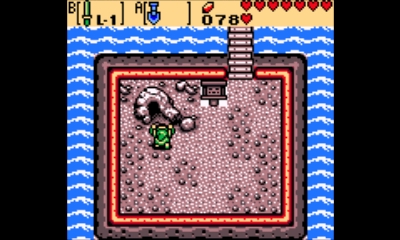
I know I said I was going to play Majora’s Mask, and I am currently doing so, but after finishing up Bravely Default I needed something to play on my 3DS. So I picked up my game of Oracle of Seasons game that I gave up when I got A Link Between Worlds for Christmas. I am glad I finally got the chance to finish it up. I wasn’t much a fan of the other Oracle game. It was good, but Oracle of Ages has way too much tedious chatting and fetch questing in between the parts where the player actually gets to play. Oracle of Seasons doesn’t have much of that nonsense, and it’s all the better for it. While not as quite as good as Link’s Awakening, Oracle of Seasons is an excellent game. It is, however, maybe the most difficult Zelda game that is not on the NES.

oos4

The internet tells me that Oracle of Seasons started as remake of the original Legend of Zelda. I believe it. The two games are quite alike. The first three or four dungeons of Seasons are much like the early dungeons of LoZ. Later the season changing mechanics become more involved, which obscures the similatiries, but there are still some. Many of the bosses are straight out of the first game. It is also, at times, brutally difficult. I don’t think I would have beaten it if I hadn’t been playing a linked game and therefore able to get the Master Sword. Oracle of Ages is a test of the player’s mind, Oracle of Seasons is a test of the player’s skill. There are some tricky puzzles, but there are more hazards and enemies. Like the LoZ’s rooms full of Darknuts and Wizrobes, OoS is all about the mastery of Zelda’s stiff combat. The individual rooms in the dungeons aren’t as difficult as the originals, the later dungeons are more of a prolonged nightmare. Normally, once you clear a room it is cleared until you leave the dungeon or die. However, in Oracle of Seasons, when you go into one of the side scrolling underground areas all the enemies respawn. Which means that as the player moves through the dungeon, there are no cleared rooms. They are always full of enemies.

oos3

Also, the game doesn’t have the same potion as the original. In that game there were blue and red potions, good for one or two uses depending on which color. In Oracle of Seasons, there is a potion, which you have to do most of the trading sequence to unlock, which is one use and is automatically used when you run out of hearts. So if you wanted to save it for the boss but you fell to a half dozen wizrobes just before, you’d have to leave the dungeon and run all the way across the map to get a new one. It is a frustrating decision. All together it means that that while the individual challenges are never as hard as Legend of Zelda’s, there is a constant source of tension and challenge in that there are always more enemies.

The first half of this game is just perfectly smooth. Compared to the other handheld Zelda’s, this game is really straightforward. There is none of the nonsense between the player and the dungeons, that player must only find them. It is refreshing. I love the Zelda series, but sometimes the games bog down forcing the player to do things that simply aren’t that fun. Seasons, the first half in particular, is remarkably short on that kind of stuff. The game is Zelda on the simplest terms in a lot of ways. Where it deviates from that is with the Rod of Seasons. It adds some puzzle solving to the overworld. Fun puzzles solving, not the nonsense from Ages. Each season changes the layout of the map a little, with different map features. Winter has snow drifts for the player to walk on, Spring had flowers that shoot the player up, etc. These are cued in by persistent map features. If there is a spring flower, it will still be there in the summer and fall, merely a withered husk of its springy healthy self. While it does require some thought, environmental never gets too difficult. There is only one spot where it gets truly complex, the Lost Woods, but it gives the player just enough to think about.

oos1

There are some downsides. Some of the later dungeons get downright brutal. Not necessarily a bad thing, but it can be frustrating. Much like the previous two Gameboy Zeldas, the thing still feels limited. I know that is absolutely an unfair complaint to lodge against the games; I don’t care. Their system of origin really keep me from liking them as much as I do nearly any other Zelda game. A lot of it has to do with the item switching. I think I complained about that in both my Link’s Awakening article and my Oracle of Ages one; the complaint still stands. Have to go to the menu over and over to change weapons and tools to solve puzzles is not fun. It is annoying. Still, Oracle of Seasons is a fun game. It doesn’t reach the heights of console games, but it was a fun experience. It was definitely better than Oracle of Ages, but not quite as good as Link’s Awakening.

oos2

One last thing, I guess I need to mention the linked parts of the two Oracle games. If you input a code from one of the beaten games, it opens up some changed cutscenes and puzzles in the new game. There are also a lot of extra rings and items to acquire. Mostly this is done by getting a code from a character in one game and then giving to a character in the other. It is tedious and not very fun, but it does provide some neat linked activity for the two games. Most importantly, it also unlocks the true ending of this little subseries. In the second game, the witches Twinrova start to complete their dastardly plot of sacrificing Zelda to resurrect Ganon. It adds an extra dungeon and a couple of boss battles for Link to thwart them. It is a pretty neat addition.

Defaulting Bravely

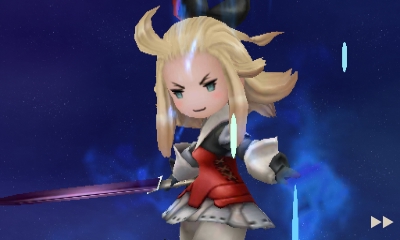
Bravely Default has been widely praised. You can check reviews everywhere. People love this game, with good reason. It combines some old school sensibilities with some very progressive features. At first, I was would have counted myself among the lovers of this game. The Final Fantasy (I know it doesn’t say Final Fantasy on the box, but it might as well be) Job system is always fun and this is an excellent rendition of it. The default system adds some nice strategic depth. But the further the game went on, the less found myself enjoying it. Bravely Default may have many strengths, but balance and pacing are not among them.

bd3

It starts out fine. You go through dungeons, you fight bosses, you get new jobs. Things keep moving. None of the dungeons take too long and you learn abilities a fairly rapid pace. After the first couple of chapters, the repetitive nature of the starts to sink in. Each one follows the same pattern. You go to a new area and can’t get into the temple, so you go to the town and solve some problems until you figure it out. It isn’t a problem, but it becomes predictable. Then you get to Chapter 5, which has you doing the first four chapters over again. Then chapter six … is the same thing again. The only difference after the first pass is that you can skip all the dungeons. And you have all the jobs. So all it is all boss battles. It is frustrating. There is still some story momentum, but fighting nothing bosses and bosses over and over becomes wearing. It gives the game an odd shape, where after about the halfway point most of the game just falls away. Many skills that would be useful against hordes of lesser enemies become useless unless you are intentionally grinding to gain experience or job levels. And that is assuming you don’t use the options to eliminate random battles entirely.

bd4

The balance isn’t much better. That is the problem with creating a game with a job system as wide open as Bravely Default’s system. Depending on what jobs you choose and what abilities you’ve unlocked, the game is either ridiculously easy or ridiculously hard. Eventually the balance tips in the player’s favor, once the party has accumulated enough skills, but before that it is all hills and valleys. I some parts you can just set it one auto-battle and barely look at the screen. At other parts any random battle could quickly and easily result in a game over. It’s not a fun roller coaster ride, it’s car crash whiplash. I’ve played plenty of jobs system games before. I’ve played Final Fantasy V and Tactics, I’ve played a handful of Dragon Quest games with a similar system. I have never played a game with balance that was further off. It makes for a lot of fights with repetitive tactics, where a lot of battles end up needing the same strategy. There is a sidequest in Chapter 4 where you have to fight 6 dragons. They are some tough enemies, especially for that point in the game. However, the can all be beaten with the same strategy involving just one skill. It isn’t fun, but it is effective.

bd1

These are some pretty big flaws in an otherwise great game. Ultimately, it was more fun than frustrating, but there was simply too much frustration. The look and sound helped, as did a story that while not especially good, did have some interesting twists. I think I had more of a problem with the balance and pacing than most people. The thing that grated on me the most was seeing this game praised at the expense of its spiritual predecessor, Final Fantasy 4 Heroes of Light. That game is also flawed, but I had more fun playing it that I did with its more polished follow-up. Still, I’m glad to get even a flawed game like this nowadays. I’ll definitely be right there when we get the sequel.

Ride of the Valkyria

When I finished Valkyria Chronicles the other day, I leaned back in my brown faux-leather recliner and opined that “they don’t make them like that anymore.”  Which is strictly true.  No one makes games like Valkyria Chronicles anymore.  Of course, it ignores that no one has ever made games like Valkyria Chronicles, at least not in any great quantity.


ValkyriaChronicles

There really aren’t any games that play like Valkyria Chronicles, other than the pale shadows that are its sequels. (to be fair, I’ve only played the first sequel) It is unique. However, it is also quite polished.  This game plays exactly how it was intended to play.  The combination of originality, quality and polish is difficult to find.  I would be hard pressed to name more than a handful like it.  Last years The Wonderful 101 springs to mind, a strange and excellent game that got summarily ignored by the gaming populace.  Also Actraiser, a platformer/sim game for the SNES.  It is a game I’ve heard described as “depressingly unique.”  There are maybe a few others that fit the mold of unique classics.  Not that there is anything wrong with being merely a great game in an established genre, no one is likely to forget Super Mario World or Final Fantasy VII or Halo 2.  But there is just something all the more special about game “like” Valkyria Chronicles.

What I loved most about Valkyria Chronicles was that despite being a largely new experience, it greatly reminded me of playing games as a kid.  Back then, all games were new experiences for me.  I would play for five or six hour stretches, completely absorbed in the game world.  I can’t do that nowadays.  For one thing, as an adult I simply do not have the time to sit and play video games for hours on end.  I sneak my gaming in in spare minutes between work and other responsibilities.  Also, I rarely feel the inclination to play for that long of a stretch.  While I undeniably get plenty of enjoyment out of video games, there isn’t the wonder and newness that I used to experience.  It is understandable, I am both older and have played many, many games now.  With Valkyria Chronicles, I did want to binge, to glue myself to my comfy chair and just play.  I felt like a kid on summer vacation, bunkered down in my friends game room as we played Final Fantasy 3.  The game that can inspire that sort of wonder in me has become increasingly rare.

ValkyriaChronicles.jpg1

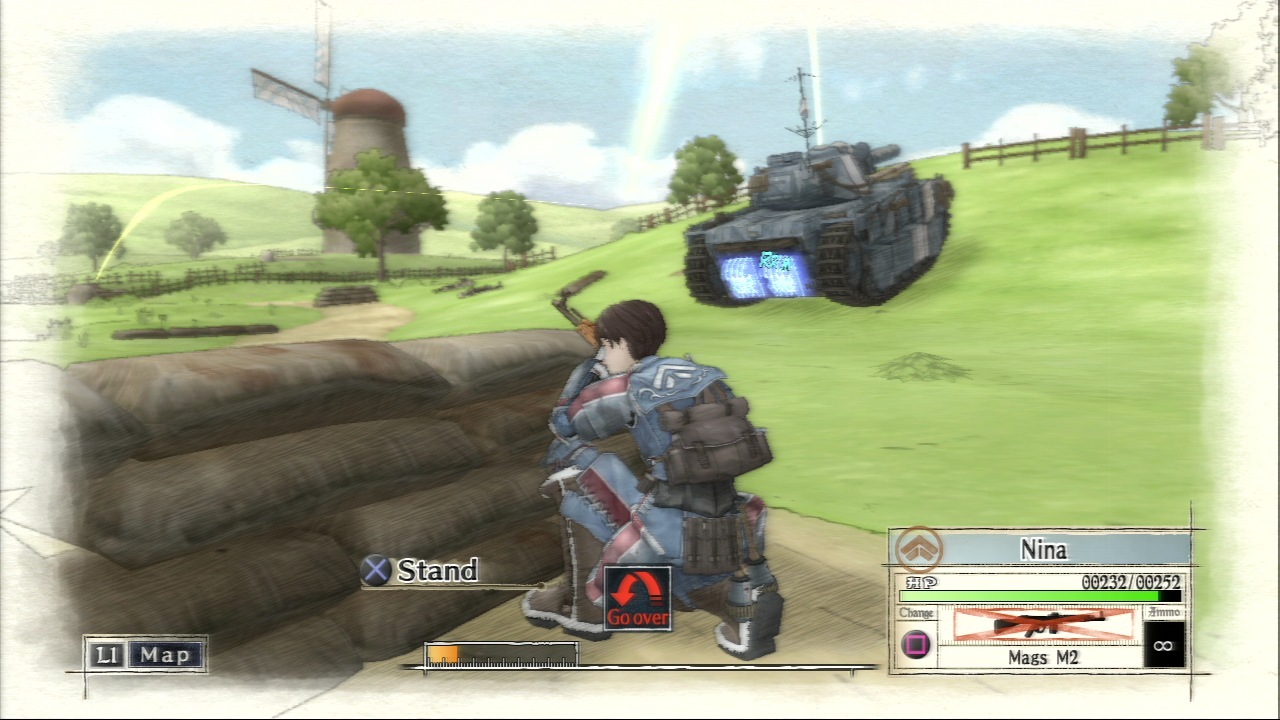
Valkyria Chronicles has a couple of things going for it that helped inspire that feeling.  The first is its varied strategic combat.  While there are suggested and obviously optimal strategies, the game allows the players to choose their strategy for themselves. The player can customize their roster of units, choosing exactly how to balance the games six classes among the twenty or so slots in their squad. Then, the player gets to choose which ones to actually send out into battle.  Do you go heavy on the highly mobile scouts?  Leave an empty slot for mid-battle reinforcements.  My strategy usually had me dropping out a couple of snipers who would empty their clips and clear a path for the rest of my units before being replaced by the highly dangerous shocktroopers.

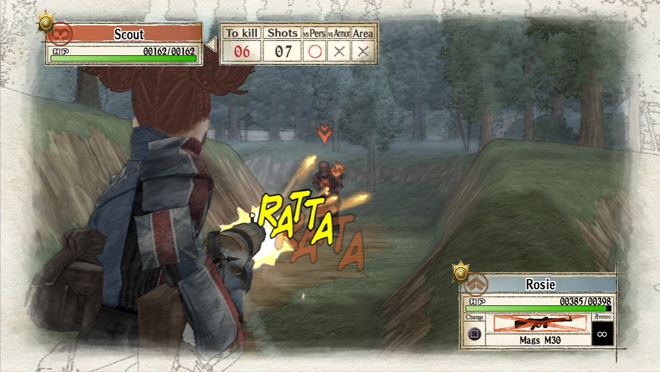
Another thing it has going for it is the look.  The graphics are solid, if unspectacular for the PS3, but everything is covered in a scratchy, watercolor filter that, along with some comic book sound effects, gives the game an appealing and unique look.  It also has one of the most mature stories in any game.  Mature in the sense of it actual definition, not in the sense that it has tits and blood in it.  There are moments of sophomoric anime hijinks, but by and large Valkyria Chronicles deals well with themes like racism and the horrors of war.  The main characters are nuanced and flawed.  Rosie is fiercely loyal and brave, but she also has a lot of misplaced hatred.  Even the wart starting villain is shown to be in many ways honorable and unprejudiced.  Unlike many in both the Gallian and Imperial Armies, he is more willing to look at a person’s skill than their birth.  That doesn’t make him not a bad guy, only a human bad guy with both faults and strengths.

ValkyriaChronicles2

Really, Valkyria Chronicles is just a great game. Its combination of uniqueness and quality make it one of the games that is long going to be one that cements the reputation of its system. When people look back on the PS3 and wonder what it had that made people love it, Valkyria Chronicles will be near the top of the list. An all-time classic.

Now Playing March ‘14

The best thing about my new job is that is doesn’t really cut down on my video game playing time.  Also, that I don’t have to deal with moronic customers.  So even though I am again employed, I still have the time to power through a ton of handheld games.  This month, I put most of my time into Valkyria Chronicles.  Because it is about my favorite thing just now.  I’ll save the gushing for another day, like tomorrow or next Monday.

Beaten

Valkyria Chronicles: I’ve got a full post about this game coming soon. Here I’ll just say that this easily the best game I’ve played in the PS3. It is just stupendous.

Final Fantasy VI: Another game that I’m putting together a post for, as well as a game I’ve already written about. I hope to replay the whole series this year, and this game is my favorite of the bunch.

Kirby Squeak Squad:

ss

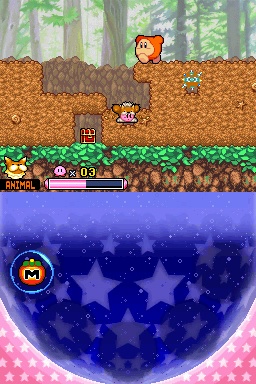
I’m glad I tracked this game down, even if it did turn out to be one of the lesser Kirby games. On the surface it seems no different than most of the series, but everything seems kind of loose and sloppy. Not really bad, but definitely not on the same level as games like Kirby’s Adventure or Super Star Saga. It does feature some good new powers. Like the magic power; it gives Kirby a top hat from which he releases doves to attack. It is hilarious and fun. I hope that it escapes this lackluster title and becomes a standard power up. It feels like I’m being a little too rough on this game. It’s is not really bad. It is just lacking the polish that better games in the series have. Also, the collectathon treasure system, where each stage has a handful of treasure of which Kirby must find a certain number to progress, is not really a welcome addition. The series got by without that for a long time, it was not really a positive addition. Still, a decent little game that is worth at least a look.

Giana Sisters Twisted Dreams:

giana

I wanted to like this game. I like platformers, I like the look, and I liked the world switching mechanic. But this game feels like a rough draft. I had tons of problems with this game, some minor, some major. There were small problems, like levels and boss battles that go on a little too long or the kind of terrible music. Those are problems, but ones that can be worked around or ignored on their own. Then there are bigger problems, like the general floatiness of the controls and the annoying level design. Those problems are harder to ignore when added to the smaller problems. The controls are the worst part. There were tons of times that I seemed to bounce off of platforms I was supposed to be landing on. Then there is fireball boost ability, an ability that sends the player shooting across the screen, which never seems to send you the direction you want to go. It get frustrating quickly when you have to shoot off at a diagonal because the game is terrible at recognizing them. With the level design, the player is rated on how many of the crystals strewn throughout the stage they find. No a big deal, but there are numerous points of no return, where the player can cut themselves off from a large number of crystals without realizing it until it is too late. And the levels seem to go one forever. It just adds up to an experience that is more stressful than fun. Not because of the difficulty, but because the game is sort of janky. The thing is, it does plenty of other things well. A lot of the exploring puzzles are great and it removes lives from the equation, letting the player attempt hard parts as often as they like without any real penalty.

Professor Layton and the Azran Legacy: I’ve already written about this game here.

Brothers: A Tale of Two Sons:

brothers

This is about the perfect download title. About, it is not quite on the level of Journey, but there nothing to complain about. It is an adventure game where two brothers go on a quest to save their father. The player controls each brother with one of the sticks on the controller, with a shoulder button each used to interact with things. It is simple in theory, but the solutions to the environmental puzzles can get complex. Sometimes you have to use the big brother to boost the smaller brother up on a ledge, sometimes they have to work in tandem to clear obstacles. The game also looks great. The best part is likely the length. Many of these games have a tendency to run long. They explore and exploit the mechanics that they set up, then keep going, either breaking things down or just repeating the challenges the player had already faced. Brothers is about 3 to 4 hours long, and each challenge is something new and different. It is great, refreshing.

Ongoing

Devil Survivor 2: I played through most of the third day of this game, but got stuck on the boss. I should be able to get by it with a little work, but honestly it wasn’t grabbing me. I really like the first Devil Survivor and so far this one has been good, improved in some ways if lacking the newness of the original.

Bravely Default: I am souring on this game after greatly enjoying the first half. I’m having trouble making myself play the second half. There are a lot of good things about this game, but it has some balance and pacing issues.

Batman: Arkham City: I can’t imagine a worse looking take on the Batman universe. This is a grossly ugly version of most of those characters. Still, it’s a lot of fun. If the game looked like the animated series or the 60’s TV show it would be my favorite Batman thing ever. I am having a lot of fun just zipping around Gotham and doing sidequests with lesser villains. I should have it finished up before too long, since I think I am coming up on the end of the game pretty soon.

Upcoming

Pikmin 3: I’ve had this sitting around since it came out last year. I just haven’t made time to play it. As soon as I finish up with Batman I plan to change that. I had held off because I wanted to play the first two first, but I’ve only been able to track down Pikmin 2 and my brother borrowed that one.

Inazuma Eleven: I downloaded this a couple of weeks ago, but I haven’t managed to finish off Bravely Default and make time to play it. But BD should be finished up soon and I should be able to move on to this.

Advance Wars: This, as well as a bunch of other GBA games, are coming to the WiiU Virtual Console. Most of the others I’ve played, but Advance Wars is one I missed that I always wanted to play.

NES Remix 2: NES Remix was a delight, and this one looks to be more of the same but with more actually good games this time. I am pumped. I hope Nintendo keeps it up with these. I want Gameboy Remix and SNES Remix. As long as this comes out when it is supposed to , April 25, then I will spend the last week of the month playing this extensively.

The Legend of Zelda Majora’s Mask: Honestly, I’ll get to it this time. I swear.